1593: "USS Pickerel"
Interesting Things with JC #1593: "USS Pickerel" – Before nuclear power changed undersea warfare, one diesel boat stayed below for 21 straight days and crossed the Pacific on discipline, batteries, and nerve. USS Pickerel did not make a show of it. She just kept making way in the dark.
Curriculum - Episode Anchor
Episode Title: USS Pickerel
Episode Number: 1593
Host: JC
Audience: Grades 9–12, college intro, homeschool, lifelong learners
Subject Area: U.S. history, naval history, engineering, technology, media literacy
Lesson Overview
This lesson uses the USS Pickerel episode to examine a key transition in submarine history: the move from World War II-era “submersible” operations toward true extended underwater operations in the early Cold War. Students analyze how engineering changes such as GUPPY modernization and snorkel use increased underwater endurance, why Pickerel’s 16 March to 5 April 1950 submerged transit mattered, and how this voyage fits between older diesel-electric submarines and the later nuclear era marked by USS Nautilus. The historical anchor points in the script align with Navy history sources: Pickerel’s record submerged voyage of 5,194 nautical miles, her commissioning on 4 April 1949, and Nautilus’s commissioning on 30 September 1954.
3–4 Measurable Learning Objectives Using Action Verbs
Define diesel-electric submarine operation, GUPPY modernization, and snorkel use in historical context.
Compare World War II submarine operating patterns with postwar extended submerged operations.
Analyze why USS Pickerel’s 1950 Pacific transit represented a turning point in undersea naval capability.
Explain how Pickerel fits chronologically and technologically between earlier fleet submarines and the nuclear submarine era inaugurated by USS Nautilus.
Key Vocabulary
Diesel-electric (dee-zul ih-LEK-trik) — A propulsion system in which diesel engines can charge batteries and electric motors drive the submarine underwater.
GUPPY (GUP-ee) — “Greater Underwater Propulsion Power Program,” a postwar U.S. Navy modernization effort that improved submerged performance and endurance.
Snorkel (SNOR-kel) — A mast system that allows a submarine near periscope depth to bring in air for diesel engines and recharge batteries without fully surfacing.
Periscope depth (PAIR-ih-skohp depth) — A shallow submerged depth at which a submarine can raise masts such as a periscope or snorkel above the surface.
Endurance (en-DUR-uhns) — The length of time a vessel can continue operating under specified conditions.
Watchstanding (WOCH-stand-ing) — Continuous crew duty rotations used to monitor navigation, machinery, safety, and operations aboard ship.
Commissioned (kuh-MISH-und) — Officially placed into active naval service.
Nuclear propulsion (NOO-klee-er pruh-PUHL-shun) — Power generated by an onboard nuclear reactor, allowing submarines to remain submerged far longer than diesel-electric boats.
Narrative Core
Open
The episode opens by correcting the date and immediately presenting the remarkable fact: on March 16, 1950, USS Pickerel left Hong Kong and stayed submerged for 21 straight days while heading for Pearl Harbor, setting a Navy-record submerged voyage.
Info
The listener then receives technical and historical background: Pickerel was SS-524, entered service on April 4, 1949, and represented a postwar GUPPY-modernized diesel-electric submarine designed for better underwater speed, endurance, and control, though still limited by batteries, machinery, and snorkel operations.
Details
The key turning point is the Pacific crossing itself. The story emphasizes the routine but demanding realities of battery management, machinery checks, watchstanding, and repeated snorkel use that made prolonged underwater transit possible before nuclear propulsion.
Reflection
The broader meaning is that Pickerel stood at a transition point in submarine history. She was more capable underwater than earlier World War II boats, but she still belonged to the conventional diesel-electric era that would soon be transformed by USS Nautilus and nuclear power.
Closing
These are interesting things, with JC.
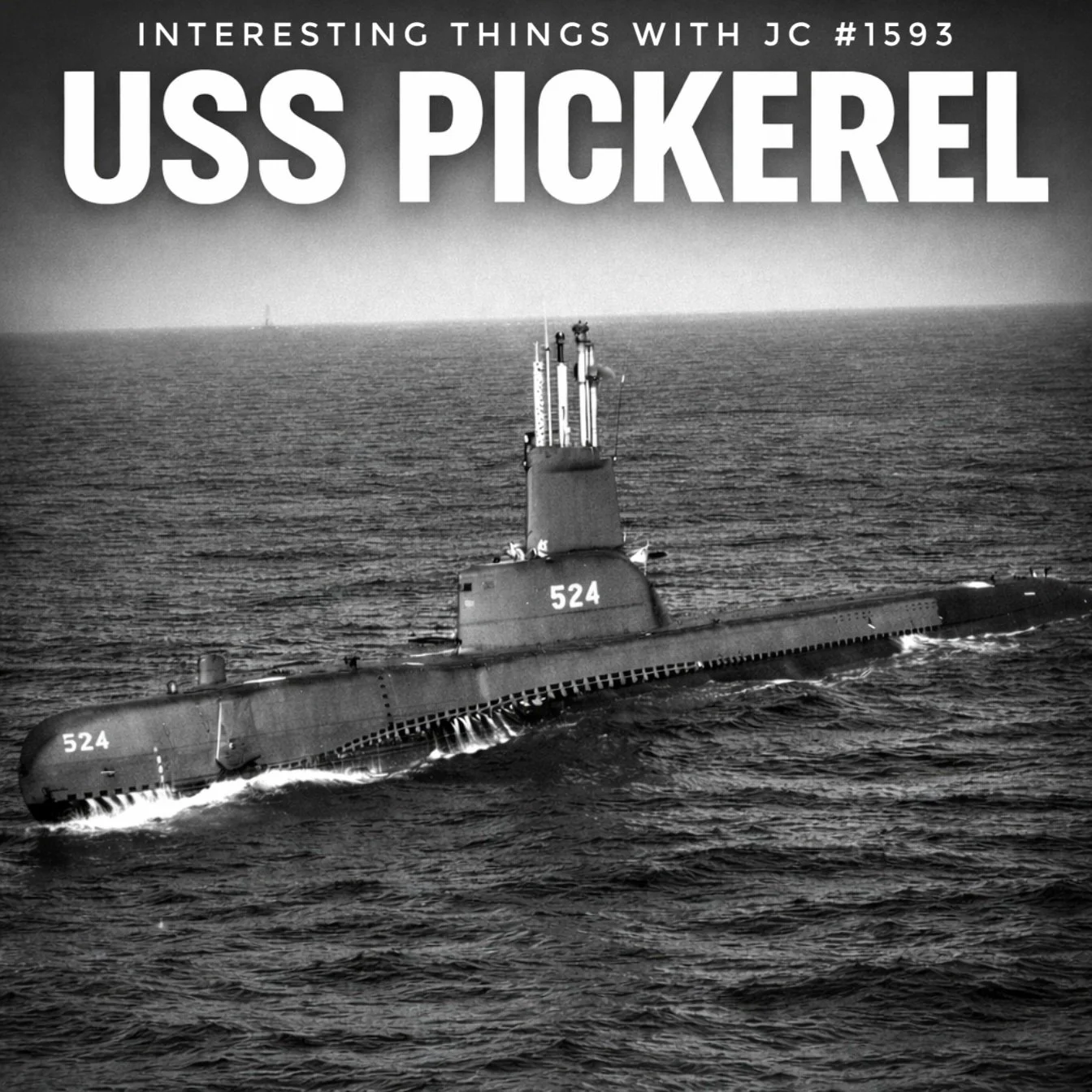
Black-and-white cover image for “Interesting Things with JC #1593.” Large white text at the top reads “USS PICKEREL.” Below, a U.S. Navy submarine marked with hull number 524 travels on the ocean surface, viewed from above and slightly to the side. The sea stretches to the horizon, and the image has a historic documentary style.
Transcript
Interesting Things with JC #1593: "USS Pickerel"
On March 16, 1950, the submarine USS Pickerel left Hong Kong and headed east for Pearl Harbor. She remained submerged for 21 straight days and covered 5,194 nautical miles, about 5,977 miles or 9,619 kilometers. The Navy recorded it as a record submerged voyage.
Pickerel, hull number SS-524, entered service on April 4, 1949. She was a Tench-class diesel-electric submarine completed under the GUPPY program, a postwar modernization effort designed to improve underwater speed, endurance, and handling. She was advanced for her day, but she was still a conventional boat. No nuclear reactor. No endless underwater endurance. Every hour below depended on batteries, machinery, planning, and a snorkel mast that let her diesel engines run while the boat remained underwater near periscope depth.
A World War II submarine could dive, attack, and hide, but it still spent much of its time running on the surface. The postwar submarine was being shaped for longer underwater travel, less exposure, and better endurance below. Running on the snorkel reduced the need to surface, but it still forced the boat to operate close to the top of the water while charging batteries and feeding air to the diesels. Pickerel showed what that new kind of service looked like.
From March 16 to April 5, 1950, the crew carried that test across the Pacific. Inside the boat, the passage demanded constant watchstanding, battery management, machinery checks, and steady reliance on the snorkel system day after day. It was a sustained demonstration of discipline, endurance, and engineering.
USS Nautilus would not be commissioned until September 30, 1954. That places Pickerel between two periods in submarine history. She was no longer one of the older boats that slipped under only when needed, and she was not yet one of the nuclear submarines that could remain submerged far longer than diesel crews once thought possible. She stood at the turning point.
There was no spectacle in that passage. There was a steel hull crossing a vast ocean below the surface, driven by routine, discipline, and technical precision. Pickerel’s 21 days underwater marked the point when the American submarine was becoming a vessel built to remain below for extended periods, not just a warship that could dive when needed.
These are interesting things, with JC.
Student Worksheet
What made USS Pickerel’s March–April 1950 voyage historically significant?
How did the snorkel system change what a diesel-electric submarine could do?
In what way was Pickerel different from a World War II submarine, and in what way was it still limited?
Why does the episode describe Pickerel as standing “at the turning point” in submarine history?
Creative prompt: Write a one-paragraph diary entry from the perspective of a sailor aboard Pickerel during day 18 of the submerged transit.
Teacher Guide
Estimated Time
45–60 minutes for a single class period; 75–90 minutes if students also complete the quiz and open-ended assessment.
Pre-Teaching Vocabulary Strategy
Introduce diesel-electric, GUPPY, snorkel, endurance, and nuclear propulsion before playing or reading the episode. Ask students to predict which technologies would matter most in a 21-day submerged voyage, then revisit those predictions after instruction.
Anticipated Misconceptions
Students may assume all submarines can stay underwater indefinitely; clarify that diesel-electric submarines depended on battery charge and air intake for diesels, unlike later nuclear boats.
Students may assume snorkeling meant deep-submerged operation; clarify that snorkel use required operating near periscope depth.
Students may confuse “record submerged voyage” with speed or combat action; clarify that this record concerned sustained underwater transit distance and duration.
Discussion Prompts
Why is a quiet, routine engineering achievement sometimes more historically important than a dramatic battle?
What limits did diesel-electric submarines still face even after postwar modernization?
How do technological transitions create “in-between” machines like Pickerel that belong partly to two eras?
Why might disciplined routine be as important as new hardware in a successful voyage?
Differentiation Strategies
ESL: Preteach vocabulary with visuals of a snorkel mast, battery system, and timeline from 1949 to 1954.
IEP: Provide a guided note sheet with three categories: date, technology, significance.
Gifted: Have students compare Pickerel with Nautilus and evaluate whether engineering change or propulsion change mattered more to submarine history.
Extension Activities
Timeline task: Build a submarine development timeline from World War II fleet boats to GUPPY boats to nuclear submarines.
Engineering task: Have students identify the constraints of diesel-electric submerged travel and propose improvements.
Research task: Compare how different navies adopted snorkel technology after World War II.
Cross-Curricular Connections
Physics: Energy storage, propulsion, drag, and operating constraints underwater.
Engineering: Design trade-offs involving endurance, stealth, safety, and power systems.
History: Early Cold War naval modernization and technological transition.
Media literacy: Evaluating concise historical storytelling for accuracy and significance.
Quiz
Q1. On what date did USS Pickerel leave Hong Kong for its record submerged voyage?
A. March 16, 1950
B. April 4, 1949
C. September 30, 1954
D. April 5, 1950
Answer: A
Q2. How long did USS Pickerel remain submerged during the voyage described in the episode?
A. 14 days
B. 18 days
C. 21 days
D. 30 days
Answer: C
Q3. What was the main purpose of the snorkel system on a diesel-electric submarine?
A. To launch missiles underwater
B. To let diesel engines run and batteries recharge while near periscope depth
C. To allow unlimited underwater endurance
D. To replace the electric motors
Answer: B
Q4. Why is USS Pickerel described as being at a “turning point” in submarine history?
A. It was the first submarine ever built
B. It was a World War I submarine still in service
C. It bridged the gap between older fleet submarines and later nuclear submarines
D. It was the fastest submarine in the world
Answer: C
Q5. Which submarine marked the arrival of the U.S. Navy’s nuclear-powered era?
A. USS Grampus
B. USS Threadfin
C. USS Pickerel
D. USS Nautilus
Answer: D
Assessment
Open-Ended Question 1
Explain why USS Pickerel’s 1950 voyage mattered even though it involved no battle or spectacle.
Open-Ended Question 2
Analyze how technology and crew discipline worked together to make extended submerged travel possible on a diesel-electric submarine.
3–2–1 Rubric
3 = Accurate, complete, thoughtful; uses key facts and clearly explains historical significance
2 = Partial or somewhat accurate; includes some facts but lacks detail or clear explanation
1 = Inaccurate or vague; missing essential facts or misunderstandings about the technology or history
Standards Alignment
U.S. Standards
CCSS.ELA-LITERACY.RH.9-10.2 — Students determine central ideas in an informational historical text and trace how those ideas develop; this fits the episode’s focus on transition in submarine history.
CCSS.ELA-LITERACY.RH.9-10.3 — Students analyze a series of events and technological developments, such as the move from World War II submarine practice to GUPPY modernization and then to nuclear propulsion.
CCSS.ELA-LITERACY.RST.9-10.4 — Students interpret domain-specific terms including diesel-electric, snorkel, endurance, and nuclear propulsion.
C3 D2.His.1.9-12 — Students evaluate how historical developments were shaped by time, place, and broader context; Pickerel’s voyage is best understood in postwar naval modernization and early Cold War context.
NGSS HS-ETS1-1 — Students analyze criteria and constraints in a major technological challenge; the episode naturally supports study of underwater endurance limits in diesel-electric submarines.
NGSS HS-ETS1-3 — Students evaluate solutions to complex problems using trade-offs such as safety, reliability, and performance, which aligns with snorkel use and GUPPY improvements.
ISTE 1.3.a / 1.3.b / 1.3.c — Students use research strategies, evaluate source accuracy, and curate evidence when comparing historical and technical sources on submarine development.
International Equivalents
England National Curriculum, History KS3/KS4 — Supports chronological knowledge, cause and consequence, and understanding change over time; these align closely with the episode’s treatment of postwar naval transition.
Cambridge IGCSE History (0470) — Emphasizes historical knowledge, evidence use, and explanation of twentieth-century international developments, which fits the Cold War and naval modernization context.
IB Diploma Programme History — Encourages comparative, multi-perspective historical thinking focused on change, causation, and significance; the episode is well suited for those historical-thinking skills.
AQA GCSE History (8145) — Supports study of modern history through causation, consequences, and long-term developments, all relevant to the transition from diesel-electric to nuclear undersea warfare.
Show Notes
USS Pickerel’s 1950 Pacific transit matters in the classroom because it shows students that historical turning points are often built from engineering, discipline, and incremental innovation rather than dramatic headlines.
The episode captures a real transition in submarine history: after World War II, U.S. boats modernized through the GUPPY program gained improved underwater performance and could use snorkels to operate diesel engines and recharge batteries while near periscope depth, reducing but not eliminating the need to surface. Pickerel’s 21-day, 5,194-nautical-mile submerged voyage from Hong Kong toward Pearl Harbor demonstrated what that new underwater service looked like in practice, years before the nuclear-powered USS Nautilus entered service in 1954.
In class, this topic supports history, engineering, literacy, and evidence-based reasoning by asking students to connect dates, technology, and significance into one clear historical argument.
References
Naval History and Heritage Command. (n.d.). March 16 – NHHC. U.S. Navy. https://www.history.navy.mil/today-in-history/march-16.html
Naval History and Heritage Command. (2025, July 9). Nautilus (SSN-571). U.S. Navy.
https://www.history.navy.mil/browse-by-topic/ships/submarines/uss-nautilus.html
Naval History and Heritage Command. (2014). Nuclear Navy and USS Nautilus celebrate 60th anniversary. U.S. Navy. https://www.history.navy.mil/news-and-events/news/2014/nuclear-navy-and-uss-nautilus-celebrate-60th-anniversary.html
Naval History and Heritage Command. (2024). History. U.S. Submarine Force Museum.
https://www.history.navy.mil/content/history/museums/subforce/about-us/history.html
Naval History and Heritage Command. (1987/2025 digital edition). On Course Through History: The U.S. Navy at 250. U.S. Navy.
Defense Media Network. (2015, October 20). Submarine development.
https://www.defensemedianetwork.com/stories/submarine-development/
Royal Navy Submarine Museum. (n.d.). Snorting in the Royal Navy, 1945 onwards.
https://rnsubs.co.uk/dits-bits/articles/development/rn-snorting.html