1594: "America’s First St. Patrick’s Day Wasn’t Where You Think"
Interesting Things with JC #1594: "America’s First St. Patrick’s Day Wasn’t Where You Think" – The story most Americans know starts in Boston or New York. But the first recorded St. Patrick’s Day celebration in what became the United States erupted where cannon fire and faith met on a fragile frontier.
Curriculum - Episode Anchor
Episode Title: America’s First St. Patrick’s Day Wasn’t Where You Think
Episode Number: 1594
Host: JC
Audience: Grades 9–12, college intro, homeschool, lifelong learners
Subject Area: History, American Studies, Media Literacy, Cultural History
Lesson Overview
By the end of this lesson, learners will be able to:
Define the historical significance of St. Augustine, Florida, as the oldest continuously occupied European-established settlement in the continental United States and explain why that matters for early American history.
Compare the recorded St. Patrick’s Day observances in St. Augustine in 1600 and 1601 with later and better-known observances in Boston in 1737 and New York in 1762.
Analyze how archival discoveries can change public memory and long-standing local traditions about “firsts” in history.
Explain how migration, empire, religion, and multicultural frontier life shaped early celebrations in colonial North America.
Key Vocabulary
Archive (AR-kyv) — A place where historical documents are preserved and studied; Dr. J. Michael Francis found the key St. Patrick’s Day records in Spain’s Archivo General de Indias.
Feast day (FEEST day) — A religious day set aside to honor a saint; March 17 is the feast day of Saint Patrick.
Procession (pruh-SESH-uhn) — A formal public movement of people through streets or a ceremonial route; the 1601 St. Augustine record describes a procession that historians identify as a parade.
Colonial outpost (kuh-LOH-nee-uhl OUT-post) — A small settlement established by an empire in a distant territory; St. Augustine functioned as a Spanish colonial outpost on a frontier.
Chaplain (CHAP-lin) — A clergy member serving a military or institutional community; Ricardo Artur served as a Catholic chaplain to Spanish troops in St. Augustine.
Patron saint (PAY-truhn saynt) — A saint regarded as a special protector of a people, place, or cause; Saint Patrick is the patron saint of Ireland.
Public memory (PUHB-lik MEM-uh-ree) — The way a society collectively remembers and repeats stories about the past; Boston and New York long dominated public memory of early American St. Patrick’s Day celebrations.
Narrative Core
Open: The episode begins by invoking familiar images of modern St. Patrick’s Day celebrations in Boston and New York, then challenges the listener’s expectations by suggesting the real first chapter happened much earlier and somewhere unexpected.
Info: The story provides background on St. Augustine, founded by Spain in 1565, and describes it as a difficult frontier settlement populated by Spanish soldiers, clergy, Africans, Native Americans, laborers, sailors, and settlers from multiple European backgrounds.
Details: The central historical turn comes from archival records identified by historian J. Michael Francis in Seville. Those records document gunpowder used for a celebration honoring San Patricio in 1600 and a procession with cannon fire in 1601, making St. Augustine the earliest recorded St. Patrick’s Day celebration and parade in what is now the United States. The episode also highlights two Irish figures in the colony: priest Ricardo Artur and merchant-soldier Darby Glavin.
Reflection: The episode broadens the meaning of the discovery by showing that early American history was multilingual, multicultural, and shaped by empire, migration, faith, and survival. It also models how new archival evidence can correct widely repeated public narratives.
Closing: These are interesting things, with JC.
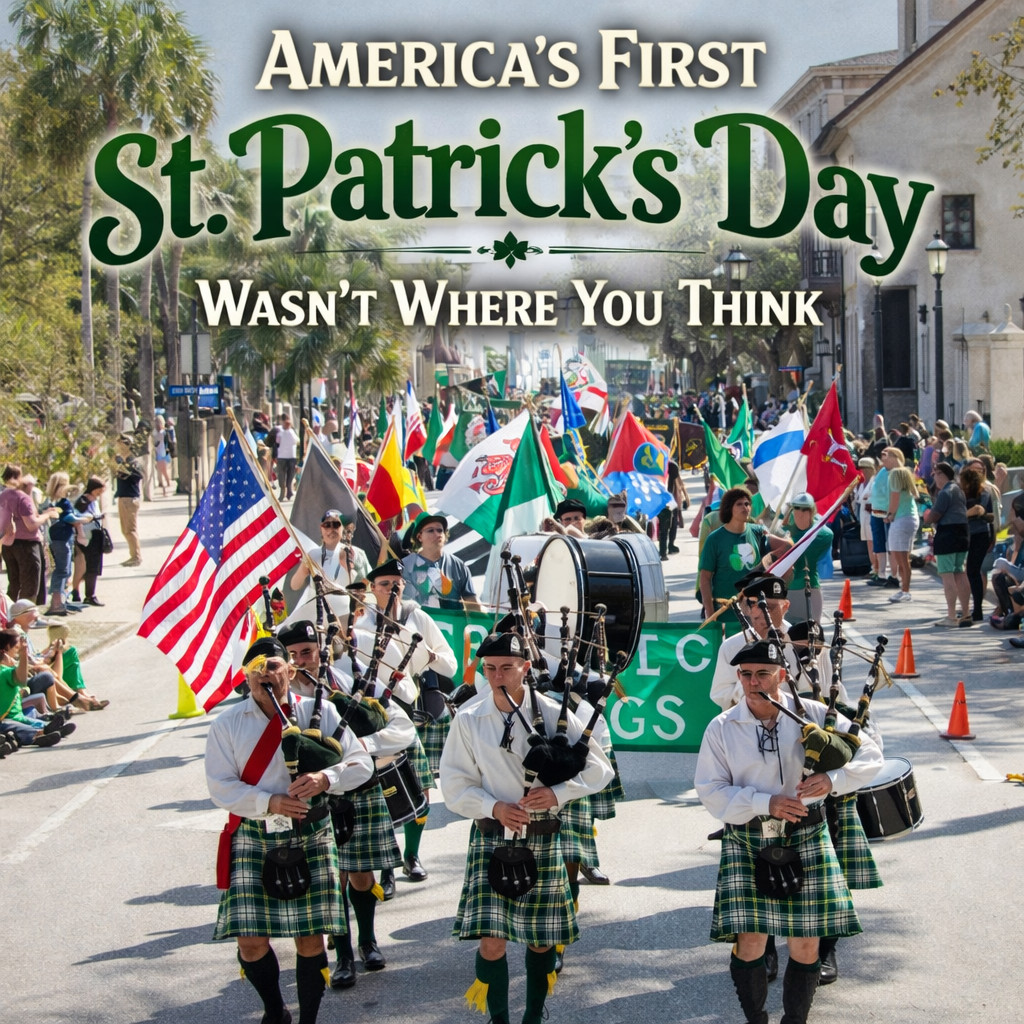
A street parade scene under bright daylight shows several bagpipers and drummers in green tartan kilts marching toward the camera. An American flag and multiple colorful flags are visible behind them, with spectators lining both sides of the street and palm trees and buildings in the background. Large overlaid text at the top reads: “America’s First St. Patrick’s Day Wasn’t Where You Think.”
Transcript
Interesting Things with JC #1594: "America’s First St. Patrick’s Day Wasn’t Where You Think"
On March 17 each year, millions of Americans fill the streets of cities like Boston and New York. Green clothing. Music. Parades. A celebration tied to Saint Patrick, the patron saint of Ireland.
For generations, many Americans have believed the same story. Boston held the first St. Patrick’s Day celebration in what became the United States in 1737. New York followed with one of the earliest famous parades in the 1760s. Those claims have lived for decades in local tradition, tourism, and public memory.
But the real opening chapter appears much earlier.
More than a century earlier.
And not in an Irish stronghold.
It began in a Spanish colonial outpost on the edge of a wilderness.
The place was St. Augustine, Florida.
Founded by Spain in 1565, St. Augustine remains the oldest continuously inhabited European-founded settlement in what is now the United States. The Spanish called the region La Florida (Lah Floh-REE-dah).
Life there was hard, exposed, and uncertain. The town was small. Its population included Spanish soldiers, Catholic clergy, Native Americans, sailors, laborers, the enslaved and settlers from several parts of Europe. Records from the period also show people from Ireland living within that frontier community.
For a long time, historians assumed St. Patrick’s Day arrived in North America through Irish communities in the 1700s.
Then, in December 2017, historian Dr. J. Michael Francis of the University of South Florida uncovered archival records that pushed the story back far beyond Boston and New York.
He found them in Spain’s great imperial archive, the Archivo General de Indias (Ar-KEE-voh Heh-neh-RAHL deh IN-dee-ahs), in Seville, Spain.
These were ordinary colonial financial records from St. Augustine. Expenses. Supplies. Gunpowder. Routine entries from a distant outpost of empire.
And buried in those records was something extraordinary.
One entry from the year 1600 recorded gunpowder used for a public celebration honoring the feast day of San Patricio (Sahn Pah-TREE-see-oh). In English, Saint Patrick.
That means St. Augustine held a recorded St. Patrick’s Day celebration on March 17, 1600.
Then came the next year.
Records from March 17, 1601, show another cannon salute and a procession through the streets of the town.
In plain terms, a parade.
That places a recorded St. Patrick’s Day parade in St. Augustine in 1601.
Put that beside the dates most people know. Boston’s famous 1737 observance came 137 years later. New York’s well-known early observance in 1762 came 161 years later. Jamestown, Virginia, founded in 1607, did not yet exist when St. Augustine marked Saint Patrick’s feast.
So why would a Spanish colony honor an Irish saint?
The answer appears to rest, in part, with two Irishmen found in the same historical record.
One was an Irish priest named Ricardo Artur, the Spanish form of Richard Arthur. He had once been a soldier. By the late 1500s, he was serving as a Catholic chaplain to Spanish troops in St. Augustine. From 1597 to 1604, he also served as the town’s parish priest.
Historians believe Arthur likely helped introduce the feast day of Saint Patrick to the local community.
The other Irishman had a harder road behind him.
His name was Darby Glavin, also recorded in Spanish documents as David Glavid. He had worked in maritime trade before being captured by the English in 1584. He was forced into service connected to England’s failed Roanoke venture. After that collapse, he was taken back to England.
Years later, he escaped.
He eventually defected to Spain in Puerto Rico and then made his way to St. Augustine in 1597. There he worked as both a soldier and a merchant.
When the celebration took place in 1600, and when the procession moved through town in 1601, Glavin was living in that colony. He may well have stood in those streets as the town marked the day.
Picture it.
A rough settlement bordered by forest and marsh.
Cannon fire cracking over a wooden town.
Gunpowder set aside for ceremony.
A frontier community made up of Spanish settlers, Africans, Native people, clergy, soldiers, and at least two Irishmen, all part of a public observance for an Irish saint.
More than a century before Boston.
More than a century and a half before New York’s famous tradition took hold.
And long before what is widely recognized as Ireland’s first recorded St. Patrick’s Day parade, held in Waterford in 1903.
That is one of the ironies of history. A tradition many people now associate most closely with Ireland developed visible public form far from Ireland itself, in places shaped by migration, empire, faith, memory, and survival.
And sometimes the story people repeat is not the first chapter at all.
In 2025, St. Augustine marked the 425th anniversary of that recorded 1600 celebration.
That date does more than correct trivia.
It reminds us that early American history did not unfold in only one language, one culture, or one city. Some traditions began where worlds met. In settlements far from the centers people remember. In places where a priest from Ireland, in a Spanish town in La Florida (Lah Floh-REE-dah), could help start a tradition that would one day spread across a continent.
And if you listen closely, you can almost hear it.
The boom of the cannon.
The sound of footsteps on a dirt street.
A feast day carried across an ocean and kept alive in a fragile town that most of the world had forgotten.
These are interesting things, with JC.
Student Worksheet
In your own words, explain why the St. Augustine discovery changes the way many people understand the history of St. Patrick’s Day in America.
Compare the recorded events in St. Augustine in 1600 and 1601 with the better-known celebrations in Boston and New York. What is the difference between a celebration and a parade in this context?
Why is the multicultural setting of St. Augustine important to the episode’s larger point about early American history? Use at least two details from the transcript.
Write a short paragraph about how archives and historical documents can change public memory.
Creative prompt: Imagine you are standing in St. Augustine on March 17, 1601. Write a first-person description of what you see, hear, and think during the procession.
Teacher Guide
Estimated Time
One 45–60 minute class period
Optional extension: additional 20–30 minutes for document analysis or comparative research
Pre-Teaching Vocabulary Strategy
Pre-teach archive, feast day, procession, colonial, chaplain, and patron saint.
Have students sort terms into three categories: religion, history, and evidence.
Ask students to predict how each term might connect to St. Patrick’s Day before reading or hearing the transcript.
Anticipated Misconceptions
Students may assume the “first well-known celebration” is the same as the “first recorded celebration.”
Students may think early American history was exclusively English-speaking or British in origin, when Spanish Florida predates Jamestown and contains a broader cultural mix.
Students may believe St. Patrick’s Day parades began in Ireland, but the commonly cited first recorded parade in Ireland is much later, in Waterford in 1903.
Students may confuse religious observance with modern secular festival culture.
Discussion Prompts
Why do some historical stories become dominant in public memory even when older evidence exists?
What does St. Augustine’s story reveal about the complexity of early American identity?
Why might a Spanish colony celebrate an Irish saint?
How does the episode demonstrate the importance of archival research?
Differentiation Strategies: ESL, IEP, gifted
ESL: Provide a vocabulary bank with phonetic guides and sentence frames such as “The evidence changed history because…” and “One difference between Boston and St. Augustine is…”
IEP: Chunk the transcript into short sections and pair each with one guiding question. Offer an audio read-aloud and allow oral responses.
Gifted: Ask students to investigate how “historical firsts” are claimed, debated, and revised in other cases, then present their findings with source evaluation.
Extension Activities
Have students create a timeline from 1565 to 1903 that includes St. Augustine’s founding, the 1600 celebration, the 1601 procession, Boston 1737, New York 1762, Jamestown 1607, and Waterford 1903.
Compare how Boston, New York, and St. Augustine each narrate their St. Patrick’s Day heritage.
Analyze how historians distinguish between tradition, memory, and documentary evidence.
Cross-Curricular Connections
History: Spanish colonization, early America, religion in colonial life
Media Literacy: Evaluating widely repeated claims against documentary evidence
English Language Arts: Determining central idea, comparing sources, explanatory writing
Sociology: Cultural transmission, migration, and public ritual
Arts: Designing a historically informed procession banner or commemorative exhibit label
Quiz
Q1. Which city has the earliest recorded St. Patrick’s Day celebration in what is now the United States?
A. Boston
B. New York
C. St. Augustine
D. Philadelphia
Answer: C
Q2. What did the 1601 St. Augustine record describe?
A. A church construction project
B. A procession through the streets
C. The founding of Jamestown
D. A trade agreement with Boston
Answer: B
Q3. Who was Ricardo Artur?
A. A British governor in New York
B. An Irish priest serving in St. Augustine
C. A merchant in Boston in 1737
D. A mayor of Waterford in 1903
Answer: B
Q4. Why is the discovery by J. Michael Francis important?
A. It proved New York’s parade was canceled
B. It showed Boston was not founded until 1762
C. It pushed the documented history of St. Patrick’s Day in America back to 1600–1601
D. It proved Saint Patrick lived in Florida
Answer: C
Q5. What larger idea does the episode emphasize?
A. Early American history developed in only English colonies
B. Public celebrations never change over time
C. Archives are less reliable than tradition
D. Early American history was shaped by multiple languages, cultures, and empires
Answer: D
Assessment
Open-Ended Question 1
How does the episode use evidence to challenge a commonly repeated historical claim about St. Patrick’s Day in America?
Open-Ended Question 2
What does the story of St. Augustine suggest about the cultural and religious diversity of early American history?
3–2–1 Rubric
3 = Accurate, complete, thoughtful; uses specific evidence from the transcript and explains significance clearly
2 = Partially accurate; includes some correct details but explanation is incomplete or underdeveloped
1 = Inaccurate or vague; includes few relevant details or shows misunderstanding of the episode
Standards Alignment
U.S. Standards
CCSS.ELA-LITERACY.RH.9-10.1 — Students cite specific textual evidence to support analysis of primary and secondary sources. This episode centers on how archival evidence overturns a common public narrative.
CCSS.ELA-LITERACY.RH.9-10.2 — Students determine central ideas of a source and summarize how key details develop that idea. Learners identify the main historical claim and track the supporting evidence.
CCSS.ELA-LITERACY.RH.11-12.6 — Students evaluate authors’ differing points of view on the same historical event or issue. This fits classroom comparisons between popular memory and documentary evidence.
C3 D2.His.1.9-12 — Evaluate how historical events and developments were shaped by unique circumstances of time and place as well as broader historical contexts. St. Augustine’s Spanish colonial setting is essential to understanding the event.
C3 D2.His.14.9-12 — Analyze multiple and complex causes and effects of events in the past. Students consider empire, migration, faith, and local frontier conditions together.
ISTE 1.3.a–b Knowledge Constructor — Students use effective research strategies and evaluate accuracy, validity, bias, origin, and relevance of sources. This directly supports lessons on archival discovery and evidence checking.
Optional U.S. Enrichment Standards
NCAS Anchor Standard 7 — Perceive and analyze artistic work. Students may analyze public ritual, symbolic color, music, and parade traditions as cultural expression.
Career Ready Practices: Communicate Clearly / Consider the Environmental, Social and Economic Impacts of Decisions — Students synthesize evidence, present conclusions, and consider how communities preserve and reinterpret traditions.
International Equivalencies
England National Curriculum, History KS3 — Pupils should extend and deepen chronologically secure knowledge, identify significant events, make connections, draw contrasts, and analyse trends over time. This lesson’s timeline work and comparison of 1600, 1601, 1737, 1762, and 1903 align closely.
Cambridge IGCSE History (0470) Aims — Learners develop knowledge rooted in the nature and use of historical evidence and strengthen investigation, analysis, evaluation, and communication skills. This directly matches the episode’s emphasis on archival records and historical revision.
IB MYP Individuals and Societies — Students engage with real-world examples, research, analysis, and original source material to understand people and societies. The episode supports inquiry into evidence, culture, and historical interpretation.
IB Diploma Programme History — History is presented as a dynamic, contested, evidence-based discipline involving inquiry and interpretation. That language aligns strongly with the lesson’s focus on changing accepted narratives through documents.
Show Notes
This episode examines a major correction to a familiar American holiday story: while Boston’s 1737 observance and New York’s 1762 parade remain famous in public memory, archival records uncovered by historian J. Michael Francis show that St. Augustine, Florida, recorded a St. Patrick’s Day celebration in 1600 and a street procession in 1601, more than a century earlier. Set within Spain’s 1565 settlement of St. Augustine, the episode helps students see early American history as multilingual, multicultural, and shaped by empire, religion, migration, and documentary evidence rather than later tradition alone. In the classroom, this topic matters because it teaches historical thinking: learners must distinguish between commonly repeated claims and the strongest surviving evidence, while also recognizing that the American past did not begin in only English colonies or a single cultural tradition.
References
Francis, J. M. (2018, March 15). The truth behind St. Patrick’s Day: Celebrations did NOT originate in Boston. University of South Florida. https://www.usf.edu/news/2018/truth-behind-st-patricks-day-celebrations-did-not-originate-boston.aspx
National Park Service. (n.d.). St. Augustine Town Plan Historic District, St. Augustine, Florida. U.S. Department of the Interior. https://www.nps.gov/places/st-augustine-town-plan-historic-district-st-augustine-florida.htm
National Park Service. (n.d.). African Americans in St. Augustine, 1565–1821. Castillo de San Marcos National Monument. U.S. Department of the Interior. https://www.nps.gov/casa/learn/historyculture/african-americans-in-st-augustine-1565-1821.htm
The NYC St. Patrick’s Day Parade. (n.d.). History. https://www.nycstpatricksparade.org/history/
Waterford Treasures. (n.d.). Luke Wadding: The man who gave us St. Patrick’s Day. https://waterfordtreasures.com/luke-wadding-the-man-who-gave-us-st-patricks-day/