1598: "Lewis Latimer and the Globe-Supporter for Electric Lamps"
Interesting Things with JC #1598: "Lewis Latimer and the Globe-Supporter for Electric Lamps" - Everybody talks about the bulb. Almost nobody talks about the small fix that helped keep electric light alive out in the real world. Lewis Latimer was helping hold the future together while everybody else was staring at the glow.
Curriculum - Episode Anchor
Episode Title: "Lewis Latimer and the Globe-Supporter for Electric Lamps"
Episode Number: 1598
Host: JC
Audience: Grades 9–12, college intro, homeschool, lifelong learners
Subject Area: History of technology, engineering design, invention studies, media literacy
Lesson Overview
Students examine how small engineering improvements can have large historical effects. This episode uses Lewis Howard Latimer and John Tregoning’s 1882 globe-supporter patent to show that innovation is often practical, incremental, and tied to real-world maintenance, safety, and usability. The lesson also situates Latimer’s work within the rapid expansion of electric lighting in the early 1880s and connects his later technical and publishing work to the broader history of electrification. The patent date, patent number, co-inventors, Latimer’s 1881 lamp patent, his 1882 carbon-manufacturing patent, his 1884 work for Edison’s company, and his 1890 technical book are supported by patent and archival records.
Define what a globe-supporter for electric lamps is and explain its practical purpose in early electric lighting systems.
Compare Lewis Latimer’s 1881, 1882, and later technical contributions to show how inventors improve systems, not just single products.
Analyze why serviceability, durability, and maintenance mattered during the early spread of electric lighting in public spaces.
Explain how Latimer’s work illustrates the relationship between invention, engineering refinement, and technological adoption.
Key Vocabulary
Patent (PAT-ent) — A patent is a legal protection granted for an invention; U.S. Patent No. 255,212 covered the globe-supporter designed by John Tregoning and Lewis H. Latimer.
Globe-supporter (glohb suh-POR-ter) — A globe-supporter is the mechanism that holds a lamp’s glass globe or shade in place. In this episode, it is the central invention being discussed.
Arc lamp (ark lamp) — An arc lamp is an early electric lamp that produced light from an electric arc and was often used in outdoor or large public settings.
Filament (FIL-uh-ment) — A filament is the part of an incandescent lamp that glows when heated by electric current; Latimer helped improve filament production.
Carbon (KAR-bən) — In early electric lighting, carbon was used to make filaments; Latimer’s 1882 process helped reduce breakage during manufacture.
Incandescent (in-kan-DES-ənt) — Incandescent describes light produced by a heated filament; Latimer later helped publish a practical book on the Edison incandescent system in 1890.
Serviceability (sur-vuh-suh-BIL-uh-tee) — Serviceability means how easily a device can be repaired, maintained, or adjusted. The episode emphasizes that this mattered in early lighting systems.
Electrification (ee-lek-truh-fuh-KAY-shən) — Electrification is the spread of electric power and lighting into buildings, streets, and daily life; Latimer worked during that transition.
Narrative Core
Open:
The episode begins with a patent date and a device that sounds ordinary: a globe-supporter for electric lamps. That contrast creates curiosity by showing that history is not only shaped by headline inventions, but also by crucial support mechanisms.
Info:
Listeners learn that this invention was not the light bulb itself. It was the hardware that helped hold a lamp’s glass globe or shade securely, an important issue in an era when electric lighting was still being developed and maintained in demanding environments. The patent record confirms the title, inventors, and March 21, 1882 patent date.
Details:
The episode expands from one patent to Latimer’s larger body of work: the 1881 electric lamp patent with Joseph V. Nichols, the 1882 carbon-manufacturing patent, his later work for Edison’s company beginning in 1884, and his role in publishing a practical book on incandescent lighting in 1890.
Reflection:
The broader point is that Latimer’s genius included making technology usable, durable, and workable in everyday life. The episode frames innovation as a chain of improvements that help society adopt new tools, rather than a single dramatic breakthrough. That reading also aligns with engineering-design standards that emphasize solving real-world problems through criteria, constraints, and evaluation.
Closing:
These are interesting things, with JC.
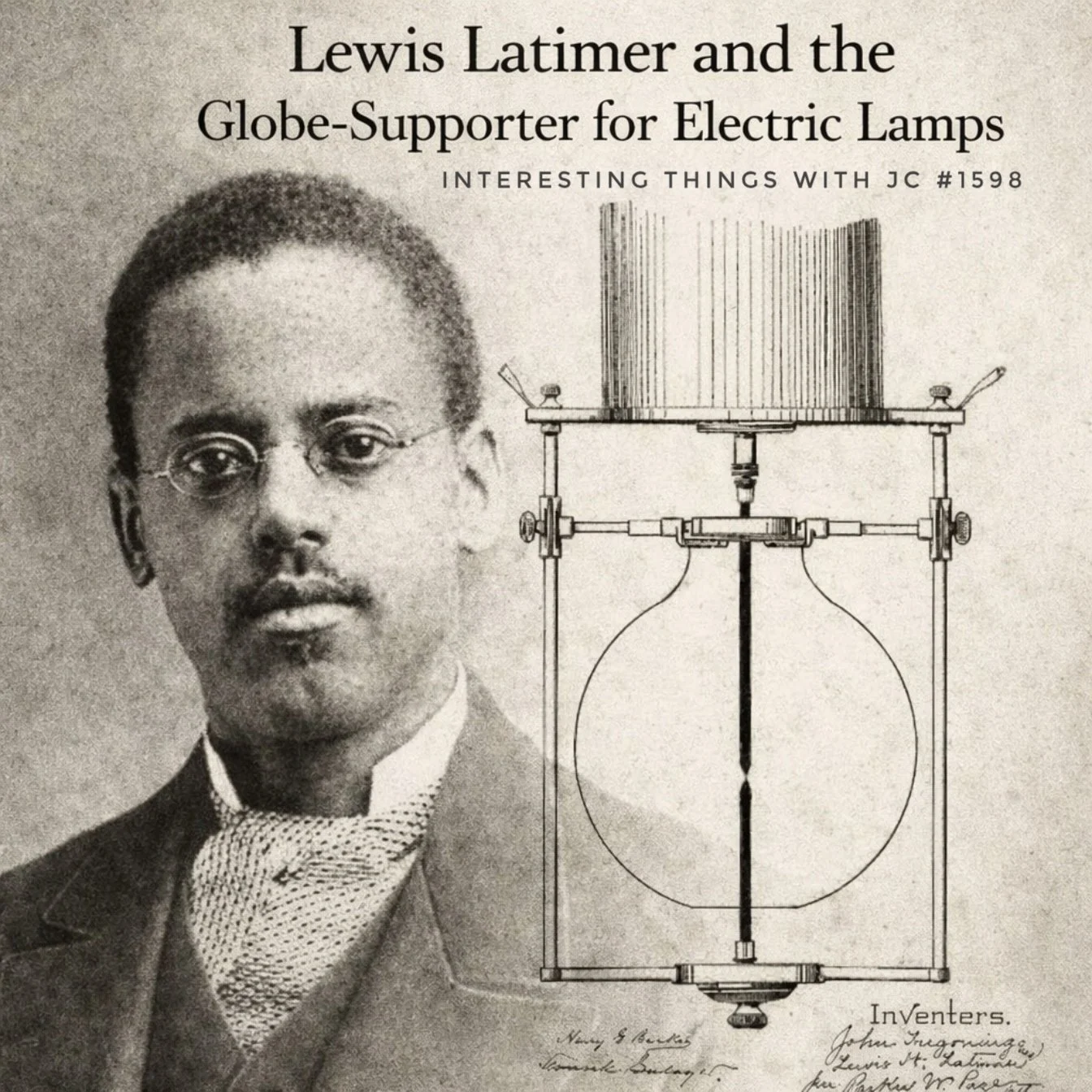
Lewis Latimer shown beside a patent-style illustration of the globe-supporter for electric lamps featured in Interesting Things with JC #1598.
Transcript
Interesting Things with JC #1598: "Lewis Latimer and the Globe-Supporter for Electric Lamps"
On March 21, 1882, Lewis Howard Latimer and John Tregoning received U.S. Patent No. 255,212 for a globe-supporter for electric lamps. They assigned it to the United States Electric Lighting Company. It may not sound flashy, but it solved a real problem at a time when electric light was still new and still being worked out.
This was not the light bulb itself. It was the part that helped hold the lamp’s glass globe or shade in place. That mattered, especially with arc lamps used outside and in big public spaces. Older designs could be a hassle to service, and the glass was easier to damage during repairs or bad weather. Latimer and Tregoning came up with a better way to secure the globe while also making the lamp easier to work on.
That kind of improvement was a big deal in the early 1880s. Electric lighting was starting to move out of testing rooms and into streets, buildings, and everyday life. Latimer was working for Hiram Maxim’s United States Electric Lighting Company, and he was right in the middle of that shift.
This patent was only one part of what Latimer gave to the lighting industry. In 1881, Latimer and Joseph V. Nichols co-patented an improved electric lamp. In 1882, Latimer also patented his process for manufacturing carbons used in lamp filaments, which helped reduce breakage during production and made electric lighting more practical.
Later, Latimer joined the Edison Electric Light Company in 1884. In 1890, he helped publish Incandescent Electric Lighting: A Practical Description of the Edison System, one of the first practical technical books on the subject. In 1918, he became a charter member of the Edison Pioneers and is widely recognized as the group’s only Black member.
Lewis Latimer’s real talent was not just coming up with ideas. It was making those ideas work in the real world. He helped support the light, in the most literal sense, while the modern world was still learning how to use it.
These are interesting things, with JC.
Student Worksheet
What problem did the globe-supporter patent solve in early electric lamps?
Why would a stronger or easier-to-service globe support matter in outdoor or public lighting?
How was Latimer’s 1882 globe-supporter patent different from inventing the light bulb itself?
What other lighting-related inventions or contributions by Latimer are mentioned in the episode?
Write 3–4 sentences explaining why incremental improvements can be just as important as famous inventions.
Teacher Guide
Estimated Time
30–45 minutes
Pre-Teaching Vocabulary Strategy
Begin with a quick sort using the terms patent, filament, globe-supporter, incandescent, and serviceability. Ask students to label each as legal, mechanical, scientific, or historical language. Then have them predict how all five terms connect in one story.
Anticipated Misconceptions
Students may assume Lewis Latimer invented the light bulb itself. The lesson should clarify that his importance lies in improving electric-light systems and manufacturing processes, especially carbon filaments and related lamp technology. Authoritative museum and patent sources consistently present him as a major improver of electric lighting rather than the original inventor of the bulb. (Lemelson MIT)
Students may also assume “small” inventions are historically unimportant. This episode helps show that maintenance, durability, safety, and usability are essential to whether a technology actually succeeds in society.
Discussion Prompts
Why do people often remember headline inventions but forget support technologies?
In what ways does a repair-friendly design change whether a technology becomes widely adopted?
How does Latimer’s career challenge the idea that invention happens in isolation?
What does this episode suggest about the relationship between engineering and everyday life?
Differentiation Strategies: ESL, IEP, gifted
ESL: Provide a labeled lamp diagram and sentence starters such as “The patent improved _____ by _____.”
IEP: Break the transcript into three chunks and use a guided note template with who, what, why it mattered.
Gifted: Ask students to compare Latimer’s support innovation with a modern enabling technology such as a smartphone battery system, charging port design, or heat sink.
Extension Activities
Patent sketch analysis: Students examine a historical patent drawing and infer how the device worked.
Engineering redesign: Students sketch a modern protective globe mount for a public lamp, including criteria and constraints.
Mini research task: Students trace one additional Latimer patent and explain its historical context.
Cross-Curricular Connections
Physics: electric current, light production, and materials
Engineering: design criteria, constraints, maintenance, and durability
History: industrialization and urban modernization
ELA: close reading of informational text and technical description
Art/Design: technical drawing and visual communication
Quiz
Q1. What was U.S. Patent No. 255,212 for?
A. A telephone receiver
B. A process for manufacturing carbons
C. A globe-supporter for electric lamps
D. A railroad water closet
Answer: C
Q2. Who received the 1882 globe-supporter patent with Lewis Latimer?
A. Joseph V. Nichols
B. Thomas Edison
C. Hiram Maxim
D. John Tregoning
Answer: D
Q3. What was one major advantage of the globe-supporter described in the episode?
A. It generated electricity
B. It helped secure the glass globe and made service easier
C. It replaced all arc lamps
D. It eliminated the need for filaments
Answer: B
Q4. Which earlier patent mentioned in the episode involved Latimer and Joseph V. Nichols?
A. Electric lamp
B. Air conditioner
C. Book supporter
D. Lamp fixture
Answer: A
Q5. In 1890, Latimer helped publish a technical book about which system?
A. Bell telephone system
B. Edison incandescent lighting system
C. Railroad signaling system
D. Telegraph relay system
Answer: B
Assessment
Explain how the globe-supporter patent shows the importance of incremental innovation in the history of technology.
Using evidence from the episode, describe how Lewis Latimer contributed to making electric lighting more practical for everyday use.
3–2–1 Rubric
3 = Accurate, complete, thoughtful; uses specific details from the episode and explains significance clearly.
2 = Partial or missing detail; shows basic understanding but lacks depth or precision.
1 = Inaccurate or vague; response is unsupported, confused, or incomplete.
Standards Alignment
NGSS
HS-ETS1-1 — Students analyze a real-world engineering problem by identifying criteria and constraints; this episode asks students to see why securing a lamp globe and improving maintenance mattered in real operating conditions.
HS-ETS1-2 — Students design or evaluate solutions to complex practical problems; the lesson invites students to examine how Latimer and Tregoning improved an existing lamp system rather than inventing from scratch.
HS-ETS1-3 — Students evaluate solutions using trade-offs such as safety, reliability, and maintenance; this directly fits discussion of fragile glass, weather exposure, and serviceability in public lighting.
Common Core State Standards: Literacy in History/Social Studies
CCSS.ELA-LITERACY.RH.9-10.2 — Students determine central ideas in a primary or secondary source; they can identify the main historical claim of the episode and summarize how Latimer’s contributions developed over time.
CCSS.ELA-LITERACY.RH.9-10.3 — Students analyze a series of events and causal relationships; they can trace how design improvements helped electric lighting move into wider public use.
CCSS.ELA-LITERACY.RH.9-10.9 — Students compare treatments of the same topic in primary and secondary sources; they can compare the episode script with patent records and museum summaries.
C3 Framework for Social Studies
D2.His.1.9-12 — Students evaluate how developments were shaped by time, place, and broader context; this fits the rise of electric lighting in the early 1880s.
D2.His.2.9-12 — Students analyze change and continuity; this lesson shows continuity in lighting needs and change in the technology used to meet them.
D2.His.3.9-12 — Students assess the significance of an individual’s actions in historical context; Latimer’s work is ideal for that analysis.
ISTE Standards for Students
1.1 Empowered Learner — Students set goals and demonstrate learning through research, annotation, and response to technical history.
1.3 Knowledge Constructor — Students gather information from patent drawings, technical summaries, and historical sources to build evidence-based explanations.
1.4 Innovative Designer — Students can create or revise a lamp-support design using real criteria such as durability and ease of repair.
Respectful International Equivalencies
England National Curriculum: Design and Technology (KS3) — This episode aligns with the curriculum’s emphasis on designing and making products that solve real and relevant problems.
Cambridge IGCSE History (0470) — The topic supports historical evidence analysis and explanation of significance, cause, and consequence.
IB MYP Design — The lesson fits inquiry, analysis, solution development, and evaluation within historical and contemporary design contexts.
Show Notes
This episode explores how Lewis Howard Latimer’s March 21, 1882 globe-supporter patent solved a practical problem in early electric lighting: keeping the glass globe secure while making lamps easier to maintain. Rather than focusing on the myth of a single great invention, the episode shows students how technological progress often depends on useful refinements, better materials, and improved serviceability. It also places that patent within Latimer’s wider contributions, including his 1881 electric lamp patent with Joseph V. Nichols, his 1882 carbon-manufacturing patent, his work for the Edison Electric Light Company beginning in 1884, and his role in publishing a practical technical book on incandescent lighting in 1890. For classrooms, this topic matters because it teaches engineering thinking, historical context, and the importance of often-overlooked contributors who helped make modern infrastructure workable in everyday life.
References
Google Patents. (1881). Electric lamp (U.S. Patent No. 247,097). https://patents.google.com/patent/US247097A/en
Google Patents. (1882a). Globe supporter for electric lamps (U.S. Patent No. 255,212). https://patents.google.com/patent/US255212A/en
Google Patents. (1882b). Process of manufacturing carbons (U.S. Patent No. 252,386). https://patents.google.com/patent/US252386A/en
National Park Service. (n.d.). A few gifted men who worked for Edison. https://www.nps.gov/edis/learn/kidsyouth/the-gifted-men-who-worked-for-edison.htm