1597: "Albert Pinkham Ryder"
Interesting Things with JC #1597: "Albert Pinkham Ryder" – He spent more than twenty years on a single painting, building it up until it started to crack under its own weight. While others aimed for clean and finished, Ryder let the surface carry the struggle.
Curriculum - Episode Anchor
Episode Title: Albert Pinkham Ryder
Episode Number: 1597
Host: JC
Audience: Grades 9–12, college intro, homeschool, lifelong learners
Subject Area: Art History, Visual Arts, Cultural Studies
Lesson Overview
Students examine the artistic philosophy, techniques, and long-term material consequences of Albert Pinkham Ryder’s work, with emphasis on process, experimentation, and interpretation of literary inspiration.
Learning Objectives:
Define the materials and techniques Ryder used and explain how they affected his paintings over time.
Compare Ryder’s slow, iterative process with conventional artistic production methods of the 19th century.
Analyze how Shakespeare’s The Tempest influenced Ryder’s composition and artistic choices.
Explain how time, experimentation, and imperfection contribute to meaning in visual art.
Key Vocabulary
Impasto (im-PAS-toh) — Thickly applied paint that creates visible texture; Ryder’s surfaces often rose into ridges.
Resin (REZ-in) — A viscous substance mixed into paint; contributed to instability in Ryder’s layered works.
Varnish (VAR-nish) — A finishing or mixing layer; Ryder used it between layers, affecting drying and durability.
Degradation (deg-ruh-DAY-shun) — The breakdown of materials over time; visible in cracking and darkening paint.
Composition (kom-puh-ZISH-un) — The arrangement of elements in artwork; Ryder minimized figures against a dominant storm.
Iteration (it-uh-RAY-shun) — Repeated reworking of a piece; Ryder revisited paintings over decades.
Narrative Core
Open – A man spends decades working on a relatively small painting, challenging expectations of time and scale.
Info – Background on Ryder, his unconventional pace, and the literary source from Shakespeare’s The Tempest.
Details – His layered techniques, use of unstable materials, and extreme methods (like using a hot poker) caused visible cracking and transformation.
Reflection – Artistic meaning can come from persistence and imperfection, even when materials fail by traditional standards.
Closing – These are interesting things, with JC.
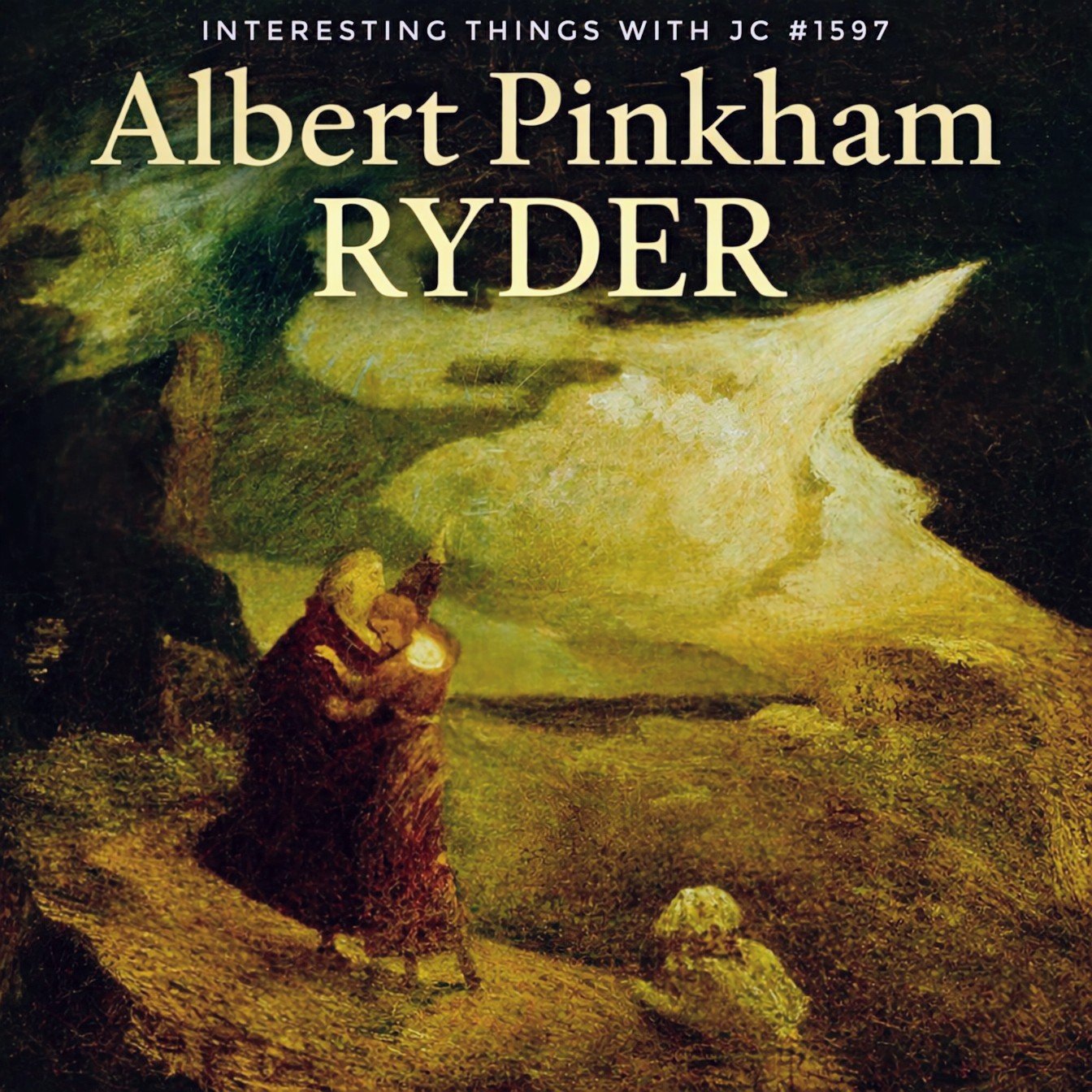
A textured, dark-toned painting shows two small human figures standing on a rocky shoreline, holding a glowing lantern while looking toward a large, swirling storm in the sky. The scene is dominated by green and yellow hues, with thick, uneven paint creating a rough surface. The figures appear small compared to the vast sky and landscape. Large overlay text reads “Albert Pinkham Ryder” and “Interesting Things with JC #1597.”
Transcript
Interesting Things with JC #1597: "Albert Pinkham Ryder"
A man spends decades on a single painting. Not something huge. Not something meant to grab you from across a room. A canvas about 27 and three quarters by 35 inches, around 70.5 by 88.9 centimeters. Small enough that you have to step in close, almost within arm’s reach, to really see what’s going on in the surface.
Albert Pinkham Ryder was born in 1847 in New Bedford, Massachusetts. By the 1880s, he was in New York, and people knew he worked different. Most painters worked fast. Finish the piece. Sell it. Move on.
Ryder worked at his own pace.
If something didn’t feel right, he kept going back to it. Days. Months. Years.
One of those paintings was The Tempest.
It pulls from Shakespeare, mainly Act 1, Scene 2. You’ve got Prospero and Miranda out on a rocky shore, a storm breaking around them. In Ryder’s version, they’re small against it. A lantern, a gesture upward, and everything else is sky and water coming apart.
He started it in 1892 and kept working it through the 1910s, reworking it heavily between 1896 and 1918. More than twenty years on the same canvas.
He built it in layers.
Oil paint went down first. Then he waited. Sometimes weeks. Sometimes longer. Then back in again. He added varnish, resin, even wax. The surface got thicker. In some areas, the paint rises up in ridges you can see from the side. In others, it sank and pulled apart.
He scraped parts down and repainted them. At one point, he took a hot poker and dragged it through the thickest part of the sky to get the texture he wanted.
The whole thing kept shifting.
The painting started to break while he was still working on it. Cracks spread across the surface, some fine like hairlines, others wider, cutting through layers that never fully set. Parts of it darkened more than he likely expected. That kind of breakdown shows up across a lot of his work. It came from how he built his paintings, wet layers, heavy mixtures, pushing the material past what it was meant to do.
By normal standards, that means something went wrong.
Ryder kept going anyway.
He wasn’t trying to make something clean. He was trying to make something feel right. And he was willing to accept the damage if it got him closer to that.
Today, The Tempest hangs in the Detroit Institute of Arts. You can see it all. The uneven surface. The raised ridges. The cracked sections that catch light differently depending on where you stand.
It doesn’t look preserved.
It looks like it’s been through something.
And that’s what brings it back to that small canvas you had to step in close to see.
Most things done fast look good for a while. Smooth. Clean. Easy.
But the work that stays with you usually takes longer than you planned, and it rarely comes out perfect. You can often see the time put into it if you look close enough.
Ryder understood that trade off.
And he stayed with it until the painting carried that story on its own.
These are interesting things, with JC.
Student Worksheet
How does the size of The Tempest affect the way a viewer experiences the painting?
What materials and techniques did Ryder use that contributed to the painting’s condition?
How does Shakespeare’s The Tempest influence the subject and composition of the artwork?
Why did Ryder continue working on the painting despite visible deterioration?
Creative Prompt: Describe a time when revising or reworking something improved its meaning, even if it became less “perfect.”
Teacher Guide
Estimated Time: 45–60 minutes
Pre-Teaching Vocabulary Strategy:
Introduce terms using visual examples of textured vs. smooth paintings.
Connect literary reference (The Tempest) with a brief plot summary.
Anticipated Misconceptions:
Students may assume deterioration equals failure rather than intentional trade-off.
Students may think all artists aim for realism or polish.
Clarify that artistic goals vary widely.
Discussion Prompts:
Should art prioritize durability or emotional impact?
How does scale influence perception in visual art?
Can damage become part of meaning?
Differentiation Strategies:
ESL: Provide side-by-side vocabulary definitions and images.
IEP: Use guided questions with sentence starters.
Gifted: Compare Ryder to abstract expressionists or modern mixed-media artists.
Extension Activities:
Analyze another artwork inspired by literature.
Create a layered artwork experimenting with texture and reflect on results.
Cross-Curricular Connections:
Literature: Shakespeare’s The Tempest (themes of control, nature, power).
Chemistry: Material properties and paint curing processes.
Physics: Light interaction with textured surfaces.
Quiz
Q1. What literary work inspired Ryder’s painting?
A. Hamlet
B. Macbeth
C. The Tempest
D. Othello
Answer: C
Q2. Approximately how long did Ryder work on The Tempest?
A. 2 years
B. 5 years
C. Over 20 years
D. 1 year
Answer: C
Q3. What unusual tool did Ryder use on the painting?
A. A knife
B. A sponge
C. A hot poker
D. A ruler
Answer: C
Q4. What happened to the painting’s surface over time?
A. It became smoother
B. It cracked and shifted
C. It faded completely
D. It remained unchanged
Answer: B
Q5. Where is The Tempest housed today?
A. The Louvre
B. The Met
C. Detroit Institute of Arts
D. British Museum
Answer: C
Assessment
Open-Ended Questions:
Analyze how Ryder’s techniques influenced both the visual appearance and physical condition of The Tempest.
Explain the relationship between time, process, and meaning in Ryder’s work.
Rubric:
3 = Accurate, complete, thoughtful
2 = Partial or missing detail
1 = Inaccurate or vague
Standards Alignment
Common Core (CCSS):
CCSS.ELA-LITERACY.RH.9-10.2 — Analyze central ideas, including artistic themes and process.
CCSS.ELA-LITERACY.W.9-10.2 — Write explanatory texts about artistic methods.
CCSS.ELA-LITERACY.SL.9-10.1 — Engage in collaborative discussion about interpretation.
National Core Arts Standards (NCAS):
VA:Cr2.1.HSI — Experiment with materials and techniques.
VA:Re7.2.HSII — Analyze how context and intent shape meaning.
VA:Cn11.1.HSII — Relate art to broader historical and cultural contexts.
C3 Framework:
D2.His.1.9-12 — Evaluate historical context of artistic production.
D2.His.16.9-12 — Analyze evidence and interpretation in cultural works.
International Equivalents:
UK National Curriculum (Art & Design KS4) — Analyze and evaluate creative processes and outcomes.
IB Diploma Programme (Visual Arts) — Examine relationships between artwork, context, and technique.
Cambridge IGCSE Art & Design — Develop experimentation with media and critical reflection.
Show Notes
This episode explores Albert Pinkham Ryder’s painting The Tempest, a work he developed over more than two decades. Drawing inspiration from Shakespeare’s play, Ryder created a composition where human figures are dwarfed by a turbulent natural world. His unconventional use of layered materials, including oil paint, varnish, resin, and wax, led to a surface that cracked and shifted even as he worked on it. Rather than correcting these issues, Ryder embraced them as part of the artistic process, prioritizing emotional impact over technical stability. Today, the painting remains a powerful example of how time, persistence, and experimentation shape both the meaning and physical reality of art. In educational settings, this topic highlights the importance of process-based learning, interdisciplinary connections between literature and visual art, and the acceptance of imperfection as part of mastery.
References:
Detroit Institute of Arts. (n.d.). The Tempest. https://dia.org/collection/tempest-60087
Broun, E. (1989). Albert Pinkham Ryder. Smithsonian Institution Press. (Referenced in museum contexts for Ryder's techniques and biography; see related Smithsonian holdings at https://americanart.si.edu/artist/albert-pinkham-ryder-4199 for extended context).
Homer, W. I., & Goodrich, L. (1989). Albert Pinkham Ryder: Painter of dreams. Harry N. Abrams. (Key source on his layered, unstable methods with varnish, resin, and wax; widely cited in museum entries).
New Bedford Whaling Museum. (2021). A wild note of longing: Albert Pinkham Ryder and a century of American art. https://www.whalingmuseum.org/exhibition/a-wild-note-of-longing
Brooklyn Rail. (2021, September). A wild note of longing: Albert Pinkham Ryder and a century of American art. https://brooklynrail.org/2021/09/artseen/A-Wild-Note-of-Longing-Albert-Pinkham-Ryder-and-a-Century-of-American-Art
Samuel, B. J. (2022, June 13). Albert Pinkham Ryder - art and decay. https://www.bjasamuel.com/post/albert-pinkham-ryder-art-and-decay
Metropolitan Museum of Art. (n.d.). Albert Pinkham Ryder: The toilers of the sea (related marine technique context). https://www.metmuseum.org/art/collection/search/11981