Interesting Things with JC #1632: "Double Slit Experiment at the Quantum Level" – One photon goes through two slits and hits as a single dot while a wave pattern still builds, even after the setup removes anything that should make waves, and it keeps forming from one hit at a time.
Curriculum - Episode Anchor
Episode Title: Double Slit Experiment at the Quantum Level
Episode Number: 1632
Host: JC
Audience: Grades 9–12, Introductory College, Homeschool, Lifelong Learners
Subject Area: Physics (Quantum Mechanics)
Lesson Overview
Objectives:
Explain how the double slit experiment demonstrates wave-particle duality
Describe how single photons can produce an interference pattern
Analyze how observation affects quantum outcomes
Evaluate why classical explanations fail at the quantum level
Essential Question:
How can a single particle behave as if it travels multiple paths at once?
Success Criteria:
Students can describe the interference pattern formation
Students can explain why one photon at a time still creates a wave pattern
Students can identify the role of measurement in quantum systems
Student Relevance Statement:
Students encounter technologies like lasers, imaging systems, and quantum computing that rely on these principles. Understanding this builds scientific literacy in modern physics.
Real-World Connection:
Quantum behavior underlies semiconductors, MRI machines, and emerging quantum computing systems.
Workforce Reality:
Careers in physics, engineering, and computing require understanding non-intuitive systems where observation affects results and probability governs outcomes.
Key Vocabulary
Wave-Particle Duality (wayv pahr-tih-kuhl doo-al-ih-tee): Concept that particles exhibit both wave-like and particle-like properties
Interference (in-ter-feer-uhns): Overlapping of waves producing patterns of reinforcement and cancellation
Photon (foh-ton): A particle of light
Quantum (kwon-tuhm): The smallest measurable unit in a physical system
Probability Distribution (prob-uh-bil-ih-tee dis-trih-byoo-shun): Likelihood of outcomes across possible states
Superposition (soo-per-puh-zish-uhn): State where multiple possibilities exist simultaneously
Measurement Effect (mezh-er-ment ih-fekt): Change in system behavior when observed
Slit (slit): Narrow opening that constrains particle paths
Narrative Core
Open:
A single photon approaches two openings. Logic says it must choose one.
Info:
Early experiments showed light creates interference patterns, suggesting wave behavior.
Details:
Even when photons are sent one at a time, the same striped pattern forms. Removing environmental and classical influences does not eliminate the pattern. The photon behaves like a spread of possibilities passing through both slits simultaneously. Measurement collapses this behavior into a single observed path.
Reflection:
This challenges classical thinking. The photon is not simply a particle moving along a fixed path. It behaves according to probabilities until observed.
Closing:
These are interesting things, with JC.
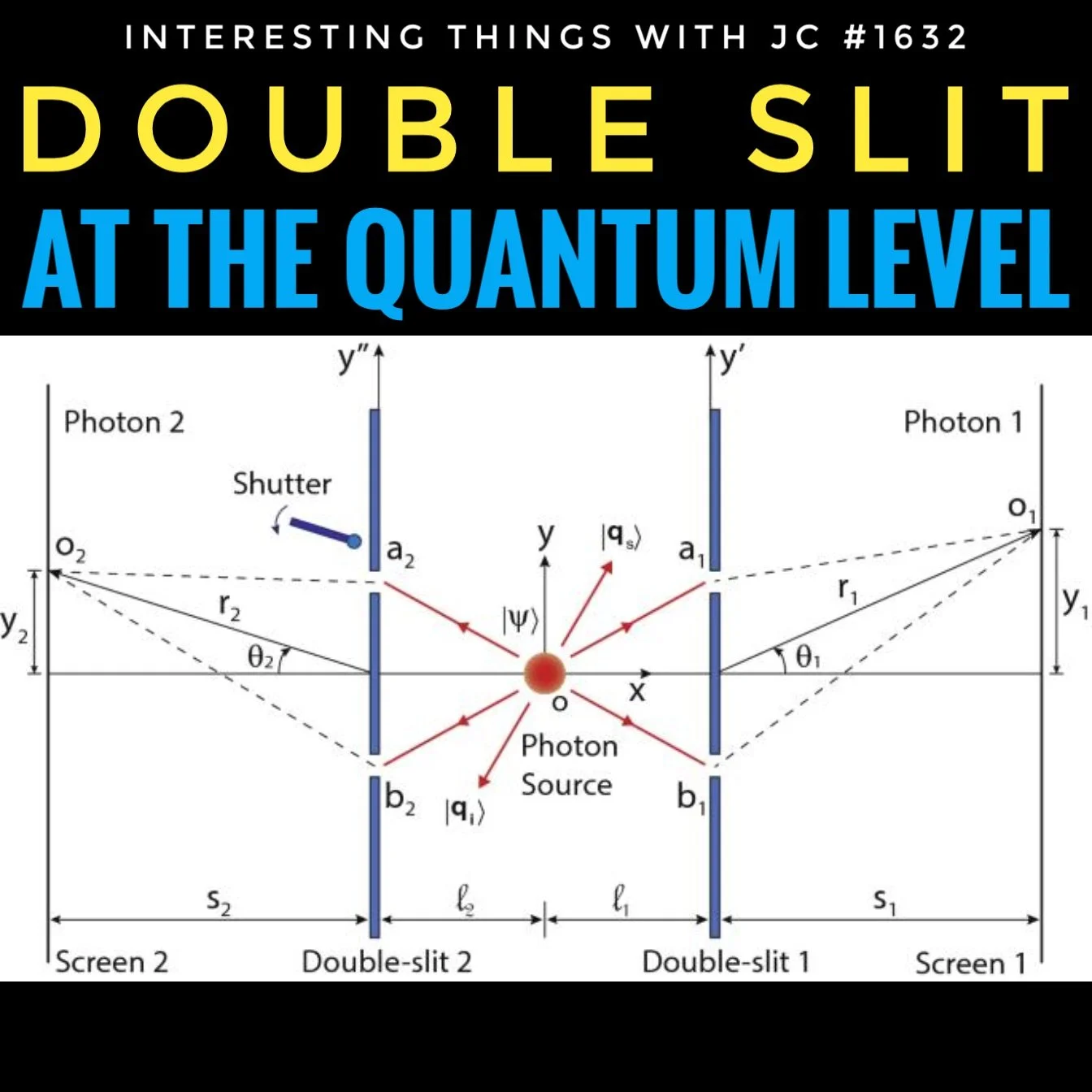
Diagram of a photon source sending light through two double-slit barriers to screens, showing multiple possible paths, labeled angles, and distances that illustrate quantum interference.
Transcript
Interesting Things with JC #1632:
"Double Slit Experiment at the Quantum Level"
A single photon heads toward a barrier with two narrow openings, and somehow it ends up acting like it went through both.
People first saw something like this in the early 1800s, when Thomas Young passed light through two slits and a striped pattern appeared on a screen. Bright bands, dark bands, the kind you only get when waves overlap and cancel.
So you run it again, but slower. One photon at a time, spaced far enough apart that nothing can interact with anything else.
You would expect each photon to go through one slit or the other and build two simple clusters.
Instead, the same striped pattern builds up, one dot at a time.
That’s the part most people hear about.
The real test comes when you start taking things away.
In 2025, researchers at MIT pushed this all the way down to the quantum level by stripping the experiment to the smallest version that could still run. They removed the parts that normally let waves build and travel, the extra structure, the background interactions, anything that could carry a classical explanation.
By the time they finished, there was nothing left in the setup that should produce a wave pattern.
And it still did.
So the pattern is not coming from the equipment, and it is not coming from photons interacting with each other.
What moves through the slits is not a tiny object picking one path. On the way through, it behaves like a spread of possible paths. That spread goes through both openings, overlaps with itself, and shapes where a photon is likely to land. Where those possibilities reinforce, you see a hit. Where they cancel, you see nothing.
Then at the screen, it shows up as one point. One event.
If you try to check which slit it went through, the pattern disappears. The moment you force it to take one path, the wave behavior is gone.
The strange part is not that it can look like a wave.
It’s that even after you remove every normal reason for it to behave like one, it still does.
And that leaves you with a single photon moving toward two slits, carrying more than one possible path until the moment it lands.
These are interesting things, with JC.
Student Worksheet
Comprehension Questions:
What pattern appears when light passes through two slits?
What happens when photons are sent one at a time?
What causes bright and dark bands?
Analysis Questions:
Why does the interference pattern challenge classical particle theory?
How does removing environmental factors strengthen the experiment’s conclusion?
Explain how probability distributions relate to photon behavior.
Reflection Prompt:
Describe how the idea of superposition changes your understanding of reality.
Difficulty Scaling:
Basic: Identify key terms and describe the experiment
Intermediate: Explain interference and probability
Advanced: Evaluate implications for quantum theory
Student Output:
Written responses (1–3 paragraphs per section)
Optional diagram of experiment
Academic Integrity Guidance:
Use original explanations
Support answers with lesson concepts
Avoid copying text directly
Teacher Guide
Quick Start:
Play the podcast, then immediately discuss predictions vs outcomes
Pacing Guide (Audio-First):
5 min: Bell ringer
5 min: Audio
15 min: Discussion
20 min: Worksheet
Bell Ringer:
Ask: “Can something be in two places at once?”
Audio Guidance:
Pause after “one dot at a time” to emphasize buildup concept
Audio Fallback:
Read transcript aloud if audio unavailable
Time-on-Task:
45–60 minutes total
Materials:
Audio or transcript
Whiteboard
Worksheet
Vocabulary Prep:
Preview “superposition” and “interference”
Misconceptions:
Photons are not splitting physically
Pattern is not caused by interaction between photons
Discussion Prompts:
What does it mean to “observe” something?
Does reality depend on measurement?
Formative Checkpoints:
Ask students to sketch expected vs actual results
Quick verbal explanations
Differentiation:
Visual learners: diagrams
Advanced: introduce probability wave functions
Assessment Differentiation:
Oral vs written responses
Simplified vs extended explanations
Time Flexibility:
Condense by reducing analysis questions
Substitute Readiness:
Transcript allows full lesson delivery without audio
Engagement Strategy:
Use prediction vs outcome contrast
Extensions:
Research quantum computing
Explore Schrödinger’s cat
Cross-Curricular:
Math: probability
Philosophy: nature of reality
SEL Connection:
Encourages comfort with uncertainty and complexity
Skill Emphasis:
Critical thinking, scientific reasoning
Answer Key:
Interference pattern from wave overlap
Single photons still form pattern over time
Measurement collapses possibilities into one outcome
Quiz
What does the double slit experiment demonstrate?
A. Gravity
B. Wave-particle duality
C. Magnetism
D. ThermodynamicsWhat happens when photons are sent one at a time?
A. No pattern forms
B. Two clusters form
C. Interference pattern forms
D. Light stopsWhat causes dark bands?
A. Reflection
B. Cancellation of waves
C. Absorption
D. HeatWhat happens when you measure which slit the photon goes through?
A. Pattern increases
B. Pattern disappears
C. Light doubles
D. Nothing changesWhat concept describes multiple possible paths existing at once?
A. Reflection
B. Superposition
C. Gravity
D. Refraction
Assessment
Open-Ended Questions:
Explain why the double slit experiment cannot be explained by classical physics.
Describe how measurement affects quantum systems.
Rubric (3–2–1):
3: Clear, accurate explanation with key concepts
2: Partial understanding with minor errors
1: Limited or incorrect explanation
Exit Ticket:
What is one reason the double slit experiment is considered important in physics?
Standards Alignment
NGSS HS-PS4-3: Evaluate the claims, evidence, and reasoning behind the idea that electromagnetic radiation can be described by wave and particle models; students analyze how the double slit experiment demonstrates interference and quantum behavior
NGSS HS-PS4-1: Use mathematical representations to support claims regarding relationships among frequency, wavelength, and energy; students connect interference patterns to wave properties of light
NGSS Science Practice: Developing and Using Models — students construct conceptual models of photon behavior (wave vs particle)
CCSS RST.11-12.3: Follow precisely a complex multistep procedure when carrying out experiments or analyzing results; students trace the experimental design and modifications
CCSS RST.11-12.7: Integrate and evaluate multiple sources of information presented in different formats; students interpret narrative, diagrams, and experimental descriptions
CCSS WHST.11-12.2: Write explanatory texts to examine scientific concepts; students explain wave-particle duality and measurement effects
ISTE 5a: Formulate problem definitions suited for technology-assisted methods; students analyze quantum uncertainty as a computational challenge
ISTE 7c: Contribute constructively to project teams; students engage in collaborative discussion about interpretations of quantum behavior
C3 D2.Sci.3: Analyze the validity of scientific explanations using evidence; students evaluate why classical explanations fail
C3 D4.1: Construct arguments using evidence; students defend interpretations of interference patterns
Career Readiness: Apply systems thinking and probabilistic reasoning to complex phenomena in physics, engineering, and computing fields
Career Readiness: Interpret experimental data where outcomes are non-deterministic
Homeschool/Lifelong Learning: Develop independent inquiry skills through observation, questioning, and evidence-based reasoning
Homeschool/Lifelong Learning: Build conceptual flexibility when encountering non-intuitive scientific principles
Show Notes
This lesson explores one of the most foundational experiments in quantum physics, demonstrating how light behaves in ways that challenge everyday intuition. By examining the double slit experiment at the quantum level, students confront the limits of classical thinking and begin to understand probability-based models that shape modern science and technology.
References
National Institute of Standards and Technology. Quantum Research Highlights. https://www.nist.gov/physics/nists-quantum-research-highlights
Massachusetts Institute of Technology. (2025). Quantum double-slit minimal system research. https://news.mit.edu/topic/quantum-physics
Feynman, R. P. (1965). The Feynman lectures on physics. https://www.feynmanlectures.caltech.edu/