1633: "Alfred Adler & Happiness"
Interesting Things with JC #1633: "Alfred Adler & Happiness" – Alfred Adler sits with a patient and ignores their past to ask where they are going, breaking from Sigmund Freud as he treats behavior as forward movement, and this shift keeps showing up as people chase happiness directly and lose it while those focused on contribution in work, friendship, and love stabilize instead.
Curriculum - Episode Anchor
Episode Title: Alfred Adler & Happiness
Episode Number: 1633
Host: JC
Audience: Grades 9–12, Introductory College, Homeschool, Lifelong Learners
Subject Area: Psychology / Human Behavior
Lesson Overview
Objectives:
Explain Alfred Adler’s concept of Individual Psychology
Distinguish Adler’s forward-focused theory from Sigmund Freud’s past-focused model
Analyze the role of “social interest” in personal well-being
Apply Adler’s three life tasks (work, friendship, love) to real-life scenarios
Essential Question: How does focusing on contribution rather than self-centered happiness affect well-being?
Success Criteria:
Students can describe Adler’s theory in their own words
Students can compare Adler and Freud accurately
Students can connect social interest to real-life behavior
Student Relevance Statement: Students regularly think about identity, purpose, and relationships; this lesson connects those concerns to psychological theory.
Real-World Connection: Mental health practices, teamwork, leadership, and relationship-building all reflect Adler’s ideas.
Workforce Reality: Employers value collaboration, contribution, and social awareness over purely individual achievement.
Key Vocabulary
Individual Psychology (in-duh-VIJ-oo-uhl sy-KOL-uh-jee): Adler’s theory focusing on goal-directed behavior
Social Interest (SOH-shuhl IN-trist): Desire to contribute to and connect with others
Inferiority Feelings (in-feer-ee-OR-ih-tee): Universal sense of being less than, motivating growth
Compensation (kom-pen-SAY-shun): Effort to overcome perceived weaknesses
Life Tasks (lyfe tasks): Work, friendship, and love as core areas of living
Goal Orientation (gohl or-ee-en-TAY-shun): Behavior directed toward future outcomes
Psychoanalysis (sy-ko-uh-NAL-uh-sis): Freud’s theory focusing on unconscious past influences
Narrative Core
Open: A quiet office in Vienna. A question shifts psychology from the past to the future.
Info: Adler separates from Freud and develops a new way of understanding behavior as goal-driven.
Details: He introduces social interest and the idea that happiness comes from contribution, not pursuit. He identifies work, friendship, and love as central life tasks.
Reflection: People are not just shaped by their past; they are moving toward meaning through connection and responsibility.
Closing: These are interesting things, with JC.
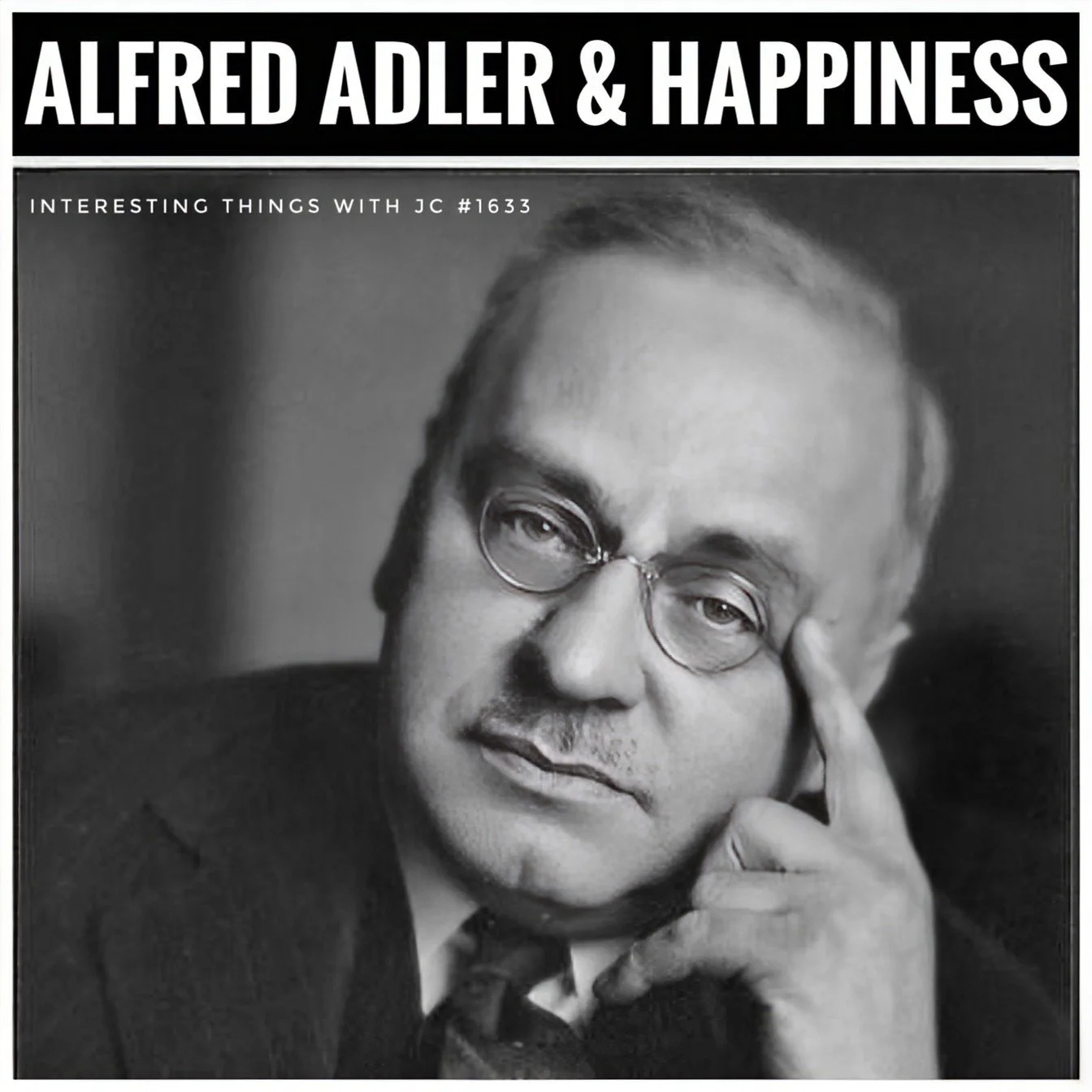
Black-and-white portrait of Austrian psychologist Alfred Adler, wearing glasses and resting his head on his hand, with the title “Alfred Adler & Happiness” and “Interesting Things with JC #1633” displayed above.
Transcript
Interesting Things with JC #1633:
Alfred Adler & Happiness
A man in Vienna sits across from a patient in the early 1900s and asks a question that feels a little out of place for the time. Not what happened to you, but where are you headed.
That man is Alfred Adler, and by 1911 he has already split from Sigmund Freud. And it is a real split. Freud keeps digging into the past, looking for causes buried in childhood. Adler turns the other direction. He starts asking what a person is trying to move toward.
He notices people are not just shaped by what happened to them. They are moving toward something, even if they cannot quite explain it.
So he builds what he calls Individual Psychology, and by the 1920s he is teaching it across Europe and the United States. In 1927, in a book called Understanding Human Nature, he puts it simply. You understand a person better by looking at where they are trying to go, not just where they have been.
That flips the whole thing. Behavior is not just reaction. It is direction.
And that brings him straight into the question of happiness.
Adler does not think happiness is something you go after directly. In fact, he thinks that is part of the problem. The more someone tries to lock down their own happiness, the more it slips. So he points somewhere else. He calls it social interest. It means being connected, being useful, actually contributing to other people.
You can see it in simple ways. A person who throws themselves into work that helps others, shows up for friends, and takes responsibility in a relationship tends to feel more stable than someone focused only on their own satisfaction. Not perfect. But steadier.
He boils life down to three areas. Work, friendship, and love. Not as ideas, but as real things you either do or you do not. Can you contribute something that matters. Can you build real relationships. Can you share your life honestly with another person. When those are working, happiness tends to show up. When they are not, turning inward does not fix it.
He also takes something most people try to hide and flips it. That feeling of being less than. Adler says that is not the problem. That is where everyone starts. The real question is what you do with it. Do you try to prove yourself over other people, or do you grow into actually working with them.
That shift is where he places a more stable kind of happiness. Not constant pleasure. Not a life without problems. Something much simpler than that. Something built by being part of a shared life.
And if you go back to that room in Vienna, what Adler is really doing is turning the whole conversation forward and asking a question that still holds.
What are you trying to become…and who does it help.
These are interesting things, with JC.
Student Worksheet
Comprehension Questions:
What key question did Adler ask his patients?
How does Adler’s theory differ from Freud’s?
What is “social interest”?
What are the three life tasks Adler identified?
How does Adler view feelings of inferiority?
Analysis Questions:
Why might focusing only on personal happiness make it harder to achieve?
How does contribution to others influence stability in life?
Compare Adler’s and Freud’s views on human behavior.
Reflection Prompt:
Which of the three life tasks (work, friendship, love) do you think is most important right now and why?
Difficulty Scaling:
Basic: Define key terms
Intermediate: Explain concepts in examples
Advanced: Apply theory to real-life situations
Student Output: Written responses (1–2 paragraphs per analysis/reflection)
Academic Integrity Guidance: Use original ideas, support answers with lesson content, avoid copying peers
Teacher Guide
Quick Start: Play audio, then guide discussion on future vs past focus
Pacing Guide:
Audio (5 min)
Discussion (10 min)
Worksheet (15 min)
Review (10 min)
Bell Ringer: “Do you think your past or your goals shape you more? Why?”
Audio Guidance: Students listen for differences between Adler and Freud
Audio Fallback: Teacher reads transcript aloud
Time on Task: 40 minutes total
Materials: Transcript, worksheet, writing tools
Vocabulary Strategy: Pre-teach key terms with examples
Misconceptions:
Happiness is something you directly pursue
Inferiority is always negative
Discussion Prompts:
Can helping others improve your own life?
Is happiness a result or a goal?
Formative Checkpoints:
Quick verbal summaries
Worksheet responses
Differentiation:
Provide sentence starters for struggling students
Extend with real-world case studies for advanced learners
Assessment Differentiation: Oral responses allowed for some learners
Time Flexibility: Expand discussion or shorten worksheet as needed
Substitute Readiness: Full transcript and worksheet included
Engagement Strategy: Relate concepts to student relationships and goals
Extensions: Research modern psychology applications of Adler’s ideas
Cross-Curricular Connections: Sociology, health education, leadership studies
SEL Connection: Focus on empathy, belonging, and purpose
Skill Value Emphasis: Critical thinking, self-awareness, collaboration
Answer Key:
Comprehension: 1. Future direction 2. Past vs future focus 3. Contribution/connection 4. Work, friendship, love 5. Starting point for growth
Analysis: Answers vary but must reflect Adler’s principles
Quiz
What did Adler focus on in understanding behavior?
A. Childhood trauma
B. Future goals
C. Biological instincts
D. Random eventsWhat is “social interest”?
A. Personal success
B. Competition
C. Contribution to others
D. Avoiding relationshipsWhich are Adler’s three life tasks?
A. Wealth, power, fame
B. Work, friendship, love
C. School, sports, hobbies
D. Health, money, statusHow did Adler view inferiority?
A. A weakness to hide
B. A punishment
C. A starting point for growth
D. A permanent conditionWhat happens when people focus only on their own happiness?
A. It increases
B. It stays constant
C. It becomes harder to achieve
D. It guarantees success
Assessment
Open-Ended Questions:
Explain how Adler’s idea of social interest contributes to long-term happiness.
Compare Adler’s and Freud’s approaches to understanding human behavior.
Rubric (3–2–1):
3: Clear explanation, accurate concepts, real-world connection
2: Partial understanding, some inaccuracies
1: Minimal understanding, lacks clarity
Exit Ticket: One sentence: “Happiness comes from ______ because ______.”
Standards Alignment
CCSS.ELA-LITERACY.RH.11-12.2: Determine the central ideas of Adler’s psychological theory and accurately summarize how goal-oriented behavior differs from past-focused explanations, using evidence from the transcript
CCSS.ELA-LITERACY.W.11-12.1: Construct a written argument evaluating whether contribution (social interest) leads to more stable well-being than self-focused happiness, supported with textual and real-life evidence
CCSS.ELA-LITERACY.SL.11-12.1: Initiate and participate effectively in collaborative discussions analyzing Adler vs. Freud, building on others’ ideas and expressing reasoning clearly
C3 Framework D2.Psy.1.9-12: Apply psychological theories (Adler’s Individual Psychology and Freud’s psychoanalysis) to interpret human behavior in structured scenarios
C3 Framework D3.3.9-12: Present claims about human motivation and happiness using evidence from primary narrative content
ISTE 1.1c (Empowered Learner): Use reflective thinking to evaluate personal goals and connections to social contribution
ISTE 1.7c (Global Collaborator): Contribute constructively to group discussions focused on interpersonal responsibility and shared outcomes
Career Readiness (NACE – Teamwork & Critical Thinking):
Demonstrate the ability to work effectively with others by applying the concept of social interest
Analyze personal and group behaviors to improve collaboration and shared responsibility
NGSS HS-ETS1-3 (Applied Human Systems Thinking): Evaluate competing models of human behavior (past-driven vs. goal-driven) and justify which better explains observed outcomes
Homeschool / Lifelong Learning Competency:
Apply psychological frameworks to personal decision-making, relationships, and long-term goal setting with clear self-reflection
Show Notes
This lesson explores Alfred Adler’s shift from past-focused psychology to a forward-looking understanding of human behavior. Students examine how purpose, contribution, and relationships influence well-being, making the content highly relevant to personal development and real-world success.
References
Adler, A. (1927). Understanding human nature. https://archive.org/details/understandinghum00adle
Adler, A. (1930). The science of living. https://archive.org/details/in.ernet.dli.2015.37217
Ansbacher, H. L. (1953). Purcell's "Memory and psychological security" and Adlerian theory. The Journal of Abnormal and Social Psychology, 48(4), 596–597. https://doi.org/10.1037/h0062528
Encyclopaedia Britannica. (2023). Alfred Adler. https://www.britannica.com/biography/Alfred-Adler
Cherry, K. (2022). Alfred Adler biography and theory. https://www.verywellmind.com/alfred-adler-biography-2795502
McAdams, D. P. (2006). The redemptive self: Stories Americans live by. Oxford University Press. https://doi.org/10.1093/acprof:oso/9780195176933.001.0001
Watts, R. E. (2012). The origin of striving for superiority and social interest. In R. E. Watts (Ed.), Adlerian therapy: Theory and practice. https://www.taylorfrancis.com/chapters/edit/10.4324/9780203841594-5/origin-striving-superiority-social-interest-richard-watts