Interesting Things with JC #1634: "Chernobyl Explodes and Igor Khiryak Goes Back In" – A pontoon bridge is being assembled in a moving river while radiation levels are unknown, sections pinned and anchored as current pushes against them, and the crossing keeps carrying evacuation buses out and response traffic in as crews rotate through minutes-long exposure windows to keep it from shifting.
Curriculum - Episode Anchor
Episode Title: Chernobyl Explodes and Igor Khiryak Goes Back In
Episode Number: 1634
Host: JC
Audience: Grades 9–12, introductory college, homeschool, lifelong learners
Subject Area: History, emergency response, engineering, nuclear safety, civic responsibility
Lesson Overview
Learning Objectives:
Explain how infrastructure, evacuation, and emergency response intersected after the Chernobyl Reactor No. 4 explosion.
Describe how PMP pontoon bridge systems functioned as temporary military infrastructure.
Analyze Igor Khiryak’s role using evidence from a brief historical narrative.
Evaluate how ordinary technical work can become critical during a public emergency.
Essential Question: How can one person’s technical duty become historically important during a crisis?
Success Criteria: Students can identify key events, define technical terms, explain why the bridge mattered, and support claims with evidence from the transcript.
Student Relevance Statement: This lesson shows how transportation, engineering, and teamwork affect real people during emergencies.
Real-World Connection: Modern disaster response depends on temporary bridges, evacuation routes, trained crews, and disciplined communication.
Workforce Reality: Emergency engineering work requires skill, accuracy, stamina, and responsibility; it is not glamorous, and mistakes can endanger others.
Key Vocabulary
Pontoon Bridge(pon-TOON bridge): A temporary floating bridge supported by buoyant sections.
PMP Floating Bridge(P-M-P FLOH-ting bridge): A Soviet military pontoon bridge system transported by heavy trucks and assembled on water.
Evacuation(ee-vak-yoo-AY-shun): The organized movement of people away from danger.
Radiation Exposure(ray-dee-AY-shun ek-SPOH-zher): Contact with ionizing radiation from radioactive materials.
Anchor(ANG-ker): A device or system used to hold a floating structure in place.
Current(KUR-ent): The movement of water in a river or stream.
Reactor(ree-AK-ter): A structure where nuclear reactions are controlled to produce energy.
Infrastructure(IN-fruh-struk-cher): Systems such as roads, bridges, power, and transportation that support society.
Load(lohd): The weight or force a structure must carry.
Response Unit(ree-SPONSS YOO-nit): A trained group sent to manage part of an emergency.
Narrative Core
Open: The river kept moving after the reactor exploded.
Info: On April 27, 1986, Pripyat was evacuated after the Chernobyl disaster. Thousands of residents left while emergency crews and military units entered the area.
Details: Igor Khiryak, a young Soviet soldier in a pontoon bridge unit, helped assemble and maintain a temporary crossing over the Pripyat River using PMP floating bridge sections.
Reflection: His work was technical, dangerous, and easy to overlook. Yet the crossing mattered because evacuation and response traffic depended on movement.
Closing: These are interesting things, with JC.
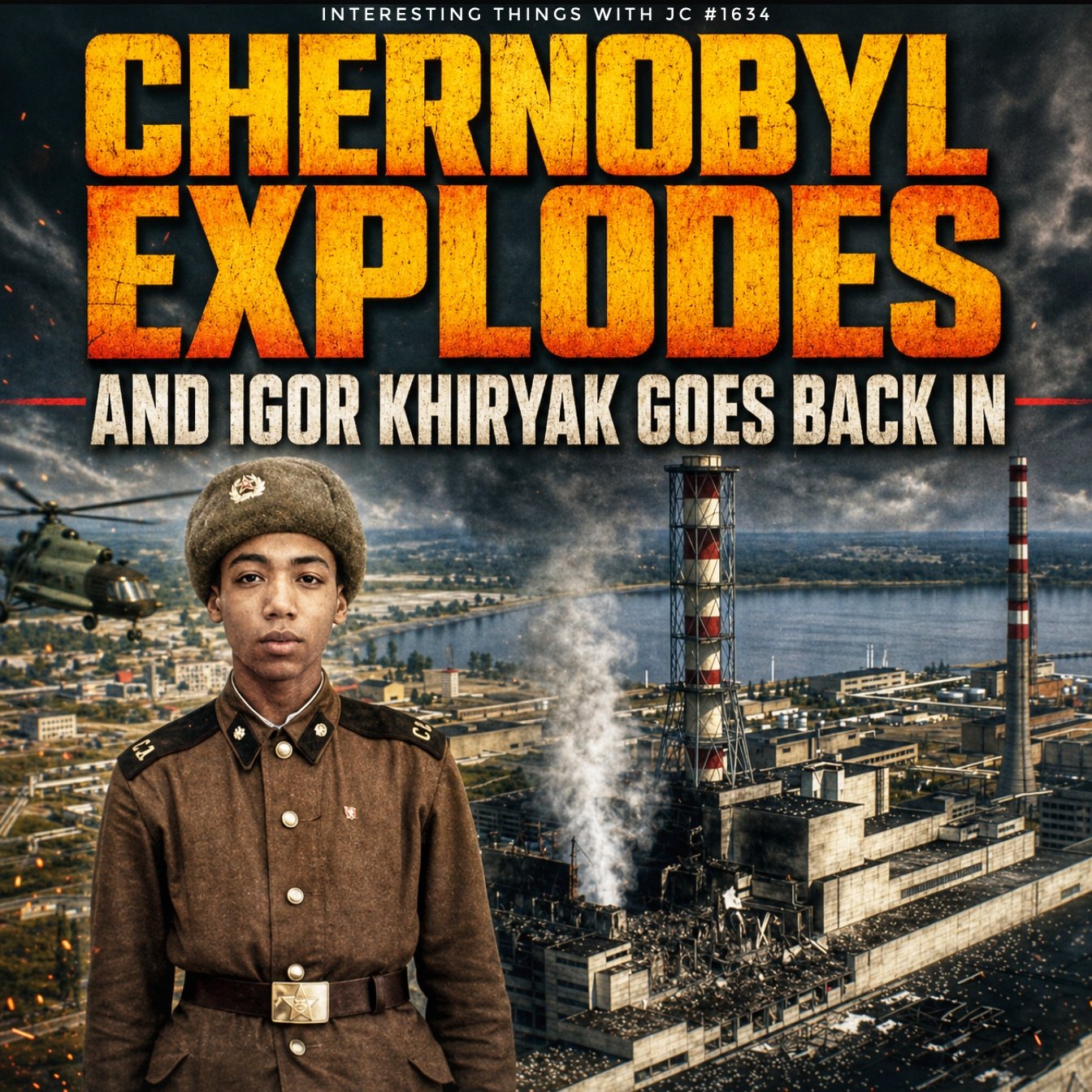
Cinematic illustration of a young Soviet soldier Igor Khiryak in uniform standing in front of the damaged Chernobyl nuclear reactor, with smoke rising, a river and industrial buildings in the background, and bold text referencing the Chernobyl explosion and Igor Khiryak.
Transcript
Interesting Things with JC #1634:
"Chernobyl Explodes and Igor Khiryak Goes Back In"
The river didn’t stop moving, even after the reactor blew.
On April 27, 1986, less than 36 hours after the explosion at Reactor No. 4, the evacuation of Pripyat began. Around 50,000 people were put on buses while military convoys and response units moved in. The Pripyat River cut through that movement, and the existing crossings couldn’t handle the volume.
Igor Khiryak had been drafted the year before, in 1985, at eighteen. He was part of a Soviet pontoon bridge unit sent to the river.
They were working with PMP floating bridge sections, steel pontoons hauled in on heavy trucks and dropped into the water, unfolding into roadway spans about 6 to 7 meters, roughly 20 to 23 feet long. In certain configurations, the system could carry vehicles up to about 60 tons, roughly 54 metric tonnes. Each section had to be guided into place, pinned, and anchored against the current. Once connected, it could carry continuous traffic as long as every joint held.
They built it while radiation levels were uneven and not fully understood. In some areas, readings spiked high enough to force crews out within minutes, the kind of exposure that could deliver in an hour what would normally take months or years. Crews rotated through in short windows to limit dose, moving in, doing the work, and getting out. They didn’t know what the exposure would mean yet. They just knew the bridge had to hold.
Buses moved people out. Equipment and crews moved in. Traffic either flowed or it stalled.
Khiryak’s job was to guide the sections into place, pin them, secure the anchors, and keep the line stable under load and current. If a connection failed, the structure could shift or break.
He would spend about two and a half months working in that zone. What we have from him is limited, an interview and a few photographs, but it places him there on that line. A Black serviceman in the Soviet military in the 1980s was uncommon, but the bridge demanded the same from him as from everyone else. It had to hold.
And for a stretch of time in 1986, one of the people keeping that crossing in place was a soldier named Igor Khiryak.
These are interesting things, with JC.
Student Worksheet
Student Output: Answer in complete sentences. Use at least three details from the transcript.
Academic Integrity Guidance: Use the transcript and class materials only. Do not invent details about Khiryak beyond the evidence provided.
Comprehension Questions:
When did the evacuation of Pripyat begin?
What kind of military unit was Igor Khiryak part of?
What was the purpose of the pontoon bridge?
What tasks did Khiryak perform at the river?
Why could a failed connection have been dangerous?
Analysis Questions:
Explain why the river crossing mattered during the evacuation and response.
How does the story show the connection between engineering and public safety?
What does the phrase “Traffic either flowed or it stalled” reveal about the stakes?
Why is limited evidence still useful when studying an individual in a larger event?
Reflection Prompt: Write one paragraph explaining how ordinary technical work can become historically important during a crisis.
Difficulty Scaling:
Support: Identify three facts and write a 5-sentence summary.
Standard: Answer all questions using transcript evidence.
Extension: Compare the pontoon bridge crew’s work to a modern disaster-response infrastructure need.
Teacher Guide
Quick Start: Begin with the podcast audio. Ask students to listen for who, where, what task, and why it mattered.
Pacing Guide Audio-First: 5 minutes bell ringer; 3 minutes audio; 5 minutes silent annotation; 12 minutes worksheet; 10 minutes discussion; 10 minutes assessment or quiz.
Bell Ringer: What systems must keep working during an emergency evacuation?
Audio Guidance: First listen for the story. Second listen for evidence about engineering, risk, and responsibility.
Audio Fallback: If audio is unavailable, read the transcript aloud once, then have students reread independently.
Time on Task: 45 minutes standard; 25 minutes compressed; 60 minutes extended.
Materials: Podcast audio, transcript, worksheet, writing materials, projector or board.
Vocabulary Prep: Pre-teach pontoon bridge, current, load, anchor, radiation exposure.
Misconceptions:
Students may assume evacuation is only about buses; clarify that roads, bridges, and traffic flow are also essential.
Students may assume emergency workers always fully understand risk; clarify that early disaster response often involves uncertainty.
Students may confuse a permanent bridge with a temporary floating bridge.
Discussion Prompts:
Why might a temporary bridge become as important as a permanent road?
What responsibilities does a soldier-engineer have during a civilian emergency?
How should historians handle stories with limited surviving evidence?
Formative Checkpoints: Ask students to identify one fact, one technical detail, and one inference supported by the transcript.
Differentiation: Provide vocabulary cards for support; allow audio replay; offer sentence frames; assign extension comparison for advanced learners.
Assessment Differentiation: Students may submit written, oral, or annotated-response evidence if the same success criteria are met.
Time Flexibility: For a short class, use only comprehension questions and exit ticket. For a longer class, add the extension comparison.
Substitute Readiness: Play or read transcript, assign worksheet, collect exit ticket.
Engagement Strategy: Use the question “What happens if the bridge fails?” to focus attention on consequences.
Extensions: Research temporary bridges in flood, hurricane, or military logistics contexts.
Cross-Curricular Connections: Physics of load and buoyancy; history of the Cold War; engineering design; emergency management.
SEL Connection: Emphasize responsibility, calm under pressure, and respect for people doing difficult support work.
Skill Emphasis: Evidence use, technical reading, cause-and-effect reasoning, concise writing.
Answer Key:
1. April 27, 1986.
2. A Soviet pontoon bridge unit.
3. To support evacuation and response traffic across the Pripyat River.
4. Guide sections, pin them, secure anchors, stabilize the bridge.
5. The bridge could shift or break, disrupting traffic and endangering people.
Quiz
What major event created the emergency described in the episode?
A. A bridge collapse
B. The explosion at Reactor No. 4
C. A river flood
D. A military paradeWhat was the main function of the PMP bridge sections?
A. To block river traffic
B. To create a temporary floating roadway
C. To measure radiation
D. To evacuate people by boatWhy were crews rotated through short exposure windows?
A. The bridge was too long
B. Trucks ran out of fuel
C. Radiation risk was uneven and uncertain
D. The river frozeWhich task belonged to Khiryak?
A. Flying helicopters
B. Operating the reactor
C. Guiding and securing bridge sections
D. Driving evacuation busesWhat is the central idea of the episode?
A. Small technical roles can matter greatly during a crisis
B. Rivers stop during disasters
C. Evacuations require no planning
D. Temporary bridges are symbolic only
Assessment
Open-Ended Questions:
Explain how the pontoon bridge connected engineering decisions to human safety during the Pripyat evacuation.
What can historians responsibly conclude about Igor Khiryak from limited evidence?
3–2–1 Rubric:
3: Uses accurate facts, explains cause and effect, includes transcript evidence, and writes clearly.
2: Uses mostly accurate facts and some evidence but needs stronger explanation.
1: Gives limited facts, unsupported claims, or unclear reasoning.
Exit Ticket: In one sentence, explain why “the bridge had to hold.”
Standards Alignment
NGSS HS-ETS1-2: Students analyze a real emergency infrastructure problem by explaining how constraints such as time, load, water current, and safety affected the bridge solution.
NGSS HS-ETS1-3: Students evaluate how a temporary engineering system balanced risk, reliability, and public need during evacuation and response operations.
CCSS.ELA-LITERACY.RI.9-10.1: Students cite strong textual evidence from the transcript to support comprehension and analysis.
CCSS.ELA-LITERACY.RI.11-12.3: Students analyze how a sequence of events and technical actions shaped outcomes during a historical emergency.
CCSS.ELA-LITERACY.WHST.9-12.2: Students write explanatory responses that organize facts, technical vocabulary, and cause-and-effect reasoning.
C3 D2.His.1.9-12: Students evaluate how historical context shaped individual action during the Chernobyl emergency.
C3 D2.His.12.9-12: Students use available evidence to make careful claims about a person whose historical record is limited.
ISTE 1.3 Knowledge Constructor: Students gather and evaluate information from a transcript to build an evidence-based explanation.
CTE Engineering Design Pathway: Students identify constraints, loads, failure points, and safety responsibilities in a real-world temporary bridge scenario.
Career Readiness: Students practice disciplined listening, technical vocabulary use, evidence-based communication, and responsibility-focused problem solving.
Homeschool/Lifelong Learning: Learners connect history, engineering, and civic responsibility through a concise primary narrative and guided analysis.
Show Notes
This classroom lesson uses the story of Igor Khiryak at the Pripyat River to examine how emergency response depends on infrastructure, training, and disciplined technical work. Students learn that evacuation is not only a human story but also an engineering and logistics challenge, where bridges, traffic flow, and individual responsibility can shape outcomes during a crisis.
References
International Atomic Energy Agency. (n.d.). Frequently asked Chernobyl questions. https://www.iaea.org/topics/chornobyl/faqs
International Atomic Energy Agency. (n.d.). The 1986 Chornobyl nuclear power plant accident. https://www.iaea.org/topics/chornobyl
U.S. Nuclear Regulatory Commission. (1987). Report on the accident at the Chernobyl nuclear power station. https://www.nrc.gov/docs/ML0716/ML071690245.pdf
United Nations Scientific Committee on the Effects of Atomic Radiation. (2000). Sources and effects of ionizing radiation: Annex J, exposures and effects of the Chernobyl accident. https://www.unscear.org/unscear/uploads/documents/publications/UNSCEAR_2000_Annex-J.pdf
World Nuclear Association. (n.d.). Chernobyl accident 1986. https://world-nuclear.org/information-library/safety-and-security/safety-of-plants/chernobyl-accident
Army Recognition. (2017). New PMP-M mobile pontoon bridge enters service with Russian Army Eastern Military District. https://armyrecognition.com/archives/archives-land-defense/land-defense-2017/new-pmp-m-mobile-pontoon-bridge-enters-in-service-with-russian-army-eastern-military-district-tass-10902172
Zubacheva, K. (2019, June 5). The only Black man at Chernobyl: Who was he? Russia Beyond. https://www.russiabeyond.com/history/330465-black-man-in-chernobyl