Interesting Things with JC #1611: "Who Is Bob Lazar?" – A physicist, a fraud, a whistleblower, a storyteller? One man stepped forward with a claim too big to prove and too dangerous to ignore.
Curriculum - Episode Anchor
Episode Title: Who Is Bob Lazar?
Episode Number: 1611
Host: JC
Audience: Grades 9–12, college intro, homeschool, lifelong learners
Subject Area: History, physics, media literacy, research literacy
Lesson Overview
Students investigate how secrecy, evidence, and scientific reasoning shape public understanding of extraordinary claims. Using the Bob Lazar episode as a case study, learners examine the documented history of Area 51, evaluate Lazar’s unverified claims, compare testimony with verifiable records, and assess how scientific standards apply to sensational stories. The lesson supports evidence-based reasoning, source evaluation, and critical discussion of how real government secrecy can make unsupported claims seem more plausible. The episode’s background claims about Area 51’s role in the U-2 and A-12 OXCART programs and the official naming of element 115 as moscovium are supported by CIA and IUPAC sources.
Learning Objectives
• Define the difference between verified evidence, testimony, and speculation in historical and scientific inquiry.
• Compare Lazar’s claims with publicly documented facts about Area 51, classified aerospace testing, and element 115.
• Analyze why real secrecy in Cold War programs can make unverified stories more believable to the public.
• Explain how scientific knowledge depends on empirical evidence and multiple lines of support rather than assertion alone.
Key Vocabulary
• Compartmentalized (kuhm-part-MEN-tuh-lized) — Organized so that different people know only small parts of a larger secret project. In the episode, Lazar says the program was compartmentalized so no one person saw the whole picture.
• Reverse-engineering (ree-VURS en-juh-NEER-ing) — Studying an object to understand how it works and possibly recreate it. Lazar claimed alien craft were being reverse-engineered.
• Moscovium (mos-KOH-vee-um) — The official name for element 115, approved by IUPAC in 2016. The element exists, but the known isotopes are extremely unstable, which does not support Lazar’s description of a stable power source.
• Empirical evidence (em-PEER-ih-kul EV-ih-duhnss) — Information based on observation, measurement, testing, or documented proof. Scientific claims require empirical evidence.
• Whistleblower (WISS-ul-bloh-ur) — A person who reveals information about hidden or secret activity, usually claiming public importance. Some supporters view Lazar this way.
• Aerospace (AIR-oh-spayss) — The field involving aircraft and spacecraft design, testing, and engineering. Area 51 is historically tied to classified aerospace development.
• Testimony (TES-tuh-moh-nee) — A person’s spoken or written account. Testimony can be important, but by itself it is not the same as verified proof.
Narrative Core
Open
The episode begins with the dramatic 1989 television appearance of Bob Lazar, whose hidden face and disguised voice immediately frame the story as one of secrecy, danger, and possible revelation.
Info
Listeners receive historical context about Area 51, Groom Lake, Cold War secrecy, and the way compartmentalized government projects have genuinely operated in U.S. history. The episode also explains that Area 51 was a real secret testing ground linked to the U-2 and A-12 OXCART programs.
Details
The episode turns to Lazar’s most famous claims: S-4, nine saucer-shaped craft, a gravity-based propulsion system, and a stable form of element 115. It then contrasts those claims with established physics and with the official scientific record on moscovium.
Reflection
The broader meaning centers on trust, absence, and the lasting appeal of stories that sit near real secrecy. The episode argues that Lazar’s story survives because it occupies the space between documented government secrecy and the absence of verified alien evidence.
Closing
These are interesting things, with JC.
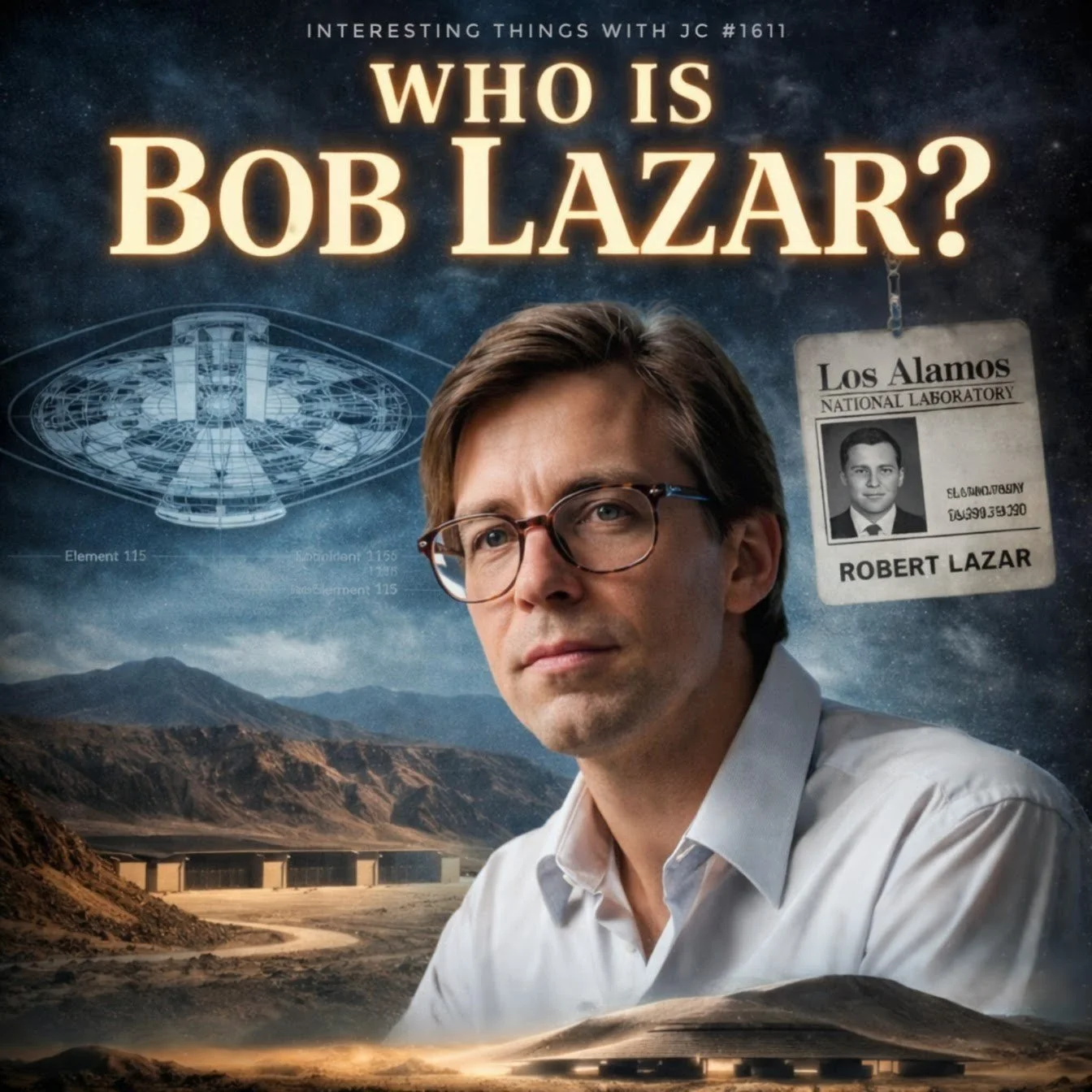
Promotional image for “Interesting Things with JC #1611,” exploring the claims, controversy, and cultural legacy surrounding Bob Lazar.
Transcript
Interesting Things with JC #1611: "Who Is Bob Lazar?"
In May of 1989, a man appeared on Las Vegas television with his face hidden and his voice disguised. He said the United States was not only studying unidentified flying objects. He said it already had them. He claimed he had walked into a secure site in the Nevada desert and seen craft that were not built by any nation on Earth.
His name was Bob Lazar.
Lazar said he had worked at a place called S-4, a site he described as being near Papoose Lake, south of the better-known installation commonly called Area 51. Groom Lake and the test site later known publicly as Area 51 were established in 1955 for the Lockheed U-2 program. The facility sits roughly 120 miles (193 kilometers) northwest of Las Vegas. For decades, the government did not publicly confirm the name Area 51, even while the site’s existence had become part of American folklore. That official silence gave the place unusual power in the public mind long before declassified records acknowledged it.
He said he had studied at the Massachusetts Institute of Technology and the California Institute of Technology. No verified public academic records from either institution have confirmed that claim. He also said he had been hired into a compartmentalized program where teams were separated and where no one person saw the whole picture. That part does fit the known logic of classified work. During the Manhattan Project, more than 100,000 people worked across multiple sites, but many knew only a narrow part of the larger effort. The same basic principle shaped later Cold War aerospace programs. People were often trusted with tasks, not with the full truth.
Then Lazar described what he said he actually saw.
He claimed the facility housed nine disc-shaped craft. He described one of them as roughly 52 feet (15.8 meters) across. Inside, he said, the surfaces looked smooth and continuous, without the seams, rivets, and visible fasteners a person would expect in ordinary aerospace construction. He said the seats appeared small, as if designed for beings smaller than adult humans.
That image fixed itself in the culture. But the part that made his account famous was not the shape of the craft. It was the engine.
Lazar said the propulsion system relied on element 115. In 1989, element 115 had not yet been synthesized and confirmed in a laboratory. He claimed a stable form of it could be used to generate and amplify gravity, allowing a craft to bend spacetime and move without wings, propellers, or visible exhaust.
That claim runs against established physics.
Gravity, as understood through general relativity, is the effect of mass and energy on spacetime. Modern physics does not provide a verified mechanism for a machine to generate controlled gravity fields for propulsion in the way Lazar described. No publicly verified experiment has demonstrated that capability. And when element 115 was later produced in laboratory work linked to Dubna, Russia, (DOOB-nah) and collaborating researchers, the result did not match Lazar’s account. The element was formally recognized in the next decade and officially named Moscovium, (mos-KOH-vee-um), in 2016. The isotopes observed were highly unstable and decayed almost immediately. That is a long way from Lazar’s description of a stable material that could power a craft.
His background drew scrutiny too.
No verified public records have confirmed his employment at S-4 or Area 51. His educational claims remain unverified. In the late 1980s, a Los Alamos phone directory listed a “K/M” next to his name, a detail supporters have cited for years as evidence that he held at least some technical role connected to the laboratory environment. Critics note that this falls well short of proving the claims he later made about reverse-engineering alien craft. In 1990, he was sentenced to probation on a pandering charge in Nevada, a fact that became part of nearly every serious reassessment of his story.
That mix of partial traces and major gaps is one reason the Lazar story has lasted.
He attached his claims to a place that turned out to be very real. Area 51 was not fantasy. It was a secret testing ground where the United States developed some of the most important aircraft of the Cold War, including the U-2 and later the A-12 OXCART. Real secrecy gave his larger story a kind of shelter. Once the public learns that one extraordinary thing was hidden for years, it becomes easier to believe that something even more extraordinary may be hidden beside it.
That is why the comparison to Daniel Ellsberg is key. In June of 1971, the New York Times began publishing material from what became known as the Pentagon Papers, a classified Defense Department study leaked by Ellsberg. The record could be examined, challenged, and authenticated in public. Lazar gave the world something different. He gave it testimony without documents, claims without recovered hardware, and a mystery without proof.
So after more than three decades, two facts still stand.
The United States does have a long documented history of highly classified aerospace work in the Nevada desert.
And there is still no verified public evidence that the government recovered and reverse-engineered alien spacecraft.
Bob Lazar remains suspended between those two facts. That is why some people still see him as a whistleblower, others see him as a fabulist, and others see him as something harder to classify: a man whose story survived because it entered a country already trained to suspect that the biggest secrets are always being kept somewhere just beyond the fence line.
That may be the lasting pull of the Lazar story. It is not only about aliens. It is about trust, absence, and the strange durability of a claim that cannot be proved but will not go away. In the American desert, where so much real machinery was hidden from public view, one unverified story found the perfect ground to live on.
These are interesting things, with JC.
Student Worksheet
What is the difference between a claim, a testimony, and verified evidence? Use one example from the episode for each.
Why did Area 51’s real history make Lazar’s story more believable to many people?
What does the episode say about element 115, and how does that compare with the scientific record?
Explain how compartmentalization works in secret government projects. Why is that detail important in this story?
Creative response: Write a short paragraph from the perspective of a historian, physicist, or journalist explaining how they would investigate Lazar’s claims.
Teacher Guide
Estimated Time
45–60 minutes
Pre-Teaching Vocabulary Strategy
Introduce the terms compartmentalized, empirical evidence, reverse-engineering, testimony, and moscovium before listening or reading. Have students sort each term into one of three categories: history, science, or media literacy. Then ask students to predict how all three fields might intersect in one story.
Anticipated Misconceptions
• “Because Area 51 was real and secret, Lazar’s alien claims must also be true.”
• “If a scientific element exists, Lazar’s description of its properties must have been correct.”
• “A confident firsthand account is the same thing as proof.”
• “Government secrecy automatically confirms conspiracy claims.”
Discussion Prompts
• Why do real examples of secrecy sometimes make unsupported claims feel credible?
• What kind of evidence would be needed to verify Lazar’s story?
• How should historians and scientists treat stories with partial traces but no decisive proof?
• Is there a difference between being open-minded and being uncritical? Explain.
Differentiation Strategies
ESL
Provide a vocabulary bank with simple definitions and sentence stems such as “The strongest evidence in the episode is…” and “One claim that is not verified is…”.
IEP
Chunk the lesson into shorter sections: history of Area 51, Lazar’s claims, scientific evaluation, public reaction. Offer a graphic organizer with columns labeled “Claim,” “Evidence For,” “Evidence Against,” and “Unknown.”
Gifted
Ask students to compare Lazar’s story with another historical controversy involving disputed testimony, classified information, or public distrust. Have them assess how narrative framing changes belief.
Extension Activities
• Research the documented history of the U-2 or A-12 OXCART and present a short summary.
• Investigate how new chemical elements are officially recognized and named.
• Conduct a media analysis of how UFO stories are framed in documentaries, news, or entertainment.
• Hold a structured debate on the question: “Should extraordinary testimony ever be taken seriously without documents or physical evidence?”
Cross-Curricular Connections
• Physics: gravity, fields, and the limits of known propulsion concepts
• Chemistry: synthetic elements and radioactive decay
• History: Cold War secrecy and defense programs
• Media Literacy: credibility, sensationalism, and source evaluation
• Ethics: belief, proof, and responsible public claims
Quiz
Q1. What was Bob Lazar’s most famous technical claim?
A. That Area 51 built the first stealth bomber
B. That alien craft used a stable form of element 115 for propulsion
C. That NASA had landed on Mars in secret
D. That the Pentagon Papers described alien contact
Answer: B
Q2. What is Area 51 historically documented to have been?
A. A civilian airport near Las Vegas
B. A museum for Cold War aircraft
C. A secret testing site for programs such as the U-2 and A-12 OXCART
D. A United Nations research base
Answer: C
Q3. What does the episode say about Lazar’s education claims?
A. They were fully verified by both schools
B. They were confirmed by military records
C. They remain publicly unverified
D. They were proven false in court
Answer: C
Q4. What happened to element 115 in the scientific record?
A. It became the main fuel source for spacecraft
B. It was officially named moscovium and observed as highly unstable
C. It was removed from the periodic table
D. It was discovered in the 1940s
Answer: B
Q5. What is one central lesson of the episode?
A. All secret programs involve extraterrestrial technology
B. Testimony is more important than scientific evidence
C. Real secrecy can make unverified claims seem persuasive
D. Physics already explains gravity control for aircraft
Answer: C
Assessment
Open-Ended Question 1
Using evidence from the episode, explain why Bob Lazar’s story has remained influential for decades.
Open-Ended Question 2
Evaluate Lazar’s claims using both historical reasoning and scientific reasoning. What remains possible, what is documented, and what is unsupported?
3–2–1 Rubric
3 = Accurate, complete, thoughtful
Response clearly distinguishes verified fact from speculation, uses evidence from the episode, and explains reasoning in detail.
2 = Partial or missing detail
Response shows general understanding but includes limited evidence, uneven explanation, or some confusion between claim and proof.
1 = Inaccurate or vague
Response is unsupported, overly general, or confuses speculation with established fact.
Standards Alignment
U.S. Standards
NGSS HS-PS2-4 — Students use mathematical and conceptual understandings of gravitational fields to evaluate whether claims about “gravity propulsion” fit established physics. This aligns directly with the episode’s discussion of gravity and why Lazar’s account conflicts with accepted scientific models.
NGSS HS-ETS1-3 — Students evaluate a proposed technological solution using scientific knowledge, evidence, criteria, and tradeoffs. This connects to examining whether Lazar’s described propulsion system is plausible under known engineering and scientific constraints.
NGSS Nature of Science: Scientific Knowledge is Based on Empirical Evidence — The lesson emphasizes that science depends on evidence and that strong arguments require multiple lines of support, not only testimony.
CCSS.ELA-LITERACY.RST.11-12.9 — Students synthesize information from a range of sources into a coherent understanding while resolving conflicting information. This fits the lesson’s use of episode narrative, historical records, and scientific sources together.
CCSS.ELA-LITERACY.WHST.11-12.7 — Students conduct short as well as sustained research projects to answer a question or solve a problem. This applies to extension tasks that ask students to investigate Area 51, moscovium, or source credibility through structured inquiry. The Common Core framework provides the relevant literacy standards for grades 11–12.
C3 D3.1.9-12 — Students gather relevant information from multiple sources representing a wide range of views while considering origin, authority, context, and corroboration. This is central to evaluating the Lazar story.
C3 D3.2.9-12 — Students evaluate source credibility by examining how experts value the source. This fits comparing Lazar’s testimony with official records and scientific evidence.
C3 D2.His.16.9-12 — Students integrate evidence from multiple relevant historical sources and interpretations into a reasoned argument about the past. This supports written and discussion-based analysis of Area 51 and Lazar’s claims.
ISTE 1.3.a Knowledge Constructor — Students use effective research strategies to find resources that support learning needs and inquiry. This applies to investigating whether claims are verifiable.
ISTE 1.3.b Knowledge Constructor — Students evaluate the accuracy, validity, bias, origin, and relevance of digital content. This directly supports media-literacy work around sensational claims and online sources.
International Academic Equivalents
Cambridge IGCSE Global Perspectives AO1 — Learners use evidence to support claims, identify and analyze issues and arguments, and evaluate the evidence and reasoning used to support perspectives. This closely matches the lesson’s evidence-based evaluation of extraordinary claims.
Cambridge IGCSE Global Perspectives AO2 Reflection — Learners reflect on processes, viewpoints, and reasoning. This aligns with classroom discussion of why unverified stories endure culturally and psychologically.
Because this episode is chiefly a history-science-media literacy lesson rather than a subject-specific UK chemistry or physics exam preparation lesson, Cambridge Global Perspectives is the strongest direct international match for the inquiry and source-analysis skills being taught.
Show Notes
This episode examines why Bob Lazar’s story became one of the most durable modern UFO narratives. It places his claims beside two realities: first, that Area 51 was in fact a real and highly secret U.S. testing site connected to the U-2 and A-12 OXCART programs, and second, that no verified public evidence has demonstrated the recovery or reverse-engineering of alien spacecraft. The episode is especially useful in classrooms because it helps students separate documented history from speculation, compare testimony with verifiable records, and practice the difference between scientific possibility and unsupported assertion. It matters today because students encounter extraordinary claims constantly across digital media, and this topic offers a compelling way to teach evidence, credibility, public trust, and critical reasoning. The historical background of Area 51 and the official scientific record on element 115, now named moscovium, make the episode especially valuable as a case study in how real secrecy and real science can both be misunderstood in public culture.
References
Cambridge International. (2024). Cambridge IGCSE Global Perspectives syllabus for examination in 2025, 2026 and 2027. Cambridge University Press & Assessment. https://www.cambridgeinternational.org/Images/662457-2025-2027-syllabus.pdf
Central Intelligence Agency. (2015, August 6). Area 51 and the accidental test flight. https://www.cia.gov/stories/story/area-51-and-the-accidental-test-flight/
Central Intelligence Agency. (2022, July 1). Ask Molly: What really went on at Area 51? https://www.cia.gov/stories/story/ask-molly-what-really-went-on-at-area-51/
Common Core State Standards Initiative. (n.d.). Common Core State Standards. https://corestandards.org/
International Society for Technology in Education. (n.d.). ISTE Standards for Students. https://iste.org/standards/students
International Union of Pure and Applied Chemistry. (2015, December 30). Discovery and assignment of elements with atomic numbers 113, 115, 117 and 118. https://iupac.org/discovery-and-assignment-of-elements-with-atomic-numbers-113-115-117-and-118/
International Union of Pure and Applied Chemistry. (2016). Names and symbols of the elements with atomic numbers 113, 115, 117 and 118. Pure and Applied Chemistry. https://iupac.org/recommendation/names-and-symbols-of-the-elements-with-atomic-numbers-113-115-117-and-118/
International Union of Pure and Applied Chemistry. (2016, November 30). IUPAC announces the names of the elements 113, 115, 117, and 118. https://iupac.org/iupac-announces-the-names-of-the-elements-113-115-117-and-118/
National Archives. (n.d.). Pentagon Papers. https://www.archives.gov/research/pentagon-papers
National Council for the Social Studies. (2013). The College, Career, and Civic Life (C3) Framework for Social Studies State Standards. https://www.socialstudies.org/sites/default/files/c3/C3-Framework-for-Social-Studies.pdf
Next Generation Science Standards. (n.d.). HS-ETS1-3 Engineering design. https://www.nextgenscience.org/pe/hs-ets1-3-engineering-design
Next Generation Science Standards. (n.d.). HS-PS2-4 Motion and stability: Forces and interactions. https://www.nextgenscience.org/pe/hs-ps2-4-motion-and-stability-forces-and-interactions
Richelson, J. T. (2013, August 15). The secret history of the U-2 and Area 51. National Security Archive. https://nsarchive2.gwu.edu/NSAEBB/NSAEBB434