1639: "Eberhard Rees"
Interesting Things with JC #1639: "Eberhard Rees" – Eberhard Rees is checking welds, tolerances, tests, and manufacturing flaws while von Braun sells the Moon rocket vision; the public sees Saturn V, but Rees stays with the weak part, the bad process, and the factory-floor mistake that could destroy the mission.
Curriculum - Episode Anchor
Episode Title: Eberhard Rees
Episode Number: 1639
Host: JC
Audience: Grades 9–12, introductory college, homeschool, lifelong learners
Subject Area: Aerospace engineering, history of technology, systems engineering, manufacturing quality control
Lesson Overview
Learning Objectives:
Explain Eberhard Rees’s role in rocket manufacturing, Marshall Space Flight Center, Apollo, Skylab, and the Lunar Roving Vehicle.
Distinguish visionary leadership from production, testing, inspection, and quality-control leadership.
Analyze how small technical flaws can create major risks in aerospace systems.
Evaluate the ethical complexity of using wartime rocket knowledge in later space exploration.
Essential Question: How do hidden engineering systems, manufacturing discipline, and quality control make large technological achievements possible?
Success Criteria: Students can identify Rees’s contributions, explain why inspection and testing mattered, and connect aerospace reliability to real-world responsibility.
Student Relevance Statement: Students use engineered systems every day, and this lesson shows why safety depends on people who notice small problems before they become large failures.
Real-World Connection: Modern aviation, spaceflight, medicine, bridges, vehicles, and energy systems all depend on careful design review, manufacturing standards, and failure prevention.
Workforce Reality: Aerospace careers require technical skill, patience, documentation, communication, ethical judgment, and the willingness to stop a process when evidence shows risk.
Key Vocabulary
Eberhard Rees(EH-ber-hard RAYSS): German-born aerospace engineer who became the second director of NASA’s Marshall Space Flight Center.
Peenemünde(PAY-nuh-moon-duh): German rocket development center on the Baltic coast during World War II.
V-2 rocket(VEE-too RAH-kit): Early long-range ballistic missile developed in Germany; historically important but also a wartime weapon.
Operation Paperclip(op-er-AY-shun PAY-per-klip): U.S. program that brought German scientists and engineers to work for American military and space projects after World War II.
Marshall Space Flight Center(MAR-shul SPAYSS FLYT SEN-ter): NASA center in Huntsville, Alabama, central to Saturn, Apollo, Skylab, and later space systems.
Saturn V(SAT-urn five): Large Apollo-era rocket used to send astronauts toward the Moon.
Quality control(KWAH-lih-tee kun-TROHL): Process of checking materials, parts, procedures, and finished systems to prevent failure.
Tolerance(TAH-lur-uhns): Allowed variation in a part’s measurement or performance.
Turbopump(TUR-boh-pump): High-speed pump that moves rocket propellants into an engine.
Lunar Roving Vehicle(LOO-nur ROH-ving VEE-ih-kul): Lightweight electric vehicle used by Apollo astronauts on the Moon.
Narrative Core
Open: Eberhard Rees was not the public face of the Moon race, but his work shows how dreams become machines through discipline, testing, and manufacturing control.
Info: Rees brought industrial knowledge into rocketry, first at Peenemünde and later in the United States at Fort Bliss, Redstone Arsenal, and NASA’s Marshall Space Flight Center.
Details: His career centered on fabrication, assembly, inspections, contractor performance, Saturn hardware, Apollo quality control, Skylab, and the Lunar Roving Vehicle.
Reflection: The lesson is not that technology succeeds because one person imagines it. It succeeds when teams identify weak points, document risk, and refuse to let small flaws pass unnoticed.
Closing: These are interesting things, with JC.
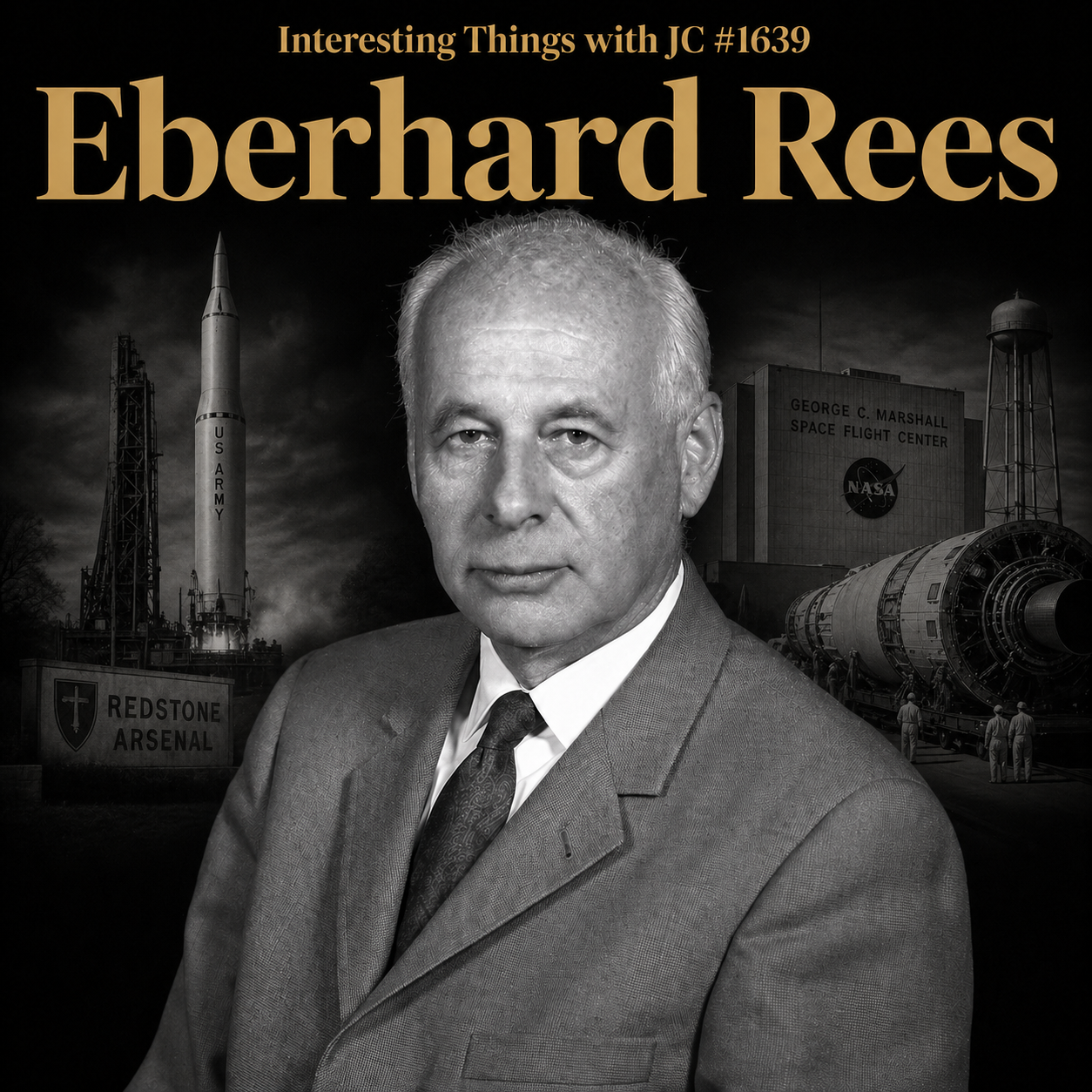
Episode artwork for Eberhard Rees, highlighting his role in rocket manufacturing, Redstone Arsenal, Marshall Space Flight Center, and the engineering systems behind early U.S. spaceflight.
Transcript
Interesting Things with JC #1639:
“Eberhard Rees”
If Wernher von Braun dreamed the rocket, Eberhard Rees helped make sure the thing could actually fly.
Rees was born in Germany in 1908, four years before von Braun. He was not really von Braun’s protégé. He was older, practical, and built for the factory floor. Von Braun had the public vision. Rees had the manufacturing mind.
Before rockets, Rees worked around heavy industry, including steel production. He understood metal, heat, tolerances, inspection, and the danger hidden inside one small mistake.
Colleagues joked that huge problems, the “pachyderms and dinosaurs,” did not always rattle him. But “grasshoppers,” the tiny technical flaws, could drive him crazy until they were fixed.
The dream could wait. The bad weld could not.
His partnership with von Braun began at Peenemünde (PAY-nuh-moon-duh), the German rocket center on the Baltic coast. During World War II, Rees helped manage fabrication and assembly of the V-2 rocket. The V-2 was the first long-range ballistic missile and the first human-made object known to reach space. It was also a weapon from one of the darkest chapters of the 20th century.
After the war, Rees came to the United States through Operation Paperclip. He first worked with the U.S. Army at Fort Bliss, Texas, before the rocket team moved to Redstone Arsenal in Huntsville, Alabama, where wartime rocket knowledge was turned into American missile systems and eventually the launch vehicles of the space program.
At Marshall Space Flight Center, von Braun sold the dream in Washington and to the public. Rees stayed near the hardware, the technicians, the test stands, and the manufacturing floor.
Some engineers believed von Braun led the vision, but Rees truly ran the center.
Rees lived in the parts of rocketry most people never saw: heat shields, missile systems, Saturn stages, contractor reports, tests, inspections, and the thousand small checks between a drawing and a launch.
The Saturn V stood 363 feet tall, about 111 meters, and produced about 7.5 million pounds of thrust, or 33.4 million newtons, at liftoff. It had to work. One small flaw could become a national disaster.
Because much of this work happened behind military fences, Huntsville later became part of UFO folklore. Fast, glowing missile and rocket tests in the 1950s could look strange to civilians or unbriefed pilots. But Rees’s record does not point to anti-gravity, alien propulsion, or fringe science. It points to liquid fuel, combustion, turbopumps, heat shields, welds, inspections, and test reports.
After the Apollo 1 fire killed Gus Grissom, Ed White, and Roger Chaffee in 1967, Rees helped tighten Apollo spacecraft design, manufacturing, and quality control. He went after the weak point, the process, and the part that could fail.
In 1970, when von Braun left Huntsville for NASA Headquarters, Rees became the second director of Marshall. He guided the center through the difficult post-Apollo years, helping preserve Huntsville’s engineering base while Marshall worked on Skylab and the Lunar Roving Vehicle.
That little electric Moon buggy had to be light enough to fly, rugged enough to unfold on the lunar surface, and reliable enough to work in dust, vacuum, and brutal temperature swings.
On the Moon, a tow truck was not coming.
Rees died on April 2, 1998, in DeLand, Florida, at age 89. He was buried in Huntsville, the city where his work helped define the space age.
Eberhard Rees was not the television face of the Moon race. He was the stern backbone, the man who knew dreams do not reach orbit unless somebody checks the weld, questions the tolerance, rejects the weak part, and demands one more test.
Von Braun imagined the road to the Moon.
Rees made sure the machine that had to travel it could survive the fire, the shaking, the vacuum, and every unforgiving mile between Earth and the lunar surface.
These are interesting things, with JC.
Student Worksheet
Comprehension Questions:
Who was Eberhard Rees, and what kind of work did he specialize in?
How was Rees’s role different from Wernher von Braun’s public role?
What was Peenemünde, and why is it historically complicated?
What did Operation Paperclip do after World War II?
Why did Saturn V quality control matter so much?
Analysis Questions:
Explain the meaning of “The dream could wait. The bad weld could not.”
Why might small technical flaws be more dangerous than large visible problems?
How does the episode separate evidence-based rocket engineering from UFO folklore?
What does Rees’s work after Apollo 1 show about responsibility in engineering?
Reflection Prompt: Write one paragraph explaining why a person who checks details may be just as important as a person who presents a bold vision.
Difficulty Scaling:
Support: Use vocabulary terms in short-answer responses and cite one detail from the transcript per answer.
Standard: Answer in complete sentences with evidence from at least three different parts of the transcript.
Challenge: Compare Rees’s quality-control mindset to another high-risk field such as medicine, aviation, construction, or nuclear energy.
Student Output: Submit 5 comprehension answers, 2 analysis responses, and 1 reflection paragraph.
Academic Integrity Guidance: Use your own wording. Evidence may come from the transcript, but explanations must show your thinking.
Teacher Guide
Quick Start: Begin with the podcast audio before reading or discussion. Ask students to listen for one phrase that shows Rees’s engineering mindset.
Pacing Guide: 5 minutes bell ringer; 8–10 minutes podcast listening; 5 minutes vocabulary check; 15 minutes worksheet; 10 minutes discussion; 7 minutes quiz or exit ticket.
Bell Ringer: “What is one small mistake that could cause a major failure in a machine, vehicle, building, or computer system?”
Audio Guidance: Play the episode once without interruption. On a second pass, pause after Peenemünde, Saturn V, Apollo 1, and the Lunar Roving Vehicle for quick notes.
Audio Fallback: If audio is unavailable, read the transcript aloud and have students mark details related to manufacturing, inspection, testing, and responsibility.
Time on Task: Standard lesson fits 45–50 minutes; extended version fits 60–75 minutes with assessment writing.
Materials: Episode audio, transcript, worksheet, quiz, writing paper or digital document, projector or board.
Vocabulary Strategy: Preview Peenemünde, tolerance, turbopump, quality control, and Lunar Roving Vehicle before listening.
Misconceptions:
Rees was not simply von Braun’s student; he was older and had a distinct production-management role.
Rocket success was not only about design ideas; it required manufacturing, testing, inspection, and process discipline.
The episode does not support alien or anti-gravity claims; it identifies conventional rocket engineering.
The V-2 must be understood as both a technical milestone and a wartime weapon.
Discussion Prompts:
Why do public stories often focus on visionaries more than production leaders?
What makes quality control an ethical responsibility?
How should students discuss technical achievement when it is connected to wartime history?
Why is “one more test” sometimes necessary even when a project is behind schedule?
Formative Checkpoints:
Students can define quality control in their own words.
Students can name one Rees contribution after coming to the United States.
Students can explain why Apollo 1 changed design and safety priorities.
Differentiation: Provide sentence starters for emerging writers; allow paired discussion before written answers; offer extension comparison for advanced learners.
Assessment Differentiation: Students may answer orally, write a paragraph, create a cause-effect chart, or complete a short technical-risk memo.
Time Flexibility: For a shorter class, complete audio, vocabulary, and exit ticket. For a longer class, add assessment questions and peer review.
Substitute Readiness: Play or read the episode, distribute worksheet, collect quiz and exit ticket. No specialized background knowledge is required.
Engagement Strategy: Use the phrase “grasshoppers” as a class metaphor for tiny flaws that demand attention.
Extensions: Students can research another hidden engineering role in Apollo, compare Saturn V to a modern launch vehicle, or design a quality-control checklist for a school project.
Cross-Curricular Connections: History connects to World War II and Cold War technology; physics connects to thrust and combustion; English connects to evidence-based explanation; career education connects to technical responsibility.
SEL Connection: Emphasize patience, accountability, humility, and the courage to question weak work before harm occurs.
Skill Value Emphasis: Students practice listening, evidence selection, technical reasoning, ethical reflection, and concise written explanation.
Answer Key:
Rees was a German-born aerospace engineer and Marshall director known for manufacturing, testing, and technical accuracy.
Von Braun was the public visionary; Rees focused on hardware, production, inspection, and execution.
Peenemünde was a German rocket center; it is complicated because its work included the V-2 weapon during World War II.
Operation Paperclip brought German technical experts to work for U.S. military and space programs.
Saturn V quality control mattered because a small defect in a huge launch system could cause mission failure or loss of life.
“The bad weld could not” means technical flaws must be fixed before ambition can safely continue.
Small flaws can hide inside complex systems and trigger larger failures under stress.
The episode points to liquid fuel, combustion, turbopumps, heat shields, welds, inspections, and test reports rather than fringe claims.
After Apollo 1, the focus on design, manufacturing, procedures, and quality control became even more urgent.
Quiz
What was Eberhard Rees best known for in the space program?
A. Designing astronaut spacesuits
B. Managing production, testing, and technical quality
C. Broadcasting Apollo missions on television
D. Piloting the Lunar Roving VehicleHow does the episode describe the difference between von Braun and Rees?
A. Von Braun handled manufacturing while Rees handled publicity
B. Von Braun focused on public vision while Rees focused on hardware and execution
C. Both men had identical leadership roles
D. Rees worked only on aircraft, not rocketsWhy is the V-2 described as historically complicated?
A. It never actually flew
B. It was both a technical milestone and a wartime weapon
C. It was built after Apollo
D. It was powered by solar panelsWhat does the Saturn V example show?
A. Large systems can ignore small flaws
B. Rocket launches depend only on public speeches
C. Enormous machines require careful inspection and testing
D. Quality control matters only after launchWhat is the main lesson of the Lunar Roving Vehicle example?
A. Space equipment must work reliably where repair options are limited
B. Moon vehicles were easy to replace
C. Electric vehicles cannot work in space
D. The rover was mainly symbolic
Assessment
Open-Ended Questions:
Explain how Eberhard Rees’s career shows the importance of manufacturing discipline in aerospace engineering.
Analyze why the episode presents Apollo 1 as a turning point for design, process, and quality control.
Rubric:
3: Response uses accurate episode evidence, explains cause and effect clearly, and connects engineering responsibility to real-world risk.
2: Response uses some accurate evidence and gives a basic explanation, but the reasoning needs more detail.
1: Response is incomplete, inaccurate, or mostly summary without explanation.
Exit Ticket: In 2–3 sentences, identify one “grasshopper” problem in a real-world system and explain why responsible people should fix it early.
Standards Alignment
NGSS HS-ETS1-2: Students break down the Saturn V, Apollo spacecraft, and Lunar Roving Vehicle as complex engineered systems made of interacting subsystems, including propulsion, structure, thermal protection, manufacturing, inspection, and testing.
NGSS HS-ETS1-3: Students evaluate how engineers use testing, inspection, quality control, and design tradeoffs to reduce risk in high-stakes aerospace systems.
NGSS HS-ETS1-4: Students explain how modeling, test reports, and failure analysis can predict system performance before launch or deployment.
NGSS HS-PS2-1: Students connect thrust, force, acceleration, and structural stress to the physical demands placed on rockets during liftoff and flight.
NGSS HS-PS3-3: Students analyze how energy transfer, combustion, heat, and thermal protection affect rocket and spacecraft design.
CCSS RST.11-12.1: Students cite precise evidence from the transcript to explain Rees’s role in manufacturing discipline, testing, and quality control.
CCSS RST.11-12.3: Students follow and explain a multistep technical process, including design, fabrication, inspection, testing, correction, and launch readiness.
CCSS RST.11-12.7: Students integrate quantitative information, such as Saturn V height and thrust, with narrative evidence to interpret scale and engineering risk.
CCSS WHST.11-12.2: Students write explanatory responses that organize technical information clearly and use accurate aerospace vocabulary.
CCSS WHST.11-12.9: Students draw evidence from the transcript and factual background sources to support claims about engineering responsibility.
C3 D2.His.1.9-12: Students evaluate how historical context shaped the development and later use of wartime rocket knowledge.
C3 D2.His.14.9-12: Students analyze how technical achievements can have complex historical meanings depending on purpose, use, and consequence.
C3 D2.Civ.10.9-12: Students examine civic responsibility in public technology programs where safety, funding, national goals, and human risk intersect.
ISTE 1.3 Knowledge Constructor: Students gather, evaluate, and organize evidence to explain a historical technology figure and distinguish verified engineering from folklore.
ISTE 1.4 Innovative Designer: Students use the idea of iteration and testing to explain how engineers identify weak points and improve system reliability.
CTE Engineering Design: Students identify how tolerances, materials, quality assurance, documentation, and testing support safe production in aerospace and advanced manufacturing.
CTE Manufacturing: Students connect Rees’s work to real-world production skills, including fabrication control, inspection standards, process improvement, and defect prevention.
Career Readiness: Students explain how technical careers require accuracy, documentation, communication, ethical judgment, and responsibility when human safety depends on engineered systems.
Homeschool/Lifelong Learning: Learners practice independent listening, evidence-based note-taking, technical vocabulary development, and reflective writing about the relationship between ambition and responsibility.
Show Notes
This classroom-ready lesson uses the story of Eberhard Rees to help students understand the hidden work behind major technological achievements. By focusing on manufacturing, inspections, testing, Apollo safety lessons, Saturn V reliability, and the Lunar Roving Vehicle, students see that space exploration depended not only on vision but also on discipline, documentation, and responsibility. The episode supports discussion about engineering ethics, historical complexity, and the importance of fixing small problems before they become serious failures.
References
National Aeronautics and Space Administration. (2024). Eberhard Rees. https://www.nasa.gov/people/eberhard-rees/
National Aeronautics and Space Administration. (2025). Marshall Space Flight Center history. https://www.nasa.gov/marshall/marshall-space-flight-center-history/
National Aeronautics and Space Administration. (2022). 55 years ago: The Apollo 1 fire and its aftermath. https://www.nasa.gov/history/55-years-ago-the-apollo-1-fire-and-its-aftermath/
National Aeronautics and Space Administration. (2026). Apollo 1 resources. https://www.nasa.gov/apollo-1-resources/
National Aeronautics and Space Administration. (2010). What was the Saturn V? Grades 5–8. https://www.nasa.gov/learning-resources/for-kids-and-students/what-was-the-saturn-v-grades-5-8/
National Aeronautics and Space Administration. (1971/2021). First use of the Lunar Roving Vehicle – July 31, 1971. https://www.nasa.gov/image-article/this-week-nasa-history-first-use-of-lunar-roving-vehicle-july-31-1971/