1640: "David Allan Coe"
Interesting Things with JC #1640: "David Allan Coe" – He never looked or sounded like the kind of artist Nashville usually pushed, but his songs kept showing up in jukeboxes, truck stops, biker bars, and outlaw country playlists all over America for decades.
Curriculum - Episode Anchor
Episode Title: David Allan Coe
Episode Number: 1640
Host: JC
Audience: Grades 9–12, Introductory College, Homeschool, Lifelong Learners
Subject Area: American Music History, Cultural Studies, Media Literacy
Lesson Overview
Learning Objectives:
Analyze the rise of outlaw country music and its cultural impact.
Explain how David Allan Coe’s songwriting reflected working-class experiences.
Evaluate how image, storytelling, and controversy shaped public perception in country music.
Identify the role of music in expressing social frustration and personal identity.
Essential Question:
How can music reflect the experiences, frustrations, and identity of everyday people?
Success Criteria:
Students can explain the outlaw country movement.
Students can identify major songs connected to David Allan Coe.
Students can discuss how public image affects an artist’s legacy.
Students can support conclusions with evidence from the transcript.
Student Relevance Statement:
Students regularly encounter musicians whose image and public reputation influence how audiences interpret their work. This lesson connects music history to media image, storytelling, and cultural identity.
Real-World Connection:
Music industries continue balancing commercial image, authenticity, and controversy. Songwriters, performers, producers, and marketers all shape how artists are remembered.
Workforce Reality:
Entertainment careers often involve branding, public scrutiny, creative independence, and audience loyalty. Success in creative industries requires both talent and adaptability.
Key Vocabulary
Outlaw Country (out-law kun-tree): A country music movement emphasizing independence and less polished production.
Ryman Auditorium (rye-man aw-di-tor-ee-um): Historic Nashville venue known as the “Mother Church of Country Music.”
Authenticity (aw-then-tis-ih-tee): The quality of appearing genuine or real.
Billboard Charts (bill-board charts): Rankings measuring music popularity and sales.
Narrative Songwriting (nair-uh-tiv song-ry-ting): Songwriting focused on storytelling.
Legacy (leg-uh-see): The lasting impact or reputation left behind.
Controversy (kon-truh-ver-see): Public disagreement or criticism surrounding a person or topic.
Working-Class (wur-king klas): People employed in industrial, labor, or service jobs.
Independent Image (in-duh-pen-dent im-ij): A public identity built around self-reliance and individuality.
Narrative Core
Open:
David Allan Coe stood out immediately in country music because he looked nothing like the polished stars Nashville usually promoted. His rough appearance became part of his identity and public appeal.
Info:
Born in Akron, Ohio, in 1939, Coe became known first as a songwriter before rising as a performer. Songs he wrote for artists like Tanya Tucker and Johnny Paycheck became major hits during difficult economic times in America.
Details:
Coe became associated with outlaw country, a movement that rejected polished commercial production in favor of more personal and realistic themes. Songs like “The Ride” connected country music to storytelling traditions rooted in mystery, struggle, and American road culture. His popularity spread through truck stops, bars, and jukeboxes across the country.
Reflection:
David Allan Coe’s career showed how audiences often connect deeply with artists who appear authentic, even when controversy surrounds them. His music reflected frustration, independence, and life outside mainstream expectations.
Closing:
These are interesting things, with JC.
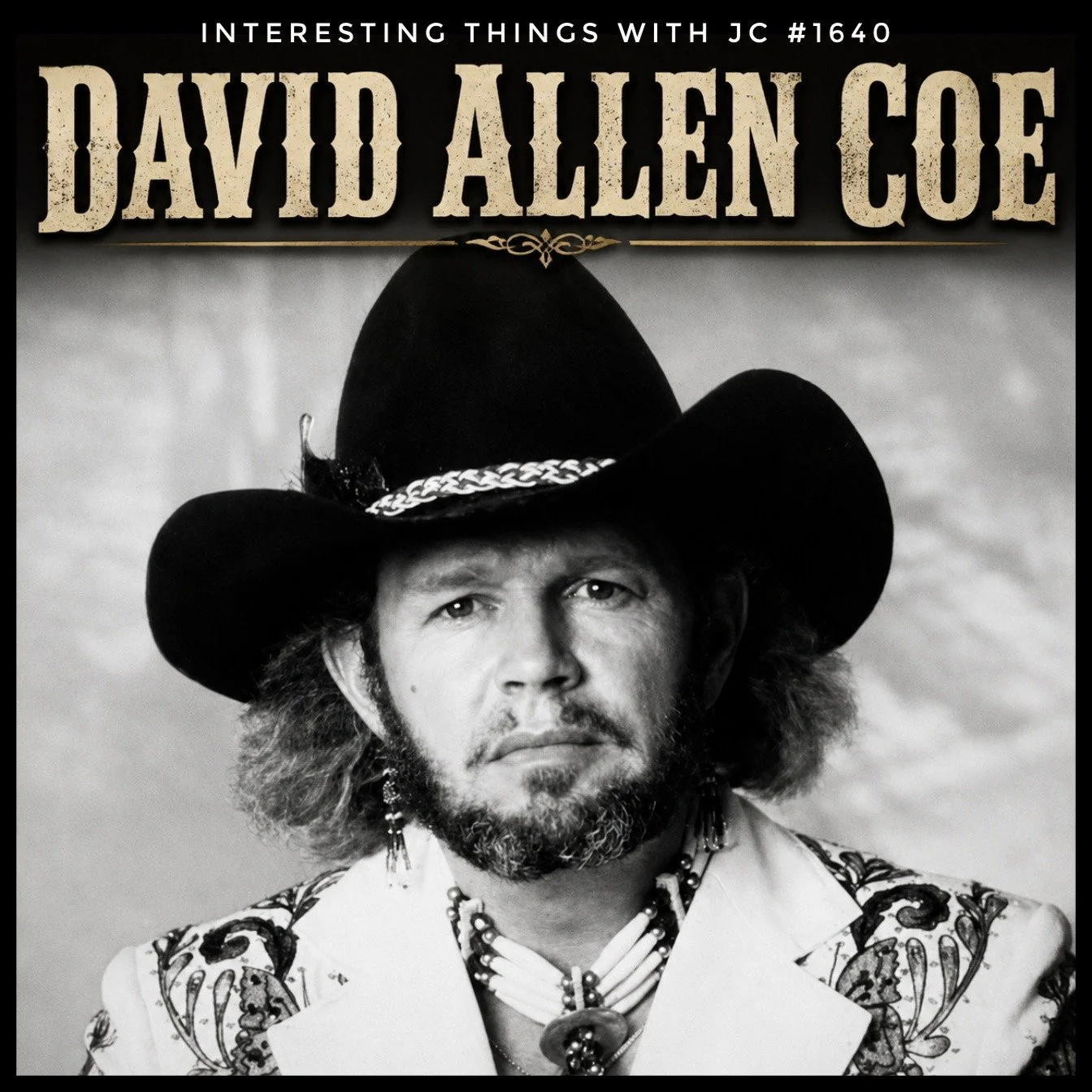
Black-and-white portrait of country music singer David Allan Coe wearing a cowboy hat and western jacket, featured in “Interesting Things with JC #1640,” honoring his legacy and influence on outlaw country music.
Transcript
Interesting Things with JC #1640:
David Allan Coe
David Allan Coe looked like somebody country music was never supposed to let through the front door.
Long hair. Tattoos. Chains. Denim. Leather.
At a time when Nashville still liked clean cut performers in flashy suits, Coe looked like he had just climbed out of a truck stop parking lot somewhere at 3 in the morning.
And honestly, that became part of the appeal.
Coe was born in Akron, Ohio, in 1939. Over the years, he told stories about reform schools, prison time, and life on the road. Some of those stories have been questioned for decades, but the mystery around him only made the legend bigger.
One thing nobody questioned was whether the man could write songs.
Before most people knew David Allan Coe as a singer, they already knew songs he had written.
Tanya Tucker recorded “Would You Lay with Me (In a Field of Stone)” in 1975. Then Johnny Paycheck took “Take This Job and Shove It” to number one in 1977. The song hit right when factories were closing, inflation was rising, and a lot of working people were fed up. It sold more than 2 million copies and later became a movie title.
One lesser known story says Coe lived in a hearse outside Nashville’s old Ryman Auditorium while trying to break into the music business in the early 1970s. The Ryman later became known as the Mother Church of Country Music.
Coe became tied to the outlaw country movement alongside Waylon Jennings and Willie Nelson. That style of country pushed back against polished Nashville production and leaned harder into real life, rough edges, and independence.
In 1983, Coe released “The Ride,” a song about meeting the ghost of Hank Williams Sr. on a dark Alabama road near Montgomery. The song became his signature hit and is still one of country music’s most recognized story songs.
Another thing a lot of people do not realize is just how big Coe became with truck drivers and bikers. His tapes and CDs spread through truck stops, bars, jukeboxes, and back roads all over America.
Over his career, Coe placed more than 30 songs on Billboard’s country charts and became one of the best known names connected to outlaw country music, even if Nashville never fully embraced him the way it did some others.
His career also carried controversy. Some underground recordings released under his name were criticized for offensive and explicit material, and those recordings stayed attached to discussions about his legacy for years.
Still, David Allan Coe left a major mark on country music. His songs spoke to people who felt overlooked, worn down, stubborn, independent, or angry at the world around them.
David Allan Coe died on April 29, 2026, at the age of 86.
For a lot of fans, he sounded less like a polished entertainer and more like somebody who had actually lived the songs he sang.
These are interesting things, with JC.
Student Worksheet
Comprehension Questions:
Where was David Allan Coe born?
What song did Johnny Paycheck record that Coe wrote?
What was the outlaw country movement reacting against?
What was “The Ride” about?
Which audiences strongly supported Coe’s music?
Analysis Questions:
Why did David Allan Coe’s image matter to his audience?
How did economic struggles during the 1970s help songs like “Take This Job and Shove It” become popular?
How can controversy affect an artist’s legacy over time?
Reflection Prompt:
Write one paragraph explaining why some audiences prefer artists who seem authentic rather than polished or commercial. Use evidence from the transcript.
Difficulty Scaling:
Beginning: Identify major facts and vocabulary.
Intermediate: Explain the relationship between music and culture.
Advanced: Analyze how public image shapes historical legacy.
Student Output:
Students will complete written responses using evidence from the transcript and classroom discussion.
Academic Integrity Guidance:
Students should use their own words, cite evidence from the lesson, and avoid copying responses from classmates or online summaries.
Teacher Guide
Quick Start:
Play the podcast episode first. Ask students to listen for themes involving identity, authenticity, and public image in music culture.
Pacing Guide:
Bell Ringer: 5 minutes
Podcast Listening: 8–10 minutes
Vocabulary Review: 10 minutes
Worksheet Activities: 20 minutes
Discussion: 10 minutes
Exit Ticket: 5 minutes
Bell Ringer:
Ask students: “Why do audiences sometimes trust artists who appear imperfect or rebellious?”
Audio Guidance:
Students should listen for examples of storytelling, historical context, and descriptions of outlaw country culture.
Audio Fallback:
If audio is unavailable, use the transcript as a read-aloud activity or independent reading assignment.
Time on Task:
Estimated lesson length: 50–60 minutes.
Materials:
Podcast audio or transcript
Student worksheet
Notebook or digital document
Projector or speakers
Vocabulary Strategy:
Introduce outlaw country, authenticity, and narrative songwriting before playback.
Misconceptions:
Students may assume outlaw country meant illegal behavior rather than artistic independence.
Students may confuse controversy with automatic historical importance.
Discussion Prompts:
Why did outlaw country appeal to certain audiences?
How did Coe’s image differ from traditional Nashville performers?
Should controversial material affect how history remembers musicians?
Formative Checkpoints:
Monitor worksheet responses.
Ask students to summarize outlaw country in one sentence.
Check understanding of cultural context during discussion.
Differentiation:
Provide vocabulary supports for emerging readers.
Allow verbal responses for discussion-based learners.
Offer extended writing opportunities for advanced students.
Assessment Differentiation:
Students may complete written, verbal, or presentation-based responses depending on learning needs.
Time Flexibility:
Lesson can be shortened to a 30-minute discussion format or expanded into a multi-day music history unit.
Substitute Readiness:
All materials are transcript-based and can be completed without specialized instruction.
Engagement Strategy:
Connect themes of rebellion, identity, and music culture to modern artists students recognize.
Extensions:
Research the outlaw country movement.
Compare David Allan Coe to Willie Nelson or Waylon Jennings.
Analyze how music reflects economic frustration in different decades.
Cross-Curricular Connections:
History: 1970s American economy
Media Studies: Public image and celebrity culture
English Language Arts: Narrative storytelling techniques
SEL Connection:
Students examine themes of identity, belonging, and emotional expression through music.
Skill Value Emphasis:
Students practice listening comprehension, historical analysis, media literacy, and evidence-based discussion.
Answer Key:
Comprehension 1: Akron, Ohio
Comprehension 2: “Take This Job and Shove It”
Comprehension 3: Polished Nashville production
Comprehension 4: Meeting the ghost of Hank Williams Sr.
Comprehension 5: Truck drivers and bikers
Analysis responses will vary but should reference authenticity, working-class frustration, and cultural identity.
Quiz
David Allan Coe was born in:
A. Nashville, Tennessee
B. Akron, Ohio
C. Dallas, Texas
D. Montgomery, AlabamaWhich song became a major hit for Johnny Paycheck?
A. The Ride
B. Friends in Low Places
C. Take This Job and Shove It
D. Ring of FireOutlaw country music emphasized:
A. Electronic production
B. Formal orchestras
C. Polished pop presentation
D. Independence and realism“The Ride” references which country music legend?
A. Johnny Cash
B. George Jones
C. Hank Williams Sr.
D. Merle HaggardDavid Allan Coe became especially popular among:
A. Classical musicians
B. Truck drivers and bikers
C. Television actors
D. Jazz audiences
Assessment
Open-Ended Questions:
Explain how David Allan Coe reflected the values of outlaw country music.
Describe how economic and social conditions influenced the popularity of songs like “Take This Job and Shove It.”
Rubric:
3 = Thorough explanation with evidence and clear reasoning
2 = Accurate explanation with limited detail
1 = Minimal explanation with weak or missing evidence
Exit Ticket:
Write one sentence explaining why authenticity mattered to David Allan Coe’s audience.
Standards Alignment
CCSS.ELA-LITERACY.RI.9-10.1: Cite strong and thorough textual evidence to support analysis of informational content related to music history and cultural movements.
CCSS.ELA-LITERACY.RI.9-10.2: Determine central ideas and analyze how themes of identity, independence, and authenticity develop throughout the transcript.
CCSS.ELA-LITERACY.RI.11-12.6: Evaluate how point of view and public image influence audience understanding of musicians and cultural figures.
CCSS.ELA-LITERACY.W.9-10.2: Write explanatory responses examining the relationship between music, economics, and working-class culture.
CCSS.ELA-LITERACY.SL.9-10.1: Participate effectively in collaborative discussions about cultural identity, controversy, and media influence.
CCSS.ELA-LITERACY.L.9-10.4: Determine meanings of domain-specific vocabulary including authenticity, narrative songwriting, and outlaw country.
C3 Framework D2.His.1.9-12: Evaluate how historical events and cultural movements shaped the outlaw country genre during the 1970s and 1980s.
C3 Framework D2.His.14.9-12: Analyze multiple factors influencing historical perspectives on musicians and public figures.
C3 Framework D2.Civ.7.9-12: Apply civic virtues and democratic principles while discussing controversial public figures respectfully and critically.
C3 Framework D3.1.9-12: Gather and evaluate sources to develop evidence-based conclusions about cultural history.
National Core Arts Standards MU:Re7.1.H.Ia: Analyze how musical works reflect societal, cultural, and historical contexts.
National Core Arts Standards MU:Cn11.0.H.IIa: Demonstrate understanding of relationships between music, identity, and lived experiences.
National Core Arts Standards MU:Pr4.3.H.Ia: Explain how stylistic traits and performance presentation communicate artistic meaning.
ISTE Standard 1.3 Knowledge Constructor: Critically evaluate media narratives and artist branding using reliable historical evidence.
ISTE Standard 1.6 Creative Communicator: Communicate analytical ideas through written discussion, reflection, and collaborative dialogue.
CTE Arts, A/V Technology & Communications Career Cluster: Examine careers connected to songwriting, performance, media production, and entertainment branding.
Career Readiness Practice 2: Apply academic and technical skills through evidence-based analysis and discussion.
Career Readiness Practice 12: Work productively in teams while respecting diverse viewpoints during classroom discussions.
NGSS Science and Engineering Practice — Analyzing and Interpreting Data: Evaluate historical and cultural evidence to identify patterns in music trends and audience response.
NGSS Connections to Engineering, Technology, and Applications of Science: Analyze how recording technology, radio, and music distribution expanded outlaw country audiences.
UK National Curriculum (Key Stage 4 English): Develop critical reading and spoken language skills through analysis of cultural and historical media texts.
IB MYP Individuals and Societies: Investigate how cultural expression reflects social and economic realities across time periods.
Homeschool/Lifelong Learning Alignment: Promote independent inquiry, media literacy, cultural awareness, and interdisciplinary historical analysis.
Show Notes
This lesson explores the life and legacy of David Allan Coe, one of the most recognizable figures connected to outlaw country music. Students examine how music reflects social frustration, identity, authenticity, and public image while learning how artists influence culture beyond mainstream entertainment.
References
Country Music Hall of Fame and Museum. (2024). David Allan Coe. https://digi.countrymusichalloffame.org/digital/collection/movingimage/id/2218/
Encyclopaedia Britannica. (2025). Outlaw music. https://www.britannica.com/art/outlaw-music
Rolling Stone. (2026). David Allan Coe, outlaw country singer and songwriter, dies at 86. https://www.rollingstone.com/music/music-country/david-allan-coe-dead-1235000000/
The Recording Academy. (2024). David Allan Coe artist profile. https://www.grammy.com/artists/david-coe/1320