1641: "Operation Northwoods"
Interesting Things with JC #1641: "Operation Northwoods" – In 1962, America’s top military leaders signed off on plans to fake terrorist attacks, stage civilian deaths, and make it look like Cuba shot down a passenger plane to push the United States into war, and when the documents were finally released decades later, one of America’s “crazy conspiracy theories” turned out to be completely real.
Curriculum - Episode Anchor
Episode Title: Operation Northwoods
Episode Number: 1641
Host: JC
Audience: Grades 9–12, Introductory College, Homeschool, Lifelong Learners
Subject Area: U.S. History, Cold War Studies, Government, Media Literacy
Lesson Overview
Learning Objectives:
Analyze the historical context surrounding Operation Northwoods during the Cold War.
Evaluate how governments use information, media, and public opinion during international conflicts.
Distinguish between documented historical events and unsupported conspiracy theories.
Examine the relationship between military strategy, civilian leadership, and democratic oversight.
Essential Question:
How can fear, conflict, and political pressure influence government decision-making during periods of international tension?
Success Criteria:
Students can explain what Operation Northwoods was and why it was proposed.
Students can identify why the proposal was rejected.
Students can evaluate the ethical implications of false flag operations.
Students can connect Cold War tensions to decision-making processes in government.
Student Relevance Statement:
Students regularly encounter information online that mixes fact, rumor, and speculation. This lesson helps students evaluate historical evidence critically and understand how official documents shape public understanding of history.
Real-World Connection:
Governments, media organizations, and military institutions continue to influence public opinion during crises. Understanding historical examples strengthens civic literacy and critical thinking.
Workforce Reality:
Careers in journalism, intelligence analysis, law, military service, public policy, and history require evidence-based reasoning, ethical decision-making, and source evaluation.
Key Vocabulary
Cold War(kohld wore) — A period of geopolitical tension between the United States and the Soviet Union after World War II.
False Flag Operation(fawls flag op-uh-ray-shun) — An action designed to appear as though another group or nation carried it out.
Joint Chiefs of Staff(joynt cheefs uhv staf) — The senior military leadership group advising the U.S. president and secretary of defense.
Cuban Missile Crisis(kyoo-buhn mis-uhl kry-sis) — A 1962 confrontation involving Soviet nuclear missiles in Cuba.
Bay of Pigs Invasion(bay uhv pigz in-vay-zhun) — A failed 1961 U.S.-backed invasion attempt against Fidel Castro’s government in Cuba.
Classified(klas-uh-fyd) — Government information restricted from public access for security reasons.
Declassified(dee-klas-uh-fyd) — Officially released government information previously kept secret.
Propaganda(prop-uh-gan-duh) — Information used to influence opinions or behavior, often politically.
Civilian Oversight(suh-vil-yuhn oh-ver-sight) — The principle that elected civilian leaders control military institutions.
Historical Record(his-tor-ih-kul rek-erd) — Verified documentation preserved as evidence of past events.
Narrative Core
Open:
In 1962, Cold War tensions between the United States and the Soviet Union were escalating rapidly. American leaders feared the spread of communism and worried about Soviet influence in Cuba, located only 90 miles from Florida.
Info:
After the failed Bay of Pigs invasion, American military leadership searched for ways to justify stronger action against Fidel Castro’s government. During this period, the Joint Chiefs of Staff developed a proposal known as Operation Northwoods.
Details:
The proposal outlined possible false flag operations designed to create public support for military intervention in Cuba. Suggested scenarios included staged attacks, manipulated media events, and fabricated incidents that could be blamed on Cuba. The documents discussed ideas such as fake casualty reports, orchestrated funerals, and even simulated attacks involving aircraft.
The proposal was signed by senior military officials and presented to Secretary of Defense Robert McNamara and President John F. Kennedy. Kennedy rejected the plan, and it was never carried out. Decades later, the documents became public after declassification reviews connected to Cold War and Kennedy-era records.
Reflection:
Operation Northwoods demonstrates how fear and geopolitical pressure can shape government decision-making during moments of crisis. It also highlights the importance of civilian oversight, transparency, and historical documentation in democratic societies.
Closing:
These are interesting things, with JC.
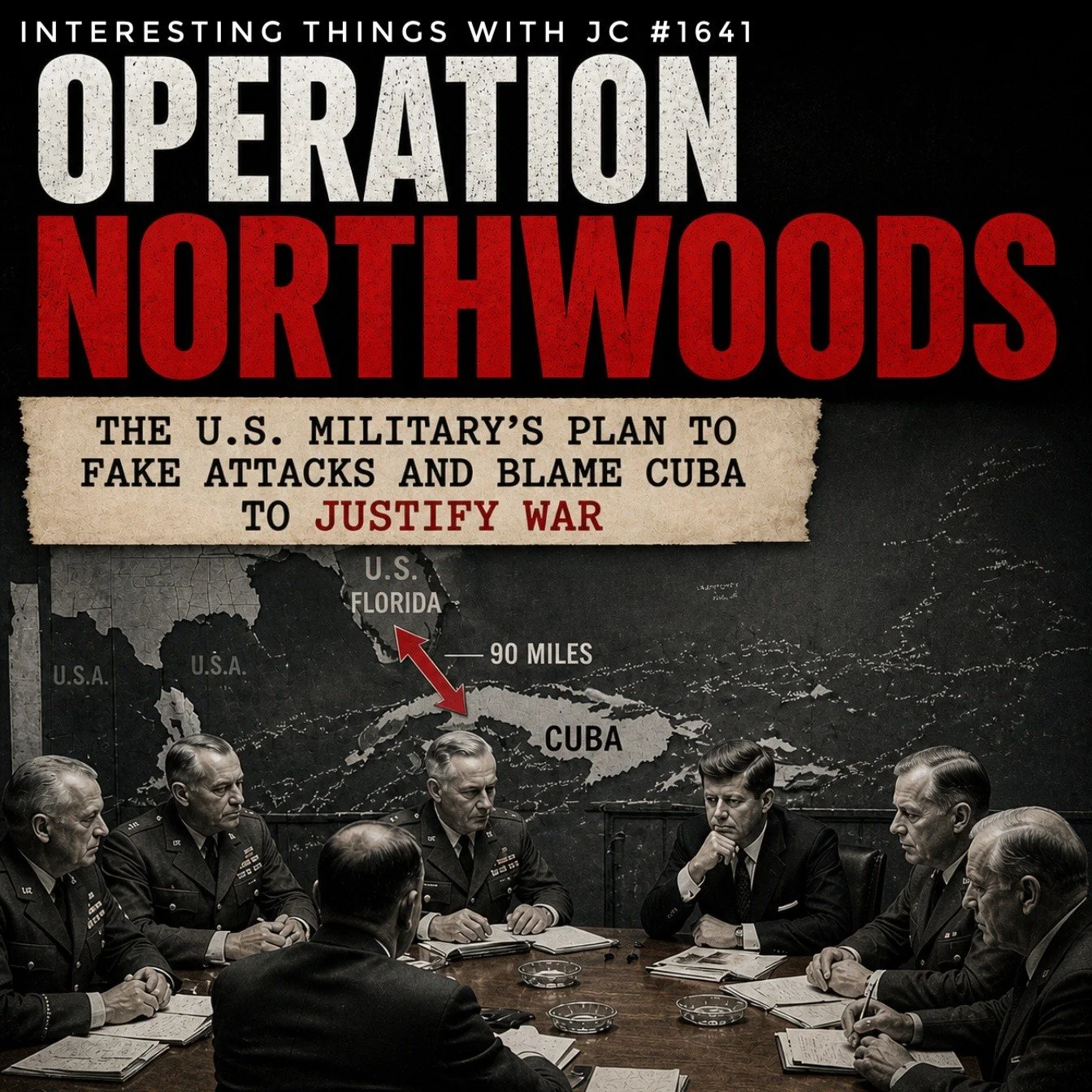
Promotional Image for “Interesting Things with JC #1641: Operation Northwoods.” Large red and white title over a dark Cold War-style map showing Cuba 90 miles from Florida. Subtitle explains a proposed U.S. military false flag plan to justify war with Cuba. Bottom image shows President John F. Kennedy meeting with military officials around a conference table.
Transcript
Interesting Things with JC #1641:
“Operation Northwoods”
In 1962, America’s top military leadership proposed something so extreme that decades later many people still assume it must be fake.
It was called Operation Northwoods.
The plan came from the Joint Chiefs of Staff during the height of the Cold War, just months after the failed Bay of Pigs invasion and during growing fears about Fidel Castro’s Cuba aligning with the Soviet Union.
The proposal outlined possible “false flag” operations. The idea was to create incidents that could be blamed on Cuba in order to build public and international support for military action.
And these were not vague suggestions.
One proposal discussed staging attacks in American cities. Another suggested sinking boats carrying Cuban refugees. One scenario described replacing a civilian aircraft with a drone aircraft, then making it appear Cuba had shot down a passenger plane.
The documents even discussed orchestrated funerals, fake casualty lists, and carefully managed media coverage.
At the time, the Chairman of the Joint Chiefs was General Lyman Lemnitzer. The proposal eventually reached Secretary of Defense Robert McNamara and President John F. Kennedy.
Kennedy rejected it.
Operation Northwoods was never carried out. But the documents were real, officially signed, and remained classified for decades.
They became public in the 1990s after the Assassination Records Review Board ordered the release of large collections of Cold War era government files connected to the Kennedy administration.
For many Americans, the release was shocking. Senior officials had formally discussed manufacturing events that could manipulate public opinion and justify war.
The United States and the Soviet Union were drifting toward the Cuban Missile Crisis. Nuclear tensions were climbing fast. Washington feared Soviet influence only 90 miles, about 145 kilometers, from Florida.
Inside that atmosphere, some military planners believed extreme measures were justified.
Not every conspiracy theory is true.
But Operation Northwoods was not a rumor, internet myth, or forged document.
It was a real U.S. military proposal, written on paper, signed by senior officials, and preserved in the historical record.
These are interesting things, with JC.
Student Worksheet
Comprehension Questions:
What was Operation Northwoods?
Why did some military leaders support the proposal?
What were “false flag” operations intended to accomplish?
Who rejected Operation Northwoods?
Why did the documents become public decades later?
Analysis Questions:
Why might Cold War fears have influenced military planning in 1962?
How does civilian oversight limit military authority in democratic governments?
Why is it important to distinguish documented history from unsupported conspiracy theories?
Reflection Prompt:
Write a paragraph explaining whether fear during international crises can lead governments to consider extreme actions. Use evidence from the lesson to support your answer.
Difficulty Scaling:
Foundational: Define key terms and summarize the proposal.
Intermediate: Analyze why the proposal was rejected.
Advanced: Evaluate the ethical and constitutional implications of false flag operations.
Student Output:
Students will complete written responses using historical evidence and vocabulary from the lesson.
Academic Integrity Guidance:
Students should support responses with lesson evidence, avoid unsupported claims, and clearly distinguish facts from opinions.
Teacher Guide
Quick Start:
Play the podcast episode first. Pause after the description of proposed operations to discuss student reactions and historical context.
Pacing Guide (Audio-First):
Bell Ringer — 5 minutes
Vocabulary Review — 10 minutes
Podcast Listening — 10 minutes
Guided Discussion — 15 minutes
Worksheet Completion — 15 minutes
Assessment/Exit Ticket — 5 minutes
Bell Ringer:
Ask students: “Should governments ever deceive the public during national security crises? Why or why not?”
Audio Guidance:
Encourage students to listen for evidence showing the difference between a proposal and an actual event.
Audio Fallback:
If audio is unavailable, use the transcript for close reading and annotation activities.
Time on Task:
Total estimated instructional time: 60 minutes.
Materials:
Podcast audio or transcript
Student worksheet
Writing materials
Projector or board for vocabulary review
Vocabulary Strategy:
Review Cold War terminology before listening. Have students identify terms during the transcript reading.
Misconceptions:
Students may assume the proposal was carried out.
Students may confuse documented events with internet conspiracy theories.
Students may misunderstand the role of civilian leadership over the military.
Discussion Prompts:
Why was Cuba strategically important during the Cold War?
What ethical concerns appear in the proposal?
How does declassification shape public understanding of history?
Formative Checkpoints:
Students accurately define “false flag operation.”
Students identify why Kennedy rejected the proposal.
Students explain the importance of historical evidence.
Differentiation:
Provide vocabulary supports for emerging readers.
Allow verbal responses for discussion-based learners.
Offer extended analysis tasks for advanced students.
Assessment Differentiation:
Shortened written responses for support needs.
Expanded historical comparison essay for advanced learners.
Time Flexibility:
Lesson can be shortened to 35 minutes by assigning reflection writing as homework.
Substitute Readiness:
The transcript and worksheet allow independent classroom implementation without additional preparation.
Engagement Strategy:
Use document-based questioning and ethical debate to maintain engagement.
Extensions:
Compare Operation Northwoods with other Cold War crises.
Research the Cuban Missile Crisis timeline.
Explore the process of government declassification.
Cross-Curricular Connections:
History: Cold War geopolitics
Civics: Constitutional oversight
Media Literacy: Evaluating evidence and sources
Ethics: Government responsibility and public trust
SEL Connection:
Students practice respectful discussion, critical reflection, and evaluation of complex historical decisions.
Skill Value Emphasis:
Students strengthen critical thinking, source analysis, ethical reasoning, and evidence-based communication skills.
Answer Key:
Operation Northwoods was a proposed false flag operation plan targeting Cuba.
Military leaders believed it could justify intervention against Castro’s government.
False flag operations are actions designed to appear carried out by another group.
President John F. Kennedy rejected the proposal.
The documents became public through declassification reviews in the 1990s.
Quiz
What was the main purpose of Operation Northwoods?
A. To negotiate peace with Cuba
B. To justify military action against Cuba
C. To create economic trade agreements
D. To support Soviet military expansionWhich group created the proposal?
A. Congress
B. The CIA alone
C. The Joint Chiefs of Staff
D. The United NationsWhat is a false flag operation?
A. A weather emergency plan
B. A military parade strategy
C. An operation designed to appear committed by another group
D. A naval rescue missionWho rejected Operation Northwoods?
A. Fidel Castro
B. Robert McNamara
C. Lyman Lemnitzer
D. John F. KennedyWhy did the public learn about Operation Northwoods decades later?
A. It was leaked during World War II
B. The documents were declassified
C. It was broadcast on television in 1962
D. Cuba released the records immediately
Assessment
Open-Ended Questions:
Explain how Cold War tensions contributed to the creation of Operation Northwoods.
Analyze why civilian oversight of the military is important in democratic governments.
Rubric (3–2–1):
3: Response is detailed, historically accurate, and supported with evidence.
2: Response is partially accurate with some supporting evidence.
1: Response is incomplete, unclear, or lacks supporting evidence.
Exit Ticket:
What is one lesson modern societies can learn from the history of Operation Northwoods?
Standards Alignment
CCSS.ELA-LITERACY.RH.9-10.1: Cite specific textual evidence to support analysis of primary and secondary historical sources related to Operation Northwoods.
CCSS.ELA-LITERACY.RH.9-10.2: Determine central ideas of Cold War-era historical documents and summarize their development accurately.
CCSS.ELA-LITERACY.RH.11-12.6: Evaluate differing perspectives regarding national security, military authority, and civilian oversight during the Cold War.
CCSS.ELA-LITERACY.WHST.9-10.1: Write evidence-based arguments addressing ethical and governmental issues connected to false flag proposals.
CCSS.ELA-LITERACY.SL.11-12.1: Initiate and participate effectively in collaborative historical discussions using verified evidence.
C3 Framework D2.His.1.9-12: Evaluate how historical events were shaped by broader political and social contexts during the Cold War.
C3 Framework D2.His.4.9-12: Analyze complex interactions among historical events, governmental institutions, and international conflict.
C3 Framework D3.1.9-12: Gather and evaluate sources while distinguishing between verified historical evidence and unsupported claims.
C3 Framework D4.1.9-12: Construct arguments using historical evidence and reasoned explanations.
ISTE 3a: Students plan and employ effective research strategies to locate accurate historical information.
ISTE 3b: Students evaluate the credibility, accuracy, and perspective of digital and historical sources.
ISTE 2d: Students demonstrate responsible and ethical behavior when analyzing sensitive historical material.
NGSS Science and Engineering Practice — Analyzing and Interpreting Data: Students evaluate historical evidence, identify patterns, and interpret documented information related to Cold War decision-making.
NGSS Science and Engineering Practice — Engaging in Argument from Evidence: Students construct claims supported by historical documentation and defend conclusions logically.
Career Readiness Standard: Students develop analytical reasoning, ethical decision-making, source validation, and evidence-based communication skills applicable to journalism, law, military leadership, intelligence analysis, public administration, and education.
Homeschool and Lifelong Learning Alignment: Learners strengthen independent inquiry, media literacy, historical analysis, civic awareness, and critical evaluation of governmental decision-making processes.
IB MYP Individuals and Societies: Students investigate the relationship between governance, conflict, ethics, and historical evidence within international contexts.
UK National Curriculum Key Stage 4 History: Students analyze significant twentieth-century international conflicts, evaluate evidence, and understand the complexity of historical interpretation.
Show Notes
This lesson explores Operation Northwoods, a real Cold War-era military proposal involving false flag operations intended to justify action against Cuba. Students examine the historical context, ethical implications, and importance of evaluating evidence carefully when studying controversial historical topics. The lesson strengthens civic understanding, media literacy, and critical thinking skills through analysis of documented historical records.
References
National Security Archive. (2001). Operation Northwoods: The proposed “pretexts” for Cuba invasion. https://nsarchive2.gwu.edu/news/20010430/northwoods.pdf
U.S. Department of State, Office of the Historian. (n.d.). Cuban Missile Crisis, 1962. https://history.state.gov/milestones/1961-1968/cuban-missile-crisis
John F. Kennedy Presidential Library and Museum. (n.d.). The Bay of Pigs invasion. https://www.jfklibrary.org/learn/about-jfk/jfk-in-history/the-bay-of-pigs
National Archives. (n.d.). Military records and Cold War documents. https://www.archives.gov/research/foreign-policy/cold-war