1642: “Nedra Talley”
Interesting Things with JC #1642: “Nedra Talley” — She helped create one of the most recognizable sounds in American pop music history as a founding member of The Ronettes. This episode explores the rise of the girl group era, Phil Spector’s “Wall of Sound,” the cultural impact of “Be My Baby,” and how Talley’s harmonies became part of the soundtrack of 1960s America.
Curriculum - Episode Anchor
Episode Title: Nedra Talley
Episode Number: 1642
Host: JC
Audience: Grades 9–12, Introductory College, Homeschool, Lifelong Learners
Subject Area: Music History, American Culture, Media Studies, Performing Arts
Lesson Overview
Learning Objectives:
Analyze how The Ronettes influenced American popular music during the 1960s
Explain the significance of Phil Spector’s “Wall of Sound” production style
Evaluate how music groups crossed cultural and social barriers during periods of change
Examine how harmony, production, and performance shaped modern pop music
Essential Question:
How did Nedra Talley and The Ronettes help shape modern American popular music?
Success Criteria:
Students can identify major contributions of The Ronettes
Students can describe the characteristics of the “Wall of Sound”
Students can connect music history to broader cultural change
Students can analyze the long-term influence of a historical recording
Student Relevance Statement:
Students regularly experience music through streaming, social media, and digital platforms. This lesson helps students understand how earlier artists shaped the sounds and production techniques still heard in modern music today.
Real-World Connection:
Music production, branding, recording technology, entertainment law, performance, marketing, and audio engineering all connect directly to the historical developments discussed in this episode.
Workforce Reality:
Professional music careers require collaboration, technical skill, adaptability, discipline, and long-term creative development beyond public recognition.
Key Vocabulary
Harmony(HAR-muh-nee) — Multiple musical notes or voices sounding together
Wall of Sound(wawl uhv sownd) — Dense music production technique developed by Phil Spector
Producer(pruh-DOO-ser) — Person responsible for supervising music recordings
Segregation(seg-rih-GAY-shun) — Separation of groups based on race or ethnicity
Beatlemania(BEE-tul-MAY-nee-uh) — Extreme fan excitement surrounding The Beatles
Influential(in-floo-EN-shul) — Having strong impact on others
Registry(REJ-uh-stree) — Official preservation list of important works
Pop Music(pop MYOO-zik) — Popular commercial music designed for wide audiences
Recording Studio(rih-KOR-ding STOO-dee-oh) — Facility used for producing audio recordings
Session Musician(SESH-un myoo-ZISH-un) — Professional musician hired for recordings or performances
Narrative Core
Open:
Before streaming services and digital playlists, music traveled through radios, jukeboxes, vinyl records, and car speakers. During the 1960s, a small group from New York helped create one of the most recognizable sounds in American music history.
Info:
Nedra Talley was born in New York City in 1945 and became a founding member of The Ronettes alongside Ronnie Bennett and Estelle Bennett. The group combined powerful harmonies, visual style, and stage presence during a period when American music was rapidly evolving.
Details:
The Ronettes became internationally known after releasing “Be My Baby” in 1963. The song’s famous drum introduction and layered production became central examples of Phil Spector’s “Wall of Sound.” Despite massive instrumentation and echo-filled recording studios, the group’s harmonies remained clear and emotionally powerful. The Ronettes also crossed cultural barriers during a time when many American venues still practiced unofficial segregation. In 1966, they opened for The Beatles during part of the band’s final U.S. tour.
Reflection:
Although Nedra Talley later stepped away from celebrity culture, the music continued influencing generations of performers and producers. Songs created decades ago still shape modern pop, rock, punk, soul, and alternative music. The preservation of “Be My Baby” by the Library of Congress demonstrates how music can become part of national cultural history.
Closing:
These are interesting things, with JC.
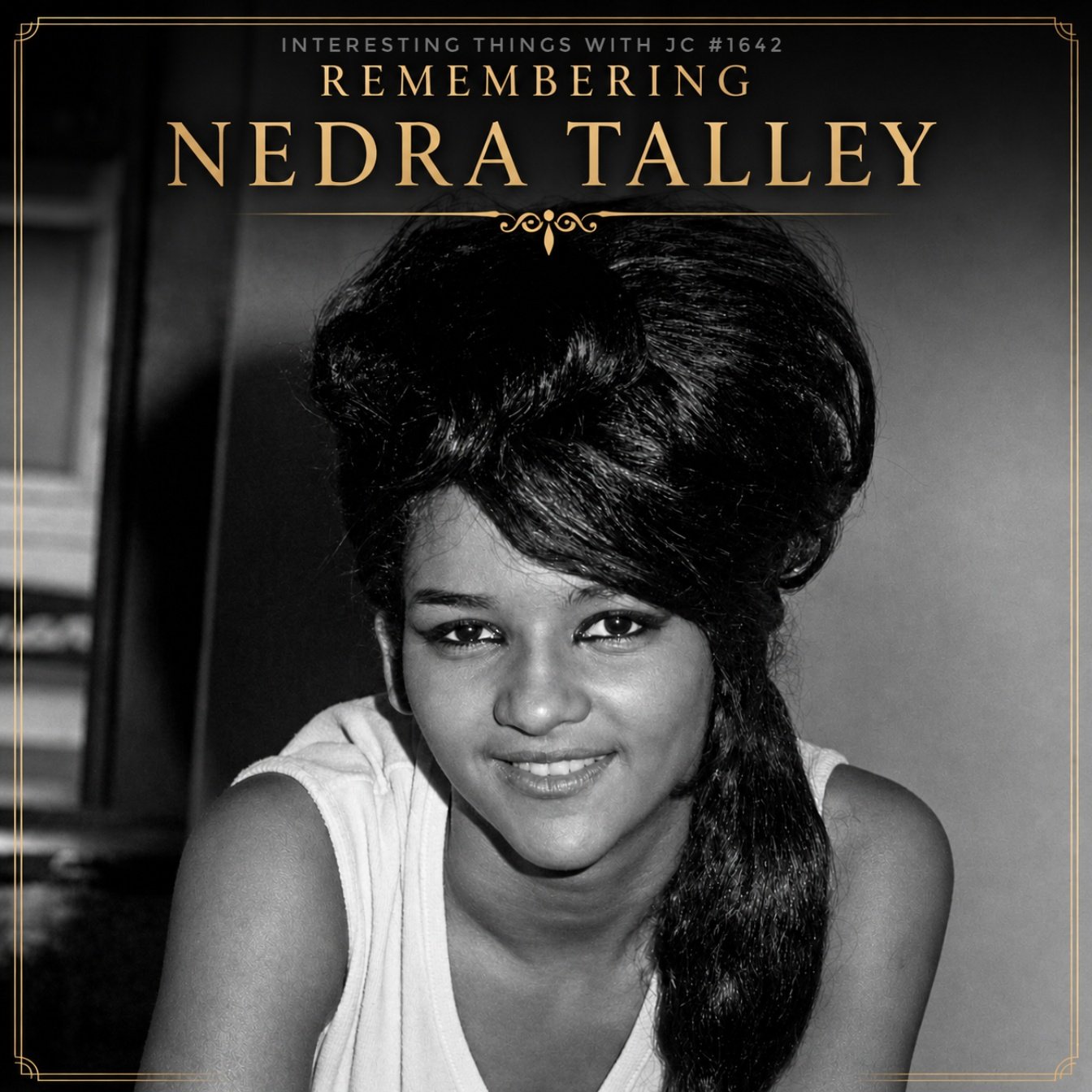
Black-and-white memorial image of singer Nedra Talley smiling toward the camera, featuring vintage 1960s hairstyle styling and gold memorial text reading “Remembering Nedra Talley” from Interesting Things with JC #1642.
Transcript
Interesting Things with JC #1642:
“Nedra Talley”
Long before streaming music, before earbuds, before playlists built by algorithms, there were records that exploded out of speakers and were broadcast over tiny transistor radios with a sound so big it almost did not seem possible.
One of the voices behind that sound belonged to Nedra Talley.
Talley was born in New York City in 1945 and became a founding member of The Ronettes alongside her cousin Ronnie Bennett, later known as Ronnie Spector, and Estelle Bennett.
What made The Ronettes different was not just the music.
It was the combination of image, attitude, harmony, and timing.
At a moment when American pop music was rapidly changing, The Ronettes blended musical influences from across American culture into a sound and visual style that crossed cultural and musical boundaries during the height of the 1960s.
Then came “Be My Baby.”
Released in 1963, the record climbed to number 2 on the Billboard Hot 100 and eventually became one of the most influential pop songs ever recorded.
Its opening drum beat by session drummer Hal Blaine became legendary inside the music industry. Generations of artists later studied, sampled, and recreated it. Brian Wilson of The Beach Boys openly called the song one of the greatest records ever made and reportedly listened to it hundreds of times.
But while Ronnie Spector often stood at center stage, Nedra Talley’s harmonies became part of the foundation holding those records together.
Inside producer Phil Spector’s “Wall of Sound” productions were layers of piano, strings, percussion, horns, and multiple musicians all recorded together in echo-filled studios. It created enormous technical challenges for singers trying to cut through the mix cleanly.
The Ronettes did it anyway.
The group also helped break barriers in ways people sometimes overlook.
In the early 1960s, many American venues and television appearances still operated under unofficial segregation practices. Yet The Ronettes became one of the defining girl groups of 1960s America, crossing cultural and musical boundaries during a rapidly changing era.
Their records played on pop stations, rhythm and blues stations, jukeboxes, and car radios across the country.
In 1966, The Ronettes opened for The Beatles on portions of their final U.S. tour. At the time, Beatlemania was at its peak, and The Ronettes had already become one of the few American girl groups respected both commercially and musically by British rock artists.
After the group dissolved in 1967, Talley largely stepped away from celebrity culture. She later recorded Christian music, focused on family life, and eventually worked in real estate in Virginia Beach, Virginia.
But the music never disappeared.
The Ronettes were inducted into the Rock and Roll Hall of Fame in 2007.
“Be My Baby” was later preserved by the Library of Congress in the National Recording Registry for being culturally, historically, and aesthetically significant.
Rolling Stone repeatedly ranked the song among the greatest recordings ever made.
Modern artists across pop, rock, punk, soul, and alternative music still borrow from the sound The Ronettes helped pioneer.
Nedra Talley died on April 26, 2026, at the age of 80, surrounded by family at home.
And decades later, those harmonies still come roaring out of speakers with the same emotion, force, and unmistakable sound that helped define American music history.
These are interesting things, with JC.
Student Worksheet
Comprehension Questions:
Who were the founding members of The Ronettes?
What song became the group’s signature recording?
What was Phil Spector’s “Wall of Sound”?
Why was Hal Blaine’s drum introduction considered important?
What major rock band did The Ronettes tour with in 1966?
Analysis Questions:
How did The Ronettes influence later generations of musicians?
Why was it difficult for singers to perform within the “Wall of Sound” style?
How did The Ronettes help cross cultural and musical boundaries during the 1960s?
Reflection Prompt:
Describe a modern song or artist that may have been influenced by earlier music styles. Explain how music from the past continues shaping music today.
Difficulty Scaling:
Beginning: Identify key facts from the episode
Intermediate: Explain music production techniques
Advanced: Analyze cultural influence and historical significance
Student Output:
Students will complete written responses using evidence from the transcript and classroom discussion.
Academic Integrity Guidance:
Students should use their own words, cite evidence from the lesson, and avoid copying outside summaries or online sources.
Teacher Guide
Quick Start:
Play the episode audio first. Ask students to listen for examples of innovation, cultural change, and music production techniques.
Pacing Guide:
Bell Ringer — 5 minutes
Audio Listening — 10 minutes
Vocabulary and Discussion — 10 minutes
Worksheet Activities — 15 minutes
Reflection and Exit Ticket — 5 minutes
Bell Ringer:
Ask students: “What makes a song memorable across generations?”
Audio Guidance:
Encourage students to focus on references to recording technology, harmony, and cultural influence while listening.
Audio Fallback:
If audio is unavailable, use the transcript as a guided reading activity.
Time on Task:
Approximately 45 minutes.
Materials:
Episode transcript
Audio playback device
Student worksheet
Writing materials
Vocabulary Strategy:
Preview technical music terms before listening to improve comprehension.
Misconceptions:
Students may assume lead singers create all musical impact alone
Students may overlook the role of producers and harmony singers
Students may not realize how difficult older recording methods were technologically
Discussion Prompts:
Why do some songs remain influential for decades?
How can music reflect cultural change?
What role does teamwork play in successful music groups?
Formative Checkpoints:
Monitor worksheet responses
Ask students to summarize the “Wall of Sound”
Check vocabulary understanding during discussion
Differentiation:
Provide guided notes for developing readers
Allow verbal discussion responses when needed
Offer extension analysis for advanced learners
Assessment Differentiation:
Students may complete written, verbal, or presentation-based responses depending on learning needs.
Time Flexibility:
Lesson may be shortened to 30 minutes or expanded into a multi-day music history unit.
Substitute Readiness:
All materials are self-contained and transcript-supported.
Engagement Strategy:
Connect historical music production techniques to modern streaming and digital music experiences familiar to students.
Extensions:
Research another influential girl group from the 1960s
Compare modern music production with 1960s recording methods
Analyze how music technology changed over time
Cross-Curricular Connections:
History: Civil rights era and cultural change
Technology: Recording engineering evolution
Media Studies: Popular culture influence
Business: Music industry marketing and promotion
SEL Connection:
Students examine perseverance, collaboration, creativity, and identity within artistic careers.
Skill Value Emphasis:
Critical listening, historical analysis, communication, and media literacy remain valuable across many careers.
Answer Key:
Ronnie Bennett, Nedra Talley, and Estelle Bennett
“Be My Baby”
A layered music production technique using multiple instruments and echo effects
It became one of the most recognizable drum intros in music history
The Beatles
Quiz
Which city was Nedra Talley born in?
A. Chicago
B. New York City
C. Los Angeles
D. DetroitWhat was the name of The Ronettes’ most famous song?
A. Respect
B. My Girl
C. Be My Baby
D. California GirlsWho developed the “Wall of Sound” production style?
A. Brian Wilson
B. George Martin
C. Hal Blaine
D. Phil SpectorWhat major band did The Ronettes open for in 1966?
A. The Rolling Stones
B. The Supremes
C. The Beatles
D. The ByrdsWhy was “Be My Baby” preserved by the Library of Congress?
A. It sold the most records
B. It was considered culturally and historically significant
C. It introduced color television
D. It ended Beatlemania
Assessment
Open-Ended Questions:
Explain how The Ronettes influenced American music and culture during the 1960s.
Analyze how music production techniques contributed to the success of “Be My Baby.”
Rubric:
3: Complete explanation with strong historical evidence and analysis
2: Partial explanation with some supporting details
1: Limited explanation with minimal evidence
Exit Ticket:
Write one sentence explaining why “Be My Baby” continues influencing musicians today.
Standards Alignment
CCSS.ELA-LITERACY.RI.9-10.1: Cite strong and thorough textual evidence to support analysis of historical and cultural developments discussed in the episode.
CCSS.ELA-LITERACY.RI.9-10.2: Determine central ideas related to music history, cultural influence, and technological innovation.
CCSS.ELA-LITERACY.RI.9-10.3: Analyze how individuals, events, and artistic movements influenced one another during the 1960s music industry.
CCSS.ELA-LITERACY.W.9-10.2: Write informative responses explaining the historical significance of The Ronettes and “Be My Baby.”
CCSS.ELA-LITERACY.SL.9-10.1: Participate effectively in collaborative discussions regarding music history and media influence.
CCSS.ELA-LITERACY.L.9-10.6: Acquire and accurately use domain-specific vocabulary related to music production and cultural studies.
National Core Arts Standards MU:Re7.1.HSII: Perceive and analyze musical works within historical and cultural contexts.
National Core Arts Standards MU:Re8.1.HSI: Interpret artistic intent and technical choices in recorded music performances.
National Core Arts Standards MU:Cn10.0.HSII: Relate musical ideas and works to societal, cultural, and historical influences.
National Core Arts Standards MU:Pr4.2.HSI: Demonstrate understanding of structure and technical elements in musical performance and recording.
C3 Framework D2.His.1.9-12: Evaluate how historical events and cultural developments shaped American society during the 1960s.
C3 Framework D2.His.14.9-12: Analyze multiple factors influencing social and cultural change through media and entertainment.
C3 Framework D3.1.9-12: Gather and evaluate sources while developing evidence-based historical conclusions.
C3 Framework D4.1.9-12: Construct arguments using historical evidence from audio, transcript, and discussion materials.
ISTE 1.3 Knowledge Constructor: Critically curate information from media, historical recordings, and informational texts.
ISTE 1.6 Creative Communicator: Communicate complex historical and artistic ideas using written and verbal analysis.
ISTE 1.7 Global Collaborator: Explore how music crossed cultural boundaries and influenced international audiences.
CTE Arts, A/V Technology & Communications Career Cluster: Analyze professional roles in music production, performance, audio engineering, and media distribution.
Career Readiness Practice 2: Apply academic and technical skills through music analysis and media literacy activities.
Career Readiness Practice 4: Communicate clearly and effectively in collaborative academic discussions.
Career Readiness Practice 12: Work productively in teams while evaluating artistic and historical material.
NGSS HS-ETS1-3: Evaluate technological systems and production methods used in historical audio recording environments.
NGSS Science and Engineering Practice: Analyze how technological innovation influenced communication and entertainment industries.
UK National Curriculum KS4 Music: Develop critical listening skills through analysis of influential musical recordings and production methods.
IB MYP Arts Criterion A: Investigate artistic movement, historical context, and creative influence within popular music history.
Homeschool/Lifelong Learning Alignment: Promote interdisciplinary inquiry through music history, cultural analysis, communication, and media literacy.
Show Notes
This lesson explores the life and musical influence of Nedra Talley and The Ronettes during one of the most transformative periods in American music history. Students examine harmony, recording innovation, cultural influence, and the lasting impact of “Be My Baby” on modern music production. The episode demonstrates how artists helped shape national culture through performance, collaboration, and technological experimentation.
References
Library of Congress. (n.d.). National Recording Registry: Be My Baby. https://blogs.loc.gov/now-see-hear/2023/08/be-my-baby-at-60/
Rock & Roll Hall of Fame. (n.d.). The Ronettes Biography. https://www.rockhall.com/inductees/ronettes
Rolling Stone. (2021). The 500 Greatest Songs of All Time. https://www.rollingstone.com/music/music-lists/best-songs-of-all-time-1224767/
Encyclopaedia Britannica. (n.d.). Ronnie Spector. https://www.britannica.com/biography/Ronnie-Spector
The Guardian. (2026) Nedra Talley Ross obituary. https://www.theguardian.com/music/2026/apr/29/nedra-talley-ross-obituary