Interesting Things with JC #1644: “Krafft Ehricke” - He is the rocket engineer who proposed lunar mining, orbital fuel depots, and space based solar power decades before modern commercial spaceflight. From the V-2 rocket program at Peenemünde to America’s Atlas rocket program, Krafft Ehricke helped shape ideas that are now influencing the future of space exploration.
Curriculum - Episode Anchor
Episode Title: Krafft Ehricke
Episode Number: 1644
Host: JC
Audience: Grades 9–12, Introductory College, Homeschool, Lifelong Learners
Subject Area: Aerospace Engineering, Space Exploration, History of Technology
Lesson Overview
Learning Objectives:
Explain Krafft Ehricke’s role in early rocket engineering and spaceflight concepts.
Analyze how historical ideas can influence future technological development.
Evaluate the relationship between scientific innovation and ethical responsibility.
Identify connections between Ehricke’s proposals and modern aerospace systems.
Essential Question:
How can visionary scientific ideas influence technologies that may not exist for generations?
Success Criteria:
Students can describe at least three concepts proposed by Krafft Ehricke.
Students can connect historical aerospace ideas to modern space programs.
Students can discuss ethical and technological challenges connected to rocket development.
Student Relevance Statement:
Students explore how imagination, engineering, and long-term planning can shape future industries and careers.
Real-World Connection:
Modern reusable rockets, lunar exploration programs, and private space companies reflect concepts first discussed decades earlier by aerospace visionaries like Ehricke.
Workforce Reality:
Aerospace engineers, systems designers, robotics specialists, and energy researchers often work on projects that may take decades to become operational.
Key Vocabulary
Krafft Ehricke (KRAHFT AIR-ih-kuh): German-American rocket engineer and space visionary.
Hermann Oberth (HEHR-mahn OH-burth): Early spaceflight theorist whose writings inspired rocket pioneers.
Peenemünde (PAY-nuh-moon-duh): German rocket research center during World War II.
V-2 Rocket: First long-range guided ballistic missile and early space-capable rocket.
Operation Paperclip: U.S. program that recruited German scientists after World War II.
Orbital Fuel Depot: A station in space designed to refuel spacecraft.
Reusable Rocket: A launch vehicle designed to fly multiple missions.
Lunar Mining: Theoretical extraction of materials from the Moon.
Solar Power Satellite: A space-based structure designed to collect solar energy.
Orbital Shipyard: A proposed space facility for constructing large spacecraft.
Narrative Core
Open:
In the 1950s, while much of the world still relied on propeller aircraft, one engineer imagined reusable rockets, lunar industries, and giant power stations in orbit.
Info:
Krafft Ehricke became fascinated with rocketry after reading the work of Hermann Oberth. During World War II, he worked at Peenemünde on the V-2 rocket program, one of history’s earliest advanced missile systems.
Details:
After the war, Ehricke moved to the United States through Operation Paperclip and later worked on the Atlas rocket program. Unlike many engineers of his era, he viewed rockets not simply as weapons, but as transportation systems capable of expanding human civilization beyond Earth. He proposed orbital refueling stations, lunar mining operations, giant orbital shipyards, and space-based solar power systems decades before the technologies existed.
Reflection:
Many of Ehricke’s ideas once seemed impossible. Today, reusable rockets, private spaceflight, lunar mission planning, and orbital infrastructure are active areas of development. His work demonstrates how long-term scientific thinking can influence generations of engineers and explorers.
Closing:
These are interesting things, with JC.
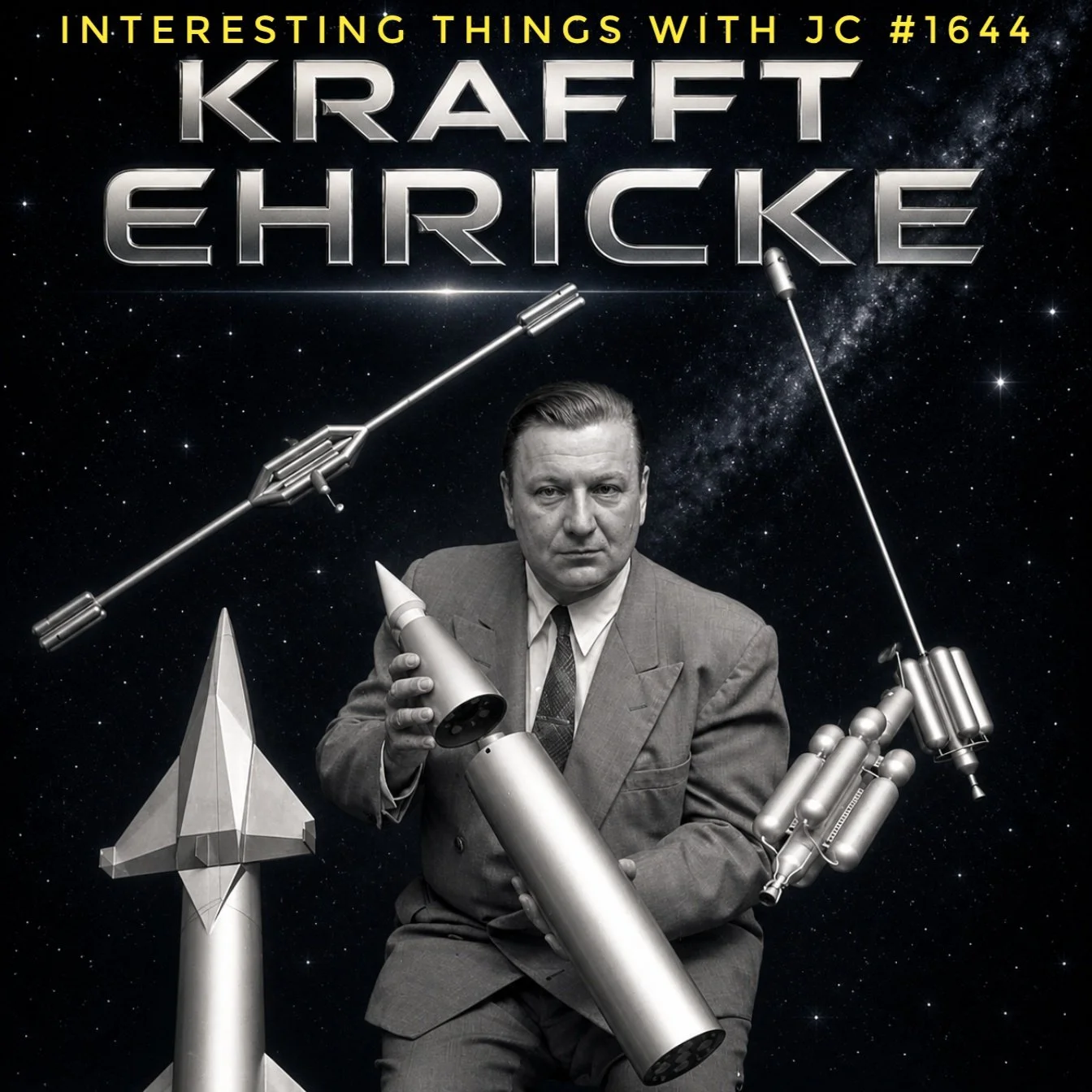
Podcast cover art for Interesting Things with JC #1644: Krafft Ehricke, showing Krafft Ehricke in a grayscale portrait holding a model rocket, surrounded by vintage spacecraft concepts against a star-filled space background. Large metallic text reads “Krafft Ehricke,” with the episode title line at the top.
Transcript
Interesting Things with JC #1644:
“Krafft Ehricke”
In the 1950s, one rocket engineer was already talking about lunar industries, orbital fuel stations, reusable cargo ships, and giant solar power satellites while much of America was still flying in propeller airplanes.
His name was Krafft Ehricke (KRAHFT AIR-ih-kuh).
Some of the systems he described decades ago are now being actively developed.
Ehricke was born in Berlin in 1917 and became fascinated with rocketry after reading the work of Hermann Oberth (HEHR-mahn OH-burth), one of the pioneers of spaceflight theory.
Unlike many engineers of his era, Ehricke did not see rockets strictly as weapons.
He saw them as transportation systems.
During World War II, Ehricke worked at Peenemünde (PAY-nuh-moon-duh), the German rocket development center where the V-2 rocket was created.
The V-2 became the world’s first long range guided ballistic missile and the first human made object to reach the edge of space during test flights.
It stood about 46 feet tall, roughly 14 meters, and weighed nearly 28,000 pounds, around 12,700 kilograms.
After the war, Ehricke came to the United States through Operation Paperclip, joining the group of German rocket engineers recruited during the early Cold War.
Like many of those scientists, his legacy remains tied to the moral contradictions surrounding wartime rocket development in Nazi Germany.
In America, Ehricke worked at Convair in San Diego on the Atlas rocket program, which later helped launch astronauts during Project Mercury.
But his interests stretched far beyond launch vehicles.
Ehricke believed Earth placed physical limits on energy production, industrial growth, and raw material access. He argued that space offered nearly unlimited solar energy and enormous quantities of usable resources if the infrastructure could be built to reach them.
His proposals became highly detailed.
Mining operations on the Moon. Manufacturing rocket fuel from lunar materials. Orbiting fuel depots where spacecraft could refuel in space instead of launching fully loaded from Earth.
Large orbital shipyards capable of assembling spacecraft too large to launch directly from the ground.
At the time, many engineers viewed those ideas as unrealistic. Some of the required technologies did not yet exist. Some still do not. But many parts of modern aerospace development now resemble concepts Ehricke discussed decades earlier.
Reusable rockets. Commercial orbital infrastructure. Private space stations. Lunar mining studies. Long term Mars mission planning. Modern discussions about space based solar power.
Ehricke also produced sketches and paintings showing future lunar cities, industrial facilities, and massive orbital structures.
Krafft Ehricke died in 1984. He never saw reusable boosters land vertically. He never saw private companies launch astronauts. And he never saw serious international planning begin for returning humans to the Moon. But many ideas now shaping the future of space exploration appeared on his drawing boards generations earlier.
Krafft Ehricke did not simply help build rockets.
He helped design ways humanity might someday live beyond Earth.
These are interesting things, with JC.
Student Worksheet
Comprehension Questions:
Who inspired Krafft Ehricke’s interest in rocketry?
What was the purpose of the V-2 rocket program?
What was Operation Paperclip?
Name two ideas Ehricke proposed that resemble modern aerospace projects.
Why did Ehricke believe humanity should expand into space?
Analysis Questions:
Why might Ehricke’s ideas have seemed unrealistic during the 1950s?
How did Ehricke’s view of rockets differ from many engineers of his era?
What ethical concerns are connected to scientists who worked on wartime technologies?
How do reusable rockets change the economics of space travel?
Reflection Prompt:
Should governments and private companies invest heavily in long-term space infrastructure projects even if the benefits may not appear for decades? Explain your reasoning.
Difficulty Scaling:
Foundational: Identify major historical facts from the episode.
Intermediate: Compare Ehricke’s ideas with current aerospace developments.
Advanced: Evaluate the ethical and economic implications of large-scale space expansion.
Student Output:
Students will complete written responses and create a short concept diagram connecting Ehricke’s proposals to modern technologies.
Academic Integrity Guidance:
Use original wording, support ideas with evidence from the lesson, and properly distinguish personal opinions from factual claims.
Teacher Guide
Quick Start:
Play the podcast episode first. Ask students to record every future technology mentioned during the audio.
Pacing Guide (Audio-First):
Bell Ringer: 5 minutes
Podcast Listening: 8–10 minutes
Vocabulary and Discussion: 10 minutes
Worksheet Completion: 20 minutes
Assessment and Exit Ticket: 10 minutes
Bell Ringer:
Ask students: “What technologies today once sounded impossible?”
Audio Guidance:
Encourage active listening by having students identify which Ehricke ideas currently exist and which remain theoretical.
Audio Fallback:
If audio is unavailable, use the transcript for guided classroom reading.
Time-on-Task:
Approximately 45–60 minutes.
Materials:
Podcast audio or transcript
Student worksheet
Notebook or digital writing tools
Optional aerospace timeline visuals
Vocabulary Strategy:
Pre-teach technical aerospace terms before audio playback.
Misconceptions:
Students may assume all early rocket scientists focused only on military applications.
Students may believe all proposed space technologies are currently operational.
Discussion Prompts:
Why are visionary thinkers important in science and engineering?
What challenges make space infrastructure difficult to build?
How should societies evaluate scientific work connected to wartime programs?
Formative Checkpoints:
Students correctly define orbital infrastructure.
Students identify links between historical proposals and current technologies.
Students participate in ethical discussion questions.
Differentiation:
Provide vocabulary supports for emerging learners.
Allow verbal discussion responses when needed.
Offer extension research for advanced students.
Assessment Differentiation:
Short-answer option for developing writers.
Extended analytical response for advanced learners.
Time Flexibility:
Lesson can be shortened to 30 minutes or expanded into a multi-day aerospace innovation unit.
Substitute Readiness:
Transcript and worksheet allow full lesson delivery without specialized instructor preparation.
Engagement Strategy:
Use comparisons between science fiction concepts and modern aerospace achievements.
Extensions:
Research reusable rocket systems.
Compare Ehricke’s ideas with modern Artemis mission plans.
Create a future orbital colony design.
Cross-Curricular Connections:
History: Cold War technology development
Physics: Rocket propulsion principles
Engineering: Systems design and infrastructure
Ethics: Scientific responsibility during wartime
SEL Connection:
Students examine perseverance, long-term thinking, and responsible innovation.
Skill Emphasis:
Critical thinking, historical analysis, systems thinking, technological forecasting.
Answer Key:
Hermann Oberth inspired Ehricke.
The V-2 was a long-range ballistic missile and early space-capable rocket.
Operation Paperclip recruited German scientists to the United States after WWII.
Modern parallels include reusable rockets, orbital stations, lunar mining studies, and Mars mission planning.
Ehricke believed space offered greater energy and resource potential than Earth alone.
Quiz
What inspired Krafft Ehricke’s interest in rocketry?
A. Naval engineering
B. Hermann Oberth’s writings
C. Commercial aviation
D. Atomic energy researchWhere did Ehricke work during World War II?
A. Cape Canaveral
B. Los Alamos
C. Peenemünde
D. HoustonWhat was one major idea proposed by Ehricke?
A. Underwater cities
B. Orbital fuel depots
C. Nuclear submarines
D. Magnetic highwaysWhat U.S. rocket program did Ehricke later help support?
A. Saturn V
B. Falcon Heavy
C. Atlas
D. Apollo Lunar ModuleWhich modern development resembles Ehricke’s early concepts?
A. Steam locomotives
B. Reusable rockets
C. Supersonic passenger trains
D. Ocean drilling platforms
Assessment
Open-Ended Questions:
Explain how Krafft Ehricke’s ideas influenced modern space exploration concepts.
Analyze the ethical complexities connected to scientists involved in wartime technological programs.
Rubric (3–2–1):
3: Thorough explanation with historical evidence, analysis, and accurate vocabulary.
2: Adequate explanation with some supporting details.
1: Limited response with minimal evidence or incomplete understanding.
Exit Ticket:
Write one Ehricke concept that exists today and one that remains mostly theoretical.
Standards Alignment
NGSS HS-ETS1-1: Analyze a major global challenge to specify qualitative and quantitative criteria and constraints for engineering solutions. Students evaluate how Ehricke identified Earth’s energy and resource limitations and proposed large-scale space infrastructure as a potential solution.
NGSS HS-ETS1-2: Design solutions to complex real-world problems by breaking them into smaller engineering challenges. Students examine orbital fuel depots, reusable launch systems, and lunar resource extraction as interconnected engineering systems.
NGSS HS-ETS1-3: Evaluate solutions to complex technological problems based on trade-offs involving cost, safety, reliability, and social impact. Students assess the practicality and risks of reusable rockets, lunar industries, and orbital construction.
NGSS HS-PS3-3: Design and evaluate systems intended to convert energy between forms. Students investigate Ehricke’s concepts for space-based solar power and orbital energy systems.
CCSS.ELA-LITERACY.RH.9-10.1: Cite specific textual evidence to support analysis of historical and technical sources. Students reference transcript evidence during worksheet and assessment responses.
CCSS.ELA-LITERACY.RH.9-10.2: Determine central ideas of historical and scientific texts and explain how ideas develop over time. Students trace Ehricke’s influence on modern aerospace systems.
CCSS.ELA-LITERACY.RST.11-12.4: Determine the meaning of scientific and technical terminology in context. Students apply aerospace vocabulary accurately during discussion and written analysis.
CCSS.ELA-LITERACY.WHST.9-10.1: Write evidence-based arguments focused on scientific and historical claims. Students evaluate whether long-term space infrastructure investments are justified.
CCSS.ELA-LITERACY.SL.11-12.1: Initiate and participate effectively in collaborative discussions on complex topics. Students debate ethical and technological implications of wartime scientific research.
C3 Framework D2.His.1.9-12: Evaluate how historical events and technological innovation shape societies over time. Students analyze Cold War aerospace development and its long-term influence.
C3 Framework D2.His.16.9-12: Integrate evidence from multiple historical and technical sources into coherent explanations. Students connect Ehricke’s proposals with current space programs.
C3 Framework D3.1.9-12: Gather and evaluate sources while considering credibility and context. Students examine primary historical developments in aerospace engineering.
ISTE 1.1 Empowered Learner: Develop strategies to explore and evaluate emerging technologies responsibly and independently.
ISTE 1.3 Knowledge Constructor: Curate information from digital and technical sources to build knowledge about aerospace systems and innovation.
ISTE 1.4 Innovative Designer: Use design thinking processes to explore future engineering systems such as orbital infrastructure and lunar industry.
CTE Engineering and Technology Standards: Apply systems thinking, technical reasoning, and engineering problem-solving to emerging aerospace technologies.
Career Readiness Standard: Demonstrate awareness of workforce pathways in aerospace engineering, propulsion systems, robotics, energy systems, and industrial design.
Career Readiness Practice: Evaluate how innovation, ethics, and long-term planning influence technological careers and public policy decisions.
Homeschool and Lifelong Learning Alignment: Promote interdisciplinary inquiry through independent exploration of history, engineering, ethics, and future technologies.
UK National Curriculum Key Stage 4 – Science: Develop analytical understanding of scientific advancements and their societal consequences.
IB MYP Sciences Framework: Encourage inquiry into scientific innovation, global systems, and the interaction between technology and society.
Show Notes
This lesson explores the life and ideas of Krafft Ehricke, a rocket engineer whose long-range vision for humanity in space anticipated many technologies now under development. Students examine aerospace innovation, ethical responsibility, and the role of visionary thinking in shaping future scientific progress.
References
Ehricke, K. A. (1976). Large-scale processing of lunar materials. NASA Technical Reports Server. https://ntrs.nasa.gov/citations/19910073655
Ehricke, K. A. (1978). The extraterrestrial imperative. Air University Review, 29(2), 2–20. https://www.airuniversity.af.edu/Portals/10/ASPJ/journals/1978_Vol29_No1-6/1978_Vol29_No2.pdf
Ehricke, K. A. (1985). Lunar industrialization and settlement: Birth of polyglobal civilization. In W. W. Mendell (Ed.), Lunar bases and space activities of the 21st century (pp. 827–855). Lunar and Planetary Institute. https://www.lpi.usra.edu/publications/books/lunar_bases/LSBchapter12.pdf
Freeman, M. (2021). Krafft Ehricke at 100 years. International Academy of Astronautics History Symposium. https://epizodyspace.ru/bibl/inostr-yazyki/2021/Freeman_Krafft_Ehricke_at_100_Years_in_52nd_History_Symposium_2021.pdf
Lunar and Planetary Institute. (1985). Lunar bases and space activities of the 21st century. https://www.lpi.usra.edu/publications/books/lunar_bases/Book.pdf
NASA. (2012). Centaur: America’s workhorse in space. https://www.nasa.gov/history/centaur-americas-workhorse-in-space/
NASA. (2025). Rocket systems area: Centaur program. https://www.nasa.gov/rocket-systems-area-centaur-program/
Palaszewski, B. (2014). Solar system exploration augmented by lunar and outer planet resources. NASA Technical Reports Server. https://ntrs.nasa.gov/api/citations/20140013161/downloads/20140013161.pdf
San Diego Air & Space Museum. (n.d.). Second stage needed to reach deeper space. https://sandiegoairandspace.org/exhibits/online-exhibit-page/second-stage-needed-to-reach-deeper-space
Smithsonian National Air and Space Museum. (n.d.). Krafft Arnold Ehricke papers, NASM.2003.0025. Smithsonian Online Virtual Archives. https://sova.si.edu/record/NASM.2003.0025
Smithsonian National Air and Space Museum. (n.d.). Krafft Arnold Ehricke papers: Finding aid. Smithsonian Institution. https://sirismm.si.edu/EADpdfs/NASM.2003.0025.pdf
Dawson, V. P., & Bowles, M. D. (2004). Taming liquid hydrogen: The Centaur upper stage rocket, 1958–2002. NASA History Office. https://www.nasa.gov/wp-content/uploads/2023/04/sp-4230.pdf
Zuniga, A. F. (2016). Kickstarting a new era of lunar industrialization via public-private partnerships. NASA Technical Reports Server. https://ntrs.nasa.gov/api/citations/20170000827/downloads/20170000827.pdf