
1645: "The Gulf of Tonkin"
Interesting Things with JC #1645: "The Gulf of Tonkin" – U.S. destroyers fired into the dark after reporting a second North Vietnamese attack, but the ships had no confirmed targets, pilots found no enemy vessels, and the disputed incident became the legal basis for expanding the Vietnam War.
Curriculum - Episode Anchor
Episode Title: The Gulf of Tonkin
Episode Number: 1645
Host: JC
Audience: Grades 9–12, introductory college, homeschool, lifelong learners
Subject Area: U.S. History, Civics, Media Literacy, Intelligence Analysis
Lesson Overview
Learning Objectives:
Explain the difference between the confirmed August 2, 1964 Gulf of Tonkin engagement and the disputed August 4 report.
Analyze how incomplete evidence, confirmation bias, and institutional pressure can shape government decision-making.
Evaluate how the Gulf of Tonkin Resolution expanded presidential war-making authority without a formal declaration of war.
Use primary-source reasoning to distinguish documented fact, interpretation, and uncertainty.
Essential Question: How can uncertain information become the basis for major national decisions?
Success Criteria: Students can summarize the two incidents, identify at least three evidence problems from August 4, and explain how the Resolution changed U.S. involvement in Vietnam.
Student Relevance Statement: This lesson helps students practice evaluating claims when evidence is incomplete, conflicting, or presented with confidence before it is fully verified.
Real-World Connection: Intelligence analysts, journalists, military officers, historians, and public officials must separate what is known from what is assumed before decisions create lasting consequences.
Workforce Reality: Careers involving security, public policy, research, journalism, and leadership require discipline, documentation, caution with uncertainty, and responsibility for how information is communicated.
Key Vocabulary
Gulf of Tonkin (GULF uhv TAHN-kin): Body of water off the coast of Vietnam where the 1964 naval incidents occurred.
DESOTO patrols (duh-SOH-toh puh-TROHLZ): U.S. Navy intelligence-gathering missions conducted near foreign coastlines.
USS Maddox (YOO-ess-ess MAD-uks): U.S. Navy destroyer involved in both reported Gulf of Tonkin incidents.
USS Turner Joy (YOO-ess-ess TER-ner joy): U.S. Navy destroyer involved in the reported August 4 incident.
Gulf of Tonkin Resolution (GULF uhv TAHN-kin REZ-uh-LOO-shun): Congressional measure giving President Johnson broad authority to use military force in Southeast Asia.
Signals intelligence (SIG-INT): Information gathered from intercepted communications or electronic signals.
Confirmation bias (KAHN-fer-MAY-shun BY-us): The tendency to favor evidence that supports an existing belief or expectation.
Retaliatory strikes (ree-TAL-ee-uh-tor-ee STRYKES): Military attacks ordered in response to a reported attack.
Bureaucratic momentum (byoor-uh-KRAT-ik moh-MEN-tum): Institutional movement toward action that can continue even when evidence becomes uncertain.
Declassified records (dee-KLAS-uh-fyd REK-erdz): Government documents once secret but later released for public review.
Narrative Core
Open: In August 1964, U.S. ships operated in a tense area near North Vietnam while intelligence missions and covert coastal raids created a dangerous environment.
Info: The August 2 attack on USS Maddox was a real naval engagement. The reported August 4 attack, however, became the center of controversy because later evidence showed that the situation was far less certain than officials first claimed.
Details: Radar returns, sonar reports, rough seas, darkness, and misread signals helped create a picture of an attack. Congress soon passed the Gulf of Tonkin Resolution, giving President Johnson broad authority to expand U.S. military action in Vietnam.
Reflection: The lesson is not that every official account is false. The lesson is that major decisions require careful handling of uncertainty, especially when pressure, fear, and institutional momentum are present.
Closing: These are interesting things, with JC.
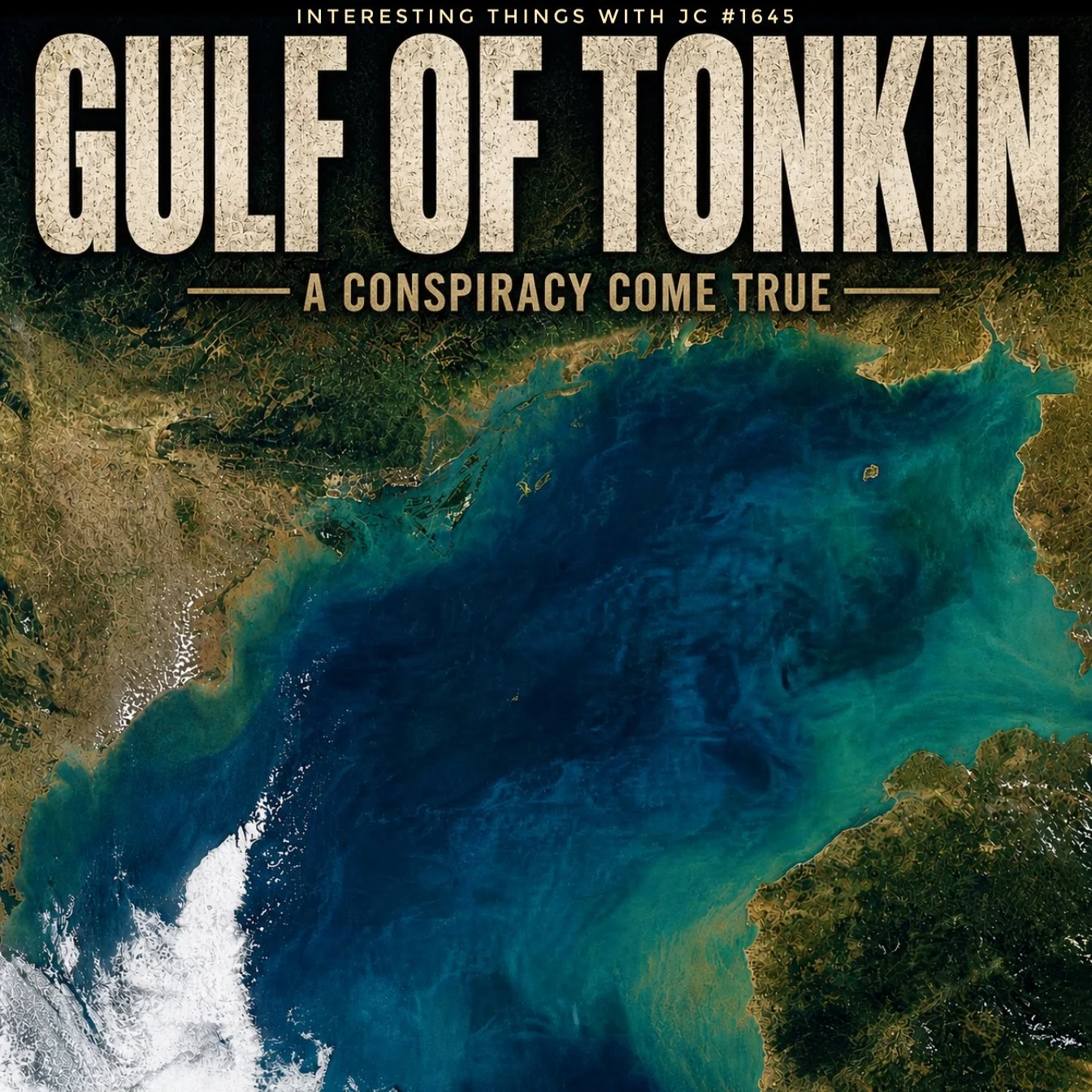
Episode cover art for Interesting Things with JC #1645, titled “Gulf of Tonkin.” The image shows a satellite-style view of a large blue-green coastal gulf surrounded by land, with bold distressed lettering across the top reading “GULF OF TONKIN” and a subtitle below reading “A Conspiracy Come True.”
Transcript
Interesting Things with JC #1645:
“The Gulf of Tonkin”
In early August 1964, the Gulf of Tonkin was dark, humid, and tense. U.S. Navy destroyers were running secret DESOTO intelligence patrols while South Vietnamese commandos, supported by the United States, carried out raids along the North Vietnamese coast.
On August 2, the destroyer USS Maddox was attacked by three North Vietnamese torpedo boats. This engagement was real. Gunfire erupted. Aircraft from the USS Ticonderoga provided support. The Maddox took only minor damage, a single bullet hole. No Americans were killed.
Two nights later, August 4, in rough seas and near total darkness, the Maddox and USS Turner Joy reported a second attack. Radar contacts. Sonar pings. Torpedoes in the water. The ships fired hundreds of rounds into the night.
President Lyndon B. Johnson went on national television, called it an unprovoked assault, and ordered retaliatory air strikes. Within days, Congress passed the Gulf of Tonkin Resolution by overwhelming margins, 416 to 0 in the House, 88 to 2 in the Senate. It gave Johnson broad authority to wage war in Vietnam without a formal declaration.
But doubts appeared almost immediately.
The Maddox’s commanding officer, Captain John Herrick, questioned whether the second attack had even occurred. Pilots sent to investigate saw no enemy vessels, no debris, no wreckage. Sonar in heavy seas had likely mistaken wave crests for torpedoes. Radar returns created false targets.
Inside the government, key intelligence had been misinterpreted or selectively presented. Signals from the real August 2 engagement were incorrectly linked to August 4. Contradictory evidence was downplayed.
Years later, declassified records from the National Security Agency, including historian Robert Hanyok’s 2005 study, confirmed it. The second attack almost certainly never happened. Even North Vietnamese General Võ Nguyên Giáp (VOH NWIN ZYAP) later stated there was no August 4 engagement.
For years, skeptics who questioned the official account were dismissed as conspiracy theorists. Then the government’s own documents proved the core claim was true.
A distorted, and in one case false, incident became the legal foundation for America’s deep involvement in Vietnam. By 1975, more than 58,000 Americans were dead. Vietnamese casualties reached into the millions.
This was not a dramatic false flag with staged explosions. It was more grounded and more dangerous. Misinterpretation. Confirmation bias. Bureaucratic momentum. And leadership that chose a clear narrative over uncertain facts.
A moment when skepticism of the official story wasn’t paranoia.
It was accurate.
These are interesting things, with JC.
Student Worksheet
Student Output Expectations: Write in complete sentences. Use evidence from the podcast transcript. Clearly separate facts from interpretations.
Academic Integrity Guidance: Use your own words unless directly quoting a short phrase. Do not invent evidence. Mark uncertain claims as uncertain.
Comprehension Questions:
What happened to USS Maddox on August 2, 1964?
Which two U.S. destroyers reported an attack on August 4?
What did the Gulf of Tonkin Resolution allow President Johnson to do?
What evidence caused doubts about the reported August 4 attack?
What did later declassified records indicate about the second attack?
Analysis Questions:How did weather, darkness, radar, and sonar contribute to uncertainty on August 4?
Why might leaders prefer a clear public narrative during a crisis?
How can confirmation bias affect intelligence analysis?
What is the difference between skepticism and conspiracy thinking in this case?
Reflection Prompt: In 5–7 sentences, explain why uncertainty should be communicated carefully when national security decisions are being made.
Difficulty Scaling:
Support: Identify three facts from the transcript and one question historians later investigated.
Standard: Answer all questions using specific transcript evidence.
Challenge: Compare the Gulf of Tonkin case to a modern situation where incomplete information could affect public decision-making.
Teacher Guide
Quick Start: Begin with the podcast audio. Ask students to listen for the difference between confirmed events and disputed claims.
Pacing Guide Audio-First:
0–3 minutes: Bell ringer and prediction question.
3–8 minutes: Play podcast once without interruption.
8–13 minutes: Students annotate the transcript for “confirmed,” “reported,” and “later questioned.”
13–25 minutes: Complete comprehension and analysis questions.
25–35 minutes: Discuss evidence, uncertainty, and decision-making.
35–45 minutes: Quiz or written assessment.
Bell Ringer: What should a government do when it receives urgent military reports that may be incomplete?
Audio Guidance: Tell students to listen for dates, ships, evidence problems, and consequences. Replay the section beginning with “But doubts appeared almost immediately” for evidence review.
Audio Fallback: If audio is unavailable, read the transcript aloud or assign paired reading with one student tracking facts and the other tracking uncertainty.
Time on Task: Standard lesson length is 45 minutes. A shortened version can use audio, three comprehension questions, and the exit ticket in 20 minutes.
Materials: Podcast audio, transcript, worksheet, writing paper or LMS response form, timer, optional map of Vietnam and the Gulf of Tonkin.
Vocabulary Prep: Preview DESOTO patrols, signals intelligence, confirmation bias, and declassified records before listening.
Misconceptions:
Students may think both attacks were equally documented; clarify that August 2 was real while August 4 was later found highly doubtful.
Students may think skepticism always means rejecting evidence; clarify that responsible skepticism asks for better evidence.
Students may assume one person caused the escalation; emphasize systems, interpretation, and institutional momentum.
Discussion Prompts:
What evidence would you want before authorizing military action?
How should leaders communicate uncertainty to the public?
Why do institutions sometimes continue moving toward action after doubts appear?
Formative Checkpoints:
Students correctly identify August 2 as confirmed.
Students identify August 4 as reported at the time but later disputed.
Students explain the role of the Gulf of Tonkin Resolution.
Differentiation: Provide sentence starters for emerging writers, vocabulary cards for multilingual learners, and extension research for advanced students.
Assessment Differentiation: Allow oral responses, written paragraphs, or a claim-evidence-reasoning chart.
Time Flexibility: For a longer class, add source comparison using Johnson’s public statement, the Resolution, and later NSA findings.
Substitute Readiness: The lesson can run from transcript only. Have students read, answer worksheet questions, complete quiz, and submit exit ticket.
Engagement Strategy: Use a three-column board chart: “Known Then,” “Doubted Then,” and “Known Later.”
Extensions: Students can research the War Powers Resolution, compare intelligence failures in history, or create a decision memo based only on information available on August 4, 1964.
Cross-Curricular Connections: Civics connects to congressional authority; English connects to source evaluation; science and technology connect to radar, sonar, and signal interpretation.
SEL Connection: Emphasize calm reasoning under pressure, intellectual humility, and responsible disagreement.
Skill Emphasis: Evidence evaluation, chronological reasoning, civic literacy, media literacy, and disciplined decision-making.
Answer Key:
Comprehension 1: USS Maddox was attacked by three North Vietnamese torpedo boats on August 2.
Comprehension 2: USS Maddox and USS Turner Joy.
Comprehension 3: It gave Johnson broad authority to use military force in Vietnam without a formal declaration of war.
Comprehension 4: Herrick’s doubts, lack of visual confirmation, no debris, no wreckage, rough seas, sonar confusion, and false radar returns.
Comprehension 5: The second attack almost certainly did not happen.
Quiz Answers: 1. B; 2. C; 3. A; 4. D; 5. B.
Quiz
What happened on August 2, 1964?
A. Congress passed the Gulf of Tonkin Resolution.
B. USS Maddox was attacked by North Vietnamese torpedo boats.
C. USS Turner Joy sank three enemy ships.
D. President Johnson announced the end of U.S. involvement in Vietnam.Why was the August 4 incident later questioned?
A. The ships were not in the Gulf of Tonkin.
B. Congress had already declared war.
C. Evidence suggested radar and sonar reports may have been misread.
D. North Vietnam immediately released U.S. prisoners.What did the Gulf of Tonkin Resolution provide?
A. Broad authority for President Johnson to use military force in Southeast Asia.
B. A peace treaty between North and South Vietnam.
C. A formal declaration of war by Congress.
D. A requirement to withdraw U.S. ships from the region.Which factor contributed to confusion on August 4?
A. Clear daylight visibility.
B. Calm seas.
C. Confirmed wreckage from enemy boats.
D. Rough seas and near total darkness.What larger lesson does the episode emphasize?
A. All military reports are false.
B. Uncertain evidence can have major consequences when treated as settled fact.
C. Congress had no role in the Vietnam escalation.
D. Radar and sonar are never useful.
Assessment
Open-Ended Questions:
Explain how the difference between the August 2 and August 4 incidents shaped the historical significance of the Gulf of Tonkin.
Evaluate the statement: “Skepticism is most useful when it is based on evidence, not assumption.” Use the episode as your example.
3–2–1 Rubric:
3: Response uses accurate evidence, explains uncertainty clearly, and connects the event to decision-making consequences.
2: Response is mostly accurate but gives limited explanation or uses general evidence.
1: Response is incomplete, inaccurate, or does not distinguish confirmed facts from disputed claims.
Exit Ticket: In one sentence, identify one fact that was known in August 1964 and one conclusion that became clearer only after later records were released.
Standards Alignment
NGSS HS-ETS1-3: Students evaluate how evidence quality, uncertainty, competing interpretations, and system constraints affect major decisions by analyzing the August 2 and August 4 Gulf of Tonkin incidents.
NGSS HS-ETS1-4: Students use a historical case study to examine how models, signals, and interpretations can produce flawed conclusions when environmental conditions and human assumptions affect data.
CCSS.ELA-LITERACY.RI.11-12.1: Students cite strong and thorough evidence from the transcript to distinguish confirmed facts, disputed claims, and later historical findings.
CCSS.ELA-LITERACY.RI.11-12.6: Students determine how point of view, purpose, and presentation shape public understanding of the Gulf of Tonkin incidents.
CCSS.ELA-LITERACY.RH.11-12.1: Students support historical analysis with precise textual evidence from the episode and related primary-source context.
CCSS.ELA-LITERACY.RH.11-12.6: Students evaluate differing accounts of the August 4 incident by comparing immediate government claims with later declassified evidence.
CCSS.ELA-LITERACY.WHST.11-12.1: Students write evidence-based arguments explaining how uncertainty, interpretation, and institutional momentum influenced U.S. decision-making.
C3 D1.5.9-12: Students determine the kinds of sources needed to investigate a public controversy involving military action, intelligence reporting, and congressional authority.
C3 D2.Civ.3.9-12: Students analyze how the Gulf of Tonkin Resolution illustrates the relationship between Congress, the presidency, and the use of military power.
C3 D2.His.14.9-12: Students analyze multiple causes and consequences of U.S. escalation in Vietnam through the lens of evidence, authority, and decision-making.
C3 D2.His.16.9-12: Students integrate evidence from historical accounts and declassified records to construct a reasoned explanation of a disputed event.
ISTE 1.3.b: Students evaluate the accuracy, perspective, credibility, and relevance of information when examining claims about the Gulf of Tonkin.
ISTE 1.3.d: Students build knowledge by actively exploring real-world issues using evidence-based inquiry and source evaluation.
CTE Career Readiness: Students practice analytical judgment, documentation, risk awareness, and responsible communication, skills used in intelligence, journalism, military, legal, public policy, and research careers.
Career Readiness: Critical Thinking: Students distinguish between evidence, inference, assumption, and conclusion when evaluating high-stakes decisions.
Career Readiness: Communication: Students explain uncertainty clearly and responsibly, avoiding overstatement when evidence is incomplete or contested.
Homeschool/Lifelong Learning: Learners strengthen civic literacy by examining how public decisions are shaped by evidence, institutions, communication, and later historical review.
Homeschool/Lifelong Learning: Learners apply source-checking habits to modern information environments by separating documented facts from claims that require verification.
Show Notes
This episode examines the Gulf of Tonkin incidents of August 1964 and how a confirmed naval clash, a later disputed report, and uncertain intelligence contributed to a major expansion of U.S. involvement in Vietnam. For classrooms, the topic matters because it gives students a concrete case study in evidence evaluation, civic authority, intelligence interpretation, and the responsibility leaders carry when public decisions are made before all facts are clear.
References
Hanyok, R. J. (2005). Skunks, bogies, silent hounds, and the flying fish: The Gulf of Tonkin mystery, 2–4 August 1964. National Security Agency. https://www.nsa.gov/portals/75/documents/news-features/declassified-documents/gulf-of-tonkin/articles/release-1/rel1_skunks_bogies.pdf
National Archives. (2022). Vietnam War U.S. military fatal casualty statistics. https://www.archives.gov/research/military/vietnam-war/casualty-statistics
National Archives. (2024). Tonkin Gulf Resolution (1964). https://www.archives.gov/milestone-documents/tonkin-gulf-resolution
Naval History and Heritage Command. (2015). USS Maddox report of Tonkin Gulf action of 4 August 1964. https://www.history.navy.mil/research/library/online-reading-room/title-list-alphabetically/t/tonkin-gulf-crisis/tonkin-gulf-incidents-of-2-4-aug-1964/uss-maddox-report-of-tonkin-gulf-action-of-4-aug-1964.html
Naval History and Heritage Command. (2015). USS Turner Joy action report for Gulf of Tonkin, 4 August 1964. https://www.history.navy.mil/research/library/online-reading-room/title-list-alphabetically/t/tonkin-gulf-crisis/tonkin-gulf-incidents-of-2-4-aug-1964/uss-turner-joy-action-report-for-gulf-of-tonkin-4-aug-1964.html
Prados, J. (2005). Tonkin Gulf intelligence “skewed” according to official history and intercepts. National Security Archive. https://nsarchive2.gwu.edu/NSAEBB/NSAEBB132/press20051201.htm
University of Virginia Miller Center. (2016). August 4, 1964: Report on the Gulf of Tonkin incident. https://millercenter.org/the-presidency/presidential-speeches/august-4-1964-report-gulf-tonkin-incident
