1646: "Electrostatic Propulsion"
Interesting Things with JC #1646: "Electrostatic Propulsion" – A fixed-wing aircraft flies with no propeller, no combustion, and no exhaust while electric fields push ionized air across its wings; the same thrust pattern is already moving spacecraft through vacuum and spreading into quiet drones, high-altitude platforms, and long-duration electric space missions.
Curriculum - Episode Anchor
Episode Title: Electrostatic Propulsion
Episode Number: 1646
Host: JC
Audience: Grades 9–12, introductory college, homeschool, lifelong learners
Subject Area: Physics, aerospace engineering, space science, applied technology
Lesson Overview
Learning Objectives:
Explain how electrostatic propulsion uses electric fields, ions, and momentum transfer to generate thrust.
Compare atmospheric electrohydrodynamic thrust with electrostatic ion propulsion in space.
Analyze why low-thrust systems can be useful even when they do not produce the large force of combustion engines.
Evaluate potential applications and limitations of electrostatic propulsion in aviation, satellites, and deep-space missions.
Essential Question: How can electric fields move aircraft or spacecraft without conventional engines?
Success Criteria: Students can describe the ionization-and-acceleration process, distinguish atmospheric EHD from vacuum ion propulsion, and support claims about applications using evidence from the episode.
Student Relevance Statement: This lesson connects electricity, motion, and engineering to real systems used in drones, satellites, and spacecraft.
Real-World Connection: Electrostatic propulsion appears in research aircraft, electric spacecraft propulsion, CubeSat systems, and concepts for very low Earth orbit satellites.
Workforce Reality: Aerospace and propulsion careers require physics knowledge, testing discipline, safety awareness, modeling skills, and responsibility when designing systems that operate in air or space.
Key Vocabulary
Electrostatic Propulsion(ee-LEK-troh-STAT-ik proh-PUL-shun): Propulsion that uses electric fields to accelerate charged particles and produce thrust.
Electrohydrodynamic Thrust / EHD(ee-LEK-troh-HY-droh-dy-NAM-ik thrust): Atmospheric thrust produced when electric fields move ions through air, creating ionic wind.
Ion(EYE-on): An atom or molecule with an electric charge because it has gained or lost electrons.
Corona Discharge(kuh-ROH-nuh DIS-charj): A localized electrical discharge near a conductor that can ionize surrounding gas.
Emitter Wire(ee-MIT-er wy-er): A thin electrode that helps create a strong electric field and initiate ionization.
Collector Electrode(kuh-LEK-ter ee-LEK-trohd): An electrode that attracts ions after they are created, helping accelerate them through air.
Ionic Wind(eye-ON-ik wind): Movement of neutral air molecules caused by collisions with accelerated ions.
Specific Impulse(spuh-SIF-ik IM-puls): A measure of propulsion efficiency that describes how effectively a system uses propellant.
Hall-Effect Thruster(hawl ih-FEKT THRUS-ter): An electric spacecraft thruster that uses electric and magnetic fields to accelerate ions.
Very Low Earth Orbit / VLEO(VER-ee loh earth OR-bit): A low-altitude orbital region where satellites experience more atmospheric drag than in higher orbits.
Narrative Core
Open: Electrostatic propulsion sounds impossible at first because it removes the familiar signs of flight: spinning blades, hot exhaust, and loud combustion.
Info: In the atmosphere, electrohydrodynamic thrust uses a strong electric field to ionize air and push charged particles toward a collector electrode.
Details: As ions accelerate, they collide with neutral air molecules. Those collisions create ionic wind, which can generate thrust without moving engine parts.
Reflection: In space, electrostatic propulsion becomes ion propulsion, where ions are accelerated in vacuum for efficient, continuous low-thrust motion.
Closing: These are interesting things, with JC.
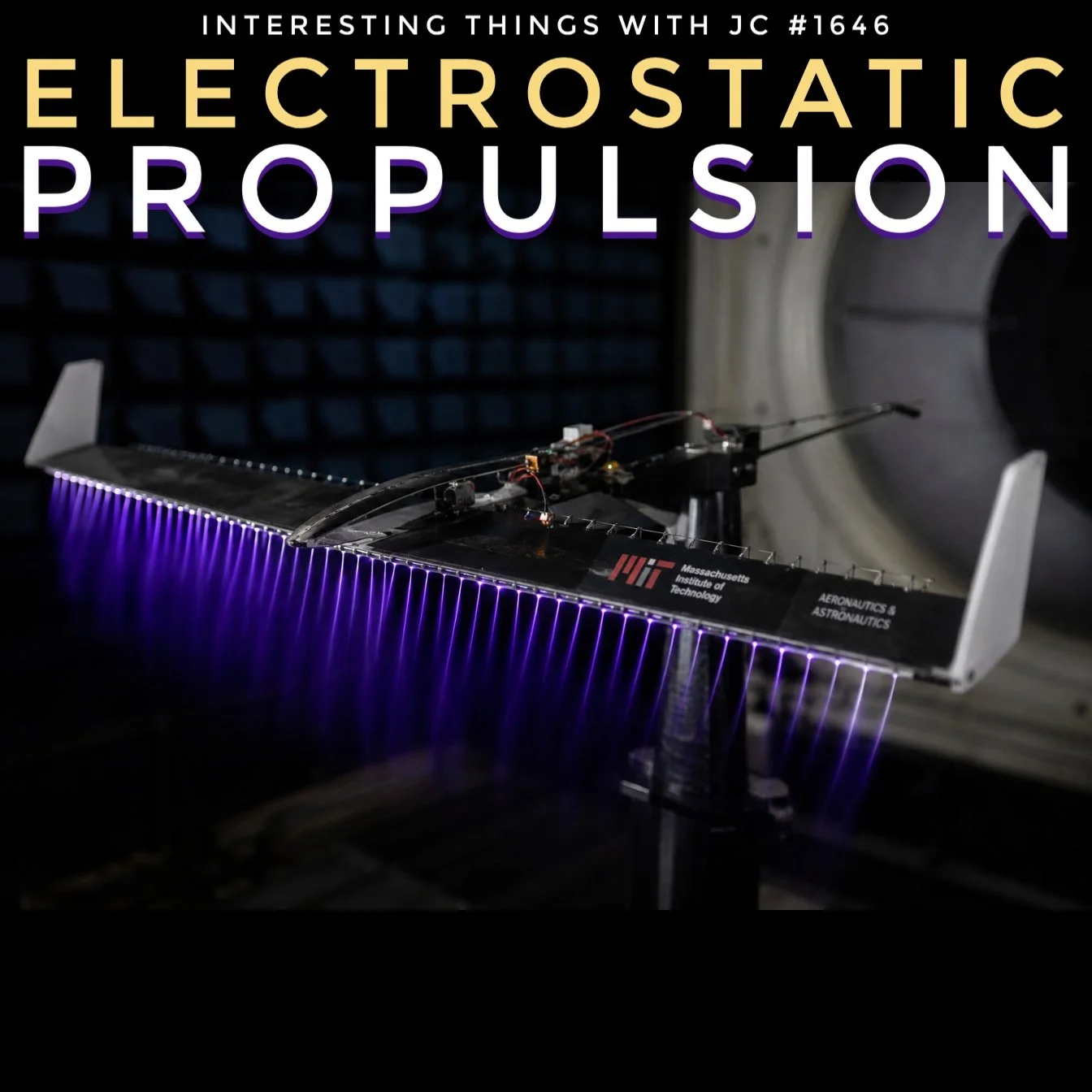
Podcast cover image for Interesting Things with JC #1646, titled “Electrostatic Propulsion.” The image shows a black experimental aircraft model in a dark wind-tunnel setting, with purple electric glow effects beneath the wing suggesting ion or electrostatic propulsion. Large gold and white text reads “Electrostatic Propulsion.”
Transcript
Interesting Things with JC #1646:
"Electrostatic Propulsion"
Electrostatic propulsion sounds like science fiction.
No spinning blades. No roaring combustion. No fuel exhaust.
Just invisible electric fields moving air, or ions in the vacuum of space, to generate thrust.
And it’s not only real. It’s already flying, improving fast, and positioned to reshape aviation and space travel.
At its core, atmospheric electrostatic propulsion, known as electrohydrodynamic or EHD thrust, uses a strong electric field to ionize air. A thin emitter wire creates a corona discharge that strips electrons from air molecules, producing ions. These ions accelerate toward a collector electrode, colliding with neutral molecules and creating a steady ionic wind that produces thrust.
No moving parts. Nearly silent. Zero direct emissions.
The idea dates back to the 1920s with Thomas Townsend Brown and what became known as the Biefeld-Brown effect. For decades it lived in small “lifter” experiments. Then in 2018, researchers at the Massachusetts Institute of Technology flew the first fixed-wing aircraft powered entirely by ionic wind. The 2.45 kilogram, 5.4 pound glider, with a 5 meter, 16.4 foot wingspan, achieved sustained flight, proving the concept at aircraft scale.
Today, progress is accelerating. Multi-stage electrode arrays, optimized geometries, and microfabrication are improving thrust density and efficiency. Engineers are building systems aimed at drones, urban air mobility, and long-endurance high-altitude platforms that can stay aloft for months.
In the atmosphere, EHD performs best at lower speeds, where it delivers efficiency and near-silent operation. That makes it ideal for surveillance, environmental monitoring, and next-generation quiet aircraft.
In space, the same principle evolves into electrostatic ion propulsion. Gridded ion thrusters and Hall-effect thrusters accelerate ions to extreme velocities in vacuum, reaching specific impulses above 3,000 seconds, far beyond chemical rockets. These systems have powered real missions for decades and continue to advance with new propellants like iodine, electrospray micro-thrusters for CubeSats, and higher power designs for faster interplanetary travel.
Concepts like atmosphere-breathing electric propulsion could allow satellites in very low Earth orbit to collect ambient particles as propellant, countering drag using only solar power.
The direction is clear.
Silent EHD aircraft.
Long-endurance platforms.
Electric cargo systems moving through space with continuous low thrust.
Electrostatic propulsion marks a shift from combustion to control, from brute force to precision.
These are interesting things, with JC.
Student Worksheet
Comprehension Questions:
What does electrostatic propulsion use instead of spinning blades or combustion exhaust?
What happens during corona discharge in an EHD system?
How do accelerated ions create ionic wind?
What made the 2018 MIT aircraft demonstration important?
Why are ion thrusters useful in space even though they produce low thrust?
Analysis Questions:
Compare EHD propulsion in air with ion propulsion in vacuum. What is similar, and what is different?
Why might a nearly silent propulsion system be useful for drones or environmental monitoring?
Explain why “zero direct emissions” does not automatically mean a technology has no environmental impact.
Why does continuous low thrust matter for long-distance space travel?
Reflection Prompt: In one paragraph, explain whether electrostatic propulsion is better described as a replacement for combustion engines or as a specialized tool for certain missions. Use at least two details from the episode.
Difficulty Scaling: Emerging learners may answer using sentence frames and vocabulary notes. Proficient learners should compare two systems with evidence. Advanced learners should include limitations such as power supply, thrust density, speed range, or atmospheric drag.
Student Output: Submit written answers to all questions plus one labeled diagram showing emitter wire, ionized air, collector electrode, and ionic wind.
Academic Integrity Guidance: Use your own wording. Direct copying from the transcript does not show understanding. When using a source, summarize the idea and identify where it came from.
Teacher Guide
Quick Start: Begin by playing the podcast first. Ask students to listen for how invisible electric fields can create visible motion.
Pacing Guide: 5 minutes bell ringer, 4 minutes audio, 6 minutes vocabulary review, 12 minutes worksheet, 10 minutes discussion, 8 minutes assessment or exit ticket.
Bell Ringer: Ask students: “Can something move through air or space without a propeller, turbine, or rocket flame? Explain your first thought.”
Audio Guidance: During the first listen, students should write down three terms they hear and one claim they want explained. During a second short replay, they should track the sequence: ionization, acceleration, collision, thrust.
Audio Fallback: If audio is unavailable, read the transcript aloud and pause after each paragraph for students to annotate one cause-and-effect relationship.
Time on Task: Standard lesson length is 45 minutes. A shortened version can use audio, vocabulary, three comprehension questions, and the exit ticket.
Materials:
Episode transcript
Student worksheet
Diagram paper or digital drawing tool
Projector or board
Optional: images or diagrams of ion thrusters and EHD lifters
Vocabulary Strategy: Pre-teach ion, electric field, thrust, and specific impulse. Ask students to connect each term to a physical action.
Misconceptions:
EHD propulsion is not magic or antigravity; it depends on ionized air and momentum transfer.
Ion propulsion in space is efficient but usually low thrust, not a launch system from Earth.
“Nearly silent” does not mean no engineering tradeoffs.
“Zero direct emissions” does not include electricity generation or manufacturing impacts.
Discussion Prompts:
What makes a propulsion system useful besides raw thrust?
Why might quiet aircraft create both benefits and responsibilities?
How does the same broad idea change when used in air versus vacuum?
Why do engineers test small demonstrations before scaling a system?
Formative Checkpoints:
Students can define ion in their own words.
Students can draw the emitter-to-collector process.
Students can explain why low thrust can still be valuable in space.
Differentiation: Provide vocabulary cards and a partially labeled diagram for support. Give advanced students a challenge prompt comparing EHD, chemical rockets, and Hall-effect thrusters.
Assessment Differentiation: Allow oral explanation, diagram-based response, or written paragraph while keeping the same core evidence requirement.
Time Flexibility: For 30 minutes, omit extended discussion. For 60 minutes, add a design challenge where students propose one realistic use case and one limitation.
Substitute Readiness: Play or read the episode, distribute the worksheet, and have students complete the quiz and exit ticket independently.
Engagement Strategy: Use the contrast between “no moving parts” and “real thrust” as the hook. Ask students to predict where the energy enters the system.
Extensions: Students can research a real electric propulsion mission, compare xenon and iodine propellants, or design a concept sketch for a quiet monitoring drone.
Cross-Curricular Connections: Physics connects to electric fields and motion. Engineering connects to design tradeoffs. Environmental science connects to monitoring applications. Mathematics connects to efficiency and impulse.
SEL Connection: Emphasize careful listening, intellectual humility, and revising first assumptions when evidence challenges expectations.
Skill Value Emphasis: Students practice systems thinking, evidence-based explanation, technical vocabulary, and responsible evaluation of emerging technology.
Answer Key | Comprehension:
1. Electric fields and ions; in air, ionic wind; in space, accelerated ions.
2. A strong electric field ionizes nearby air by stripping electrons from molecules.
3. Accelerated ions collide with neutral molecules and transfer momentum, creating moving air.
4. It demonstrated fixed-wing flight powered by ionic wind at aircraft scale.
5. They use propellant efficiently and can accelerate spacecraft continuously over long periods.
Analysis answers should identify shared use of charged particles and electric fields, while distinguishing air-based collisions from vacuum ion exhaust.
Quiz
What is the main source of thrust in atmospheric EHD propulsion?
A. Heated fuel exhaust
B. Ionic wind produced by accelerated ions
C. Rotating turbine blades
D. Magnetic levitation against Earth’s fieldWhat role does the emitter wire play in an EHD system?
A. It stores liquid fuel
B. It creates a strong electric field that helps ionize air
C. It measures wind speed
D. It cools the collector electrodeWhy was the 2018 MIT aircraft demonstration significant?
A. It was the first spacecraft to use iodine fuel
B. It showed sustained fixed-wing flight using ionic wind
C. It launched a satellite into very low Earth orbit
D. It replaced all chemical rocketsWhy are ion thrusters useful for spacecraft?
A. They produce huge launch thrust from Earth’s surface
B. They need no electrical power
C. They can provide efficient continuous low thrust in vacuum
D. They work only inside the lower atmosphereWhat is one likely limitation of atmospheric EHD propulsion?
A. It cannot use electric fields
B. It is generally better suited to lower-speed applications
C. It always requires combustion
D. It cannot move air molecules
Assessment
Open-Ended Questions:
Explain the full cause-and-effect chain that allows EHD propulsion to produce thrust in air.
Compare one realistic atmospheric application and one realistic space application of electrostatic propulsion. Include one benefit and one limitation for each.
Rubric: 3 = Accurate explanation, correct vocabulary, clear comparison, and evidence from the episode. 2 = Mostly accurate explanation with minor gaps or limited evidence. 1 = Incomplete, unclear, or missing key concepts such as ions, electric fields, or thrust.
Exit Ticket: In two sentences, explain why electrostatic propulsion represents “control” more than “brute force.”
Standards Alignment
NGSS HS-PS2-4: Students use evidence-based reasoning to explain how electric fields exert forces on charged particles and how those forces can produce thrust in atmospheric and space propulsion systems.
NGSS HS-PS3-3: Students evaluate energy conversion in electrostatic propulsion by tracing how electrical energy becomes particle motion, ionic wind, or accelerated ion exhaust.
NGSS HS-ETS1-2: Students analyze electrostatic propulsion as an engineering solution by identifying design constraints such as thrust density, power demand, speed range, noise, and mission environment.
NGSS HS-ETS1-3: Students compare propulsion technologies and justify which design is best suited for a specific use case, such as quiet drones, high-altitude platforms, CubeSats, or interplanetary spacecraft.
CCSS RST.11-12.2: Students determine the central ideas of a technical explanation and summarize how electrostatic propulsion works without relying on unsupported claims.
CCSS RST.11-12.3: Students follow a multistep technical process by explaining ionization, acceleration, collision, momentum transfer, and thrust generation in correct sequence.
CCSS WHST.9-12.2: Students write clear explanatory responses using accurate vocabulary, cause-and-effect structure, and evidence from the episode.
CCSS WHST.9-12.9: Students draw evidence from informational text to support analysis of propulsion applications, limitations, and engineering tradeoffs.
ISTE 1.3 Knowledge Constructor: Students evaluate technical information about emerging propulsion systems and synthesize it into diagrams, explanations, or evidence-based comparisons.
ISTE 1.5 Computational Thinker: Students use systems thinking to model inputs, processes, outputs, and constraints in EHD and ion propulsion systems.
C3 D2.Geo.12.9-12: Students evaluate how transportation and satellite technologies can influence environmental monitoring, communication systems, and human interaction with physical space.
C3 D4.2.9-12: Students construct explanations using claims, evidence, and reasoning to connect scientific innovation with real-world responsibilities.
Career Readiness: Students practice technical communication, systems analysis, evidence evaluation, and design tradeoff thinking used in aerospace engineering, electrical engineering, environmental monitoring, and space operations.
Homeschool/Lifelong Learning: Learners connect observable electricity concepts to advanced propulsion technologies through independent diagramming, explanation, comparison, and reflection.
Show Notes
Electrostatic propulsion gives students a clear example of how physics can challenge everyday assumptions about motion. By following ions from air molecules to ionic wind and then into vacuum-based space propulsion, learners see how electric fields can become practical engineering tools. The topic matters because future aircraft, satellites, and spacecraft may rely increasingly on quiet, efficient, electrically powered systems that require both innovation and careful responsibility.
References
Massachusetts Institute of Technology. (2018). MIT engineers fly first-ever plane with no moving parts.https://news.mit.edu/2018/first-ionic-wind-plane-no-moving-parts-1121
NASA. (2024). Ion propulsion.https://science.nasa.gov/mission/dawn/technology/ion-propulsion/
NASA. (2019). Deep Space 1 validated the promise of ion thrusters.https://www.nasa.gov/history/nasa-history-deep-space-1-validated-the-promise-of-ion-thrusters/
Rafalskyi, D., Martínez, J. M., Habl, L., Zorzoli Rossi, E., Proynov, P., Boré, A., Baret, T., Poyet, A., Lafleur, T., Dudin, S., & Aanesland, A. (2021). In-orbit demonstration of an iodine electric propulsion system. Nature, 599, 411–415. https://www.nature.com/articles/s41586-021-04015-y
European Space Agency. (2020). Atmosphere-breathing electric propulsion systems for very low orbit.https://www.esa.int/Enabling_Support/Space_Engineering_Technology/Shaping_the_Future/Atmosphere-breathing_electric_propulsion_systems_for_very_low_orbit
European Space Agency. (n.d.). Use of iodine as a propellant for Hall Effect Thrusters.https://www.esa.int/Enabling_Support/Space_Engineering_Technology/Shaping_the_Future/Use_of_Iodine_as_a_Propellant_for_Hall_Effect_Thrusters