Interesting Things with JC #1647: "Fermilab" – Scientists send neutrinos through solid rock from Illinois to distant detectors without a tunnel, while bison graze above one of America’s major particle physics laboratories and underground machines recreate conditions from moments after the Big Bang.
Curriculum - Episode Anchor
Episode Title: Fermilab
Episode Number: 1647
Host: JC
Audience: Grades 9–12, introductory college, homeschool, lifelong learners
Subject Area: Physics, astronomy, engineering, scientific research
Lesson Overview
Learning Objectives:
Explain how Fermilab uses particle accelerators and detectors to study matter and early-universe conditions.
Describe the historical role of the Tevatron and the discovery of the top quark.
Explain why neutrinos are difficult to detect and why scientists study neutrino oscillation.
Connect particle physics research to engineering, computing, precision measurement, and long-term scientific collaboration.
Essential Question: How can experiments beneath the prairie help scientists understand the structure of matter and the early universe?
Success Criteria: Students can accurately summarize Fermilab’s purpose, define accelerator and neutrino, explain why beams can travel through Earth without tunnels, and support answers with details from the episode.
Student Relevance Statement: This lesson shows how invisible particles, huge machines, careful measurement, and teamwork help answer questions about what the universe is made of.
Real-World Connection: Fermilab research depends on engineers, technicians, physicists, computer scientists, safety specialists, and data analysts working responsibly over many years.
Workforce Reality: Particle physics careers require training, patience, precision, documentation, safety awareness, and collaboration; the work is demanding and rarely produces quick results.
Key Vocabulary
Fermilab(FER-mee-lab): A U.S. particle physics and accelerator laboratory near Batavia, Illinois.
Particle accelerator(PAR-tih-kul ak-SEL-er-ay-ter): A machine that speeds particles to very high energies for research.
Tevatron(TEV-ah-tron): Fermilab’s former four-mile circular proton-antiproton collider.
Proton(PROH-tahn): A positively charged particle found in an atom’s nucleus.
Antiproton(AN-tee-PROH-tahn): The antimatter counterpart of the proton.
Top quark(top kwark): The heaviest known quark and the last quark confirmed in the Standard Model.
Standard Model(STAN-derd MAH-dul): The scientific theory describing known elementary particles and their interactions, except gravity.
Neutrino(new-TREE-noh): A nearly massless, electrically neutral particle that rarely interacts with matter.
Oscillation(ah-sih-LAY-shun): The process in which neutrinos change from one type to another as they travel.
Antimatter(AN-tee-MAT-er): Matter made of particles with opposite charge-related properties from ordinary matter particles.
Narrative Core
Open: Beneath prairie land west of Chicago, a major physics laboratory investigates questions about matter, energy, and the early universe.
Info: Fermilab combines restored prairie, bison, underground accelerator systems, and large-scale detectors. Its history includes the Tevatron, the top quark discovery, and continuing neutrino research.
Details: The Tevatron accelerated protons and antiprotons close to the speed of light and collided them to produce high-energy events. Today, Fermilab sends neutrino beams through Earth to distant detectors because neutrinos interact so weakly with matter.
Reflection: The lesson highlights how science often depends on indirect evidence. Scientists do not “see” most particles directly; they interpret patterns, tracks, timing, energy, and repeated measurements.
Closing: These are interesting things, with JC.
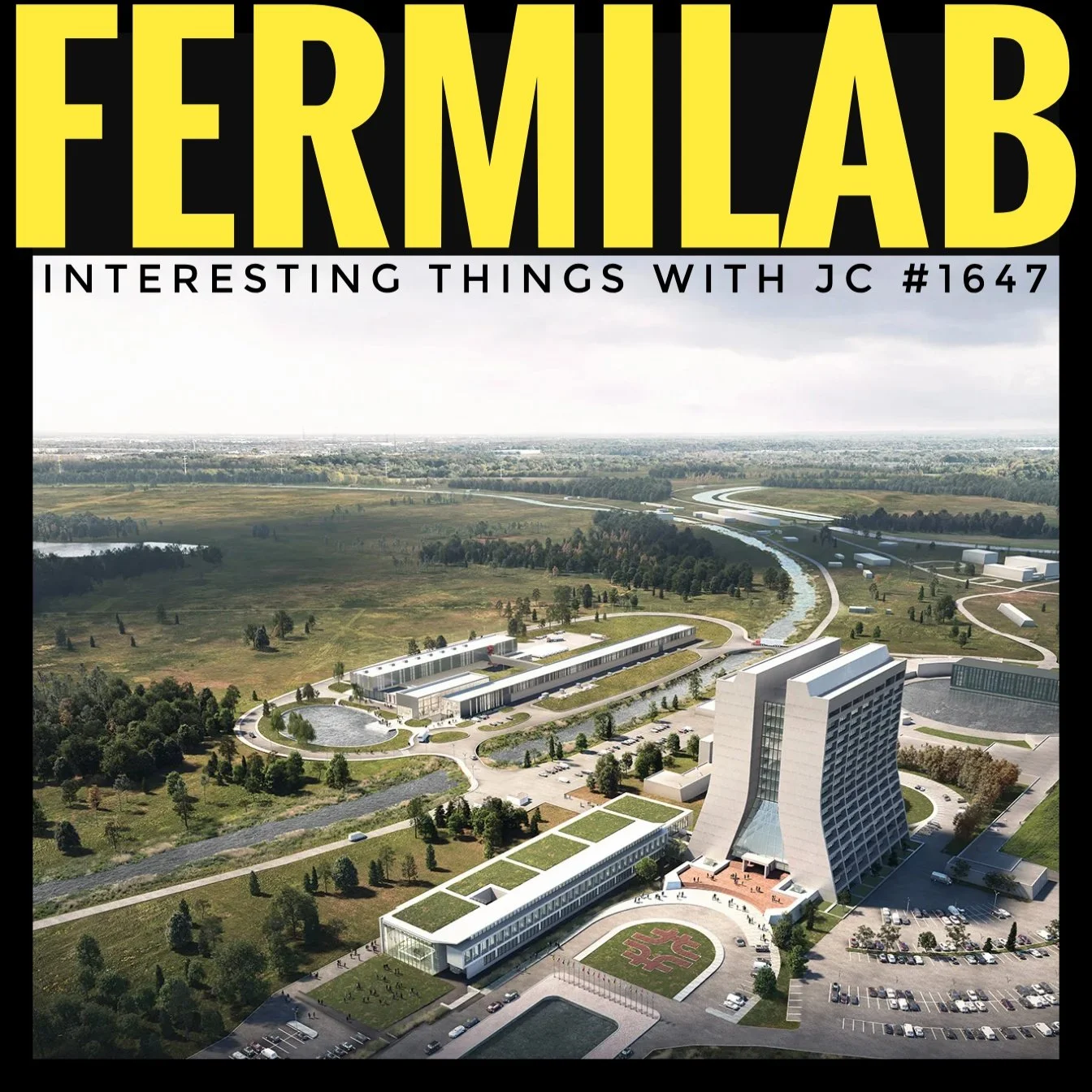
Graphic for “Fermilab” featuring large yellow title text above an aerial view of the Fermilab campus, with buildings, roads, prairie landscape, and the caption “Interesting Things with JC #1647.”
Transcript
Interesting Things with JC #1648:
"Fermilab"
Beneath the open prairie about 40 miles west of Chicago, near Batavia, Illinois, scientists are recreating the violent conditions of the first moments after the Big Bang.
That place is Fermilab.
At first glance, it looks far more like a nature preserve than a world-class physics laboratory. Rolling fields of restored tallgrass prairie stretch across the site, home to a small herd of American bison. These animals were introduced in 1969 by the lab’s first director, Robert Wilson, as a living symbol of the prairie frontier, a reminder that even at the frontier of human knowledge, something wild remains.
Below the surface operates one of the most advanced scientific facilities ever built.
Fermilab opened in 1967 and is named after Enrico Fermi (en-REE-koh FER-mee), the Italian-American physicist who achieved the world’s first controlled nuclear chain reaction in 1942 beneath the stands of a University of Chicago football field.
For decades, its crown jewel was the Tevatron, a circular particle accelerator four miles (6.3 km) in circumference. For more than 25 years, it collided protons and antiprotons at nearly one teraelectronvolt per beam, making it the most powerful collider in the world until the Large Hadron Collider in Switzerland surpassed it in 2008.
Inside these machines, particles are accelerated to speeds just below the speed of light — roughly 186,000 miles per second (299,792 km/s), then steered into head-on collisions. Those impacts release concentrated energy and briefly recreate conditions that existed fractions of a second after the Big Bang.
From the debris, scientists identify particles that cannot exist under normal conditions.
In 1995, Fermilab confirmed the top quark, the final missing member of the six quarks predicted by the Standard Model. This particle carries a mass comparable to that of an entire gold atom.
Today, Fermilab’s primary focus has shifted to neutrinos.
Neutrinos are nearly massless particles that interact so weakly with matter that trillions pass through your body every second, mostly from the Sun, but also from cosmic events and laboratory accelerators. They can travel through the entire Earth with almost no interaction.
At Fermilab, scientists generate intense beams of neutrinos and send them through the planet to a detector 500 miles (about 800 km) away in Ash River, Minnesota, as part of the NOvA experiment. No tunnel is required. The particles pass directly through solid rock.
By studying how neutrinos change type, a process known as oscillation, researchers are working to explain why the universe contains far more matter than antimatter. That imbalance allowed matter to persist and form stars, planets, and everything observed today.
Fermilab is also building the Deep Underground Neutrino Experiment, or DUNE, which will send a more powerful neutrino beam roughly 800 miles (1,300 km) to detectors located deep underground in South Dakota.
Beneath Illinois prairie, controlled particle interactions are used to study the earliest conditions of the universe and the structure of matter itself.
These are interesting things, with JC.
Student Worksheet
Student Output: Answer in complete sentences. Use at least three specific details from the episode. For analysis questions, explain your reasoning, not just the answer.
Academic Integrity Guidance: Use your own words. You may quote short phrases from the transcript, but explain what they mean. Do not copy full answers from another student or an online source.
Comprehension Questions:
Where is Fermilab located, and what does the site look like at first glance?
Why were bison introduced at Fermilab in 1969?
What was the Tevatron, and what particles did it collide?
What important particle did Fermilab confirm in 1995?
Why can neutrinos travel through Earth without a tunnel?
Analysis Questions:
Why do particle accelerators help scientists study conditions from the early universe?
How is studying collision debris similar to solving a scientific mystery?
Why might neutrino oscillation matter for understanding why the universe contains matter?
Compare the Tevatron and DUNE. What changed in Fermilab’s research focus?
Reflection Prompt: In 5–7 sentences, explain why a laboratory that looks like a prairie preserve can still be one of the most advanced research sites in the world.
Difficulty Scaling:
Support: Use sentence starters: “Fermilab studies…,” “Neutrinos are difficult to detect because…,” “The Tevatron was important because…”
Core: Answer all questions with evidence from the transcript.
Challenge: Add a diagram or timeline showing Fermilab’s shift from collider research to neutrino research.
Teacher Guide
Quick Start: Begin with the podcast audio before discussion. Ask students to listen for three things: place, machine, and mystery.
Pacing Guide (audio-first):
0–3 minutes: Bell ringer prediction.
3–8 minutes: Play podcast once without interruption.
8–12 minutes: Students list key facts they heard.
12–20 minutes: Replay or read selected transcript lines for vocabulary.
20–35 minutes: Complete worksheet comprehension and analysis.
35–45 minutes: Discussion, formative check, and exit ticket.
Bell Ringer: “How can scientists study something too small to see directly?” Students write three possible methods.
Audio Guidance: Tell students to listen for the contrast between prairie surface and underground science. Have them mark one confusing term for later clarification.
Audio Fallback: If audio is unavailable, read the transcript aloud while students annotate vocabulary, locations, and scientific processes.
Time on Task: Standard lesson: 45 minutes. Extended version: 60–75 minutes with diagramming or research extension.
Materials: Episode audio, transcript, student worksheet, projector or board, blank paper for diagrams, optional map of Illinois-to-Minnesota/South Dakota baselines.
Vocabulary Strategy: Pre-teach accelerator, neutrino, oscillation, antimatter, and detector. Ask students to define each term using one technical phrase and one everyday analogy.
Misconceptions:
Students may think particles are visible like small balls; clarify that scientists infer particles from detector evidence.
Students may think neutrinos need tunnels; clarify that neutrinos rarely interact with matter.
Students may think “recreating the Big Bang” means recreating the whole event; clarify that experiments recreate brief high-energy conditions, not the universe itself.
Students may think bison are part of the experiment; clarify that they are symbolic and part of the site’s prairie identity.
Discussion Prompts:
Why does Fermilab’s surface appearance contrast with its scientific purpose?
What makes indirect evidence reliable in science?
Why do large experiments require many different careers?
What responsibilities come with operating powerful scientific equipment?
Formative Checkpoints:
After listening: Students write one sentence explaining Fermilab’s purpose.
During vocabulary: Students match each term to a phrase from the transcript.
Before exit: Students explain why no tunnel is needed for neutrino experiments.
Differentiation: Provide a vocabulary bank for developing readers, allow oral responses for students who need language support, and offer challenge students a cause-effect diagram of accelerator research.
Assessment Differentiation: Allow students to answer open-ended questions through paragraph, labeled diagram, or recorded explanation while preserving the same evidence requirements.
Time Flexibility: For a 25-minute class, complete audio, vocabulary, and three comprehension questions. For a longer class, add a neutrino baseline map activity.
Substitute Readiness: Play or read the episode first, distribute worksheet, collect responses, and use the answer key for review. No specialized physics background is required.
Engagement Strategy: Use the contrast hook: “Prairie above, particle beams below.” Ask students to sketch what they think is happening underground before correcting the model.
Extensions: Students may research one Fermilab experiment, create a timeline from 1967 to DUNE, or compare Fermilab with CERN’s Large Hadron Collider.
Cross-Curricular Connections:
History: Enrico Fermi and mid-20th-century physics.
Math: Scale, distance, speed, and unit conversion.
Engineering: Accelerator design, magnets, detectors, and underground facilities.
Environmental Science: Prairie restoration and land stewardship at a research site.
SEL Connection: Emphasize patience, humility, and collaboration in scientific work. Major discoveries require careful teamwork and willingness to revise ideas.
Skill Emphasis: Evidence-based explanation, technical vocabulary, systems thinking, listening comprehension, and responsible interpretation of scientific claims.
Answer Key:
Fermilab is near Batavia, Illinois, about 40 miles west of Chicago; it appears like a nature preserve with prairie and bison.
Robert Wilson introduced bison as a symbol of the prairie frontier and research at the frontier of knowledge.
The Tevatron was a four-mile circular particle accelerator that collided protons and antiprotons.
Fermilab confirmed the top quark in 1995.
Neutrinos interact very weakly with matter, so they can pass through rock and Earth with little interaction.
Accelerators create high-energy collisions that briefly reproduce conditions similar to the early universe.
Scientists study collision debris because short-lived particles leave evidence through their decay products and detector signals.
Neutrino oscillation may help explain differences between matter and antimatter behavior.
The Tevatron focused on high-energy collisions; DUNE focuses on long-distance neutrino behavior.
Quiz
What is Fermilab best described as?
A. A wildlife park only
B. A particle physics and accelerator laboratory
C. A nuclear power plant
D. A telescope observatoryWhat was the Tevatron used to collide?
A. Electrons and photons
B. Protons and antiprotons
C. Neutrinos and atoms
D. Gold atoms and light beamsWhich particle did Fermilab confirm in 1995?
A. Electron
B. Neutron
C. Top quark
D. PhotonWhy can neutrinos pass through solid rock?
A. They are very large particles
B. They move slower than sound
C. They interact very weakly with matter
D. They are blocked by magnetic fieldsWhat is neutrino oscillation?
A. A detector spinning underground
B. A neutrino changing type as it travels
C. A proton becoming an atom
D. A bison herd moving across prairie
Assessment
Open-Ended Questions:
Explain how Fermilab’s Tevatron helped scientists study matter. Include the words accelerator, collision, and top quark.
Explain why neutrino experiments such as NOvA and DUNE can send particles through Earth without a tunnel. Include the words neutrino, detector, and oscillation.
3–2–1 Rubric:
3: Response is accurate, uses required vocabulary correctly, includes evidence from the episode, and explains cause-and-effect clearly.
2: Response is mostly accurate, uses some vocabulary correctly, and includes at least one relevant episode detail.
1: Response is incomplete, lacks evidence, or shows confusion about the main science idea.
Exit Ticket: In one sentence, explain why Fermilab is important to modern physics. In a second sentence, name one skill or career area needed to make its research possible.
Standards Alignment
NGSS HS-PS1-8 — Matter and Energy in Nuclear Processes: Students connect Fermilab’s accelerator research to the idea that matter can be investigated through particle interactions, energy release, and evidence produced during high-energy collisions.
NGSS HS-PS2-4 — Forces and Interactions: Students explain how accelerator systems use controlled forces, magnetic steering, and precise beam control to move charged particles at extremely high speeds.
NGSS HS-PS3-3 — Energy Transfer and Device Design: Students analyze how particle accelerators are engineered systems designed to concentrate, transfer, and measure energy under controlled conditions.
NGSS HS-PS4-5 — Information Technologies and Instrumentation: Students describe how detectors, sensors, and data systems allow scientists to gather evidence from particles that cannot be observed directly.
NGSS Science and Engineering Practice — Analyzing and Interpreting Data: Students interpret how scientists use collision debris, detector signals, and repeated measurements to infer the existence and behavior of subatomic particles.
NGSS Crosscutting Concept — Systems and System Models: Students identify Fermilab as a complex research system involving accelerators, detectors, neutrino beams, underground facilities, computing, safety, and human collaboration.
CCSS RST.9-10.2 / RST.11-12.2 — Central Ideas in Technical Texts: Students determine the central ideas of the episode and explain how details about the Tevatron, top quark, neutrinos, NOvA, and DUNE develop those ideas.
CCSS RST.9-10.4 / RST.11-12.4 — Technical Vocabulary: Students define and apply domain-specific terms such as neutrino, oscillation, antimatter, accelerator, top quark, and Standard Model in accurate scientific explanations.
CCSS RST.9-10.7 / RST.11-12.7 — Multiple Sources and Formats: Students integrate information from audio, transcript, vocabulary work, diagrams, and optional maps to explain how Fermilab conducts long-distance particle research.
CCSS WHST.9-10.2 / WHST.11-12.2 — Explanatory Writing: Students write clear explanatory responses that use scientific vocabulary, evidence from the episode, and cause-and-effect reasoning.
CCSS SL.9-10.1 / SL.11-12.1 — Collaborative Discussion: Students participate in evidence-based discussion about how scientists study particles indirectly and why large research projects require specialized teamwork.
ISTE 1.3 Knowledge Constructor: Students gather, organize, and explain scientific information about Fermilab’s research systems while distinguishing evidence-based claims from unsupported assumptions.
ISTE 1.5 Computational Thinker: Students describe how particle physics depends on large data sets, pattern recognition, measurement, modeling, and computational analysis.
CTE STEM Career Cluster — Engineering and Technology Applications: Students connect Fermilab’s work to applied roles in accelerator operations, cryogenics, detector design, computing, electrical systems, mechanical systems, and laboratory safety.
C3 D2.Sci/Tech Application — Science, Technology, and Society: Students evaluate how publicly supported scientific institutions use technology, evidence, and collaboration to investigate questions about matter and the universe.
C3 D2.Geo.2.9-12 — Human-Environment Interaction: Students explain how Fermilab’s identity combines large-scale scientific infrastructure with prairie restoration, land stewardship, and site-based planning.
C3 D4.2.9-12 — Constructing Explanations: Students construct explanations using evidence from the episode to show how Fermilab’s research changed from collider-based particle discovery to long-distance neutrino investigation.
Career Readiness — Technical Literacy: Students identify how scientific careers require reading technical information, using precise vocabulary, following procedures, and communicating evidence clearly.
Career Readiness — Collaboration and Responsibility: Students explain why particle physics research depends on disciplined teamwork, safety protocols, accurate documentation, and long-term responsibility.
Career Readiness — Problem Solving: Students analyze how researchers design experiments to study particles that are difficult to detect, using indirect evidence and engineered systems.
Homeschool/Lifelong Learning — Scientific Literacy: Learners practice listening comprehension, vocabulary development, evidence-based explanation, and curiosity-driven inquiry about modern physics.
Homeschool/Lifelong Learning — Independent Inquiry: Learners extend the episode by creating a timeline, diagram, or short written explanation showing how Fermilab’s experiments help investigate the structure of matter.
Show Notes
Fermilab introduces students to one of the world’s major particle physics laboratories, where prairie restoration, bison, underground accelerator systems, and international science meet in one place. This episode supports classroom learning about matter, energy, scientific evidence, and large-scale research by showing how particles too small to see can still reveal major clues about the universe. It matters because modern science depends not only on discovery, but also on precision, patience, engineering, teamwork, and responsible interpretation of evidence.
References
Fermi National Accelerator Laboratory. (2026). About Fermilab. https://www.fnal.gov/pub/about/
Fermi National Accelerator Laboratory. (n.d.). About: Bison at Fermilab. https://www.fnal.gov/pub/about/bisoncam/
Fermi National Accelerator Laboratory. (n.d.). Enrico Fermi, Nobel Laureate Physicist. https://history.fnal.gov/historical/events/enrico_fermi.html
Fermi National Accelerator Laboratory. (2014). Tevatron accelerator. https://www.fnal.gov/pub/tevatron/tevatron-accelerator.html
Fermi National Accelerator Laboratory. (2020). Twenty-fifth anniversary of the discovery of the top quark at Fermilab. https://news.fnal.gov/2020/03/twenty-fifth-anniversary-of-the-discovery-of-the-top-quark-at-fermilab/
Fermi National Accelerator Laboratory. (2026). Particle physics: Neutrinos. https://www.fnal.gov/pub/science/particle-physics/experiments/neutrinos.html
DUNE at LBNF. (n.d.). Introduction. https://lbnf-dune.fnal.gov/how-it-works/introduction/
DUNE at LBNF. (n.d.). Overview. https://lbnf-dune.fnal.gov/about/overview/
National Institute of Standards and Technology. (n.d.). CODATA value: Speed of light in vacuum. https://physics.nist.gov/cgi-bin/cuu/Value?c