Interesting Things with JC #1671: "What Is the L2 Point?" – A mathematician identified a location in space in 1772 where gravity keeps spacecraft moving with Earth around the Sun, and nearly 250 years later observatories began traveling there to do some of humanity's most advanced science.
Curriculum - Episode Anchor
Episode Title: What is the L2 Point?
Episode Number: 1671
Host: JC
Audience: Grades 9–12, Introductory College, Homeschool, Lifelong Learners
Subject Area: Astronomy, Physics, Space Science, Mathematics
Lesson Overview
Objectives:
Explain what a Lagrange Point is and why it exists.
Describe the location and purpose of the L2 Point.
Analyze how gravity and orbital motion interact at L2.
Evaluate why major space telescopes operate near L2.
Essential Question:
How can a location in space become one of the most important places for scientific discovery?
Success Criteria:
Define Lagrange Points accurately.
Identify the position of L2 relative to Earth and the Sun.
Explain why L2 is useful for infrared astronomy.
Connect mathematical theory to modern space exploration.
Student Relevance Statement:
This lesson demonstrates how mathematical ideas developed centuries ago can lead to technologies and discoveries that affect modern science and engineering.
Real-World Connection:
Space agencies use Lagrange Points to position spacecraft for solar monitoring, astronomy, and deep-space observation.
Workforce Reality:
Astrophysicists, aerospace engineers, mission planners, mathematicians, and telescope designers rely on orbital mechanics concepts similar to those used at L2.
Key Vocabulary
Lagrange Point (luh-GRAHNJ point) — A location where gravitational forces and orbital motion create a balanced position for a spacecraft.
L2 Point (el-two point) — The Lagrange Point located beyond Earth on the side opposite the Sun.
Gravity (GRAV-uh-tee) — The force that attracts objects with mass toward one another.
Orbital Mechanics (OR-bi-tuhl muh-KAN-iks) — The study of how objects move through space under gravitational forces.
Halo Orbit (HAY-loh OR-bit) — A looping orbit around a Lagrange Point.
Infrared Astronomy (in-fruh-RED uh-STRON-uh-mee) — The study of celestial objects using infrared light.
Sunshield (SUN-sheeld) — A structure that blocks heat and light from the Sun.
James Webb Space Telescope (jaymz webb spays TELL-uh-skohp) — A space telescope operating near L2 to observe the distant universe.
Narrative Core
Open:
Most people think important telescopes orbit Earth. Some of humanity's most powerful observatories work far beyond Earth in a location known only by a mathematical designation: L2.
Info:
In 1772, mathematician Joseph-Louis Lagrange studied how gravity behaves when two large objects influence a smaller one. His work revealed five special positions now called Lagrange Points.
Details:
L2 lies approximately 1.5 million kilometers beyond Earth, opposite the Sun. Earth's gravity helps a spacecraft orbit the Sun at the same rate as Earth despite being farther away. Spacecraft travel in halo orbits around L2 and periodically adjust their positions.
Reflection:
The arrangement of the Sun, Earth, and Moon allows spacecraft at L2 to shield themselves from heat and light using a single sunshield. This creates ideal conditions for infrared observations and deep-space research.
Closing:
A mathematical prediction made centuries before the space age became a destination for some of humanity's most advanced spacecraft. These are interesting things, with JC.
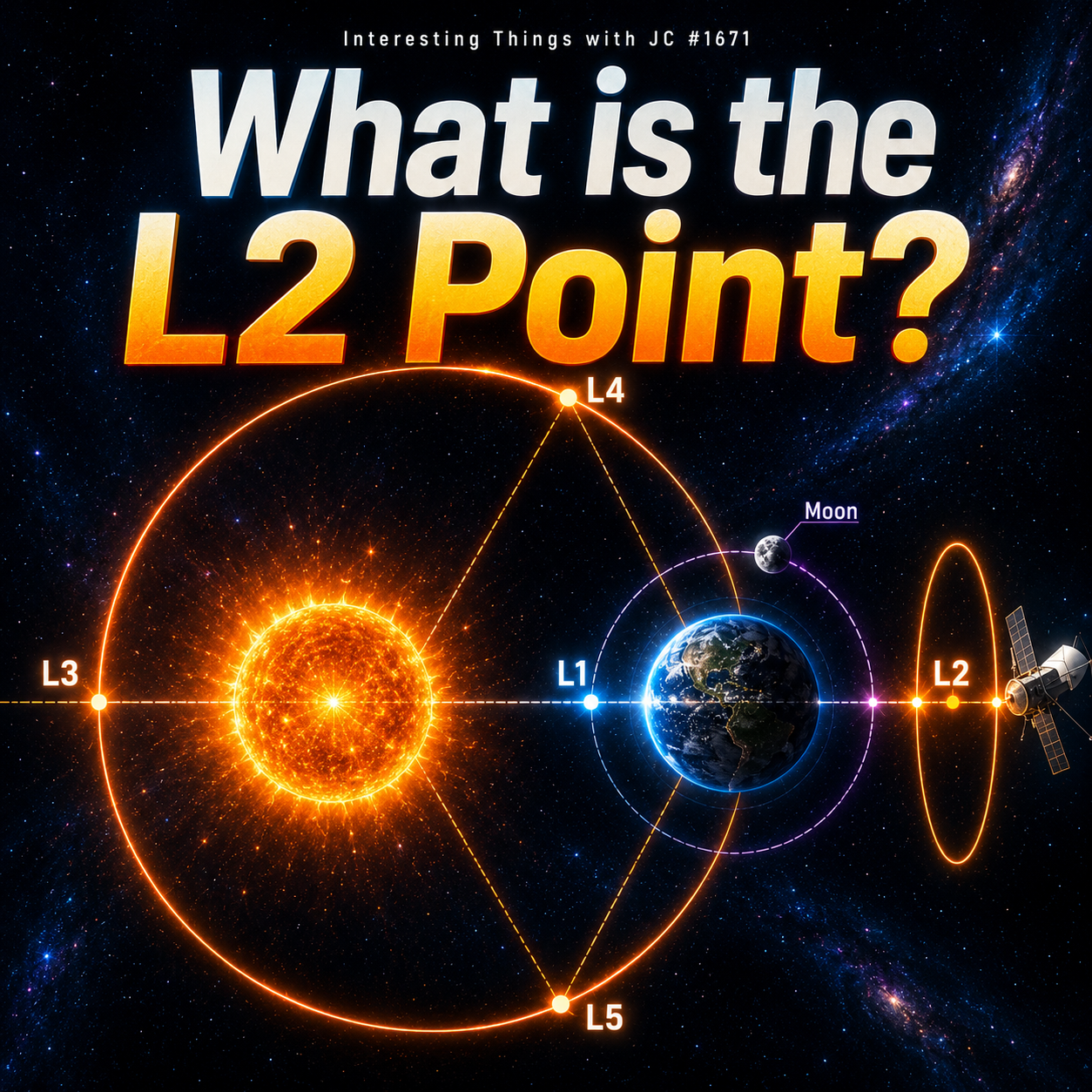
This educational space illustration explains the locations of the five Sun-Earth Lagrange points. At the top, large text reads, “What Is the L2 Point?” with “Interesting Things with JC #1671” above it.
The Sun is positioned on the left side of the image, glowing bright orange and yellow. Earth is shown near the center-right, with the Moon displayed in a smaller orbit around Earth. A horizontal line connects the Sun and Earth and extends beyond both objects.
Five labeled Lagrange points are displayed:
L1 is located between the Sun and Earth.
L2 is located beyond Earth on the side opposite the Sun.
L3 is located on the far side of the Sun.
L4 is positioned above the Earth-Sun line.
L5 is positioned below the Earth-Sun line.
Lines connecting the Sun, Earth, L4, and L5 form two large triangular shapes, illustrating the geometric arrangement of these stable gravitational regions. An elongated oval orbit is shown around the L2 region, representing the type of halo orbit used by spacecraft operating near that location.
A spacecraft resembling a space telescope appears to the right of Earth near the L2 label, emphasizing that missions such as the James Webb Space Telescope operate in this area. The background consists of stars, galaxies, and deep-space imagery.
The visual communicates that L2 is a special location approximately 1.5 million kilometers (930,000 miles) beyond Earth where the combined effects of gravity and orbital motion make it an ideal location for scientific spacecraft and infrared telescopes.
Transcript
Interesting Things with JC #1671:
"What Is the L2 Point?"
There’s a place in space where some of humanity’s most advanced telescopes go to work, and it isn’t orbiting Earth.
It sits about 930,000 miles, or 1.5 million kilometers, beyond our planet, on the far side of Earth as seen from the Sun. It isn't a planet, a moon, or even an object. It's simply a location.
Astronomers call it L2.
The name comes from Joseph-Louis Lagrange, a mathematician who, in 1772, studied how gravity behaves when two large bodies, such as the Sun and Earth, influence a much smaller object. His calculations revealed five special locations where gravity and orbital motion balance in unusual ways. They became known as the Lagrange points.
The first, L1, sits between Earth and the Sun. Spacecraft there can continuously monitor the Sun and provide early warning of solar activity.
L2 lies on the opposite side of Earth.
Normally, an object farther from the Sun should take longer to orbit it. But at L2, Earth's gravity provides just enough additional pull to keep a spacecraft moving around the Sun in step with Earth.
It's often called a gravitational parking spot, although it's not perfectly stable. Spacecraft travel in looping halo orbits around the point and make occasional course corrections to stay there.
What makes L2 so valuable is its position.
Because the Sun, Earth, and Moon all remain in roughly the same direction, a spacecraft can block their heat and light with a single sunshield. That creates an ideal environment for infrared astronomy.
That's why the James Webb Space Telescope was sent there.
From L2, Webb can study distant galaxies, examine planets around other stars, and look deeper into the universe than would be possible from Earth orbit.
What began as a mathematical solution became one of the most useful destinations in space.
When Lagrange described these points in 1772, there were no rockets and no satellites. The places he identified existed only on paper.
Today, spacecraft routinely travel to them.
One helps us watch the Sun. Another helps us explore the distant universe.
Sometimes mathematics doesn't just describe reality. Sometimes it reveals places humanity has yet to reach.
These are interesting things, with JC.
Student Worksheet
Comprehension Questions
What is the L2 Point?
Who first described the Lagrange Points?
Where is L2 located relative to Earth and the Sun?
Why is L2 useful for space telescopes?
What telescope currently operates near L2?
Analysis Questions
Why would a spacecraft farther from the Sun normally orbit more slowly?
How does Earth's gravity help make L2 useful?
Why is a single sunshield effective at L2?
How does the story demonstrate the connection between mathematics and engineering?
Reflection Prompt
Describe a scientific discovery or mathematical idea that eventually became useful in ways its creator could not have predicted.
Difficulty Scaling
Foundational: Complete comprehension questions.
Intermediate: Complete comprehension and analysis questions.
Advanced: Write a paragraph explaining why L2 is valuable for astronomy using evidence from the episode.
Student Output Expectations
Complete written responses.
Use at least three vocabulary terms correctly.
Support analysis answers with evidence from the transcript.
Academic Integrity Guidance
Use your own words.
Cite evidence from the episode when appropriate.
Do not copy another student's responses.
Teacher Guide
Quick Start
Play the episode.
Review vocabulary.
Complete worksheet activities.
Facilitate discussion.
Administer quiz or assessment.
Pacing Guide (Audio-First)
Bell Ringer (5 min)
Vocabulary Preview (5 min)
Podcast Listening (5–10 min)
Discussion (10 min)
Worksheet (15 min)
Assessment/Exit Ticket (5 min)
Bell Ringer
If you could place a telescope anywhere in space, where would you put it and why?
Audio Guidance
Ask students to listen for why L2 is valuable.
Encourage note-taking on gravity and telescope placement.
Audio Fallback
Use the transcript as a reading passage.
Conduct guided reading and annotation.
Time on Task
40–50 minutes
Materials
Podcast audio
Transcript
Student worksheet
Writing materials
Vocabulary Strategy
Pre-teach key terms.
Have students create visual definitions.
Misconceptions
L2 is not a physical object.
L2 is not completely stable.
Spacecraft do not sit motionless at L2.
Discussion Prompts
Why might scientists choose L2 over Earth orbit?
What role did mathematics play in discovering L2?
How does technology make use of theoretical ideas?
Formative Checkpoints
Vocabulary review
Pair-share discussion
Worksheet responses
Differentiation
Provide vocabulary supports.
Allow verbal responses.
Use graphic organizers.
Assessment Differentiation
Short responses for developing learners.
Extended written explanations for advanced learners.
Time Flexibility
Can be condensed to 25 minutes or expanded to a full class period.
Substitute Readiness
Transcript and worksheet can be completed without prior instruction.
Engagement Strategy
Compare L2 to a strategically positioned observation platform.
Extensions
Research additional Lagrange Points.
Investigate current missions operating near L1 or L2.
Cross-Curricular Connections
Mathematics: gravitational modeling.
History: scientific developments of the 18th century.
Engineering: spacecraft design.
SEL Connection
Emphasize curiosity, perseverance, and long-term thinking.
Skill Emphasis
Scientific reasoning
Evidence-based explanation
Systems thinking
Answer Key
A location beyond Earth opposite the Sun.
Joseph-Louis Lagrange.
About 1.5 million kilometers beyond Earth.
It allows heat and light shielding with one sunshield.
The James Webb Space Telescope.
Objects farther from the Sun generally orbit more slowly.
Earth's gravity helps maintain the spacecraft's orbital relationship.
The Sun, Earth, and Moon remain roughly in one direction.
Mathematics predicted a useful location before technology could reach it.
Quiz
What does the term L2 refer to?
A. A moon
B. A Lagrange Point
C. A planet
D. A telescope
Who identified the Lagrange Points?
A. Isaac Newton
B. Galileo Galilei
C. Joseph-Louis Lagrange
D. Johannes Kepler
Why is L2 valuable for astronomy?
A. It is inside Earth's atmosphere
B. It eliminates gravity
C. It provides favorable observing conditions
D. It is closer to the Sun
Which telescope operates near L2?
A. Hubble Space Telescope
B. Chandra Observatory
C. James Webb Space Telescope
D. Voyager 1
What type of orbit do spacecraft commonly use around L2?
A. Polar orbit
B. Halo orbit
C. Geostationary orbit
D. Lunar orbit
Assessment
Open-Ended Questions
Explain how gravity and orbital motion combine to make L2 useful for spacecraft.
Describe how a mathematical discovery from 1772 became important to modern astronomy.
3–2–1 Rubric
3: Accurate explanation, strong evidence, correct vocabulary usage.
2: Mostly accurate explanation with minor errors or limited evidence.
1: Partial understanding with significant inaccuracies or missing evidence.
Exit Ticket
In one or two sentences, explain why the James Webb Space Telescope operates near L2 rather than in low Earth orbit.
Standards Alignment
NGSS HS-ESS1-2: Construct explanations of astronomical systems using evidence and scientific reasoning.
NGSS HS-ETS1-1: Analyze complex scientific and engineering challenges and evaluate solutions.
CCSS.ELA-LITERACY.RST.11-12.2: Determine central ideas of scientific texts and summarize accurately.
CCSS.ELA-LITERACY.WHST.9-12.2: Write explanatory texts using relevant scientific information.
ISTE 1.1 Empowered Learner: Develop understanding through technology-supported inquiry.
C3 D2.Sci.1.9-12: Apply scientific reasoning to investigate questions about the natural world.
Career Readiness: Analyze how mathematics, engineering, and scientific research interact in professional environments.
Homeschool/Lifelong Learning: Evaluate scientific concepts through observation, reading, discussion, and evidence-based reasoning.
Show Notes
This lesson explores the L2 Point, one of the most important locations in modern space science. Students learn how a mathematical concept developed in the eighteenth century became essential for operating advanced observatories such as the James Webb Space Telescope. The lesson highlights the relationship between mathematics, physics, engineering, and scientific discovery while demonstrating how theoretical ideas can lead to transformative real-world applications.
References
European Space Agency. (2024). James Webb Space Telescope and Lagrange Point L2. https://www.esa.int/Science_Exploration/Space_Science/Webb
NASA. (2024). James Webb Space Telescope Overview. https://science.nasa.gov/mission/webb
NASA. (2024). What Are Lagrange Points? https://science.nasa.gov/resource/what-is-a-lagrange-point