Interesting Things with JC #1672: "Magnetism is a Relativistic Force" – A current-carrying wire stays electrically neutral on a table while a moving charge beside it feels a magnetic force, but in the charge’s own frame the spacing of charges changes and the same force appears electric.
Curriculum - Episode Anchor
Episode Title: Magnetism is a Relativistic Force
Episode Number: 1672
Host: JC
Audience: Grades 9–12, introductory college, homeschool learners, and lifelong learners
Subject Area: Physics; electromagnetism; special relativity
Lesson Overview
Learning Objectives:
Explain how electricity and magnetism are connected parts of a single electromagnetic field.
Describe how a current-carrying wire can appear neutral in one frame while producing a magnetic-force explanation in another.
Compare laboratory-frame and moving-particle-frame descriptions of the same physical interaction.
Connect electromagnetic field behavior to motors, generators, radio transmitters, MRI systems, power lines, and compasses.
Essential Question: How can the same interaction be described as magnetic by one observer and electric by another?
Success Criteria: Students can identify the observer’s frame of reference, explain charge balance in a current-carrying wire, describe why motion changes field descriptions, and apply the idea to one real-world technology.
Student Relevance Statement: Students use electromagnetism every day through phones, speakers, chargers, wireless signals, motors, medical technology, and electrical power systems.
Real-World Connection: A current-carrying wire produces magnetic effects, and moving charges experience magnetic forces; those principles support many electrical and engineering technologies.
Workforce Reality: Work involving electromagnetism requires disciplined measurement, safety awareness, mathematical accuracy, and responsibility because electrical and magnetic systems can affect communication, transportation, medicine, and infrastructure.
Key Vocabulary
Electromagnetic field(ee-LEK-troh-mag-NET-ik feeld): A unified field model in which electric and magnetic effects are connected parts of one physical system.
Frame of reference(fraym uhv REF-er-ens): The viewpoint or state of motion from which an observer measures events.
Special Relativity(SPESH-uhl rel-uh-TIV-uh-tee): Einstein’s theory describing how measurements of space and time depend on relative motion.
Current(KUR-ent): The flow of electric charge through a material.
Charge neutrality(charj noo-TRAL-uh-tee): A condition in which positive and negative charges balance overall.
Magnetic force(mag-NET-ik fors): A force associated with moving electric charges and magnetic fields.
Length contraction(length kun-TRAK-shun): The relativistic effect in which moving objects are measured as shorter along the direction of motion.
Lorentz transformation(LOR-ents tranz-for-MAY-shun): The mathematical relationship connecting measurements between observers in relative motion.
Spacetime(SPAYS-tyme): The combined structure of space and time used in relativity.
Drift velocity(drift vuh-LOSS-uh-tee): The average motion of charge carriers through a conductor.
Narrative Core
Open: A wire carrying current looks ordinary, but inside it is a clue that electricity and magnetism are not separate in the deepest physical description.
Info: In the laboratory frame, a moving charged particle near a current-carrying wire can be described as experiencing a magnetic force. In the particle’s own frame, the same interaction can be described through an electric-field explanation.
Details: Positive atomic nuclei in the wire remain essentially fixed in the metal lattice while electrons drift through the conductor. To one observer, the wire appears electrically neutral. To another observer moving with a charged particle, relative motion changes how charge spacing and field behavior are described. Modern electromagnetism treats electric and magnetic fields as frame-dependent parts of one electromagnetic field.
Reflection: The particle’s motion does not change just because the observer changes. What changes is the description: one frame may describe the interaction as magnetic, while another describes it as electric.
Closing: These are interesting things, with JC.
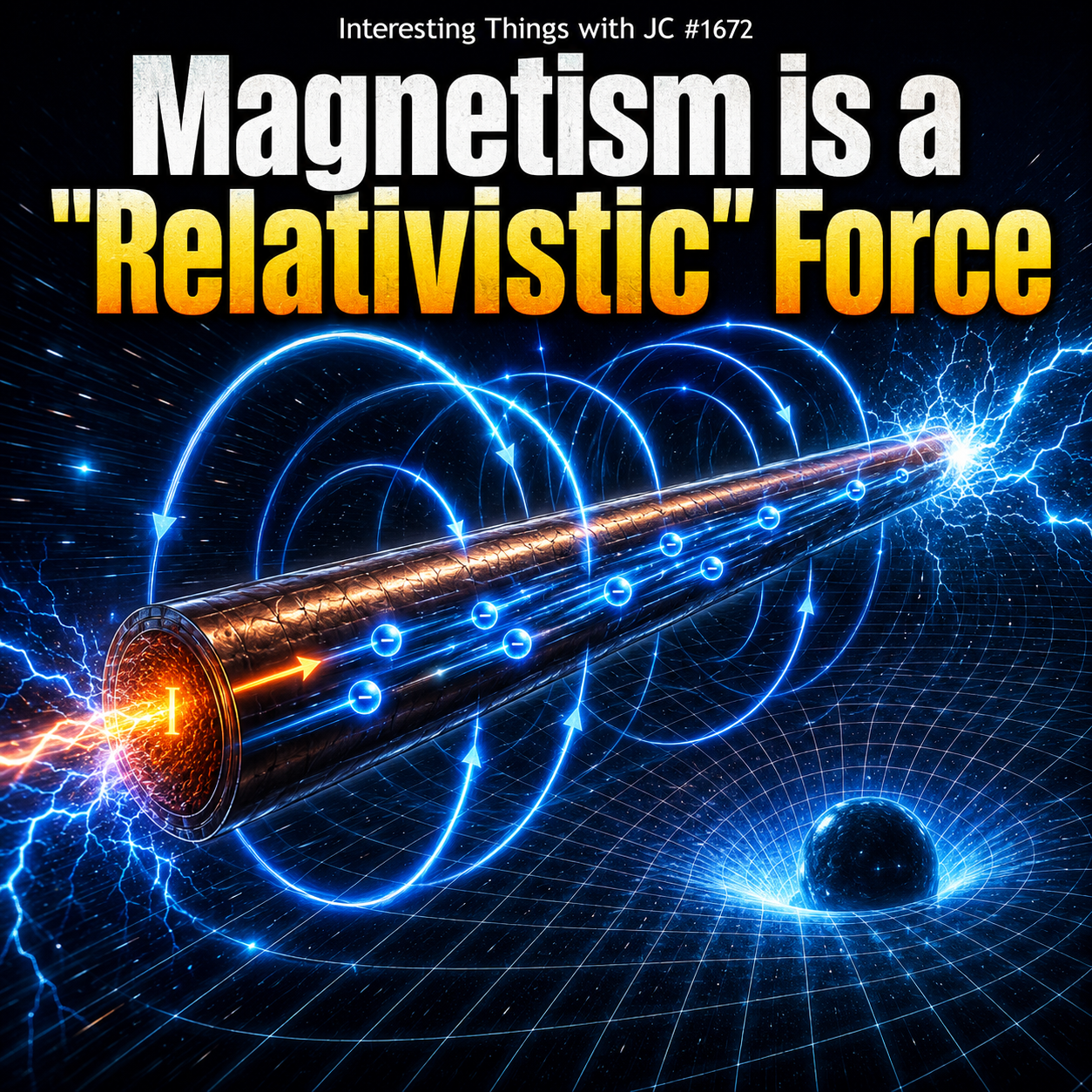
This educational graphic illustrates the concept that magnetism can be understood as a consequence of electricity viewed from different frames of reference. A current-carrying wire is shown with moving negative charges and circular magnetic field lines surrounding it. The background includes a curved spacetime grid to visually connect electromagnetism with Special Relativity. The design communicates the idea that electric and magnetic phenomena are not separate forces but different aspects of a unified electromagnetic field whose appearance depends on the observer’s motion. The title identifies the topic as “Magnetism is a ‘Relativistic’ Force” from Interesting Things with JC episode 1672.
Transcript
Interesting Things with JC #1672:
"Magnetism is a Relativistic Force"
A wire carrying electricity doesn't look like a relativistic object.
It sits on a table. Nothing about it suggests that understanding what's happening inside requires one of the most revolutionary ideas in physics. But hidden inside that ordinary wire is a clue that electricity and magnetism are not separate forces at all.
For most of human history, they certainly appeared to be.
Electricity produced sparks and lightning. Magnetism made iron move and compass needles point north. They seemed like entirely different phenomena. Then, in the nineteenth century, James Clerk Maxwell showed that both could be described by the same set of equations.
The equations worked beautifully, but they contained a mystery. They implied that electromagnetic waves always traveled at the same speed: the speed of light.
Einstein eventually showed why…
Imagine a wire carrying an electric current. Inside it, positively charged atomic nuclei remain essentially fixed while electrons move through the metal. To an observer standing beside the wire, the positive and negative charges balance, making the wire electrically neutral.
Now place a charged particle alongside the wire and let it move in the same direction as the electrons.
In the laboratory frame, the particle experiences a magnetic force.
That's the explanation every physics student learns.
But move into the particle's frame of reference and the picture changes.
Special Relativity says that motion changes how observers measure distance and time. Because the charges in the wire are moving differently relative to this new observer, the apparent spacing between them changes. The balance between positive and negative charge no longer appears exactly the same.
Suddenly, what looked like a magnetic interaction can be described as an electric one.
The particle still moves in exactly the same way. The force has not changed. The outcome has not changed. Only the description has changed. That's the remarkable part. One observer says the force is magnetic. Another says the force is electric. Both are describing the same reality…
This is why modern physics treats electric and magnetic fields as different aspects of a single electromagnetic field. Change your motion, and what appears to be a purely electric field may acquire a magnetic component. What appears magnetic may reveal an electric one.
The familiar explanation that magnetism comes from length contraction is useful for visualizing what's happening in a current-carrying wire. But the deeper truth is that electricity and magnetism are woven together by the structure of spacetime itself.
Every electric motor, generator, radio transmitter, MRI machine, power line, and compass operates within that framework.
What appears to be two different forces is really one phenomenon viewed from different frames of reference.
And hidden inside an ordinary wire carrying current is a reminder that motion changes more than where things are.
It changes how nature itself is described.
These are interesting things, with JC.
Student Worksheet
Student Output Expectations: Answer in complete sentences. For diagrams, label the observer, wire, positive nuclei, moving electrons, moving charged particle, current direction, and force description.
Academic Integrity Guidance: Use the transcript, class notes, and approved sources. Do not copy explanations word-for-word; restate the ideas in your own scientific language.
Comprehension Questions:
What two phenomena seemed separate before Maxwell’s work?
What is moving inside a current-carrying wire?
In the laboratory frame, what force does the moving charged particle experience near the wire?
What changes when the observer moves into the particle’s frame of reference?
Why does the episode say the force and outcome have not changed?
Analysis Questions:
Explain how a wire can appear electrically neutral in one frame while the same situation is described differently in another frame.
Why is the statement “magnetism comes from length contraction” useful but incomplete?
Explain why two observers can give different field descriptions without disagreeing about the actual motion of the particle.
Choose one technology from the episode and explain how it depends on electromagnetic behavior.
Reflection Prompt: In 5–7 sentences, explain how this episode changes the way you think about ordinary objects such as wires, motors, or power lines.
Difficulty Scaling:
Support Level: Draw the wire, charges, and moving particle; write one sentence explaining each frame.
Core Level: Compare the laboratory frame and particle frame in one organized paragraph.
Challenge Level: Explain why electric and magnetic fields are best understood as connected parts of one field rather than two unrelated forces.
Teacher Guide
Quick Start: Begin with the podcast audio before lecture or notes. Ask students to listen for the moment when the explanation changes from “magnetic” to “electric.”
Pacing Guide Audio-First:
0–3 minutes: Bell ringer prediction.
3–8 minutes: Play podcast audio or read the transcript aloud.
8–15 minutes: Students annotate the transcript for observer, wire, charge, and force.
15–25 minutes: Mini-lesson on current, charge neutrality, magnetic force, and frame of reference.
25–38 minutes: Student worksheet completion.
38–45 minutes: Discussion, formative check, and exit ticket.
Bell Ringer: A wire on a table looks still. How can motion still matter inside it?
Audio Guidance: Play the episode once without writing. Play it a second time while students mark every reference to observer, motion, electric force, magnetic force, or frame of reference.
Audio Fallback: If audio is unavailable, read the transcript aloud and pause after the laboratory-frame explanation and the particle-frame explanation.
Time on Task: Standard lesson: 45 minutes. Extended lesson: 60–75 minutes with diagrams, technology examples, and deeper discussion of field transformations.
Materials:
Podcast audio or printed transcript
Student worksheet
Whiteboard or digital board
Simple wire/current diagram
Optional compass, battery, insulated wire, and safety-approved classroom demonstration materials
Vocabulary Prep: Pre-teach frame of reference, current, charge neutrality, magnetic force, and length contraction before introducing the unified electromagnetic-field idea.
Misconceptions:
Magnetism is not imaginary; it is a real interaction whose description depends on observer motion.
The wire does not need to move across the table for charges inside it to be moving.
Length contraction is a helpful model for the wire example, but the full explanation involves electromagnetic fields and spacetime.
Different observers do not create different realities; they describe the same event from different frames.
Discussion Prompts:
Why must the particle’s motion be consistent across frames of reference?
What makes the wire seem ordinary even though complex physics is happening inside it?
Why did Maxwell’s equations point toward a deeper connection between light, electricity, and magnetism?
Where do students encounter electromagnetism in everyday life?
Formative Checkpoints:
Students correctly identify the laboratory frame and particle frame.
Students explain why the wire appears neutral in one description.
Students distinguish between the force changing and the description changing.
Students connect the concept to one real-world device.
Differentiation:
Provide sentence frames: “In the laboratory frame, the force is described as ___ because ___.”
Allow students to explain with labeled diagrams before writing paragraphs.
Pair students so one tracks the wire and one tracks the moving particle.
Give advanced students a short extension on Lorentz transformations and field mixing.
Assessment Differentiation: Students may submit a written paragraph, labeled diagram with explanation, or short recorded explanation if it meets the same scientific accuracy criteria.
Time Flexibility: For a 25-minute version, use the audio, one diagram, three worksheet questions, and the exit ticket. For a longer version, add a device research mini-task.
Substitute Readiness: The lesson can run from the transcript alone. The substitute should read or play the episode, guide students through the worksheet, and collect the exit ticket.
Engagement Strategy: Use the contrast between “ordinary wire” and “relativistic physics” as the hook. Ask students to name other ordinary objects that hide advanced science.
Extensions: Students can research electric motors, generators, MRI machines, radio transmitters, or power lines and explain how moving charges and electromagnetic fields are involved.
Cross-Curricular Connections: Mathematics connects through proportional reasoning and transformations; history connects through Maxwell and Einstein; engineering connects through electrical systems and communication technology.
SEL Connection: Emphasize intellectual humility: science often reveals that familiar objects can be more complex than they first appear.
Skill Emphasis: Students practice model-based reasoning, cause-and-effect explanation, vocabulary precision, and evidence-based communication.
Answer Key:
Comprehension 1: Electricity and magnetism.
Comprehension 2: Electrons move through the metal while positive atomic nuclei remain essentially fixed.
Comprehension 3: A magnetic force.
Comprehension 4: The apparent spacing or balance of charges changes because the observer’s motion changes measurements of distance and time.
Comprehension 5: The particle’s actual motion is the same; only the frame-based explanation changes.
Analysis 1: In the lab frame, positive and negative charges balance overall. In the moving particle’s frame, the relative motion of the charges changes how spacing and field behavior are described.
Analysis 2: Length contraction helps visualize the wire example, but the deeper explanation is that electric and magnetic fields are connected through relativity and spacetime.
Analysis 3: Both observers describe the same physical event from different frames. The motion remains consistent even when the electric and magnetic descriptions differ.
Analysis 4: Answers vary. Motors use electromagnetic interactions to produce motion; generators use motion and electromagnetic effects to produce electrical energy; MRI systems use magnetic fields and radio-frequency interactions for imaging.
Quiz 1: B
Quiz 2: C
Quiz 3: A
Quiz 4: B
Quiz 5: A
Quiz
What is the main idea of the episode?
A. Magnetism and gravity are the same force.
B. Electricity and magnetism are connected aspects of one electromagnetic field.
C. Wires become radioactive when carrying current.
D. Special Relativity only applies to objects moving near stars.In the laboratory frame, a charged particle moving beside a current-carrying wire experiences what kind of force?
A. Gravitational force
B. Nuclear force
C. Magnetic force
D. Frictional forceWhat remains essentially fixed inside the metal wire?
A. Positive atomic nuclei
B. Electrons
C. Photons
D. Compass needlesWhat does a change in frame of reference affect?
A. Only the color of the wire
B. How observers measure distance, time, and field descriptions
C. Whether electricity exists
D. The identity of the metal atomsWhy is the wire example important?
A. It shows that ordinary objects can reveal deep physics.
B. It proves magnets do not exist.
C. It shows that electric current stops relativity.
D. It proves all forces are contact forces.
Assessment
Open-Ended Questions:
Explain how one observer can describe an interaction as magnetic while another describes it as electric without contradicting the actual motion of the particle.
Choose one device from the episode and explain why understanding electromagnetism matters for designing, using, or maintaining it responsibly.
3–2–1 Rubric:
3: Explanation accurately uses frame of reference, current, charge balance, and electromagnetic field; includes a clear real-world connection.
2: Explanation is mostly accurate but missing one key concept or has a minor vocabulary issue.
1: Explanation is incomplete, confuses electric and magnetic descriptions, or lacks a clear connection to the episode.
Exit Ticket: In one sentence, explain why the phrase “magnetism is a relativistic force” does not mean magnetism is imaginary.
Standards Alignment
NGSS HS-PS2-4: Use Mathematical Representations of Newton’s Second Law
Analyze how forces act on moving charged particles in electromagnetic systems.
Use conceptual models to explain magnetic interactions near a current-carrying wire.
Distinguish between force, motion, and observer-dependent descriptions of force.
NGSS HS-PS3-5: Energy and Fields
Develop and use models showing how electric and magnetic fields store and transfer energy.
Explain how electromagnetic interactions occur without direct physical contact.
Relate field behavior to real-world technologies discussed in the episode.
NGSS HS-PS4-1: Wave Properties
Evaluate how Maxwell's equations connect electricity, magnetism, and electromagnetic waves.
Explain why light is an electromagnetic phenomenon.
Connect the speed of light to the development of Special Relativity.
NGSS HS-PS4-3: Electromagnetic Radiation and Information Technologies
Investigate how electromagnetic principles enable communication systems, medical imaging, and electrical infrastructure.
Explain how scientific discoveries translate into practical technologies.
NGSS Science and Engineering Practice: Developing and Using Models
Create diagrams illustrating moving charges and magnetic fields.
Compare multiple models explaining magnetism.
Evaluate model limitations and strengths.
NGSS Science and Engineering Practice: Constructing Explanations
Develop evidence-based explanations for why magnetic and electric field descriptions change between reference frames.
Support claims using information from the transcript and scientific references.
NGSS Crosscutting Concept: Cause and Effect
Trace how charge motion produces measurable electromagnetic effects.
Explain causal relationships between current flow, field generation, and force.
NGSS Crosscutting Concept: Systems and System Models
Analyze a wire, moving charges, and observers as components of an interconnected system.
Explain how changing the observer alters the system description while preserving physical outcomes.
CCSS RST.11–12.1: Cite Specific Evidence
Use evidence from the transcript to support scientific explanations.
Distinguish between observation, inference, and conclusion.
CCSS RST.11–12.2: Determine Central Ideas
Identify the episode’s central claim that electricity and magnetism are aspects of a unified electromagnetic field.
Summarize supporting scientific reasoning.
CCSS RST.11–12.7: Integrate Multiple Sources
Analyze information presented through audio, text, diagrams, and discussion.
Synthesize evidence from multiple instructional formats.
CCSS WHST.11–12.2: Informative and Explanatory Writing
Produce clear scientific explanations using precise vocabulary.
Organize reasoning logically and support conclusions with evidence.
CCSS WHST.11–12.9: Evidence-Based Writing
Draw evidence from scientific texts and instructional materials to support analysis and reflection.
C3 Framework D1.5.9–12: Developing Questions
Generate questions about phenomena that are not directly observable.
Investigate how scientific models explain hidden processes.
C3 Framework D3.1.9–12: Evaluating Sources and Evidence
Assess the reliability of scientific explanations and supporting evidence.
Compare simplified instructional models with deeper theoretical frameworks.
ISTE 1.3 Knowledge Constructor
Evaluate credible scientific information.
Build evidence-based understanding of electromagnetism and relativity.
ISTE 1.5 Computational Thinker
Analyze complex systems by breaking them into interacting components.
Identify patterns linking electric and magnetic phenomena.
CTE Science, Technology, Engineering, and Mathematics Career Pathway
Interpret technical diagrams and scientific models.
Apply systems-thinking skills used in engineering and advanced technology fields.
Connect theoretical physics to real-world technical careers.
IB MYP Sciences
Explore relationships between models, evidence, and scientific explanation.
Evaluate how advances in scientific understanding reshape explanations of natural phenomena.
IB Theory of Knowledge Connection
Examine how observation and perspective influence scientific descriptions.
Analyze how different models can describe the same underlying reality.
AP Physics Alignment
Relate electric and magnetic fields through reference-frame analysis.
Explain qualitative aspects of relativistic electromagnetism.
Connect field theory to charged-particle interactions and electromagnetic systems.
College and Introductory University Physics Alignment
Introduce the unification of electricity and magnetism through Special Relativity.
Examine observer-dependent field transformations.
Connect Maxwell’s equations, relativity, and modern field theory.
Career Readiness
Practice technical communication and scientific reasoning.
Interpret models and evidence.
Demonstrate analytical problem-solving and systems thinking.
Develop awareness of safety, reliability, and responsibility in technical fields.
Homeschool and Lifelong Learning Alignment
Connect advanced scientific ideas to everyday experiences.
Encourage inquiry-based learning and independent exploration.
Strengthen scientific literacy through observation, reflection, and evidence-based reasoning.
Build appreciation for how modern physics explains familiar technologies.
Show Notes
This lesson uses an ordinary current-carrying wire to introduce one of the deepest ideas in modern physics: electricity and magnetism are connected aspects of a single electromagnetic field. Students begin with the podcast, then analyze how different observers can describe the same interaction in different ways without changing the physical outcome. The episode matters in the classroom because it connects abstract physics to technologies students recognize, including motors, generators, MRI systems, radio transmitters, power lines, and compasses. This episode was inspired by Dr. Horace Drew, “Red Collie”, CalTech, MRC, LMB Cambridge.
References
OpenStax. (2016). 11.4 Magnetic force on a current-carrying conductor.https://openstax.org/books/university-physics-volume-2/pages/11-4-magnetic-force-on-a-current-carrying-conductor
OpenStax. (2016). 16.1 Maxwell’s equations and electromagnetic waves.https://openstax.org/books/university-physics-volume-2/pages/16-1-maxwells-equations-and-electromagnetic-waves
Martin, B., Neary, N., Rinaldo, R., & Woodman, D. (2020). 24.5: Electric and magnetic fields and Special Relativity. Physics LibreTexts. https://phys.libretexts.org/Bookshelves/University_Physics/Book%3A_Introductory_Physics_-_Building_Models_to_Describe_Our_World_%28Martin_Neary_Rinaldo_and_Woodman%29/24%3A_The_Theory_of_Special_Relativity/24.05%3A_Electric_and_magnetic_fields_and_Special_Relativity
Fowler, M. (n.d.). Special Relativity: Electromagnetism. University of Virginia. https://galileoandeinstein.phys.virginia.edu/Elec_Mag/16_7420/Lectures/16_7420_11_Special_Relativity_Electromagnetism.pdf
D’Abramo, G. (2021). A note on Purcell’s basic explanation of magnetic forces. arXiv. https://arxiv.org/abs/2108.07169