Interesting Things with JC #1673: "There Is No Universal Now" – A star 100 light-years away is doing something at this moment, but observers moving at different velocities can assign different times to the same distant event. What appears simultaneous to one observer does not appear simultaneous to another, and the universe continues without a single present moment everyone shares.
Curriculum - Episode Anchor
Episode Title: There Is No Universal Now
Episode Number: 1673
Host: JC
Audience: Grades 9–12, Introductory College, Homeschool, Lifelong Learners
Subject Area: Physics, Astronomy, Relativity
Lesson Overview
Objectives
Explain why the speed of light is central to special relativity.
Describe the relativity of simultaneity using observational examples.
Analyze how different observers can disagree about the timing of distant events.
Evaluate how modern physics challenges the concept of a universal present.
Essential Question: Does the universe share a single, universal "now"?
Success Criteria
Define simultaneity and relativity of simultaneity.
Explain the train-and-lightning thought experiment.
Distinguish between local experience and universal time.
Support conclusions using evidence from the episode.
Student Relevance Statement: Students use clocks and schedules every day. This lesson explores why those familiar experiences do not necessarily apply across the universe.
Real-World Connection: GPS satellites, space travel, and modern physics all depend on understanding how time behaves under different conditions.
Workforce Reality: Physicists, aerospace engineers, astronomers, and navigation specialists use relativistic principles when designing systems and interpreting observations.
Key Vocabulary
Special Relativity(SPEH-shul reh-luh-TIH-vuh-tee) — Einstein's theory describing how space and time behave for observers in uniform motion.
Simultaneity(sigh-muhl-tay-NEE-uh-tee) — The occurrence of events at the same time.
Relativity of Simultaneity(reh-luh-TIH-vuh-tee uhv sigh-muhl-tay-NEE-uh-tee) — The principle that observers in different states of motion may disagree about whether events occurred simultaneously.
Observer(uhb-ZUR-ver) — A person or reference frame making measurements.
Reference Frame(REF-er-ens fraym) — A perspective from which motion and events are measured.
Light-Year(LYTE yeer) — The distance light travels in one year.
Velocity(vuh-LOSS-uh-tee) — Speed in a specific direction.
Causality(kaw-ZAL-uh-tee) — The relationship between cause and effect.
Narrative Core
Open: A star 100 light-years away appears unchanged in the night sky, yet the light reaching Earth tonight began its journey decades ago.
Info: Einstein's 1905 theory of special relativity started with the observation that light travels at the same speed for all observers.
Details: The moving train thought experiment demonstrates that two observers can disagree about whether distant lightning strikes occurred at the same time. Both observations can be valid because simultaneity depends on motion.
Reflection: Human experience suggests a shared present moment. Physics indicates that such a universal "now" may not exist beyond our local perspective.
Closing: These are interesting things, with JC.
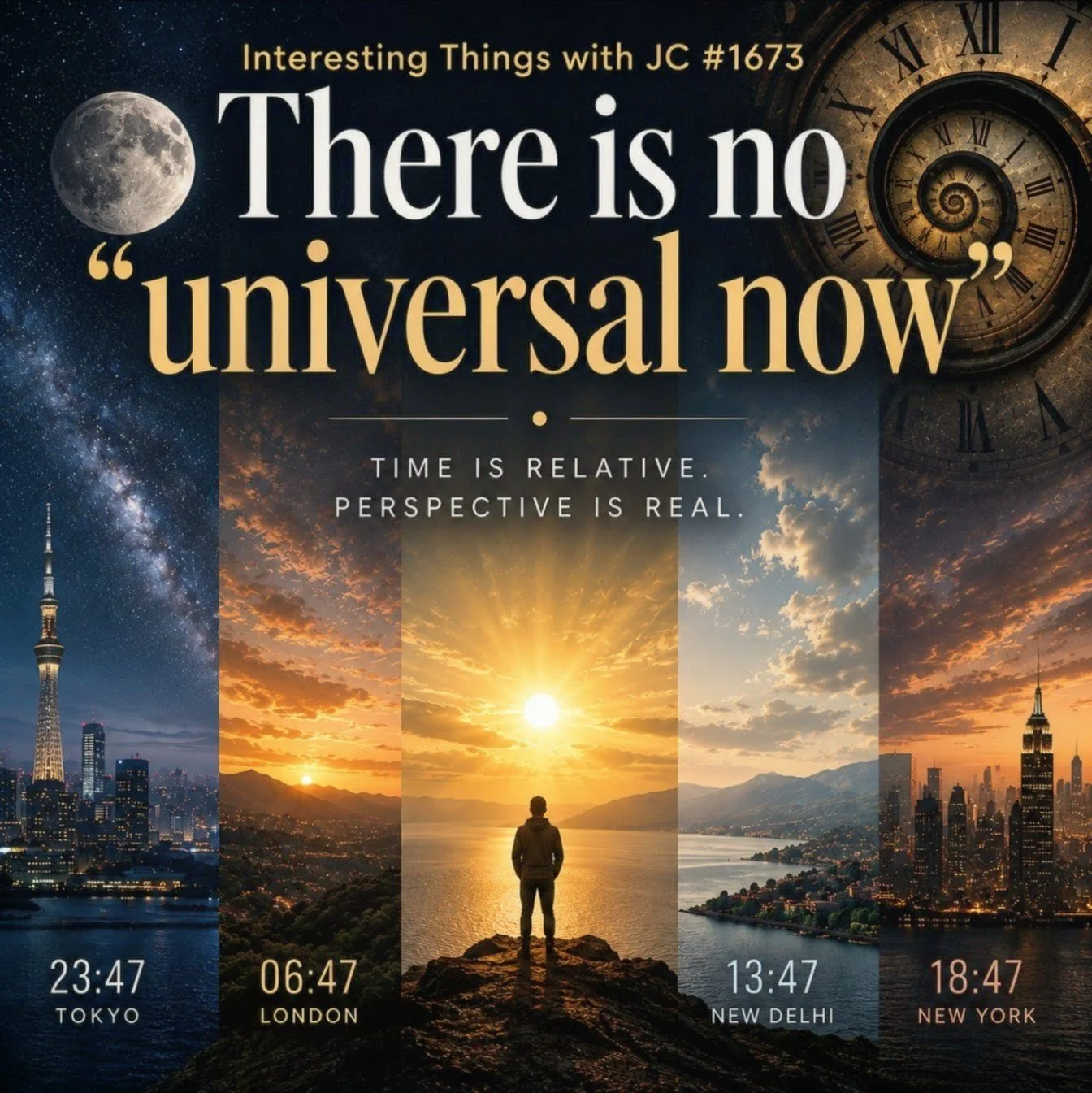
Podcast cover art for Interesting Things with JC #1673, titled “There is no universal now.” The square image shows a cinematic collage of night sky, moon, spiral clock, and four city scenes labeled Tokyo, London, New Delhi, and New York with different times. Large white and gold text fills the upper center, while a silhouetted figure stands on a rocky overlook facing a bright sun over water, suggesting relativity, time, and observer perspective.
Transcript
Interesting Things with JC #1673:
"There Is No Universal Now"
A star sits 100 light-years from Earth.
The light reaching us tonight left that star in the mid-1980s. While it was crossing space, entire generations grew up, technologies appeared and vanished, and the night sky looked almost exactly the same.
Now ask a simple question…what is happening on that star right now?
We live by clocks. We schedule meetings. We count down the final seconds before midnight and assume that "now" means the same thing everywhere.
According to modern physics, it doesn't.
In 1905, Albert Einstein showed that time is not quite what common sense suggests.
His theory of special relativity began with a stubborn fact: light always travels at the same speed, regardless of how fast the observer is moving. From that fact came an unexpected consequence.
Imagine two lightning bolts striking opposite ends of a moving train. Someone standing midway between the strikes sees the flashes arrive together and concludes the bolts struck at the same moment.
A passenger sitting midway inside the train reaches a different conclusion. Because the train is moving toward one flash and away from the other, the passenger determines that one strike happened before the other. Neither observer is mistaken. The disagreement exists because simultaneity is not absolute.
Two observers moving relative to one another can disagree about whether distant events happened at the same time, and both can be correct. What appears simultaneous to one observer may not appear simultaneous to another.
Cause and effect remain intact. Relativity does not allow the past to become the future.
What disappears is the idea that the universe shares a single present moment. Which brings us back to the star. Ask what is happening there right now and the answer depends on who is asking. One observer may assign one moment to the star. Another observer moving at a different velocity may assign another.
A star 100 light-years away is doing something at this moment.
The remarkable part is that nature never provided a universal "now." The present feels absolute because it is part of our experience, but physics suggests that beyond our local perspective, the universe may not share a single moment that everyone agrees upon.
These are interesting things, with JC.
Student Worksheet
Comprehension Questions
Why does the light from the star show us its past rather than its present?
What key observation motivated Einstein's special relativity?
Why do the train passenger and platform observer disagree?
What does relativity say about simultaneity?
Analysis Questions
How does the train example challenge common assumptions about time?
Why does relativity preserve cause and effect despite disagreements about timing?
How does the concept of a universal "now" differ from everyday experience?
Reflection Prompt
How would your view of the universe change if no single present moment exists everywhere?
Difficulty Scaling
Foundational: Define key vocabulary.
Intermediate: Explain the train example.
Advanced: Evaluate the philosophical implications of relativity of simultaneity.
Student Output
One-page written explanation or concept map demonstrating understanding of simultaneity.
Academic Integrity Guidance
Use your own words.
Cite any external sources.
Explain reasoning rather than copying definitions.
Teacher Guide
Quick Start: Play the episode. Have students record one statement that surprised them.
Pacing Guide (Audio-First)
Bell Ringer (5 min)
Podcast Listening (5 min)
Guided Discussion (10 min)
Worksheet Activities (15 min)
Assessment and Exit Ticket (10 min)
Bell Ringer: Write a definition of "now." Compare responses.
Audio Guidance: Pause after the train example to discuss observer perspectives.
Audio Fallback: Read the transcript aloud and analyze the thought experiment.
Time on Task: 45–50 minutes.
Materials
Episode audio or transcript
Student worksheet
Whiteboard or projector
Vocabulary Strategy: Preview simultaneity, observer, and reference frame before listening.
Misconceptions
Relativity means anything is true.
Relativity allows time travel into the past.
Observers disagree because one is wrong.
Discussion Prompts
Why does common sense favor a universal present?
What evidence supports Einstein's conclusion?
How does distance affect our perception of time?
Formative Checkpoints
Explain simultaneity in one sentence.
Describe the train thought experiment.
Define observer and reference frame.
Differentiation
Visual diagrams for emerging learners.
Written analysis extension for advanced learners.
Assessment Differentiation
Oral responses permitted.
Graphic organizer option available.
Time Flexibility
Condensed: 25 minutes.
Extended: 60+ minutes with research component.
Substitute Readiness: Lesson can be completed entirely from the transcript.
Engagement Strategy: Ask students whether "right now" has a universal meaning.
Extensions
Research GPS and relativity.
Explore time dilation in special relativity.
Cross-Curricular Connections
Philosophy
Mathematics
Astronomy
History of Science
SEL Connection: Encourages intellectual humility and perspective-taking.
Skill Value Emphasis
Critical thinking
Scientific reasoning
Evidence evaluation
Answer Key
Light takes time to travel through space.
Light's speed remains constant for all observers.
Motion changes how each observer measures event timing.
Simultaneity depends on the observer's frame of reference.
Quiz
What observation was central to Einstein's special relativity?
A. Gravity changes color
B. Light always travels at the same speed
C. Time stops in space
D. Stars never moveWhat is simultaneity?
A. Distance between objects
B. Force of gravity
C. Events occurring at the same time
D. Speed of motionWhy do observers on the train and platform disagree?
A. One observer is incorrect
B. Their clocks are broken
C. They occupy different reference frames
D. Lightning changes speedWhat remains intact in relativity?
A. Universal time
B. Cause and effect
C. Absolute simultaneity
D. Instant communicationAccording to the episode, what disappears?
A. Space
B. Gravity
C. Universal present time
D. Light
Assessment
Open-Ended Questions
Explain the relativity of simultaneity using the train thought experiment.
Why does modern physics challenge the idea of a universal "now"?
3–2–1 Rubric
3: Accurate explanation, evidence used, strong reasoning.
2: Mostly accurate with minor misconceptions.
1: Limited understanding or incomplete explanation.
Exit Ticket
In one sentence, explain why two observers can disagree about when an event happened.
Standards Alignment
NGSS (Next Generation Science Standards)
HS-PS4-1: Use mathematical representations and scientific reasoning to support claims about electromagnetic radiation and the behavior of light. Students analyze how the constant speed of light forms the foundation of special relativity.
Science and Engineering Practice: Developing and Using Models: Students evaluate the train-and-lightning thought experiment as a conceptual model for understanding relativity of simultaneity.
Crosscutting Concept: Systems and System Models: Students examine how measurements of time depend on the observer's frame of reference within a larger physical system.
CCSS Literacy in Science and Technical Subjects
RST.11-12.2: Determine central ideas from complex scientific explanations and summarize key concepts regarding relativity and simultaneity.
RST.11-12.7: Integrate information presented in narrative, verbal, and conceptual formats to explain scientific phenomena.
WHST.11-12.1: Construct evidence-based explanations regarding the existence or absence of a universal present moment.
WHST.11-12.9: Draw evidence from informational texts to support scientific analysis and reflection.
C3 Framework
D2.Sci.1.9-12: Use scientific reasoning to explain observable and theoretical phenomena.
D3.1.9-12: Gather and evaluate evidence supporting competing explanations of physical reality.
D4.1.9-12: Construct claims and explanations using disciplinary evidence and logical reasoning.
ISTE Standards
1.3 Knowledge Constructor: Critically evaluate scientific information and synthesize evidence from multiple sources.
1.1 Empowered Learner: Apply scientific knowledge independently to explore complex questions about space, time, and observation.
Career and Technical Education (CTE)
Scientific Research and Engineering Pathways: Analyze theoretical models used by physicists and engineers to explain observed phenomena.
Aerospace and Space Technologies: Evaluate how relativistic concepts influence astronomical observation, navigation systems, and space exploration.
STEM Problem Solving: Apply evidence-based reasoning to situations involving multiple valid observational perspectives.
College and Career Readiness
Analyze abstract scientific concepts using evidence and logic.
Distinguish between observation, interpretation, and inference.
Communicate scientific explanations using discipline-specific vocabulary.
Evaluate competing models and explanations using empirical reasoning.
Apply conceptual physics to real-world technologies such as GPS and satellite systems.
Homeschool and Lifelong Learning Alignment
Connect advanced scientific ideas to everyday experiences with time and observation.
Develop independent inquiry skills through philosophical and scientific questioning.
Strengthen scientific literacy by examining how modern physics challenges intuitive assumptions about reality.
Show Notes
This lesson explores one of the most surprising ideas in modern physics: the possibility that the universe does not share a single universal present moment. Through Einstein's theory of special relativity and the famous train thought experiment, learners investigate how observers can legitimately disagree about the timing of distant events. The topic strengthens scientific reasoning while encouraging deeper reflection about time, observation, and reality.
References
Einstein, A. (1905). On the electrodynamics of moving bodies. https://www.fourmilab.ch/etexts/einstein/specrel/www/
NASA. (2024). What is a light-year?https://spaceplace.nasa.gov/light-year/en/
Encyclopaedia Britannica. (2024). Special relativity. https://www.britannica.com/science/special-relativity
Khan Academy. (2024). Introduction to special relativity. https://www.khanacademy.org/science/physics/special-relativity