Interesting Things with JC #1674: "Subproject 68 and the Acoustic Masking Trials" – A recorded message keeps playing for up to 20 hours a day while psychiatric patients are isolated from competing stimuli, and the same phrase continues repeating thousands of times as researchers attempt to reshape thought itself.
Curriculum - Episode Anchor
Episode Title: Subproject 68 and the Acoustic Masking Trials
Episode Number: 1674
Host: JC
Audience: Grades 9–12, Introductory College, Homeschool, Lifelong Learners
Subject Area: History, Psychology, Ethics, Cold War Studies
Lesson Overview
Objectives:
Explain the goals and methods of MKULTRA Subproject 68.
Analyze the concepts of depatterning and psychic driving.
Evaluate the ethical implications of human-subject experimentation.
Assess the historical significance of MKULTRA and surviving documentation.
Essential Question: How should scientific research balance the pursuit of knowledge with the protection of human rights?
Success Criteria:
I can explain the purpose of depatterning and psychic driving.
I can identify ethical concerns raised by the experiments.
I can analyze historical evidence related to MKULTRA.
I can support conclusions using evidence from the episode.
Student Relevance Statement: Understanding historical cases of unethical research helps students recognize why informed consent, transparency, and accountability remain essential in modern medicine, psychology, and scientific research.
Real-World Connection: Modern research institutions use strict ethical review processes to protect participants. Many of these safeguards emerged because of lessons learned from controversial historical experiments.
Workforce Reality: Professionals in healthcare, psychology, law, government oversight, and research must understand ethical standards, participant rights, and responsible decision-making.
Key Vocabulary
MKULTRA(em-kay-UL-truh) — A CIA research program investigating behavior modification and mind-control techniques.
Subproject 68(sub-PROJ-ekt six-tee-eight) — A specific MKULTRA project associated with Donald Ewen Cameron's work in Montreal.
Depatterning(dee-PAT-er-ning) — An attempt to disrupt existing patterns of thought and behavior.
Psychic Driving(SY-kik DRY-ving) — Repetitive exposure to recorded messages intended to reinforce specific thoughts or behaviors.
Electroconvulsive Therapy (ECT)(ee-LEK-troh-kon-VUL-siv THER-uh-pee) — A psychiatric treatment involving controlled electrical stimulation of the brain.
Sensory Deprivation(SEN-suh-ree dep-ri-VAY-shun) — Reduction or removal of normal sensory input.
Behavior Modification(bih-HAYV-yer mod-uh-fuh-KAY-shun) — Attempts to alter human behavior through intervention or conditioning.
Informed Consent(in-FORMD kun-SENT) — Voluntary agreement to participate after understanding procedures, risks, and benefits.
Autobiographical Memory(aw-toh-by-oh-GRAF-ih-kul MEM-uh-ree) — Personal memories of one's own life experiences.
Cold War(KOLD WAR) — A period of geopolitical rivalry between the United States and the Soviet Union following World War II.
Narrative Core
Open: During the Cold War, governments, scientists, and intelligence agencies pursued answers to questions that often blurred the boundaries between research, security, and ethics.
Info: At the Allan Memorial Institute in Montreal, psychiatrist Donald Ewen Cameron conducted experiments connected to MKULTRA Subproject 68. Researchers sought to determine whether existing patterns of thought could be dismantled and replaced.
Details: Through depatterning, patients experienced intensive electroconvulsive therapy, heavy sedation, and prolonged periods of sleep. Researchers then exposed patients to repeated recorded messages, sometimes for up to twenty hours a day. The goal was to establish new behavioral patterns after weakening existing ones.
Reflection: Although researchers hoped to rebuild personality and behavior, many participants reported memory loss, disrupted identities, and lasting psychological harm. Historians continue examining the surviving evidence to understand both the experiments and their consequences.
Closing: These are interesting things, with JC.
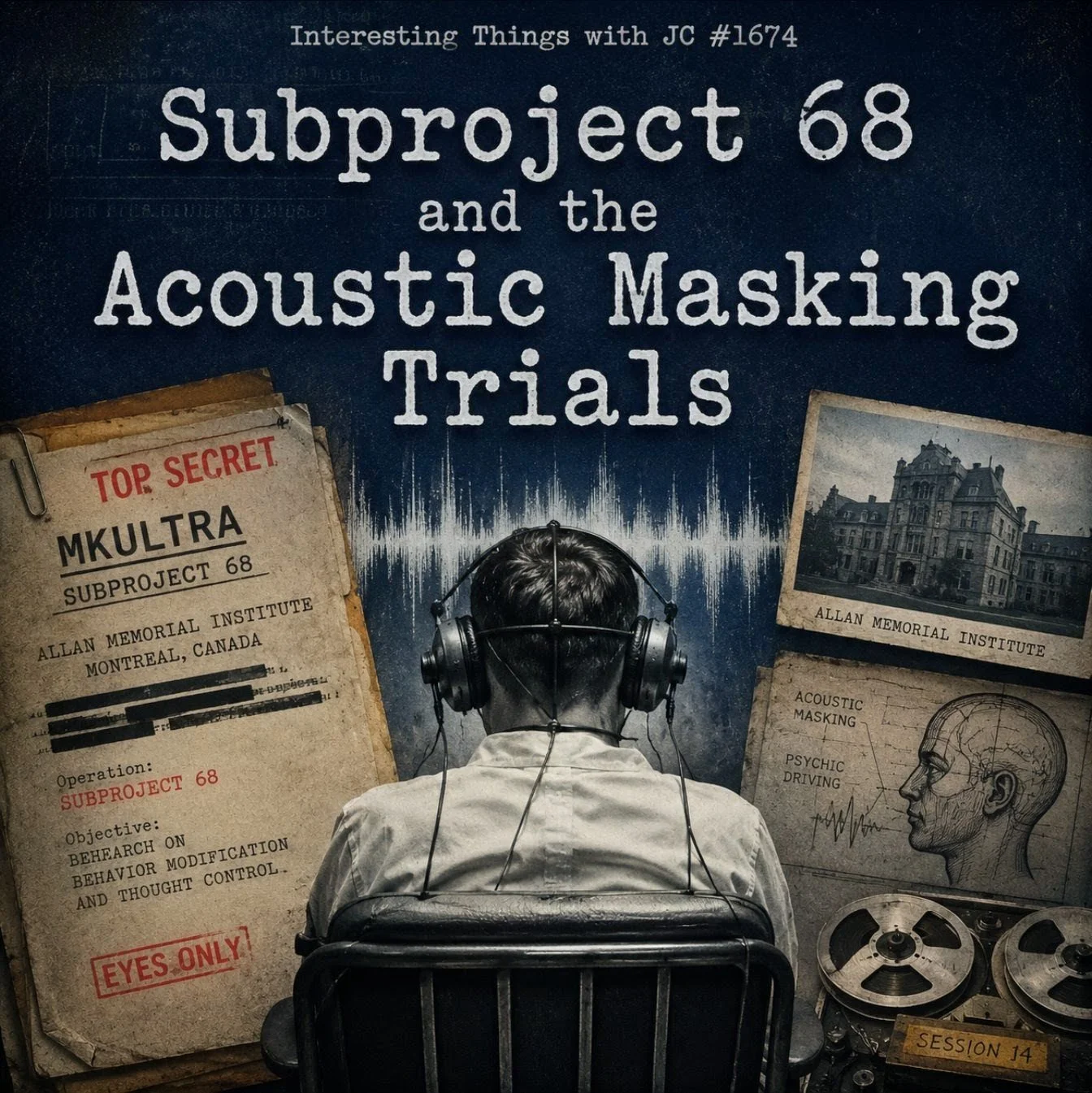
Podcast cover art for “Subproject 68 and the Acoustic Masking Trials.” A dark, vintage classified-file collage shows a person seated from behind wearing large headphones, surrounded by waveform graphics, MKULTRA documents, redactions, reel-to-reel tape equipment, and archival imagery of the Allan Memorial Institute. Text at the top reads “Interesting Things with JC #1674,” with the main title in large type across the upper center.
Transcript
Interesting Things with JC #1674:
"Subproject 68 and the Acoustic Masking Trials"
In the late 1950s, researchers in Montreal began experimenting with a question that sounds extraordinary even today. If a person heard the same message often enough, could that message eventually become part of the way they think?
The question sat at the center of MKULTRA Subproject 68, one of the projects connected to the CIA's search for methods of behavior modification during the Cold War. The work took place at the Allan Memorial Institute under psychiatrist Donald Ewen Cameron, one of the most respected figures in his profession. Cameron believed that many psychological disorders persisted because established patterns of thought and behavior remained intact. If those patterns could be broken apart, perhaps new ones could be established in their place.
The first stage of the process was called depatterning.
Patients were subjected to intensive electroconvulsive therapy, heavy sedation, and prolonged periods of drug-induced sleep. Some also received hallucinogenic drugs. The objective was to weaken existing patterns of thought and behavior to the point that something new might eventually replace them.
Many of the people undergoing these treatments had entered the institute seeking help for anxiety, depression, postpartum depression, or other personal difficulties. They arrived expecting psychiatric care. Instead, they became participants in an experiment that attempted something far more ambitious.
Once depatterning had weakened existing patterns, Cameron turned to the part of the research that made Subproject 68 so unusual.
Recorded messages.
Patients listened through speakers, headphones, and pillow speakers. Some recordings encouraged confidence, self-worth, or improved behavior. Others focused on guilt, failure, or unwanted habits. The content varied, but the method remained the same.
The message was repeated.
Then repeated again.
And again.
In documented cases, recordings played for 16 to 20 hours a day over periods lasting days or weeks. A patient might hear a single phrase thousands of times. One commonly cited example was, "You are becoming a better mother."
The recordings were often paired with conditions that reduced competing stimulation. Ordinary routines disappeared. Social interaction could be limited. Outside distractions were reduced. Historians generally describe these conditions as part of a broader sensory-deprivation strategy rather than acoustic masking in the modern engineering sense, but sound remained central to the experiment. The fewer competing inputs a patient experienced, the more completely the recorded message filled the environment.
The entire approach rested on the belief that repetition could help establish new patterns of thought after existing ones had been weakened.
What followed became one of the reasons Subproject 68 remains controversial today.
The surviving record contains far more evidence of damage than reconstruction.
Former patients reported severe memory loss, loss of autobiographical memories, difficulty recognizing family members, and the need to relearn skills they had once performed without effort. Some described losing memories of spouses, children, education, and careers. The treatments were intended to rebuild. The clearest evidence they left behind involved what had been lost.
The CIA's interest reflected broader Cold War concerns about brainwashing, coercion, interrogation resistance, and psychological control. Through intermediary organizations, including the Society for the Investigation of Human Ecology, funding eventually reached Cameron's work in Montreal. Most patients never understood those connections. They believed they were receiving medical treatment.
When investigations and Senate hearings began exposing aspects of MKULTRA during the 1970s, much of the documentary record had already been destroyed. CIA Director Richard Helms ordered most MKULTRA files destroyed in 1973. What survives comes from financial records, testimony, lawsuits, and a small collection of overlooked documents.
Subproject 68 began with an attempt to determine whether personality could be reshaped through repetition, isolation, and carefully controlled sensory environments.
Decades later, the surviving record provides a clearer answer about the risks than the promise. The experiment was designed to reconstruct the mind. What historians have spent years reconstructing instead is the story of the experiment itself.
These are interesting things, with JC.
Student Worksheet
Comprehension Questions
What central question motivated Subproject 68?
What was the purpose of depatterning?
What methods were used during depatterning?
How were recorded messages used during psychic driving?
Why were sensory-reduction conditions included?
What effects did former patients report after treatment?
Analysis Questions
Why might researchers have believed repetition could influence behavior?
What role did sensory deprivation play in the experiment?
How does incomplete documentation affect historical research?
What ethical responsibilities do researchers have when working with vulnerable populations?
Reflection Prompt
Should scientific research ever proceed when participants do not fully understand the risks involved? Use evidence from the lesson to support your position.
Difficulty Scaling
Level 1: Complete comprehension questions.
Level 2: Complete comprehension and analysis questions.
Level 3: Write a one-page evidence-based essay evaluating the historical and ethical significance of Subproject 68.
Student Output Expectations
Students will produce written responses supported by evidence from the episode and classroom discussion.
Academic Integrity Guidance
Use your own words, support claims with evidence, and clearly distinguish factual information from personal opinion.
Teacher Guide
Quick Start
Introduce the ethical question of informed consent, play the episode, facilitate discussion, complete the worksheet, and conclude with assessment activities.
Pacing Guide (Audio-First)
Bell Ringer — 5 minutes
Vocabulary Preview — 5 minutes
Podcast Listening — 12 minutes
Guided Discussion — 10 minutes
Worksheet Completion — 15 minutes
Assessment and Exit Ticket — 8 minutes
Bell Ringer
Write: "What responsibilities do researchers have toward the people who participate in their studies?"
Audio Guidance
Students should listen for:
Research goals
Experimental methods
Reported outcomes
Ethical concerns
Audio Fallback
Use the transcript for guided reading and annotation if audio is unavailable.
Time on Task
Approximately 55 minutes.
Materials
Podcast audio or transcript
Student worksheet
Note-taking materials
Whiteboard or projector
Vocabulary Prep
Preview key terms and encourage students to identify examples during listening.
Misconceptions
Historical researchers operated under the same standards as modern researchers.
Intelligence agencies had complete knowledge of all project outcomes.
Memory loss was the intended outcome rather than an unintended consequence.
Discussion Prompts
Why was behavior modification considered important during the Cold War?
What ethical issues emerge when patients are unaware of experimental goals?
Why is historical evidence sometimes incomplete?
How can modern oversight reduce research risks?
Formative Checkpoints
Vocabulary understanding
Discussion participation
Worksheet completion
Evidence-based responses
Differentiation
Provide guided notes for developing learners.
Allow oral responses.
Offer advanced research extensions.
Use small-group discussion supports.
Assessment Differentiation
Essay
Presentation
Structured interview
Graphic organizer
Time Flexibility
Can be completed in one class period or expanded into a multi-day unit.
Substitute Readiness
All lesson materials are self-contained and require no specialized preparation.
Engagement Strategy
Students evaluate historical decisions through the lens of modern ethical standards.
Extensions
Research modern informed-consent practices.
Investigate Senate hearings related to MKULTRA.
Compare historical and current research oversight systems.
Cross-Curricular Connections
History
Psychology
Ethics
Government
Law
Health Sciences
SEL Connection
Students examine trust, responsibility, empathy, and respect for human dignity.
Skill Emphasis
Critical Thinking
Historical Analysis
Source Evaluation
Ethical Reasoning
Evidence-Based Writing
Communication
Answer Key
To determine whether repeated messages could influence thought and behavior.
To weaken existing patterns of thought and behavior.
ECT, sedation, drug-induced sleep, and in some cases hallucinogens.
Messages were repeated continuously to reinforce specific ideas.
To reduce competing stimuli and maximize message exposure.
Memory loss, autobiographical memory disruption, and difficulty recognizing family members.
Analysis and reflection responses should demonstrate evidence-based reasoning.
Quiz
Which organization sponsored MKULTRA-related research?
A. FBI
B. CIA
C. NSA
D. Department of Defense
What was the purpose of depatterning?
A. Improve memory
B. Create new medications
C. Weaken existing thought patterns
D. Increase intelligence
What technique involved repetitive recorded messages?
A. Behavioral Mapping
B. Neural Conditioning
C. Psychic Driving
D. Cognitive Reinforcement
Why were sensory-reduction conditions used?
A. Improve sleep quality
B. Reduce competing stimulation
C. Increase physical endurance
D. Test hearing ability
Why is the historical record incomplete?
A. Equipment failure
B. Lost archives
C. Intentional destruction of records
D. Lack of participants
Assessment
Open-Ended Questions
Explain how depatterning and psychic driving were intended to work together within Subproject 68.
Evaluate the ethical challenges presented by the experiments and explain how modern research standards address those concerns.
3–2–1 Rubric
3 — Proficient
Thorough explanation
Strong supporting evidence
Clear reasoning and analysis
2 — Developing
Adequate explanation
Some supporting evidence
Partial analysis
1 — Beginning
Limited explanation
Minimal evidence
Incomplete analysis
Exit Ticket
What is one new fact you learned today?
What is one ethical concern raised by this episode?
What question do you still have?
Standards Alignment
NGSS Science and Engineering Practices
Analyzing and Interpreting Data: Evaluate evidence concerning the methods and outcomes of historical psychological research.
Constructing Explanations and Designing Solutions: Explain relationships between research design, intended objectives, and observed consequences.
Engaging in Argument from Evidence: Support conclusions regarding ethics and effectiveness using documented evidence.
Obtaining, Evaluating, and Communicating Information: Critically assess historical sources and communicate findings accurately.
Common Core State Standards (CCSS) — History/Social Studies
CCSS.ELA-LITERACY.RH.9-10.1: Cite specific textual evidence to support analysis of primary and secondary sources.
CCSS.ELA-LITERACY.RH.9-10.2: Determine central ideas and provide accurate summaries of complex historical texts.
CCSS.ELA-LITERACY.RH.11-12.3: Evaluate sequences of events and explain causal relationships.
CCSS.ELA-LITERACY.RH.11-12.6: Analyze differing viewpoints regarding historical events and interpretations.
CCSS.ELA-LITERACY.RH.11-12.8: Evaluate claims, reasoning, and evidence.
CCSS.ELA-LITERACY.WHST.9-12.1: Write evidence-based arguments focused on historical and ethical issues.
CCSS.ELA-LITERACY.WHST.9-12.9: Draw evidence from informational texts to support analysis and reflection.
CCSS.ELA-LITERACY.SL.9-12.1: Participate effectively in collaborative academic discussions.
C3 Framework for Social Studies
D2.His.1.9-12: Evaluate how historical events shape institutions and policy.
D2.His.4.9-12: Analyze complex causes and effects of historical developments.
D2.His.14.9-12: Analyze multiple and changing causes of historical events.
D3.1.9-12: Gather and evaluate evidence from multiple sources.
D3.2.9-12: Evaluate credibility of sources and evidence.
D4.1.9-12: Construct arguments using disciplinary evidence.
D4.4.9-12: Critique arguments using claims and evidence.
ISTE Standards for Students
1.3 Knowledge Constructor: Critically evaluate information from digital and historical sources.
1.4 Innovative Designer: Analyze systems and develop evidence-based solutions to complex problems.
1.5 Computational Thinker: Examine systematic processes and evaluate outcomes logically.
1.7 Global Collaborator: Consider multiple perspectives and contexts when evaluating historical events.
Career and Technical Education (CTE) Alignment
Research and Information Literacy
Ethical and Legal Responsibilities
Professional Communication
Documentation Analysis
Critical Thinking and Problem Solving
Risk Assessment and Decision Making
Data Interpretation
Workplace Accountability
Psychology Education Alignment
Research Methods
Experimental Design
Human Subjects Protection
Memory and Cognition
Learning Theory
Behavioral Psychology
Ethics in Psychological Research
College and Career Readiness Skills
Evidence Evaluation
Source Validation
Historical Reasoning
Written Communication
Oral Communication
Ethical Decision Making
Critical Analysis
Information Literacy
Problem Solving
Professional Judgment
Workforce Competencies
Accountability
Professional Ethics
Documentation Review
Investigative Analysis
Communication Skills
Evidence-Based Decision Making
Risk Awareness
Compliance Understanding
Homeschool and Lifelong Learning Alignment
Independent Inquiry
Historical Investigation
Self-Directed Research
Media Literacy
Ethical Reasoning
Civic Awareness
Critical Consumption of Information
Show Notes
This lesson explores MKULTRA Subproject 68 and the experiments conducted by psychiatrist Donald Ewen Cameron at the Allan Memorial Institute. Students examine the methods of depatterning and psychic driving, the broader Cold War context that motivated behavior-modification research, and the ethical questions raised by human-subject experimentation. Through historical analysis and evidence-based discussion, learners develop a deeper understanding of research ethics, informed consent, and the importance of accountability in scientific inquiry.
References
Central Intelligence Agency. (1977). MKULTRA collection and related records. https://www.cia.gov/readingroom/collection/mkultra
National Security Archive. (2001). The CIA and mind control: Behavioral modification research. https://nsarchive2.gwu.edu/NSAEBB/NSAEBB54/
U.S. Senate Select Committee on Intelligence. (1977). Project MKULTRA, the CIA's program of research in behavioral modification. https://www.intelligence.senate.gov/sites/default/files/hearings/95mkultra.pdf