1701: "July 2, 1776 - The Day the Decision Was Made"
Interesting Things with JC #1701: "July 2, 1776 - The Day the Decision Was Made"
Congress was already directing a war against Great Britain while still debating whether the colonies should become independent. On July 2, 1776, delegates voted to make independence official, then immediately turned to editing the Declaration that would explain a decision that had already been made.
Curriculum - Episode Anchor
Episode Title: July 2, 1776 - The Day the Decision Was Made
Episode Number: 1701
Host: JC
Audience: Grades 9–12, Introductory College, Homeschool, Lifelong Learners
Subject Area: United States History / Civics / Government
Lesson Overview
Objectives:
Explain why July 2, 1776, was the decisive political turning point in American independence.
Distinguish between the vote for independence and the adoption of the Declaration of Independence.
Analyze how political decision-making, compromise, and individual actions shaped historical events.
Evaluate why historical memory sometimes emphasizes symbolic events over the decisions that made them possible.
Essential Question:
When did the American colonies actually decide to become independent, and why is that different from the adoption of the Declaration of Independence?
Success Criteria:
Students accurately explain the difference between July 2 and July 4, 1776.
Students identify the importance of Richard Henry Lee's resolution.
Students describe how individual delegates influenced the outcome.
Students support conclusions using evidence from the podcast.
Student Relevance Statement:
Major historical events often result from difficult decisions made before the public remembers them. Understanding those decisions helps students evaluate leadership, civic responsibility, and historical evidence.
Real-World Connection:
Governments, businesses, courts, and organizations frequently make decisions before announcing them publicly. Understanding this process builds media literacy and civic understanding.
Workforce Reality:
Professionals in law, government, journalism, business, and public administration must distinguish between a decision itself and the document or announcement explaining that decision.
Key Vocabulary
Continental Congress(kon-tuh-NEN-tuhl KONG-gris) — The governing assembly representing the thirteen American colonies.
Independence(in-di-PEN-dents) — Freedom from political control by another nation.
Resolution(rez-uh-LOO-shun) — A formal proposal for action or policy.
Declaration(dek-luh-RAY-shun) — A formal written statement explaining a position or decision.
Unanimity(yoo-nuh-NIM-uh-tee) — Complete agreement among all participants.
Abstain(ab-STAYN) — To choose not to vote.
Treason(TREE-zun) — Betraying one's country; under British law, a capital offense.
Reconciliation(rek-un-sil-ee-AY-shun) — Restoration of friendly relations after conflict.
Olive Branch Petition(OL-iv Branch puh-TISH-un) — Congress's final appeal for peace with King George III in 1775.
Sovereignty(SOV-rin-tee) — The authority of a state to govern itself independently.
Narrative Core
Open
History remembers famous documents, but important decisions often happen before those documents are written. America's independence followed exactly that pattern.
Info
By the summer of 1776, fighting had already been underway for more than a year. Battles had been fought, lives had been lost, and reconciliation with Great Britain had become increasingly unlikely.
Details
On July 2, 1776, the Continental Congress voted on Richard Henry Lee's resolution declaring that the colonies "are, and of right ought to be, free and independent States." The vote required political compromise and remarkable personal determination. Caesar Rodney's overnight ride allowed Delaware to support independence, Pennsylvania overcame internal division, South Carolina changed its position to preserve colonial unity, and New York abstained because its delegates lacked voting authority.
The result transformed Congress from a body seeking compromise into the government of independent states possessing the authority to wage war, negotiate treaties, and govern themselves. Only afterward did Congress continue editing Thomas Jefferson's Declaration of Independence to explain the decision that had already been made.
Reflection
History often celebrates the publication of important ideas, yet the decisive moment usually comes when people choose to act upon them. The vote of July 2 represents that moment in American history.
Closing
These are interesting things, with JC.
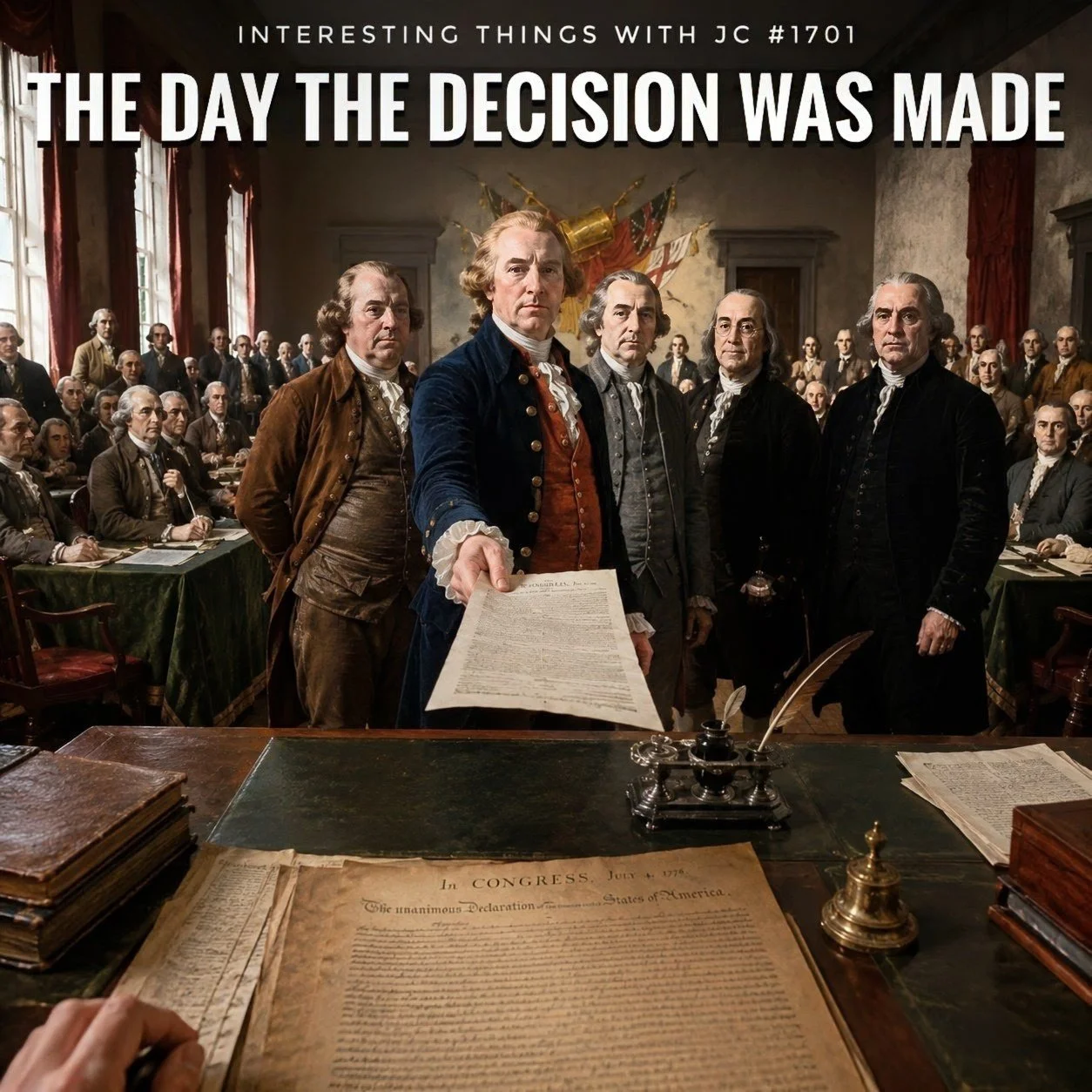
Podcast cover for Interesting Things with JC #1701, titled "The Day the Decision Was Made." From a first person perspective at the president's table, members of the Committee of Five present the draft Declaration of Independence inside the Continental Congress chamber as delegates watch. Large white title text appears across the top.
Transcript
Interesting Things with JC #1701:
July 2, 1776 - The Day the Decision Was Made
By the summer of 1776, Americans were already fighting a war for independence. The only problem was that the Continental Congress hadn't decided there would be one.
Blood had been spilled at Lexington and Concord. Boston had endured a siege. An American invasion of Canada had failed. For more than a year, Congress had debated petitions, compromise, and reconciliation with Great Britain. Only eight months earlier, many of the same delegates had signed the Olive Branch Petition, one last appeal to King George III. He refused even to receive it.
By July 2, there was only one question left.
Richard Henry Lee's resolution declared "that these United Colonies are, and of right ought to be, free and independent States." Congress wasn't debating Jefferson's Declaration of Independence. It was deciding whether independence itself would become the policy of the thirteen colonies.
The vote was anything but routine. Pennsylvania's delegation was divided. Delaware was deadlocked until Caesar Rodney, suffering from severe asthma and facial cancer, rode nearly 80 miles (129 kilometers) through the night from Dover to Philadelphia, arriving in time to cast the deciding vote for his colony. South Carolina abandoned its earlier opposition to preserve unity. New York's delegates abstained because they had not yet been authorized to vote, although New York would approve independence a week later.
When the roll call ended, twelve colonies had voted for independence. None had voted against it.
There was no celebration inside the chamber. The delegates turned almost immediately to Thomas Jefferson's draft, editing the document that would explain what they had just done.
The vote had already changed everything.
Congress was no longer petitioning the Crown. It was claiming the powers of independent states—to wage war, make treaties, govern themselves, and stand as nations in their own right. If Britain prevailed, many of the men who had voted that day expected to face trial for high treason, a crime that could carry the death penalty.
Two days later, Congress approved the final wording of the Declaration of Independence. It became one of the most influential political documents ever written, but it did not make the colonies independent. It explained a decision that had already been made.
John Adams understood the distinction. Writing to Abigail on July 3, he predicted that July 2 would be celebrated by future generations with bells, bonfires, parades, and fireworks. History chose July 4 instead, the day the Declaration was adopted.
But if you want to know when the United States committed itself to independence, look two days earlier. That's when the debate ended, the votes were counted, and there was no road back.
These are interesting things, with JC.
Student Worksheet
Name: ____________________________
Date: ____________________________
Class: ____________________________
Listening Instructions
Listen to the podcast episode once without taking notes.
During the second listening, record key facts, important people, and major events that explain why July 2, 1776, was the turning point in the American Revolution.
Part A — Comprehension
Answer in complete sentences.
Why does the episode begin by saying Americans were already fighting a war before Congress had decided there would be one?
What was the purpose of the Olive Branch Petition?
What did Richard Henry Lee's resolution propose?
Why was Caesar Rodney's ride important?
Why did New York abstain during the vote?
What powers did Congress claim after approving independence?
Why did many delegates believe they were risking their lives?
According to the episode, what did the Declaration of Independence actually do?
Part B — Analysis
Use evidence from the podcast.
Explain the difference between voting for independence and writing the Declaration of Independence.
Why did several colonies change or reconsider their positions before the final vote?
Why do you think historians often remember July 4 more than July 2?
Part C — Historical Evidence
For each statement, write Fact, Interpretation, or Opinion.
Twelve colonies voted for independence.
July 2 was the decisive political turning point.
Caesar Rodney rode through the night to Philadelphia.
The Declaration explained a decision already made.
July 4 became the better-known anniversary.
Part D — Timeline
Place these events in chronological order.
Adoption of the Declaration of Independence
Lexington and Concord
Olive Branch Petition
Vote on Lee's Resolution
Siege of Boston
Invasion of Canada
New York approves independence
Part E — Reflection
Write one paragraph.
Prompt:
Why is it important to understand the difference between making a decision and explaining a decision? Use examples from the episode and one modern example from government, business, school, or everyday life.
Expected Length: 8–10 sentences.
Difficulty Scaling
Level 1
Complete Parts A and D.
Level 2
Complete Parts A–D.
Level 3
Complete every section, citing evidence from the podcast in your reflection.
Student Output Expectations
By the end of this lesson you should be able to:
Explain why July 2 mattered.
Identify the role of several delegates.
Distinguish historical events from historical symbols.
Support historical conclusions with evidence.
Academic Integrity Guidance
Complete all written responses using your own words.
Use the podcast as your primary source of evidence.
If additional sources are consulted, cite them appropriately.
Focus on explaining ideas rather than copying language.
Teacher Guide
Quick Start
Begin class by playing the podcast uninterrupted.
Ask students to record only three ideas they found surprising.
Replay selected portions while students complete the worksheet.
Conclude with discussion and reflection.
Pacing Guide (Audio-First)
ActivityTimeBell Ringer5 minFirst Listening8 minInitial Discussion7 minSecond Listening8 minWorksheet20 minClass Discussion10 minReflection & Exit Ticket7 min
Total: Approximately 65 minutes
Bell Ringer
Display:
"What makes a nation independent—the decision to become independent or the document announcing it?"
Students write a brief response before listening.
Audio Guidance
First listening:
Listen for the overall story.
Do not pause the recording.
Second listening:
Pause after major sections.
Encourage students to record evidence rather than opinions.
Audio Fallback
If audio is unavailable:
Read the transcript aloud.
Assign sections to student readers.
Maintain the same pacing and discussion schedule.
Time on Task
Listening: 16 minutes
Writing: 25 minutes
Discussion: 17 minutes
Assessment: 7 minutes
Materials
Podcast audio
Transcript
Student worksheet
Pens or pencils
Whiteboard
Timeline graphic (optional)
Vocabulary Strategy
Introduce vocabulary before listening.
During the second listening, ask students to identify each term in context rather than memorize definitions.
Common Misconceptions
July 4 created independence.
The Declaration itself was the vote.
Every colony supported independence immediately.
Congress unanimously agreed without debate.
Britain recognized independence in July 1776.
Discuss why each statement is inaccurate.
Discussion Prompts
Why might governments delay making difficult decisions?
Why was colonial unity so important?
What risks did delegates knowingly accept?
Why do some historical dates become more famous than others?
How can public memory differ from historical reality?
Formative Checkpoints
Students should be able to:
Explain Lee's Resolution.
Describe Caesar Rodney's role.
Distinguish July 2 from July 4.
Explain why New York abstained.
Identify the purpose of the Declaration.
Differentiation
Support
Provide vocabulary organizers.
Offer guided notes.
Pair students during discussion.
Extension
Compare July 2 with another historic political decision.
Research one delegate who voted for independence.
Assessment Differentiation
Students may demonstrate learning through:
Written responses
Oral presentation
Timeline project
Graphic organizer
Short essay
Time Flexibility
45-minute class
Podcast
Bell Ringer
Parts A and B
Exit Ticket
90-minute class
Entire lesson
Extended discussion
Delegate research activity
Substitute Readiness
This lesson is fully self-contained.
A substitute can follow the pacing guide using only:
Podcast
Transcript
Worksheet
Teacher Guide
Engagement Strategy
Conduct a mock roll-call vote.
Assign students different colonies using historical voting positions and discuss why each delegation voted as it did.
Extensions
Compare the Declaration with later declarations of independence around the world.
Examine how governments formally recognize sovereignty.
Analyze John Adams' July 3 letter to Abigail.
Cross-Curricular Connections
Civics
Government
Political Science
English Language Arts
Constitutional Studies
SEL Connection
Students examine courage, responsibility, ethical decision-making, and the consequences of leadership under uncertainty.
Skill Value Emphasis
Students strengthen:
Evidence evaluation
Historical reasoning
Civic literacy
Critical thinking
Written communication
Decision analysis
Answer Key
Part A
Fighting began before Congress formally adopted independence.
It sought reconciliation with King George III.
It declared the colonies should become free and independent states.
Rodney broke Delaware's deadlock by arriving in time to vote.
Its delegates lacked authorization from their colony.
To wage war, make treaties, govern themselves, and act as sovereign states.
They could have been charged with high treason if Britain won.
It explained and justified independence rather than creating it.
Part B
Responses should include:
July 2 = decision.
July 4 = explanation.
Political compromise and colonial unity.
Historical memory versus historical events.
Part C
Fact
Interpretation
Fact
Interpretation
Fact
Part 2 complete.
Next installment:
Quiz
Assessment
Standards Alignment (expanded with CCSS, C3, ISTE/CTE, NGSS where applicable, Career Readiness, Homeschool/Lifelong Learning, and measurable justifications)
Show Notes
References
Required closing statement.
Quiz
Instructions: Choose the best answer for each question. Select only one answer for each item.
What issue was the Continental Congress deciding on July 2, 1776?
A. Whether to declare war on France
B. Whether the colonies should become independent states
C. Whether to replace George Washington
D. Whether to adopt the Articles of Confederation
Why was Caesar Rodney's arrival in Philadelphia significant?
A. He wrote the Declaration of Independence.
B. He persuaded New York to vote.
C. He broke Delaware's tie by casting its deciding vote.
D. He introduced Richard Henry Lee's resolution.
Why did New York abstain during the vote on independence?
A. It supported Great Britain.
B. Its delegates had not yet received authority to vote.
C. Its delegates were absent from Congress.
D. It wished to remain neutral throughout the war.
According to the podcast, what was the primary purpose of the Declaration of Independence?
A. To begin the Revolutionary War
B. To create the Continental Congress
C. To explain and justify the decision for independence
D. To negotiate peace with Britain
Which statement best summarizes the episode's central idea?
A. July 4 marked the beginning of the Revolution.
B. Independence became official when Congress voted on July 2.
C. The Olive Branch Petition ended the conflict.
D. Britain granted independence after the Declaration was signed.
Assessment
Open-Ended Questions
Using evidence from the podcast, explain why July 2, 1776, can be considered the true political turning point of the American Revolution. Include at least three pieces of historical evidence.
Compare the vote on Richard Henry Lee's resolution with the adoption of the Declaration of Independence. Why is understanding the difference important for interpreting American history?
3–2–1 Rubric
3 – Proficient
Explains the distinction between the July 2 vote and the July 4 Declaration accurately.
Uses multiple pieces of historical evidence.
Demonstrates strong historical reasoning and clear written communication.
2 – Developing
Shows a general understanding but includes minor inaccuracies or incomplete explanations.
Uses limited supporting evidence.
Demonstrates developing analytical skills.
1 – Beginning
Confuses the sequence or significance of events.
Provides little or no supporting evidence.
Responses require additional historical understanding.
Exit Ticket
Before leaving class, answer the following in one or two sentences:
If someone says, "The United States became independent on July 4, 1776," how would you respond using evidence from today's lesson?
Standards Alignment
NGSS (Science & Engineering Practices—Historical Inquiry Application)
Practice SEP 8: Obtaining, Evaluating, and Communicating Information
Connection: Students analyze a primary-source-based historical narrative and distinguish factual evidence from interpretation.
Measurable Outcome: Students cite evidence from the transcript to support historical conclusions.
Justification: Although this lesson is history-based, students practice evaluating evidence and communicating conclusions using disciplinary inquiry skills.
CCSS Reading
CCSS.ELA-LITERACY.RH.9-10.1
Cite specific textual evidence to support analysis of primary and secondary sources.
Connection: Students use the transcript to answer worksheet and assessment questions.
Measurable Outcome: Students support written responses with evidence from the podcast.
CCSS.ELA-LITERACY.RH.9-10.2
Determine the central ideas of a primary or secondary source.
Connection: Students identify the episode's central historical argument regarding July 2 versus July 4.
Measurable Outcome: Students summarize the historical significance of the congressional vote.
CCSS.ELA-LITERACY.RH.11-12.6
Evaluate authors' differing points of view on the same historical event.
Connection: Students compare popular historical memory with the historical record.
Measurable Outcome: Students distinguish between symbolic and political milestones.
CCSS Writing
CCSS.ELA-LITERACY.WHST.9-10.1
Write arguments focused on discipline-specific content.
Connection: Students defend the significance of July 2 using historical evidence.
Measurable Outcome: Assessment responses include evidence-based historical reasoning.
CCSS.ELA-LITERACY.WHST.11-12.9
Draw evidence from informational texts to support analysis and reflection.
Connection: Students incorporate transcript evidence into written responses.
Measurable Outcome: Students produce historically supported written arguments.
CCSS Speaking & Listening
CCSS.ELA-LITERACY.SL.11-12.1
Initiate and participate effectively in collaborative discussions.
Connection: Students participate in guided classroom discussion and mock congressional debate.
Measurable Outcome: Students contribute evidence-based responses during discussion activities.
C3 Framework for Social Studies
D2.His.1.9-12
Evaluate how historical events and developments were shaped by unique circumstances.
Connection: Students analyze the political conditions leading to independence.
Measurable Outcome: Students explain how congressional debate influenced the Revolution.
D2.Civ.4.9-12
Explain how individuals influence governmental institutions and political decisions.
Connection: Students evaluate the roles of Caesar Rodney, Richard Henry Lee, Thomas Jefferson, and other delegates.
Measurable Outcome: Students explain how individual actions affected national outcomes.
ISTE Standards
ISTE 1.3 Knowledge Constructor
Students critically evaluate information from credible historical sources.
Connection: Students distinguish historical evidence from popular misconceptions.
Measurable Outcome: Students demonstrate source evaluation and historical literacy.
Career Readiness Competencies
Analytical Thinking: Evaluate historical evidence before drawing conclusions.
Communication: Present historical arguments clearly in writing and discussion.
Problem Solving: Analyze competing viewpoints during congressional debate.
Adaptability: Recognize how political leaders adjusted positions to preserve unity.
Professional Judgment: Differentiate between decisions, announcements, and historical interpretation.
Homeschool / Lifelong Learning Alignment
Independent Learning: Students complete guided historical inquiry using primary-source material.
Information Literacy: Students evaluate evidence rather than relying on common historical assumptions.
Real-World Application: Students connect governmental decision-making to modern civic institutions.
Self-Directed Inquiry: Students investigate additional delegates and events from 1776.
Transferable Life Skills: Students strengthen critical thinking, evidence evaluation, communication, and informed citizenship.
Show Notes
This lesson explores one of the most misunderstood moments in American history by distinguishing the Continental Congress's vote for independence on July 2, 1776, from the adoption of the Declaration of Independence on July 4. Through historical evidence, discussion, and primary-source analysis, students examine how political decisions are made, why compromise matters, and how public memory sometimes emphasizes symbolic moments over the events that actually changed history.
References
American Battlefield Trust. (n.d.). The Lee Resolution. https://www.battlefields.org/learn/primary-sources/lee-resolution
Library of Congress. (n.d.). Continental Congress and the Declaration of Independence. https://guides.loc.gov/declaration-of-independence/digital-collections
National Archives. (n.d.). Declaration of Independence: A Transcription. https://www.archives.gov/founding-docs/declaration-transcript
National Constitution Center. (n.d.). The Road to Independence. https://constitutioncenter.org/the-constitution/historic-document-library
U.S. Department of State, Office of the Historian. (n.d.). Milestones: 1776–1783—The Declaration of Independence. https://history.state.gov/milestones/1776-1783/declaration