1702: "July 3rd, 1776 - The Message Had to Be Perfect"
Interesting Things with JC #1702: "July 3rd, 1776 - The Message Had to Be Perfect"
Congress was rewriting Thomas Jefferson's Declaration of Independence after the colonies had already voted for independence, removing entire passages and reshaping its language before a single copy could be printed until the document became a statement meant for the world instead of one man's argument.
Curriculum - Episode Anchor
Episode Title: The Message Had to Be Perfect
Episode Number: 1702
Host: JC
Audience: Grades 9–12, Introductory College, Homeschool, Lifelong Learners
Subject Area: U.S. History, Government, Civics, Writing, Political Communication
Lesson Overview
Objectives:
Explain why the Continental Congress continued revising the Declaration of Independence after voting for independence.
Analyze how editorial decisions influenced the historical and political impact of the Declaration.
Evaluate the relationship between persuasive writing, diplomacy, and national unity.
Distinguish between personal expression and writing intended for a public audience.
Essential Question:
Why can the editing of a historic document be just as important as writing its first draft?
Success Criteria:
Students identify major revisions Congress made to Jefferson's draft.
Students explain why those revisions were made.
Students analyze how audience influences written communication.
Students support conclusions using evidence from the episode.
Student Relevance Statement:
Students revise essays, emails, social media posts, scholarship applications, and presentations. This lesson demonstrates that even history's most famous writers relied on editing to communicate effectively.
Real-World Connection:
Professional writers, attorneys, diplomats, journalists, engineers, and business leaders all revise important documents before publication. Effective communication is rarely the product of a first draft.
Workforce Reality:
Nearly every profession values collaboration, editing, and peer review. Strong ideas become stronger through careful revision and consideration of the intended audience.
Key Vocabulary
Declaration of Independence(dek-luh-RAY-shun uv in-duh-PEN-dents) — The document announcing that the American colonies considered themselves independent states.
Continental Congress(kon-tuh-NEN-tuhl KON-gris) — The governing assembly representing the thirteen colonies during the American Revolution.
Draft(draft) — An early version of a written document prepared for revision.
Revision(rih-VIZH-un) — Changes made to improve clarity, accuracy, or effectiveness.
Consensus(kun-SEN-sus) — General agreement among members of a group.
Diplomacy(dih-PLOH-muh-see) — Managing relationships between governments through careful communication and negotiation.
Grievance(GREE-vuhns) — A formal complaint about unfair treatment.
Consent of the Governed(kun-SENT uv thuh GUV-ernd) — The principle that a government's authority comes from the people.
Unalienable Rights(un-AYL-yuh-nuh-bul rights) — Rights believed to belong naturally to every person and cannot legitimately be taken away.
Editorial Process(ed-ih-TOR-ee-ul PROH-sess) — Reviewing and revising written work before publication.
Narrative Core
Open:
Most people remember July 4, 1776, as the birth of the United States. Yet one day earlier, another important event unfolded—not on a battlefield, but around a table where delegates debated words.
Info:
Although independence had already been approved, Congress understood that the Declaration would become the nation's introduction to the world. Every sentence would communicate not only to Americans but also to foreign governments whose recognition and support might prove essential.
Details:
Thomas Jefferson's original draft expressed strong emotions and included harsh criticism of King George III, the British people, and the slave trade. Congress carefully reviewed the document line by line. Delegates removed language that might divide the colonies or weaken the Declaration's broader purpose. The largest deletion criticized the king for supporting the slave trade, a passage that exposed contradictions within several colonies themselves. Congress also softened language directed toward ordinary British citizens, choosing instead to focus responsibility on the Crown.
These revisions shifted the Declaration from a passionate protest into a carefully reasoned statement of universal principles. The enduring ideas of equality, natural rights, and government by consent became the document's defining message.
Benjamin Franklin later comforted Jefferson by telling a story about a hat maker whose friends gradually edited away nearly every word on his shop sign. Franklin reminded Jefferson that once writing serves the public, it becomes a collaborative effort rather than the work of a single author.
Reflection:
History often celebrates those who write great words, but lasting documents are frequently the product of careful revision. The Declaration's influence owes as much to thoughtful editing as to Jefferson's original talent.
Closing:
These are interesting things, with JC.
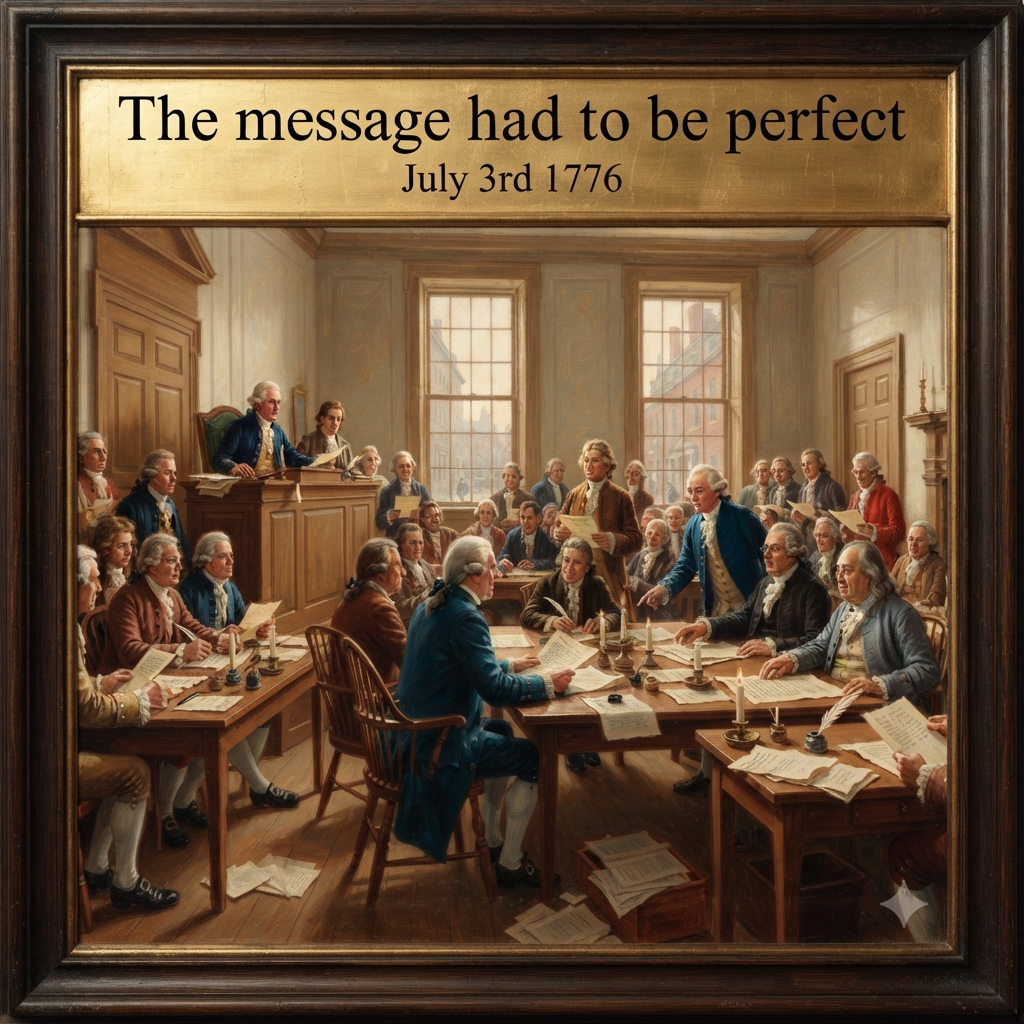
Square podcast cover featuring a framed historical illustration of delegates of the Continental Congress gathered inside Independence Hall in Philadelphia on July 3, 1776. The title, "The message had to be perfect," appears prominently across the top, with "July 3rd 1776" beneath it. The delegates are shown reading, debating, and editing documents around wooden tables lit by daylight from tall windows, emphasizing the careful revision of the Declaration of Independence before its adoption.
Transcript
Interesting Things with JC #1702:
The Message Had to Be Perfect
July 3, 1776.
The colonies had already voted for independence. Thomas Jefferson had already written the Declaration. But before a single copy could be printed, Congress spent one more sweltering day arguing over something just as important.
How should a new nation introduce itself to the world?
Jefferson's draft was passionate and deeply personal. It accused King George III of tyranny, condemned the slave trade, rebuked the British people, and listed the injuries the colonies believed they had suffered. It was powerful writing, but Congress understood that this document had a larger job to do. It wasn't simply announcing a revolution. It was asking other nations to recognize one.
So Congress became Jefferson's editors.
Working line by line, they removed roughly one-quarter of his draft and made dozens of revisions. Their largest cut erased a 168-word passage blaming King George III for perpetuating the slave trade. Delegates from South Carolina and Georgia objected, while others recognized that the accusation also exposed the colonies' own role in slavery. However uncomfortable the decision, preserving unity took precedence, and the passage disappeared.
Congress also removed Jefferson's criticism of the British people as "unfeeling brethren." The quarrel, they decided, was with the Crown, not necessarily every British citizen. There was little value in insulting people whose sympathy, or future support, might still matter.
Each edit made the Declaration less emotional and more enduring. Personal anger gave way to universal principles. The long list of complaints remained, but it no longer overshadowed the larger claim that governments exist by the consent of the governed and that people possess unalienable rights to life, liberty, and the pursuit of happiness.
Jefferson later recalled watching the debate with growing frustration as delegates revised his carefully chosen words. Benjamin Franklin noticed his discomfort and tried to reassure him with a story about a hat maker whose friends kept improving his shop sign until almost every word had vanished. The lesson was gentle but memorable: once writing belongs to the public, it rarely belongs to its author alone.
By the evening of July 3, most of the difficult work was finished. The Declaration that emerged no longer read like an impassioned list of grievances. It read like the formal announcement of a people claiming an equal place among the nations of the world.
History remembers July 4 because that's when Congress approved the Declaration.
But July 3 was the day they made sure the message was worthy of being remembered.
These are interesting things, with JC.
Student Worksheet
Purpose: Listen to the podcast first. Then complete the activities using evidence from the episode. If audio is unavailable, read the transcript before beginning.
Student Output Expectations: Complete all responses using complete sentences and cite evidence from the episode whenever possible.
Comprehension
Why did Congress continue working on the Declaration after voting for independence?
What was the largest single change made to Jefferson's original draft?
Why did some delegates object to Jefferson's language about the slave trade?
Why did Congress remove Jefferson's criticism of the British people?
According to the episode, what made the final Declaration more enduring?
Analysis
Why is understanding the intended audience important when writing an important document?
How did Congress balance personal opinion with national interests?
Was preserving colonial unity worth removing controversial passages? Support your answer with evidence.
Compare Jefferson's original purpose as an author with Congress's responsibility as editors.
How did Benjamin Franklin's story help explain the editing process?
Reflection
Describe a time when feedback improved something you wrote.
Why can collaboration strengthen important decisions?
What lesson from this episode could help you become a better writer or communicator?
Difficulty Scaling
Level 1: Identify facts directly from the episode.
Level 2: Explain why Congress made particular revisions.
Level 3: Evaluate whether those revisions strengthened or weakened the Declaration's message using evidence.
Academic Integrity Guidance
Complete your own work.
Support opinions with evidence from the podcast or transcript.
If outside sources are used, cite them appropriately.
Distinguish historical facts from personal interpretations.
Teacher Guide
Quick Start: Play the podcast before beginning discussion. If audio is unavailable, distribute the transcript and conduct a guided reading.
Pacing Guide (Audio-First):
Bell Ringer (5 minutes)
Podcast Listening (8–10 minutes)
Guided Discussion (10 minutes)
Student Worksheet (20 minutes)
Review and Formative Assessment (10 minutes)
Exit Ticket (5 minutes)
Bell Ringer
Write for two minutes:
"Should an important document reflect one author's opinions, or should it represent the views of an entire group? Explain."
Audio Guidance
Encourage students to listen for:
Why Congress continued editing.
Which revisions were most significant.
How the intended audience influenced decisions.
The role of Benjamin Franklin's anecdote.
Audio Fallback
If audio cannot be played:
Read the transcript aloud.
Assign partner reading.
Highlight major revisions during discussion.
Time on Task: Approximately 60 minutes.
Materials
Podcast audio or transcript
Student Worksheet
Writing utensils
Optional copy of the Declaration of Independence
Vocabulary Strategy
Introduce vocabulary before listening. Have students identify each term during the episode and explain it in context afterward.
Common Misconceptions
Independence was not finalized solely by Jefferson.
Jefferson did not have complete editorial control.
The Declaration was intended for an international audience as well as the colonies.
Editing does not necessarily weaken writing; it often strengthens clarity and purpose.
Discussion Prompts
Why would foreign governments care about the wording of the Declaration?
Why might Congress prioritize unity over individual preferences?
What makes a document timeless?
Can removing emotional language strengthen persuasion?
What responsibilities do editors have when shaping public documents?
Formative Checkpoints
Students identify at least two major revisions.
Students explain why those revisions mattered.
Students connect editing decisions to audience awareness.
Students participate in evidence-based discussion.
Differentiation
Support
Provide vocabulary definitions in advance.
Allow partner discussions.
Offer sentence starters.
Extension
Compare Jefferson's original draft with the adopted Declaration.
Research additional congressional edits not discussed in the episode.
Write an editorial defending one revision.
Assessment Differentiation
Oral responses
Graphic organizer
Written essay
Small-group presentation
Time Flexibility
45-minute condensed lesson
60-minute standard lesson
90-minute extended document-analysis lesson
Substitute Readiness
All activities may be completed independently using the transcript if audio is unavailable.
Engagement Strategy
Ask students to imagine serving as delegates in Congress. Should they preserve Jefferson's original words or revise them for the benefit of the new nation?
Extensions
Examine modern political speeches that underwent revisions before delivery.
Compare the Declaration with other declarations of independence worldwide.
Analyze the role of editors in journalism and publishing.
Cross-Curricular Connections
U.S. History
Government
English Language Arts
Journalism
Communications
Political Science
SEL Connection
Students practice respectful collaboration, perspective-taking, constructive criticism, and thoughtful communication.
Skill Value Emphasis
Critical reading
Historical analysis
Collaborative decision-making
Evidence evaluation
Professional communication
Revision and editing
Answer Key
Comprehension
To prepare the Declaration for publication and international recognition.
Removal of the passage criticizing King George III for perpetuating the slave trade.
It exposed contradictions within the colonies and threatened unity.
Congress wanted to focus criticism on the Crown rather than all British citizens.
It emphasized universal principles instead of emotional grievances.
Analysis
Accept reasonable answers supported with evidence from the episode.
Quiz
Directions: Choose the best answer for each question.
Why did Congress continue editing the Declaration after independence had already been approved?
A. To delay independence
B. To prepare the document for its broader purpose
C. To rewrite the Constitution
D. To reduce its length for printing
Which section received the largest deletion?
A. Religious liberty
B. Colonial taxation
C. Slave trade passage
D. Military organization
Why was criticism of the British people removed?
A. Congress forgot to include it
B. Printing space was limited
C. The focus shifted toward the Crown
D. Jefferson requested the change
Benjamin Franklin's story illustrated the importance of:
A. Printing technology
B. Public speaking
C. Collaborative editing
D. Military planning
According to the episode, July 3 is remembered because:
A. Independence was declared that day.
B. Congress finalized the message before approval.
C. The war ended.
D. Jefferson signed the document first.
Assessment
Open-Ended Questions
Explain how Congress's revisions changed the Declaration of Independence from a personal document into a national statement. Use at least three examples from the episode.
Evaluate the following statement:
"Good editing can change history."
Support your position using evidence from the podcast and your understanding of audience, diplomacy, and communication.
3–2–1 Rubric
3 – Proficient
Accurately explains historical events.
Uses multiple pieces of evidence from the episode.
Demonstrates thoughtful analysis.
Writes clearly with organized reasoning.
2 – Developing
Explains most major ideas accurately.
Includes some supporting evidence.
Shows partial understanding of historical significance.
Organization may need improvement.
1 – Beginning
Limited understanding of the topic.
Minimal or inaccurate evidence.
Responses lack clear explanation or historical support.
Exit Ticket
Before leaving class, answer the following in one or two sentences:
What is one revision Congress made that you believe had the greatest long-term impact, and why?
Standards Alignment
NGSS (Science & Engineering Practices – Applicable Skill Standard)
SEP 8 – Obtaining, Evaluating, and Communicating Information
Connection: Students evaluate historical evidence and communicate conclusions about editorial revisions.
Measurable Skill: Analyze multiple pieces of evidence to explain how revisions strengthened the Declaration.
Justification: Students practice evaluating information and communicating evidence-based conclusions.
CCSS Reading
CCSS.ELA-LITERACY.RH.9-10.1 – Cite Specific Textual Evidence
Connection: Students reference the transcript while answering worksheet and assessment questions.
Measurable Skill: Support historical interpretations using textual evidence.
Justification: Encourages close reading of primary-source-based material.
CCSS.ELA-LITERACY.RH.11-12.2 – Determine Central Ideas
Connection: Students identify how revisions shifted the Declaration's overall purpose.
Measurable Skill: Summarize historical arguments and identify supporting details.
Justification: Reinforces historical reading comprehension.
CCSS Writing
CCSS.ELA-LITERACY.WHST.9-10.1 – Write Arguments Focused on Discipline-Specific Content
Connection: Students defend positions during analysis and assessment.
Measurable Skill: Construct evidence-based historical arguments.
Justification: Develops persuasive writing grounded in historical evidence.
CCSS.ELA-LITERACY.WHST.11-12.9 – Draw Evidence from Informational Texts
Connection: Students use the transcript to support written responses.
Measurable Skill: Integrate evidence into analytical writing.
Justification: Strengthens historical reasoning through documentation.
CCSS Speaking & Listening
CCSS.ELA-LITERACY.SL.11-12.1 – Collaborative Discussions
Connection: Classroom discussion examines why Congress revised Jefferson's draft.
Measurable Skill: Participate respectfully while supporting ideas with evidence.
Justification: Encourages collaborative historical inquiry.
C3 Framework
D2.His.1.9-12 – Evaluate Historical Sources and Evidence
Connection: Students examine why Congress edited portions of the Declaration.
Measurable Skill: Evaluate historical decision-making using contextual evidence.
Justification: Promotes historical inquiry and evidence evaluation.
ISTE Standards
ISTE 1.3 Knowledge Constructor
Connection: Students gather information from the podcast and transcript to build historical understanding.
Measurable Skill: Organize reliable information into evidence-based conclusions.
Justification: Reinforces responsible research and information literacy.
Career Readiness Competencies
Analytical Thinking: Evaluate historical revisions and determine their impact.
Communication: Explain complex ideas clearly in discussion and writing.
Problem Solving: Consider how Congress resolved competing priorities.
Adaptability: Recognize the value of revising work based on collaboration.
Professional Judgment: Balance individual viewpoints with organizational goals.
Homeschool / Lifelong Learning Alignment
Independent Learning: Students complete the worksheet using podcast or transcript.
Information Literacy: Evaluate historical evidence rather than relying on assumptions.
Real-World Application: Connect editing and collaboration to workplace communication.
Self-Directed Inquiry: Encourage additional research into Jefferson's original draft.
Transferable Life Skills: Practice revision, critical thinking, and evidence-based reasoning applicable throughout life.
Show Notes
This lesson explores an often-overlooked moment in American history by focusing on July 3, 1776, when the Continental Congress carefully revised the Declaration of Independence before its final approval. Students discover that powerful historical documents are not simply written—they are refined through collaboration, debate, and careful consideration of audience and purpose. The episode demonstrates how editing can strengthen communication, preserve unity, and shape history, making it highly relevant to both historical study and modern writing.
References
BlackPast. (n.d.). The deleted passage of the Declaration of Independence and the debate over slavery. https://blackpast.org/african-american-history/declaration-independence-and-debate-over-slavery/
Fine Line Flag. (n.d.). Signing of the Declaration of Independence in 1776. https://www.finelineflag.com/pages/flag-history
History.com Editors. (2020, June 29). Why Thomas Jefferson's anti-slavery passage was removed from the Declaration of Independence. https://www.history.com/articles/declaration-of-independence-deleted-anti-slavery-clause-jefferson
Library of Congress. (n.d.). The Declaration of Independence: Primary documents in American history. https://guides.loc.gov/declaration-of-independence
National Archives. (n.d.). America's Founding Documents: Declaration of Independence. https://www.archives.gov/founding-docs/declaration
National Park Service. (2025). Declaration of Independence timeline. https://www.nps.gov/inde/learn/historyculture/resources-declarationofindependence.htm
U.S. Department of State, Office of the Historian. (n.d.). Milestones in the History of U.S. Foreign Relations: The Declaration of Independence. https://history.state.gov/milestones/1776-1783/declaration