1703: "250 Years of the United States of America"
Interesting Things with JC #1703: "250 Years of the United States of America"
On July 4, 1776, Congress approved the final text of the Declaration of Independence and ordered it printed across the colonies. That decision launched a nation that, over the next 250 years, fought for its independence, wrote the world's oldest written national constitution still in continuous use, defeated tyranny, reached the Moon, and reshaped human history.
Curriculum - Episode Anchor
Episode Title: 250 Years of the United States of America
Episode Number: 1703
Host: Jim Connors (JC)
Audience: Grades 9–12, Introductory College, Homeschool, Lifelong Learners
Subject Area: United States History, Civics, Government, Innovation, Leadership
Lesson Overview
Objectives:
Students will:
Explain the historical significance of American independence in 1776.
Describe how the Constitution established a framework for representative government and separated powers.
Analyze major milestones in American economic, technological, and military development.
Evaluate how historical challenges shaped the continuing development of the United States.
Essential Question:
How has the United States influenced world history during its first 250 years while continuing to evolve as a nation?
Success Criteria:
Students can:
Identify major historical events referenced in the episode.
Explain why the Constitution remains historically significant.
Connect innovation, industry, and civic responsibility to national development.
Support conclusions using evidence from the episode.
Student Relevance Statement:
Students inherit institutions, freedoms, and responsibilities built by previous generations. Understanding how those institutions developed helps prepare them to participate responsibly in civic life.
Real-World Connection:
Governments, economies, scientific innovation, and democratic institutions continue to influence daily life. Studying their historical development strengthens informed citizenship and critical thinking.
Workforce Reality:
Many careers—including engineering, public service, military leadership, education, manufacturing, entrepreneurship, and technology—depend on understanding how innovation, teamwork, and long-term planning shape societies.
Key Vocabulary
Independence(in-duh-PEN-dence) — Freedom from outside political control.
Constitution(kon-stuh-TOO-shun) — The supreme law establishing the structure and powers of government.
Limited Government(LIM-it-ed GOV-ern-ment) — A government whose powers are restricted by law.
Separation of Powers(sep-er-AY-shun of POW-ers) — Division of governmental authority among branches.
Republic(ri-PUB-lik) — A form of government in which citizens elect representatives.
Innovation(in-uh-VAY-shun) — Introduction of new ideas, technologies, or methods.
Industrial Production(in-DUS-tree-ul pro-DUK-shun) — Manufacturing goods on a large scale.
Arsenal of Democracy(AR-suh-nul of dih-MOK-ruh-see) — A phrase describing America's industrial support of the Allied powers during World War II.
Apollo Program(uh-POL-oh) — NASA's program that successfully landed humans on the Moon.
Civic Responsibility(SIV-ik re-spon-suh-BIL-uh-tee) — Duties and obligations citizens have toward their communities and nation.
Narrative Core
Open
Every nation has a story. Some span thousands of years, while others are much younger. Yet the age of a nation does not always determine the size of its impact. The United States reached its 250th anniversary after a relatively short period in human history, but during those years it experienced profound political, economic, scientific, and cultural change.
Info
The episode traces the nation's development from the Declaration of Independence through the creation of the Constitution, westward expansion, industrial growth, World War II, and the Space Age. It highlights moments when individuals and institutions worked together to overcome significant challenges.
Details
Students encounter examples of perseverance, innovation, constitutional government, military service, entrepreneurship, exploration, and scientific advancement. The lesson also acknowledges difficult chapters, including the Civil War and periods of economic hardship, demonstrating that national development often includes both achievement and struggle.
Reflection
History is not only about celebrating accomplishments. It is also about understanding decisions, consequences, and responsibilities. Every generation inherits unfinished work and contributes to shaping the future through civic participation, innovation, and service.
Closing
The first 250 years of the United States demonstrate how ideas about liberty, representative government, scientific inquiry, and opportunity influenced both the nation and the wider world. Understanding that history provides context for informed citizenship today.
These are Interesting Things, with JC.
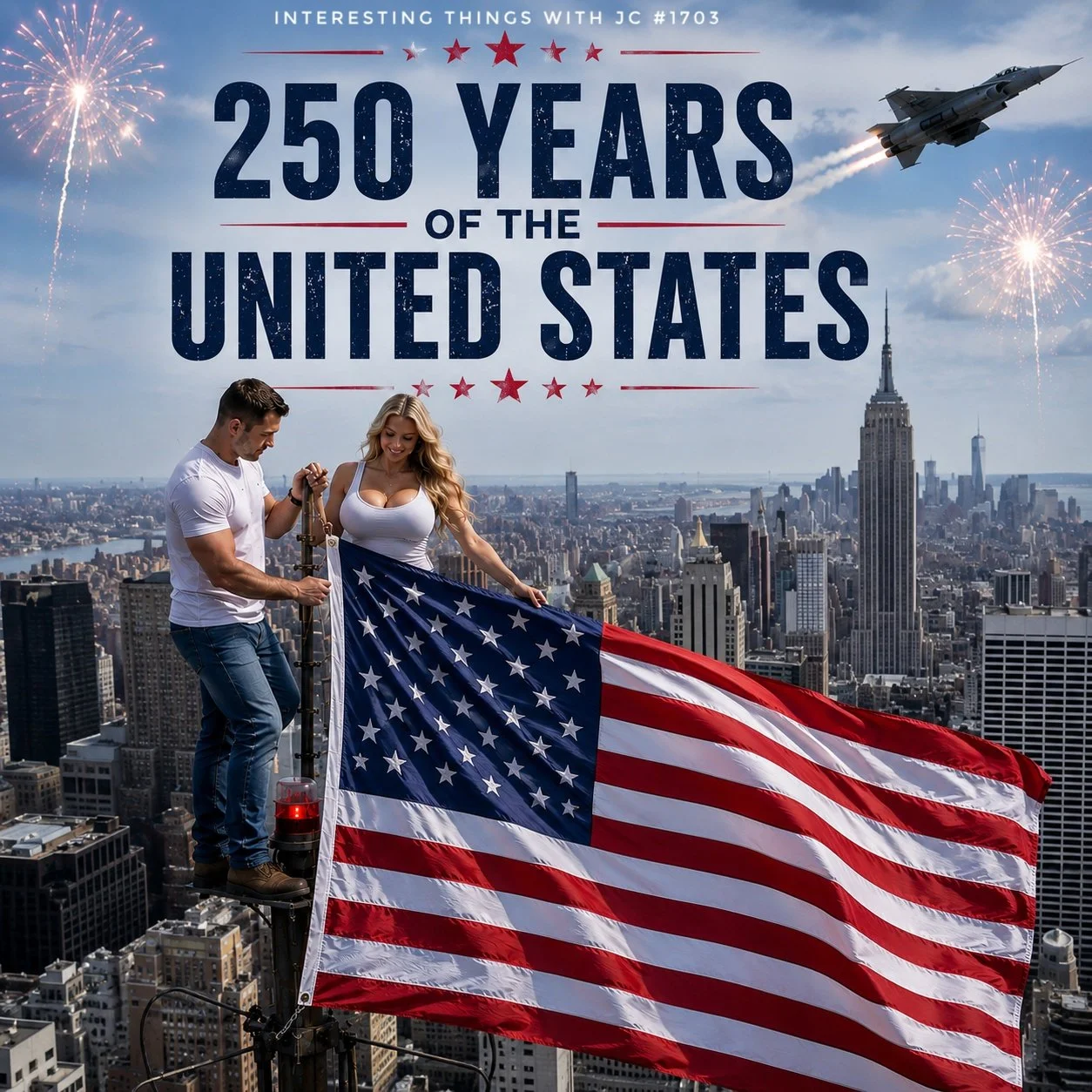
The image is a promotional graphic for Interesting Things with JC episode #1703, "250 Years of the United States." Across the top appears the series title and episode number. Centered in large bold lettering is the title, "250 Years of the United States," accented with red stars and horizontal lines.
Below the title, two people (one of which is a stunning blonde woman) are shown standing on a rooftop high above Manhattan while raising a large American flag that fills much of the lower half of the image. The flag appears to wave dramatically across the scene. Behind them, the New York City skyline extends into the distance, with the Empire State Building serving as a recognizable landmark.
Fireworks illuminate the sky on the left and right sides, suggesting a celebration, while a modern military aircraft flies overhead in the upper-right portion of the image. The blue sky, patriotic colors, and celebratory elements visually reinforce the theme of commemorating the 250th anniversary of the founding of the United States. The image is intended as promotional artwork and symbolizes American history, civic pride, innovation, and national milestones rather than depicting a specific historical event.
Transcript
Interesting Things with JC #1703:
"250 Years of the United States of America"
Two hundred fifty years.
That's nothing in human history.
And yet, in those 250 years, the United States changed the course of human history.
In 1776, thirteen small colonies with almost no navy and an inexperienced army stood against the most powerful empire on Earth. Every rational observer gave them no chance.
America fought anyway.
Against the odds, we won our independence through raw determination, brutal sacrifice, and the fierce conviction that free people should govern themselves.
Then came something just as revolutionary: the Constitution. A framework of limited government, separated powers, and the enduring principle that our rights come from our Creator, not from kings or governments. More than two centuries later, it remains the world's oldest written national constitution still in continuous use.
We didn't inherit greatness.
We built it.
Pioneers crossed mountains and deserts. Railroad crews linked a continent. Farmers fed growing cities. Inventors, engineers, and risk takers turned bold ideas into world changing industries.
When freedom was threatened during World War II, America became the Arsenal of Democracy, producing hundreds of thousands of aircraft, tens of thousands of tanks, thousands of ships, and the supplies that armed the Allies. We fought from the beaches of Normandy to the islands of the Pacific and helped defeat two of history's most brutal regimes.
Then America accomplished what humanity had never done before.
Just 66 years after two bicycle mechanics flew for 12 seconds at Kitty Hawk, Americans left Earth and walked on the Moon.
From canvas wings to lunar footprints... in a single lifetime.
American ingenuity drove advances in aviation, computing, satellite navigation, medicine, and space exploration that billions now rely on every day.
We've made serious mistakes. We fought a Civil War. We've endured depression, division, and hardship.
But quitting has never been the American way.
Generation after generation inherits an unfinished nation and shoulders the responsibility to leave it stronger.
That's why people still cross oceans, deserts, and borders for the chance to build a life here.
Not because it's easy.
Because it's worth it.
For 250 years, the United States has shown the world what free people can achieve when they're free to dream, build, compete, innovate, and defend what they believe.
Happy 250th Birthday, America.
Let's get back to work.
These are Interesting Things, with JC.
Student Worksheet
Instructions: Listen to the podcast episode first. If audio is unavailable, read the transcript carefully before completing the activities. Answer in complete sentences unless instructed otherwise. Use evidence from the episode to support your responses.
Learning Goal: Demonstrate understanding of how the United States developed politically, economically, technologically, and socially during its first 250 years.
Comprehension
Why did many observers believe the American colonies had little chance of defeating Great Britain?
According to the episode, what made the Constitution revolutionary?
What examples of American expansion and development are mentioned after independence?
Why was the United States called the "Arsenal of Democracy" during World War II?
What technological achievement occurred only 66 years after the Wright brothers' first flight?
What major hardships does the episode acknowledge the United States has experienced?
According to the episode, why do people continue coming to America?
What message does the episode give about the responsibility of each generation?
Analysis
Provide complete responses supported by evidence from the transcript.
Explain how determination influenced the outcome of the American Revolution.
How does the Constitution contribute to stability within a democratic republic?
Compare America's industrial achievements during World War II with its achievements during the Space Race. What characteristics made both possible?
Why does the narrator include both national accomplishments and national struggles?
How does innovation contribute to a nation's long-term success?
Historical Timeline Activity
Place the following events in chronological order.
Apollo 11 Moon Landing
American Revolution
Adoption of the Constitution
World War II
Westward Expansion
Wright Brothers' First Flight
Cause and Effect
Complete the chart.
Historical EventImmediate EffectLong-Term SignificanceDeclaration of IndependenceConstitutionIndustrial ExpansionWorld War II ProductionApollo Program
Vocabulary Application
Use each vocabulary word correctly in an original sentence.
Constitution
Innovation
Limited Government
Separation of Powers
Civic Responsibility
Reflection
Respond in one well-developed paragraph.
The episode states that every generation inherits an unfinished nation. What responsibilities do citizens have in helping improve their communities? Support your answer with examples from history or your own observations.
Extension Challenge
Research one of the following topics and prepare a one-page summary.
The Constitutional Convention
The Transcontinental Railroad
The Manhattan Project
Apollo 11
The Industrial Revolution in America
The GI Bill
The Wright Brothers
Include:
Three verified facts
One primary source
One historical image
One paragraph explaining why the topic still matters today
Difficulty Scaling
Level 1
Complete comprehension questions.
Level 2
Complete comprehension and analysis sections.
Level 3
Complete all activities including the research extension.
Student Output Expectations
Students should demonstrate:
Accurate historical understanding
Evidence-based reasoning
Clear written communication
Proper chronological sequencing
Connections between historical events and long-term outcomes
Academic Integrity Guidance
Use your own words.
Cite outside sources if additional research is completed.
Distinguish facts from personal opinions.
Support conclusions using evidence.
Teacher Guide
Quick Start
Begin class with the podcast episode.
Ask students to listen for examples of perseverance, innovation, constitutional government, and civic responsibility.
Conduct a brief class discussion.
Complete the worksheet individually or in collaborative groups.
Finish with the reflection and exit discussion.
Pacing Guide (Audio-First)
Bell Ringer — 5 minutes
Podcast Listening — 8–10 minutes
Guided Discussion — 10 minutes
Worksheet Completion — 25 minutes
Reflection — 10 minutes
Closure — 5 minutes
Total: Approximately 60 minutes
Bell Ringer
Display the question:
"What events or inventions have had the greatest impact on the United States?"
Students write for three minutes before discussion.
Audio Guidance
Encourage students to listen for:
Historical milestones
Evidence of perseverance
Constitutional principles
Technological innovation
Civic responsibility
Students may annotate while listening.
Audio Fallback
If audio is unavailable:
Read the transcript aloud.
Assign small groups to summarize each major section.
Conduct discussion using transcript evidence.
Time on Task
Listening: 15%
Discussion: 20%
Individual Work: 45%
Reflection and Closure: 20%
Materials
Podcast audio or transcript
Student worksheet
Pens or pencils
Highlighters
Internet access (optional)
U.S. history timeline (optional)
Vocabulary Strategy
Before listening:
Preview vocabulary.
Have students predict meanings.
Revisit definitions after listening.
Require students to use vocabulary during discussion.
Common Misconceptions
Students may believe:
History is only a collection of dates.
National development occurs without setbacks.
Innovation happens independently of earlier discoveries.
Constitutional government never changes through interpretation and amendment.
Clarify that historical development involves continuous adaptation, debate, and improvement.
Discussion Prompts
Why is the Constitution considered historically significant?
What role did innovation play in American development?
How can societies learn from difficult periods in their history?
What qualities allowed America to transition from a new nation to a global leader in science and technology?
What responsibilities accompany freedom?
Formative Checkpoints
During instruction, verify students can:
Identify major historical events.
Explain chronological relationships.
Use vocabulary accurately.
Support claims with evidence.
Connect historical events to modern society.
Differentiation
Support
Provide guided notes.
Use vocabulary cards.
Pair students for discussion.
Offer timeline templates.
Advanced Learners
Compare American constitutional development with another nation.
Evaluate multiple historical interpretations.
Incorporate primary-source analysis.
Assessment Differentiation
Students may demonstrate mastery through:
Written responses
Oral presentation
Historical timeline
Graphic organizer
Short essay
Multimedia presentation
Time Flexibility
45-Minute Class
Audio
Comprehension
Reflection
60-Minute Class
Full lesson
90-Minute Block
Full lesson
Research extension
Small-group presentations
Substitute Readiness
This lesson is fully self-contained.
Substitute teachers can:
Play the podcast.
Distribute worksheets.
Facilitate discussion.
Collect completed work.
No additional preparation is required.
Engagement Strategy
Conduct a "Milestone Gallery Walk."
Assign small groups one historical milestone from the episode. Students create a brief poster explaining:
What happened
Why it mattered
How it influenced future generations
Groups rotate and evaluate one another's work.
Extensions
Students may:
Research additional American innovations.
Compare constitutional systems.
Build a historical timeline.
Investigate local community history.
Interview a veteran, engineer, entrepreneur, or public servant about civic responsibility and innovation.
Cross-Curricular Connections
History
American Revolution
Constitutional history
World War II
Space Race
Government
Constitutional principles
Separation of powers
Representative democracy
Science
Aviation
Engineering
Space exploration
Economics
Industrial production
Entrepreneurship
Innovation
English Language Arts
Informational text analysis
Evidence-based writing
Public speaking
SEL Connection
Students consider:
Perseverance
Responsibility
Respect for differing perspectives
Community engagement
Goal setting
Long-term thinking
Skill Value Emphasis
Students strengthen:
Critical thinking
Historical reasoning
Communication
Collaboration
Evidence evaluation
Problem solving
Civic literacy
Answer Key
Comprehension
Great Britain possessed the world's strongest military and navy, while the colonies had limited resources and an inexperienced army.
It established limited government, separation of powers, and constitutional protections that continue today.
Westward expansion, railroads, agriculture, invention, engineering, and industrial growth.
The United States produced enormous quantities of military equipment and supplies for Allied nations.
Americans landed on the Moon during the Apollo Program.
The Civil War, economic depression, political division, and national hardship.
Because they believe opportunities exist to build better lives.
Every generation has the responsibility to strengthen and improve the nation for those who follow.
Analysis (Sample Responses)
Determination helped overcome military disadvantages during the Revolution.
Constitutional limits help prevent concentration of governmental power.
Both World War II production and the Space Race relied on innovation, education, industry, and collaboration.
Including both successes and struggles presents a more complete historical narrative.
Innovation improves quality of life, strengthens economies, and expands scientific knowledge.
Quiz
Directions: Select the best answer for each question. Use evidence from the podcast to support your thinking. Do not write the answers on this page if your instructor is collecting the quiz separately.
Which event marked the beginning of the United States as an independent nation?
A. Adoption of the Constitution
B. Declaration of Independence
C. End of the Civil War
D. Louisiana Purchase
According to the episode, what principle helped make the Constitution revolutionary?
A. Unlimited executive authority
B. Hereditary leadership
C. Limited government and separation of powers
D. Direct democracy without elections
Why was the United States known as the "Arsenal of Democracy" during World War II?
A. It supplied military equipment to Allied nations.
B. It built the first aircraft.
C. It invented radar.
D. It remained neutral throughout the war.
What achievement occurred just 66 years after the Wright brothers' first flight?
A. The first jet aircraft
B. The first satellite
C. Humans walked on the Moon
D. The first transatlantic flight
What central message concludes the episode?
A. History cannot be changed.
B. Every generation has a responsibility to strengthen the nation.
C. Technology alone creates national success.
D. The nation's work is complete.
Assessment
Open-Ended Questions
The episode describes the United States as "an unfinished nation." Explain what this idea means using at least three examples from the episode to support your answer.
Throughout its first 250 years, the United States experienced both remarkable achievements and significant challenges. Analyze how those experiences shaped the nation's development. Use evidence from the episode and additional historical knowledge where appropriate.
3–2–1 Rubric
3 – Exceeds Expectations
Demonstrates accurate historical understanding.
Uses multiple examples from the episode.
Explains relationships between events clearly.
Supports conclusions with evidence.
Writing is organized and well developed.
2 – Meets Expectations
Demonstrates general understanding.
Uses at least one supporting example.
Explains ideas clearly with minor omissions.
Writing is organized.
1 – Developing
Limited understanding of concepts.
Few or inaccurate supporting details.
Organization or reasoning needs improvement.
Exit Ticket
Before leaving class, answer the following on an index card or digital form:
What is one historical event from today's lesson that surprised you?
What is one idea from the episode you believe will remain important over the next 250 years?
What is one question you still have about American history?
Standards Alignment
NGSS (Science & Engineering Practices)
HS-ETS1-3 – Engineering Design
Connection: Students evaluate how engineering and technological innovation influenced transportation, manufacturing, and space exploration.
Measurable Skill: Analyze how technological advances addressed complex societal challenges.
Justification: The episode highlights engineering achievements from aviation through lunar exploration.
HS-ETS1-4 – Engineering Design
Connection: Students examine how innovation builds upon previous discoveries.
Measurable Skill: Evaluate iterative technological development across historical periods.
Justification: The progression from Kitty Hawk to the Moon illustrates cumulative engineering progress.
Common Core State Standards – Reading
CCSS.ELA-LITERACY.RH.11-12.2
Connection: Students determine central ideas and summarize historical content.
Measurable Skill: Identify and explain major historical themes.
Justification: Students analyze the episode's primary historical arguments.
CCSS.ELA-LITERACY.RH.11-12.7
Connection: Students integrate information from audio, transcript, and historical resources.
Measurable Skill: Compare multiple sources of historical information.
Justification: Audio-first instruction encourages synthesis of evidence.
Common Core State Standards – Writing
CCSS.ELA-LITERACY.WHST.11-12.1
Connection: Students write evidence-based responses.
Measurable Skill: Develop historical arguments supported by evidence.
Justification: Reflection and assessment require analytical writing.
CCSS.ELA-LITERACY.WHST.11-12.9
Connection: Students draw evidence from informational texts.
Measurable Skill: Cite historical evidence accurately.
Justification: Written responses rely on the transcript and historical content.
Common Core State Standards – Speaking & Listening
CCSS.ELA-LITERACY.SL.11-12.1
Connection: Students participate in structured classroom discussions.
Measurable Skill: Build upon others' ideas while supporting claims with evidence.
Justification: Teacher-led discussions emphasize collaborative reasoning.
C3 Framework for Social Studies
D2.His.1.9-12
Connection: Evaluate historical developments over time.
Measurable Skill: Analyze continuity and change across major historical periods.
Justification: Students connect events spanning 250 years of American history.
D2.Civ.1.9-12
Connection: Examine the constitutional principles of representative government.
Measurable Skill: Explain the functions of constitutional institutions.
Justification: The Constitution serves as a central theme of the lesson.
ISTE Standards
ISTE 1.3 – Knowledge Constructor
Connection: Students research historical topics using credible sources.
Measurable Skill: Evaluate and synthesize reliable information.
Justification: Extension activities require evidence-based historical research.
Career Readiness Competencies
Analytical Thinking
Students evaluate historical evidence and identify cause-and-effect relationships.
Communication
Students communicate historical understanding through discussion and writing.
Problem Solving
Students analyze how Americans addressed military, political, and technological challenges.
Adaptability
Students recognize how societies evolve in response to changing circumstances.
Professional Judgment
Students distinguish between evidence, interpretation, and opinion while evaluating historical narratives.
Homeschool / Lifelong Learning Alignment
Independent Learning
Students complete guided historical inquiry using primary and secondary sources.
Information Literacy
Students evaluate the credibility and relevance of historical evidence.
Real-World Application
Students connect constitutional principles, innovation, and civic participation to contemporary society.
Self-Directed Inquiry
Students pursue independent research into historical topics of personal interest.
Transferable Life Skills
Students strengthen critical thinking, communication, research, and informed decision-making skills applicable beyond the classroom.
Show Notes
This lesson explores the first 250 years of United States history by examining the nation's founding, constitutional government, westward expansion, industrial development, military production during World War II, technological innovation, and the Space Age. Students analyze how perseverance, constitutional principles, scientific advancement, and civic responsibility contributed to national development while recognizing that history includes both accomplishments and challenges. The lesson encourages learners to consider their own role in continuing the work of informed citizenship and responsible participation in society.
References
National Aeronautics and Space Administration. (1969, June 26). Apollo 11 press kit. https://www.nasa.gov/wp-content/uploads/static/apollo50th/pdf/A11_PressKit.pdf
National Aeronautics and Space Administration. (1969, November). Apollo 11 mission report. https://www.nasa.gov/wp-content/uploads/static/apollo50th/pdf/A11_MissionReport.pdf
National Aeronautics and Space Administration. (2009, July 17). July 20, 1969: One giant leap for mankind. https://www.nasa.gov/history/july-20-1969-one-giant-leap-for-mankind/
National Aeronautics and Space Administration. (2015, April 17). Apollo 11 mission overview. https://www.nasa.gov/history/apollo-11-mission-overview/
National Aeronautics and Space Administration. (2026, March 18). Apollo 11. https://www.nasa.gov/mission/apollo-11/
National Air and Space Museum. (n.d.). Apollo 11: The moon landing. https://airandspace.si.edu/explore/stories/apollo-11-moon-landing
National Air and Space Museum. (n.d.). Apollo 11 timeline. https://airandspace.si.edu/explore/stories/apollo-missions/apollo-11-moon-landing/apollo-11-timeline
National Archives. (1787). A study of the United States Constitution. https://www.archives.gov/files/atlanta/education/chronological-topics/images/constitution-guide.pdf
National Archives. (2022, November 18). 20 July 1969. https://www.archives.gov/publications/prologue/2003/summer/20-july-1969.html
Gonzaga University. (2022, September 13). Gonzaga celebrates Constitution Day and Citizenship Day. https://www.gonzaga.edu/news-events/stories/gonzaga-celebrates-constitution-day-and-citizenship-day
Lunar and Planetary Institute. (n.d.). Apollo 11 mission overview. https://www.lpi.usra.edu/lunar/missions/apollo/apollo_11/
National WWII Museum. (2023, April 23). Manufacturing Victory curriculum guide. https://www.nationalww2museum.org/sites/default/files/2023-04/23-0215-eft-manufacturing-victory-curriculum-guide-2023-8.5x11-110pgs-interactive.pdf
National WWII Museum. (n.d.). Take a closer look: America goes to war. https://www.nationalww2museum.org/students-teachers/student-resources/research-starters/america-goes-war-take-closer-look