1704: "Lincoln Wasn't the Only Target"
Interesting Things with JC #1704: "Lincoln Wasn't the Only Target"
On July 5, 1865, President Andrew Johnson signed the order confirming the convictions of the conspirators who tried to assassinate not only Abraham Lincoln, but also the vice president, secretary of state, and commanding general in a single coordinated plot.
Curriculum - Episode Anchor
Episode Title: Lincoln Wasn't the Only Target
Episode Number: 1704
Host: JC
Audience: Grades 9–12, Introductory College, Homeschool, Lifelong Learners
Subject Area: United States History; Civil War and Reconstruction; Government; Civics
Lesson Overview
Objectives:
Explain the coordinated assassination conspiracy of April 14, 1865, and identify its intended targets.
Analyze why the conspirators believed attacking multiple government leaders could destabilize the United States.
Evaluate how the government's investigation and trials reflected the challenges of restoring order after the Civil War.
Distinguish between documented historical evidence and speculation regarding involvement by additional individuals.
Essential Question:
How did the broader assassination conspiracy against multiple national leaders threaten the stability of the United States at the end of the Civil War?
Success Criteria:
Students will successfully:
Identify each intended target of the conspiracy.
Describe the outcome of each planned attack.
Explain the legal consequences faced by the conspirators.
Use historical evidence to distinguish verified facts from unproven claims.
Student Relevance:
Modern governments rely on continuity of leadership during emergencies. Understanding this historical event demonstrates why succession planning, security, and criminal investigations remain essential today.
Real-World Connection:
Law enforcement agencies continue to investigate organized conspiracies by collecting evidence, interviewing witnesses, and separating fact from rumor before reaching legal conclusions.
Workforce Reality:
Professionals in law enforcement, intelligence, military service, emergency management, legal practice, journalism, and public administration depend upon careful evidence analysis, documentation, and ethical decision-making.
Key Vocabulary
Assassination(uh-sass-uh-NAY-shun) — The deliberate murder of an important public figure, usually for political purposes.
Conspiracy(kun-SPIR-uh-see) — A secret agreement between two or more people to commit an unlawful act.
Military Commission(MIL-uh-ter-ee kuh-MISH-un) — A special military court authorized to try certain offenses.
Secretary of State(SEK-ruh-ter-ee uv STAYT) — The cabinet official responsible for foreign affairs.
Succession(suk-SESH-un) — The legal process by which leadership passes to another official.
Executive Order(ig-ZEK-yuh-tiv OR-der) — A directive issued by the President that carries the force of executive authority.
Evidence(EV-uh-dens) — Information used to establish facts during an investigation.
Reconstruction(ree-kun-STRUK-shun) — The period following the Civil War during which the United States rebuilt the nation and reunited the states.
Narrative Core
Open:
Most people know Abraham Lincoln was assassinated at Ford's Theatre. Far fewer realize that his murder was intended to be only one part of a coordinated attack designed to cripple the federal government.
Info:
John Wilkes Booth and his fellow conspirators planned to kill President Abraham Lincoln, Vice President Andrew Johnson, Secretary of State William H. Seward, and General Ulysses S. Grant. Their objective was to create confusion and instability as the Civil War was ending.
Details:
Only Booth completed his assigned mission, fatally shooting Lincoln on April 14, 1865. Lewis Powell brutally attacked William Seward but failed to kill him. George Atzerodt never attempted to assassinate Vice President Johnson, and Grant was no longer in Washington when the attacks occurred. Investigators quickly uncovered the wider conspiracy, leading to arrests, military trials, executions, and prison sentences for those found guilty of participating or assisting.
Reflection:
The conspiracy illustrates how the survival of a government may depend upon the resilience of its institutions as much as upon individual leaders. Even during one of the nation's greatest tragedies, constitutional succession and law enforcement continued to function.
Closing:
These are interesting things, with JC.
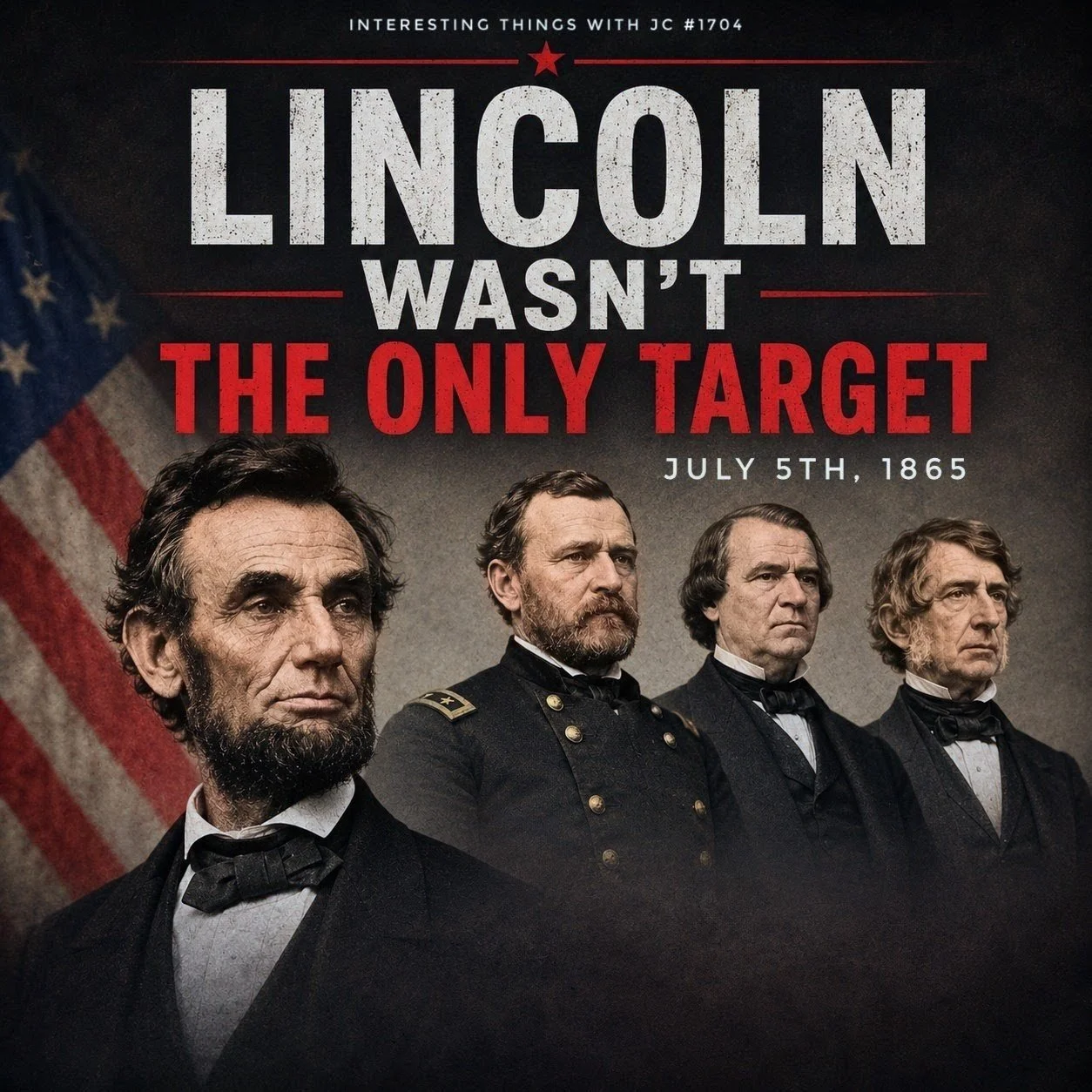
Promotional artwork for Interesting Things with JC Episode #1704 titled "Lincoln Wasn't the Only Target." A large portrait of President Abraham Lincoln appears in the foreground on the left, with a partially visible American flag behind him. Standing behind Lincoln are three other nineteenth-century figures representing General Ulysses S. Grant, Vice President Andrew Johnson, and Secretary of State William H. Seward. Large white and red lettering dominates the upper half of the image, reading "LINCOLN WASN'T THE ONLY TARGET," with "July 5th, 1865" displayed beneath the title. The overall design uses muted gray, black, and red tones with a textured, historical appearance to emphasize the coordinated assassination conspiracy against multiple Union leaders following the Civil War.
Transcript
Interesting Things with JC #1704:
Lincoln Wasn't the Only Target
When Abraham Lincoln was assassinated on April 14, 1865, he wasn't the only man marked for death that night.
The attack at Ford's Theatre was only one part of a coordinated conspiracy. John Wilkes Booth and his fellow conspirators planned to strike President Lincoln, Vice President Andrew Johnson, General Ulysses S. Grant, and Secretary of State William H. Seward in the hope of throwing the Union government into chaos just as the Civil War was coming to an end.
Had the conspiracy succeeded, the nation would have lost its president, vice president, commanding general, and secretary of state within a matter of hours. Booth succeeded only once. He murdered Lincoln at Ford's Theatre on the night of April 14, 1865.
At nearly the same time, Lewis Powell, better known as Lewis Payne, forced his way into Seward's home while the secretary of state was recovering from a carriage accident. Armed with a knife, Powell slashed and stabbed Seward repeatedly, leaving him gravely wounded. Seward survived. Grant had already left Washington, and George Atzerodt, assigned to kill Vice President Johnson, lost his nerve and never attempted the attack.
In the weeks that followed, investigators uncovered the full scope of the conspiracy. Eight people were arrested and tried before a military commission for helping Booth or participating in the plot.
On July 5, 1865, President Andrew Johnson signed the executive order confirming the commission's verdicts. Mary Surratt, Lewis Payne, David Herold, and George Atzerodt were sentenced to death and hanged two days later, on July 7. Surratt became the first woman executed by the United States federal government.
The remaining four defendants received prison sentences. Dr. Samuel Mudd, who treated Booth's broken leg after the assassination, Samuel Arnold, Michael O'Laughlen, and Edward Spangler were sentenced to life at hard labor for aiding Booth or participating in the conspiracy.
Investigators also examined whether former Confederate President Jefferson Davis had encouraged or supported the plot. Suspicion lingered, but no evidence ever emerged that was sufficient to charge him with involvement in Lincoln's assassination.
Booth's bullet killed a president. Johnson's signature closed the government's case against the people accused of trying to bring down an entire government.
These are interesting things, with JC.
Student Worksheet
Listening Instructions: Listen to the podcast episode once without taking notes. During the second listening, record important people, events, and outcomes. If audio is unavailable, read the transcript carefully before completing the activities.
Learning Goal: Demonstrate an understanding of the April 14, 1865 assassination conspiracy by identifying key individuals, evaluating evidence, and explaining the significance of the events.
Comprehension
What was the conspirators' overall objective?
Name the four intended targets of the conspiracy.
Which attack succeeded?
Why did William Seward survive?
Why was General Ulysses S. Grant not attacked?
What prevented George Atzerodt from carrying out his assignment?
How many people were tried before the military commission?
Who became the first woman executed by the United States federal government?
Analysis
Why might Booth have believed attacking multiple government leaders would create greater instability than assassinating only President Lincoln?
Compare the outcomes of the attacks against Lincoln and Seward. What factors contributed to their different results?
Why is it important that investigators found insufficient evidence to charge Jefferson Davis with involvement?
Explain how evidence-based investigations protect both justice and historical accuracy.
Reflection
Write one well-developed paragraph answering the following:
How did the failure of most of the conspiracy influence the future stability of the United States government?
Support your answer with at least three facts from the episode.
Difficulty Scaling
Level 1
Complete all comprehension questions.
Level 2
Complete comprehension and analysis questions using evidence from the transcript.
Level 3
Write the reflection paragraph and compare this conspiracy with another historical attempt to disrupt a government.
Student Output Expectations
Students should submit:
Completed comprehension responses
Completed analysis responses
Reflection paragraph (150–250 words)
Evidence cited directly from the transcript
Academic Integrity Guidance
Use your own words except when directly quoting the transcript.
Support conclusions with evidence.
Distinguish verified historical facts from personal opinions.
Teacher Guide
Quick Start: Begin class by playing the complete podcast episode. Ask students to listen for the names of every intended target before discussing the conspiracy.
Pacing Guide (Audio-First):
Bell Ringer – 5 minutes
Podcast Listening – 6–8 minutes
Clarification Discussion – 10 minutes
Worksheet Completion – 20 minutes
Review – 10 minutes
Exit Ticket – 5 minutes
Bell Ringer:
Ask students:
"If several top government leaders were attacked on the same day, what challenges might a nation face?"
Allow students to brainstorm before introducing the historical event.
Audio Guidance:
Encourage students to identify:
Intended victims
Actual outcomes
Motives
Investigation results
Audio Fallback:
If audio is unavailable, students should read the transcript and annotate names, dates, and outcomes before discussion.
Time on Task: Approximately 55–60 minutes.
Materials:
Podcast audio
Transcript
Student worksheet
Notebook
Whiteboard or projector
Timeline of the Civil War (optional)
Vocabulary Strategy:
Before listening, preview:
Conspiracy
Assassination
Military Commission
Succession
Executive Order
Have students predict how each term might appear in the lesson.
Common Misconceptions:
Lincoln was not the only assassination target.
Lewis Powell did not kill William Seward.
George Atzerodt never attempted to assassinate Andrew Johnson.
General Grant was not attacked because he had already departed Washington.
Suspicion alone is not evidence of guilt.
Discussion Prompts:
Why was attacking several leaders strategically significant?
What role did succession play in maintaining government stability?
Why is evidence essential when assigning historical responsibility?
How should historians treat claims that cannot be proven?
Formative Checkpoints:
Students correctly identify all four intended targets.
Students explain why three attacks failed.
Students distinguish verified facts from speculation.
Students connect the investigation to principles of justice.
Differentiation:
Provide guided notes for emerging learners.
Pair students for discussion before independent writing.
Allow oral responses when appropriate.
Challenge advanced students to compare the conspiracy with another historical political assassination.
Assessment Differentiation:
Oral interview
Graphic organizer
Written response
Short presentation
Time Flexibility:
One 60-minute class period, or
Two 35-minute class periods with extended discussion.
Substitute Readiness:
This lesson is fully self-contained. A substitute teacher can conduct the lesson using the transcript if audio equipment is unavailable.
Engagement Strategy:
Create a classroom timeline showing the events of April 14–July 7, 1865. Students place major events in chronological order before discussing cause and effect.
Extensions:
Research presidential succession procedures.
Compare military commissions with civilian courts.
Investigate how the Secret Service's protective mission evolved after Lincoln's assassination.
Cross-Curricular Connections:
History
Government
Criminal Justice
Law
Civics
English Language Arts
SEL Connection:
Students examine responsible decision-making, ethical leadership, civic responsibility, and the importance of evidence before forming conclusions.
Skill Emphasis:
Critical thinking
Historical reasoning
Source evaluation
Evidence-based writing
Chronological analysis
Civic literacy
Answer Key
Comprehension
To destabilize the Union government by killing multiple national leaders.
Abraham Lincoln, Andrew Johnson, Ulysses S. Grant, William H. Seward.
Lincoln.
He survived despite severe knife wounds inflicted by Lewis Powell.
He had already left Washington.
He lost his nerve.
Eight.
Mary Surratt.
Analysis (Sample Responses)
Eliminating multiple leaders could have created confusion and disrupted the federal government.
Booth completed his attack while Powell failed to kill Seward despite seriously injuring him.
Historical conclusions must rely on evidence rather than suspicion.
Evidence-based investigations protect fairness, accuracy, and public trust.
Quiz
Multiple Choice
What was the primary goal of Booth's conspiracy?
A. Capture Confederate leaders
B. End Reconstruction
C. Create chaos by eliminating several Union leaders
D. Destroy military suppliesWhich official survived a knife attack?
A. Andrew Johnson
B. William Seward
C. Ulysses S. Grant
D. Edwin StantonWhy was General Grant not attacked?
A. He was heavily guarded.
B. He had resigned.
C. He had already left Washington.
D. He changed hotels.Who failed to even attempt the attack on Vice President Johnson?
A. David Herold
B. Lewis Powell
C. Samuel Arnold
D. George AtzerodtWhich statement best reflects responsible historical investigation?
A. Suspicion is enough for conviction.
B. Rumors are reliable evidence.
C. Historical conclusions should be based on verified evidence.
D. Every conspiracy theory is equally valid.
Assessment
Open-Ended Questions
Explain why the conspirators believed attacking multiple government leaders would have a greater impact than assassinating only President Abraham Lincoln. Support your response with evidence from the episode.
Describe how the investigation and subsequent trials demonstrated the importance of due process and evidence in restoring confidence in the United States government following the Civil War.
3–2–1 Rubric
3 – Proficient
Uses multiple accurate historical facts.
Explains cause-and-effect relationships clearly.
Supports conclusions with evidence from the transcript.
Demonstrates understanding of the broader historical significance.
2 – Developing
Includes generally accurate information.
Uses some supporting evidence.
Explains major events but lacks depth or detail.
1 – Beginning
Includes limited or inaccurate information.
Provides little supporting evidence.
Demonstrates only a basic understanding of the events.
Exit Ticket
Before leaving class, answer the following in two or three sentences:
What was the most surprising fact you learned about the Lincoln assassination conspiracy, and why is it historically important?
Standards Alignment
NGSS Science & Engineering Practices
SEP 8 – Obtaining, Evaluating, and Communicating Information
Connection: Students evaluate historical evidence from the podcast and transcript.
Measurable Skill: Distinguish verified historical facts from unsupported claims.
Justification: Historical inquiry requires evaluating the credibility of information before reaching conclusions.
CCSS Reading
CCSS.ELA-LITERACY.RH.9-10.1
Cite specific textual evidence to support analysis of primary and secondary sources.
Connection: Students support worksheet and assessment responses using evidence from the transcript.
Measurable Skill: Cite accurate historical evidence.
Justification: Evidence-based historical analysis is central to the lesson.
CCSS.ELA-LITERACY.RH.11-12.2
Determine the central ideas of a source and provide an accurate summary.
Connection: Students summarize the broader conspiracy and its outcomes.
Measurable Skill: Identify central historical themes.
Justification: Students analyze the significance of coordinated political violence.
CCSS Writing
CCSS.ELA-LITERACY.WHST.9-10.1
Write arguments focused on discipline-specific content.
Connection: Reflection and assessment responses require historical argumentation.
Measurable Skill: Construct evidence-supported written responses.
Justification: Students defend conclusions using documented facts.
CCSS.ELA-LITERACY.WHST.11-12.9
Draw evidence from informational texts to support analysis and research.
Connection: Students use transcript evidence throughout the lesson.
Measurable Skill: Integrate evidence into historical writing.
Justification: Reinforces academic writing and research skills.
CCSS Speaking & Listening
CCSS.ELA-LITERACY.SL.11-12.1
Initiate and participate effectively in collaborative discussions.
Connection: Classroom discussions examine motives, outcomes, and historical consequences.
Measurable Skill: Present evidence respectfully during discussion.
Justification: Encourages civil discourse grounded in historical evidence.
C3 Framework
D2.His.1.9-12
Evaluate how historical events were shaped by unique circumstances of time and place.
Connection: Students analyze why the conspiracy occurred immediately after the Civil War.
Measurable Skill: Explain historical context.
Justification: Develops contextual historical reasoning.
D3.1.9-12
Gather and evaluate sources while developing claims.
Connection: Students distinguish documented facts from speculation regarding Jefferson Davis.
Measurable Skill: Evaluate historical claims.
Justification: Reinforces responsible historical inquiry.
ISTE Standards
ISTE 3a – Knowledge Constructor
Connection: Students gather and organize evidence from audio and text.
Measurable Skill: Evaluate information reliability.
Justification: Promotes responsible information literacy.
Career Readiness Competencies
Analytical Thinking
Students analyze complex historical events involving multiple participants.
Communication
Students explain historical events using accurate vocabulary and evidence.
Problem Solving
Students examine how government institutions responded to an unprecedented national crisis.
Adaptability
Students recognize how governments maintain continuity during emergencies.
Professional Judgment
Students learn the importance of evidence before reaching conclusions about responsibility or guilt.
Homeschool / Lifelong Learning Alignment
Independent Learning
Students independently analyze the transcript and supporting evidence.
Information Literacy
Students evaluate credible historical information while rejecting unsupported claims.
Real-World Application
Students connect historical succession planning and crisis management to modern government operations.
Self-Directed Inquiry
Students extend learning by researching related historical events and constitutional procedures.
Transferable Life Skills
Students develop critical thinking, evidence evaluation, chronological reasoning, and informed decision-making applicable beyond the classroom.
Show Notes
This lesson examines the often-overlooked fact that Abraham Lincoln was only one of several intended targets in a coordinated assassination conspiracy on April 14, 1865. Students explore the conspiracy's objectives, the outcomes of each planned attack, the investigation that followed, and the legal consequences for those involved. Through evidence-based analysis, learners gain a deeper understanding of government continuity, civic institutions, and the importance of distinguishing documented history from speculation.
References
American Battlefield Trust. (n.d.). The Lincoln Assassination Conspirators. https://www.battlefields.org/learn/articles/president-has-been-shot
Library of Congress. (n.d.). Abraham Lincoln Papers at the Library of Congress. https://www.loc.gov/collections/abraham-lincoln-papers/about-this-collection/
National Park Service. (n.d.). Ford's Theatre National Historic Site: Lincoln Assassination. https://www.nps.gov/foth/index.htm
U.S. Senate Historical Office. (n.d.). The Assassination of Abraham Lincoln. https://www.senate.gov/artandhistory/history/common/civil_war/Death_of_Lincoln.htm
U.S. National Archives and Records Administration. (n.d.). The Trial of the Lincoln Assassination Conspirators. https://ia803207.us.archive.org/32/items/assassinationofp00hero/assassinationofp00hero.pdf