1705: "Tara Westover - the Girl Who Taught Herself to Study"
Interesting Things with JC #1705: "Tara Westover, the Girl Who Taught Herself to Study"
Tara Westover opened an algebra book to prepare for the ACT even though she had never attended school, and each lesson she taught herself uncovered just how much of the world had been missing from her education.
Curriculum - Episode Anchor
Episode Title: Tara Westover, The Girl Who Taught Herself to Study
Episode Number: 1705
Host: JC
Audience: Grades 9–12, Introductory College, Homeschool, Lifelong Learners
Subject Area: History, Education, Biography, Personal Development, Critical Thinking
Lesson Overview
Objectives:
Analyze how access to education can shape individual opportunity and lifelong learning.
Explain the role of self-directed learning in overcoming educational barriers.
Evaluate the relationship between perseverance, curiosity, and academic achievement.
Connect Tara Westover's experiences to broader discussions about education, history, and civic literacy.
Essential Question:
How can determination and self-directed learning overcome barriers to formal education?
Success Criteria:
Students will be able to summarize Tara Westover's educational journey, identify major turning points in her life, analyze the importance of educational access, and support conclusions using evidence from the podcast.
Student Relevance:
Students encounter learning challenges in different ways. Tara Westover's story demonstrates that learning is not determined solely by where education begins but by persistence, curiosity, and a willingness to continue asking questions.
Real-World Connection:
Employers, colleges, and professional organizations increasingly value adaptability, independent learning, problem-solving, and resilience. Tara Westover's experiences illustrate how these skills contribute to long-term success.
Workforce Reality:
Modern careers require continuous learning. Professionals frequently teach themselves new technologies, procedures, and skills throughout their careers, making lifelong learning an essential workforce competency.
Key Vocabulary
Autodidact(AW-toh-DYE-dakt) — A person who teaches themselves without formal instruction.
Memoir(MEM-wahr) — A nonfiction account of a person's experiences and memories.
Perseverance(pur-seh-VEER-unts) — Continued effort despite challenges or setbacks.
Scholarship(SKOL-er-ship) — Financial support awarded to help pay for education.
Literacy(LIT-er-uh-see) — The ability to read, write, understand, and apply information.
Holocaust(HOL-uh-kawst) — The systematic persecution and murder of approximately six million Jews and millions of others by Nazi Germany during World War II.
Self-Directed Learning(self dih-REK-tid LUR-ning) — Learning initiated and managed by the learner rather than directed by a teacher.
Admission(ad-MISH-un) — Acceptance into a school, college, or university.
Doctorate(DOK-ter-it) — The highest academic degree awarded by a university.
Resilience(rih-ZIL-yunts) — The ability to recover from difficulties and continue moving forward.
Narrative Core
Open
Education often begins in a classroom, but learning can begin anywhere. For Tara Westover, it began with a decision to pursue a future she had never been prepared for.
Information
Raised in rural Idaho without attending school, Tara grew up working alongside her family rather than receiving a traditional education. Without teachers, assignments, or textbooks, she entered adulthood with significant gaps in academic knowledge.
Details
Determined to attend college, Tara independently studied algebra, grammar, reading comprehension, and other foundational subjects. Her preparation enabled her to earn a qualifying ACT score and enroll at Brigham Young University.
Although admitted to college, Tara quickly discovered that many historical events, scientific concepts, and literary references familiar to her classmates were completely new to her. Rather than becoming discouraged, she continued learning. Her academic achievements eventually earned her a Gates Cambridge Scholarship, a master's degree from Trinity College, Cambridge, a fellowship at Harvard University, and a doctorate in history from Cambridge.
Her memoir, Educated, introduced millions of readers to the profound impact that access, or lack of access, to education can have on an individual's life.
Reflection
Tara Westover's story demonstrates that intelligence and opportunity are not always the same thing. Her achievements illustrate how persistence, curiosity, and disciplined learning can overcome extraordinary educational obstacles while emphasizing the importance of educational access for all learners.
Closing
These are interesting things, with JC.
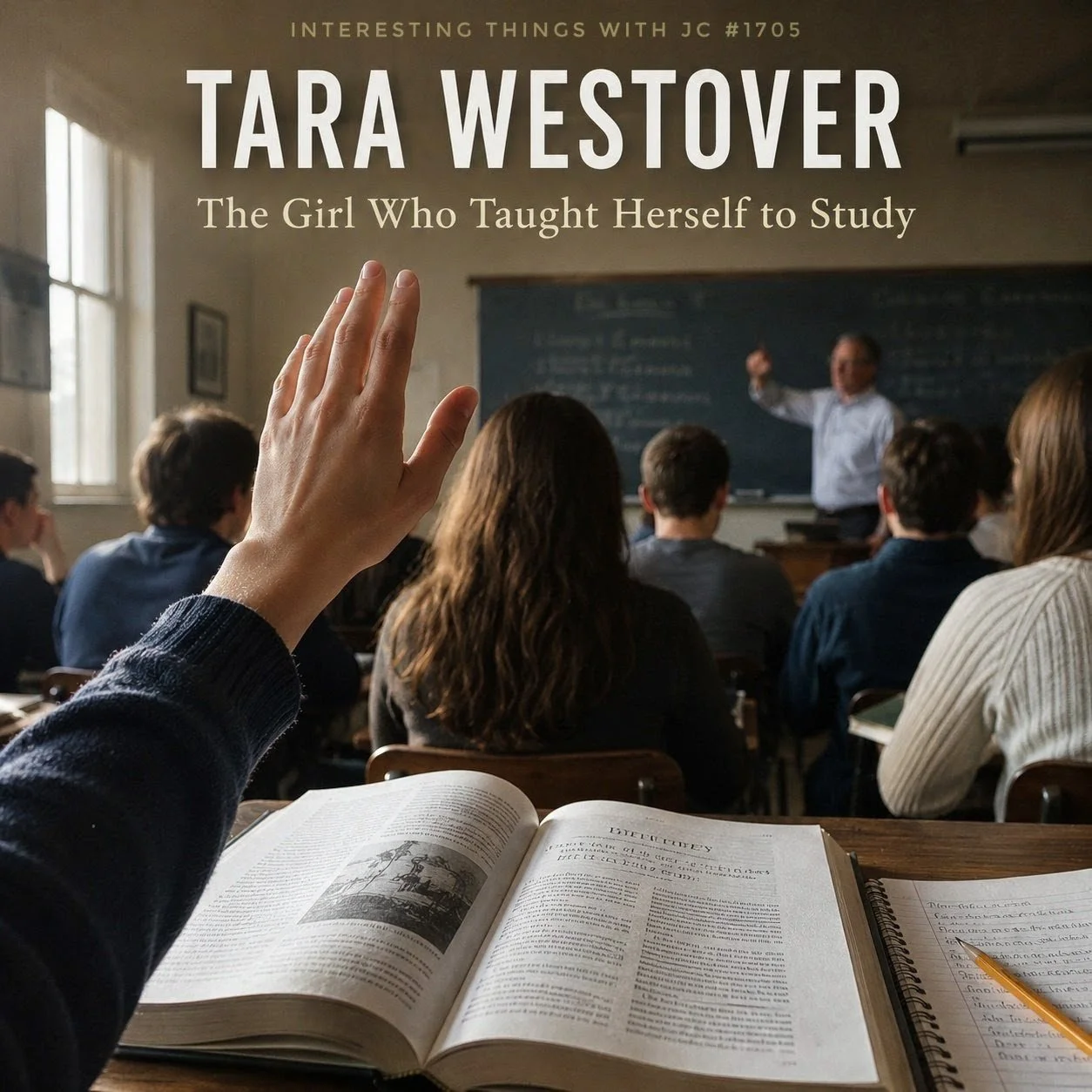
A classroom scene viewed from a student's desk, featuring a raised hand, an open textbook, fellow students, and a teacher at a chalkboard beneath the title Tara Westover – The Girl Who Taught Herself to Study. The image represents education, self-directed learning, perseverance, and the importance of asking questions.
Transcript
Interesting Things with JC #1705:
Tara Westover, The Girl Who Taught Herself to Study
Tara Westover decided she wanted to go to college when she was seventeen years old.
That decision would have been unremarkable except for one detail. She had never attended school. There was no transcript, no diploma, and no teacher she could turn to because she'd never had one. For years, there wasn't even an official record of her birth. Still, she intended to take the same ACT exam as students who had spent their lives moving from one classroom to the next.
She was born in 1986 and raised in the mountains of southeastern Idaho, where her father believed public schools, hospitals, and many government institutions couldn't be trusted. The children stayed home, but there was no formal education to replace the one they weren't receiving. Instead, Tara's days were spent bottling fruit, storing food, working in her father's salvage yard, and preparing for the disasters he believed were inevitable. Those were the lessons her family considered necessary. Much of the history, science, literature, and mathematics taught in American schools simply never entered her world.
Everything changed when one of her older brothers left home. He encouraged Tara to leave as well, and for the first time she allowed herself to imagine a different future. The obstacle was obvious. College required knowledge she had never been given, so she bought an algebra textbook and started where she could.
One subject led naturally to the next. Algebra became grammar. Grammar became reading comprehension. Every chapter answered one question and uncovered another. Without a classroom or a teacher, the books themselves became her education, and she stayed with each lesson until she understood enough to move forward.
It was enough.
Her ACT score earned her admission to Brigham Young University.
Passing the entrance exam proved she could learn.
Walking onto campus revealed how much she'd never had the opportunity to learn.
Many of the historical events, scientific ideas, books, and cultural references her classmates treated as common knowledge were entirely new to her. During one history class, a professor referred to the Holocaust. Tara raised her hand and asked what the word meant.
That moment has become one of the best-known passages in Educated, not because it revealed the limits of her intelligence, but because it revealed the limits of her education.
Once those missing pieces began to fall into place, they did so quickly. Her work at BYU earned her a Gates Cambridge Scholarship. She completed a master's degree at Trinity College, Cambridge, was a visiting fellow at Harvard University, and returned to Cambridge to earn her doctorate in history in 2014.
Four years later, she published Educated. The memoir spent more than two years on The New York Times bestseller list, was translated into more than forty-five languages, and introduced readers around the world to a childhood that seemed almost impossible to imagine.
Years after earning a doctorate in history, many people still remember Tara Westover for a question she asked during her first semester of college.
Not because she couldn't answer it.
Because before that day, no one had ever given her the chance to ask it.
These are interesting things, with JC.
Student Worksheet
Purpose: Listen to the podcast first. Then complete the following activities using evidence from the episode and your own reasoning. If audio is unavailable, read the transcript before beginning.
Student Output Expectations: Complete all responses using complete sentences. Support analytical answers with evidence from the podcast.
Academic Integrity Guidance: Demonstrate your own understanding. When using information from the podcast, summarize in your own words unless directly quoting the transcript.
Comprehension Questions
Why was Tara Westover's decision to attend college unusual?
Describe Tara's childhood responsibilities instead of attending school.
How did Tara prepare for the ACT examination?
What happened during her first history class at BYU?
Name three academic accomplishments Tara achieved after entering college.
Analysis Questions
How did self-directed learning change Tara's future?
Why is access to education important for both individuals and society?
Explain how curiosity became one of Tara's greatest strengths.
What does Tara's story suggest about the difference between intelligence and educational opportunity?
Reflection Prompt
Describe a time when you had to learn something without formal instruction. What strategies helped you succeed, and how does your experience compare with Tara Westover's journey?
Difficulty Scaling
Beginning
Identify five important facts from the episode.
Define the vocabulary words in your own language.
Intermediate
Explain how Tara's circumstances influenced her educational journey.
Compare her experience with that of a typical high school student.
Advanced
Evaluate whether determination alone is enough to overcome educational barriers. Support your position with evidence from the episode and additional historical or contemporary examples.
Teacher Guide
Quick Start
Begin the lesson by playing the complete podcast episode. Encourage students to listen for obstacles Tara faced, decisions she made, and turning points that changed her life.
Pacing Guide (Audio-First)
Bell Ringer — 5 minutes
Podcast Listening — 8–10 minutes
Vocabulary Review — 10 minutes
Student Worksheet — 20 minutes
Discussion — 10 minutes
Assessment and Exit Ticket — 10 minutes
Bell Ringer
Ask students:
"What would it be like to prepare for college if you had never attended school?"
Allow students two to three minutes to write privately before discussing responses.
Audio Guidance
Encourage students to listen for:
Educational barriers
Turning points
Evidence of resilience
Examples of independent learning
Historical references they recognize
Audio Fallback
If audio cannot be played, students should silently read the transcript before beginning worksheet activities.
Time on Task
Approximately 60–70 minutes.
Materials
Podcast audio or transcript
Student worksheet
Notebook or digital document
Internet access for optional extension research
Vocabulary Preparation
Preview key vocabulary before listening. Encourage students to identify each term when it appears in the episode.
Common Misconceptions
Intelligence and education are not identical.
Formal schooling is one pathway to learning, but not the only one.
Self-directed learning still requires discipline, structure, and persistence.
Educational opportunity varies widely across different environments.
Discussion Prompts
Why do educational opportunities differ among communities?
How does curiosity influence learning?
What role did Tara's brother play in changing her future?
Why is asking questions an important part of education?
How can society help remove barriers to education?
Formative Checkpoints
Students identify major chronological events accurately.
Students distinguish between intelligence and opportunity.
Students support conclusions with evidence from the episode.
Students correctly use key vocabulary during discussion.
Differentiation
For Emerging Learners
Provide vocabulary definitions in advance.
Allow partner discussion before written responses.
For Advanced Learners
Research educational access in different countries.
Compare Tara Westover's experiences with another self-taught historical figure.
Assessment Differentiation
Students may demonstrate understanding through:
Written responses
Oral presentation
Graphic organizer
Timeline
Reflective essay
Time Flexibility
One 60-minute class
Two 35-minute periods
Independent homeschool lesson
Adult education discussion session
Substitute Readiness
The lesson can be taught entirely from the transcript if audio equipment or internet access is unavailable.
Engagement Strategy
Ask students to create a timeline showing Tara's educational milestones and identify the decisions that produced each milestone.
Extensions
Read excerpts from Educated.
Research the Gates Cambridge Scholarship.
Investigate how colleges evaluate nontraditional applicants.
Compare formal education with lifelong learning models.
Cross-Curricular Connections
History
English Language Arts
Psychology
Sociology
Career Education
SEL Connection
Students examine resilience, perseverance, self-confidence, empathy, and the importance of seeking help when pursuing personal goals.
Skill Emphasis
Critical reading
Evidence evaluation
Listening comprehension
Historical reasoning
Written communication
Reflection
Problem solving
Answer Key
Comprehension
She had never attended school and had no formal educational records.
Bottling fruit, storing food, working in a salvage yard, and preparing for emergencies.
She independently studied algebra, grammar, reading comprehension, and other subjects.
She asked what the Holocaust was because she had never learned about it.
Admission to BYU, Gates Cambridge Scholarship, master's degree at Trinity College Cambridge, Harvard fellowship, doctorate from Cambridge, publication of Educated.
Analysis
Accept well-supported responses demonstrating evidence-based reasoning.
Quiz
Directions: Select the best answer for each question.
Why was Tara Westover's college application unusual?
A. She graduated from several high schools.
B. She had never attended formal school.
C. She transferred from another university.
D. She studied overseas first.Which subject did Tara begin studying first?
A. History
B. Biology
C. Algebra
D. LiteratureWhich university admitted Tara after her ACT score?
A. Harvard University
B. Yale University
C. Brigham Young University
D. Stanford UniversityWhich scholarship did Tara eventually receive?
A. Rhodes Scholarship
B. Fulbright Scholarship
C. Gates Cambridge Scholarship
D. Marshall ScholarshipWhat is the central theme of this episode?
A. Wealth determines success.
B. Curiosity and persistence can overcome educational barriers.
C. Formal education is unnecessary.
D. College guarantees success.
Assessment
Open-Ended Questions
Tara Westover's educational journey began without formal schooling. Using evidence from the episode, explain how self-directed learning allowed her to overcome educational barriers. Include at least three examples from the podcast to support your response.
The episode distinguishes between intelligence and educational opportunity. Explain this distinction and evaluate why access to education is important for individuals and society. Support your answer with evidence from the episode and your own reasoning.
3–2–1 Rubric
3 – Proficient
Thoroughly answers the question.
Uses multiple pieces of evidence from the podcast.
Demonstrates critical thinking and clear organization.
Uses appropriate academic vocabulary.
2 – Developing
Answers most of the question.
Includes some supporting evidence.
Demonstrates basic understanding with minor inaccuracies or limited explanation.
1 – Beginning
Provides minimal or incomplete responses.
Includes little or no supporting evidence.
Demonstrates limited understanding of the episode.
Exit Ticket
Before leaving class, answer the following in one or two sentences:
What is one lesson from Tara Westover's story that you can apply to your own education, and why?
Standards Alignment
NGSS Science and Engineering Practices
SEP1 – Asking Questions and Defining Problems
Students generate meaningful questions about educational access, historical knowledge, and lifelong learning while examining Tara Westover's experiences. This is demonstrated through classroom discussion and reflective writing.SEP8 – Obtaining, Evaluating, and Communicating Information
Students evaluate information presented in the podcast, organize evidence, and communicate conclusions through written and oral responses, strengthening information literacy skills.
CCSS Reading
CCSS.ELA-LITERACY.RI.11-12.1 – Cite Strong and Thorough Textual Evidence
Students support written responses using evidence from the podcast transcript and discussion. This standard aligns directly with the worksheet, assessment, and classroom discussion.CCSS.ELA-LITERACY.RI.11-12.2 – Determine Central Ideas
Students identify the central message regarding educational opportunity, perseverance, and lifelong learning while distinguishing supporting details from the narrative.
CCSS Writing
CCSS.ELA-LITERACY.W.11-12.2 – Informative/Explanatory Writing
Students compose organized written responses explaining Tara Westover's educational journey using factual evidence and logical reasoning.CCSS.ELA-LITERACY.W.11-12.9 – Draw Evidence from Informational Texts
Students integrate evidence from the transcript into analytical and reflective writing assignments.
CCSS Speaking & Listening
CCSS.ELA-LITERACY.SL.11-12.1 – Collaborative Discussions
Students participate in evidence-based discussions, respectfully evaluating differing viewpoints while supporting claims with information from the episode.
C3 Framework
D2.His.14.9-12 – Analyze Multiple and Complex Causes and Effects of Events
Students examine how family beliefs, educational opportunity, and personal determination combined to influence Tara Westover's life and academic success.
ISTE Standards
ISTE 1.1 Empowered Learner
Students demonstrate ownership of their learning by setting goals, reflecting on progress, and evaluating strategies for independent learning inspired by Tara Westover's experiences.ISTE 1.3 Knowledge Constructor
Students critically evaluate information, gather evidence, and synthesize ideas from the podcast to support informed conclusions.
Career Readiness Competencies
Analytical Thinking
Students evaluate complex life situations using evidence rather than assumptions.Communication
Students strengthen written and verbal communication through discussion, reflection, and evidence-based responses.Problem Solving
Students analyze how Tara identified educational barriers and developed practical solutions through self-directed study.Adaptability
Students recognize the importance of learning new skills when circumstances change throughout life and career.Professional Judgment
Students evaluate responsible decision-making, perseverance, and ethical academic behavior while reflecting on lifelong learning.
Homeschool / Lifelong Learning Alignment
Independent Learning
Students recognize strategies for planning, monitoring, and evaluating their own learning.Information Literacy
Students practice locating, interpreting, and evaluating reliable information from educational resources.Real-World Application
Students connect perseverance, curiosity, and self-education to college, careers, and everyday decision-making.Self-Directed Inquiry
Students formulate questions, investigate unfamiliar topics, and reflect upon their learning process.Transferable Life Skills
Students develop resilience, organization, persistence, communication, and critical thinking applicable throughout adulthood.
Show Notes
This lesson explores the remarkable educational journey of Tara Westover, whose determination to learn transformed her life despite never attending formal school as a child. Students examine how curiosity, perseverance, and access to education influence opportunity while strengthening critical reading, listening, discussion, and analytical writing skills. The lesson encourages learners to appreciate education as a lifelong process and demonstrates that asking questions is often the first step toward meaningful understanding.
References
Westover, T. (n.d.). Official website. https://tarawestover.com/
BBC News. (2018, February 20). Tara Westover: From survivalist childhood to Cambridge PhD.https://www.bbc.com/news/business-43038598
Brigham Young University. (n.d.). About Brigham Young University.https://www.byu.edu/about
Gates Cambridge. (n.d.). Tara Westover – Gates Cambridge Scholar Biography.https://www.gatescambridge.org/biography/6162/
Harvard Kennedy School. (n.d.). Tara Westover.https://shorensteincenter.org/person/tara-westover/
Penguin Random House. (n.d.). Educated by Tara Westover.https://www.penguinrandomhouse.com/books/218680/educated-by-tara-westover/
University of Cambridge. (2024). The Family, Morality and Social Science in Anglo-American Cooperative Thought, 1813–1890 (Doctoral thesis repository). https://www.repository.cam.ac.uk/handle/1810/364372
Westover, T. (2018). Educated: A memoir. Random House. https://www.amazon.com/Educated-Memoir-Tara-Westover/dp/0399590501