1706: "John Smeaton - The Hero of Glasgow"
Interesting Things with JC #1706: "John Smeaton
The Hero of Glasgow"
A baggage handler runs toward a burning Jeep after it crashes into Glasgow Airport and joins travelers, airport workers, and police in stopping a terrorist attack before the explosives can cause the devastation that was intended, then spends the years that follow making sure the other people who charged in beside him are remembered too.
Curriculum - Episode Anchor
Episode Title: John Smeaton
Episode Number: 1706
Host: JC
Audience: Grades 9–12, Introductory College, Homeschool, Lifelong Learners
Subject Area: History, Civics, Terrorism Studies, Character Education
Lesson Overview
Objectives:
Analyze the events surrounding the attempted terrorist attack at Glasgow Airport in 2007.
Explain how ordinary citizens responded during a public emergency.
Evaluate leadership, teamwork, and civic responsibility demonstrated during the incident.
Distinguish between individual recognition and collective action.
Essential Question:
What responsibilities, if any, do ordinary citizens have during moments of public crisis?
Success Criteria:
Students can accurately summarize the event, identify the actions of multiple participants, analyze why teamwork mattered, and support conclusions using evidence from the episode.
Student Relevance:
Students encounter emergencies ranging from accidents to natural disasters. Understanding how people responsibly respond to crises helps develop judgment, situational awareness, and civic responsibility.
Real-World Connection:
Emergency response depends not only on trained professionals but also on informed citizens capable of making sound decisions under pressure.
Workforce Reality:
Many careers—including aviation, transportation, healthcare, emergency services, education, and public safety—require calm decision-making, teamwork, and situational awareness during unexpected events.
Key Vocabulary
Gallantry(GAL-ən-tree) — Courage shown during dangerous situations.
Terrorism(TER-uh-riz-um) — The unlawful use of violence or intimidation to achieve political or ideological goals.
Civilian(suh-VIL-yən) — A person who is not a member of the military or law enforcement.
Propane(PRO-payn) — A flammable gas commonly used as fuel.
Mass Casualty(mass KAZH-oo-ul-tee) — An incident causing numerous injuries or deaths.
Situational Awareness(sich-oo-AY-shun-ul uh-WAIR-ness) — Understanding one's surroundings and recognizing potential dangers.
Collective Action(kuh-LEK-tiv AK-shun) — Coordinated efforts by multiple individuals toward a common goal.
Gallantry Medal(GAL-ən-tree MED-ul) — An award recognizing exceptional bravery.
Narrative Core
Open:
On June 30, 2007, an attempted terrorist attack unfolded outside Glasgow Airport. What followed became an international example of courage displayed by ordinary people.
Info:
The attackers intended to detonate a vehicle packed with flammable materials at one of Scotland's busiest airports. Although the vehicle ignited, the explosive plan failed to produce the intended catastrophic explosion.
Details:
Airport baggage handler John Smeaton witnessed the attack while outside on break. Seeing a police officer struggling with one attacker, he rushed forward and joined numerous airport employees, police officers, travelers, and others who worked together to restrain the attackers until additional officers arrived.
Reflection:
Although Smeaton became internationally famous, he consistently emphasized that many people acted together that day. His humility became as memorable as his bravery.
Closing:
These are interesting things, with JC.
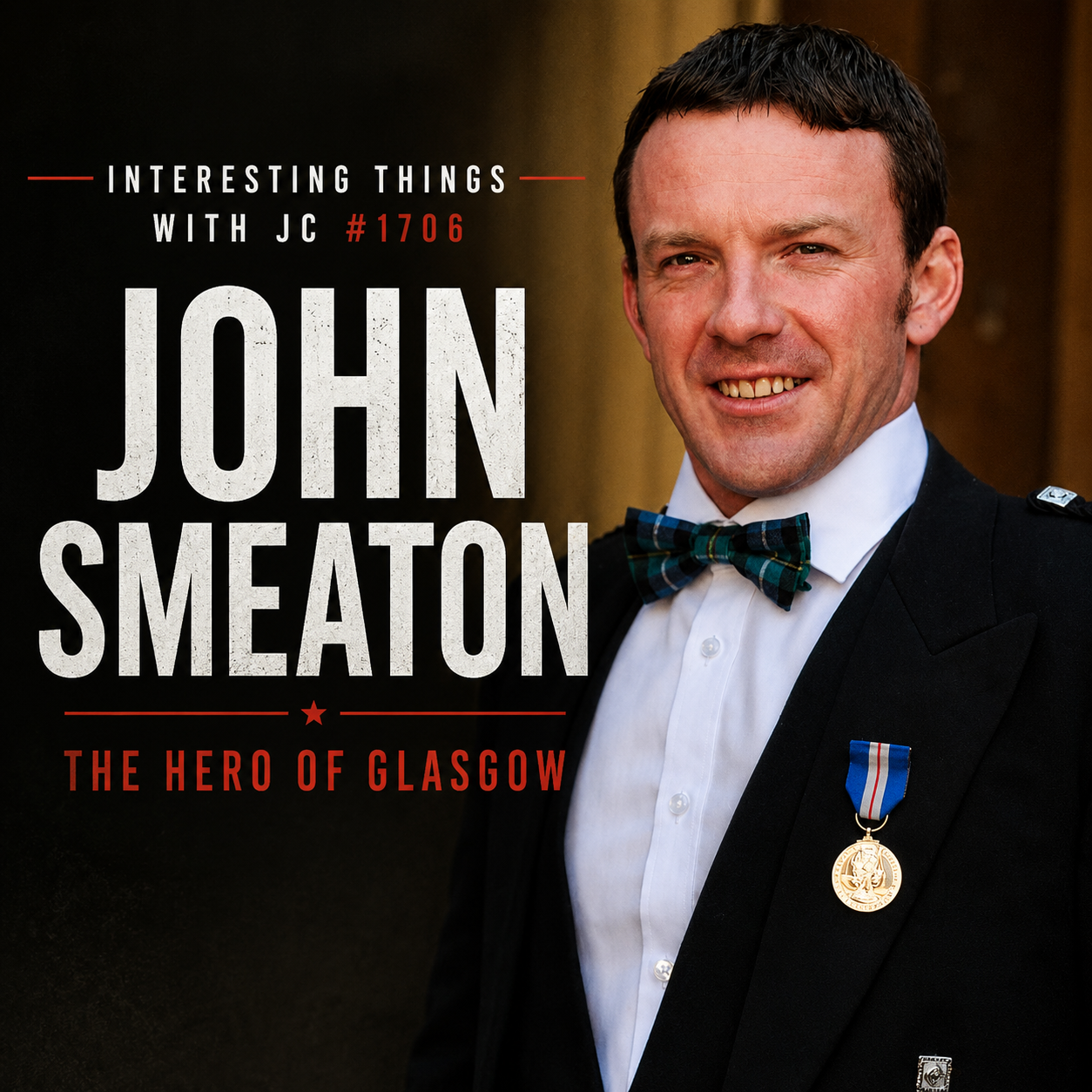
Promotional cover image for Interesting Things with JC Episode #1706, titled "John Smeaton." The left side features the podcast branding and large white text reading "JOHN SMEATON," with the subtitle "THE HERO OF GLASGOW" in red. The right side shows John Smeaton smiling while wearing a black formal jacket, white dress shirt, tartan bow tie, and the Queen's Gallantry Medal pinned to his lapel. The background is softly blurred stone architecture in warm brown tones. The overall design uses a black, white, and red color scheme to emphasize the episode's focus on Smeaton's courageous actions during the 2007 Glasgow Airport terrorist attack.
Transcript
Interesting Things with JC #1706:
"John Smeaton - The Hero of Glasgow"
On June 30, 2007, a Jeep Cherokee crashed through the front doors of Glasgow Airport. Flames were already pouring from the vehicle. Standing outside on a cigarette break was airport baggage handler John Smeaton.
Inside the Jeep were propane cylinders, containers of gasoline, and other combustible materials. The plan was to turn the entrance of one of Scotland's busiest airports into the site of a mass-casualty terrorist attack.
As smoke rolled across the terminal entrance, one of the attackers climbed from the burning vehicle and began struggling with a police officer.
John Smeaton ran straight toward the fight.
As he arrived at the rammy, he shouted, "You're nae hitting the polis, mate!" Then he unleashed a right-footed strike that would've had every football supporter in Glasgow on their feet. This wasn't a shot into the back of the net. It was a penalty delivered straight to the terrorist's family jewels. If accuracy earned trophies, John Smeaton would've lifted the cup.
Airport workers Michael Kerr, Alex McIlveen, Stephen Clarkson, police officers, travelers, and others rushed in behind him. Together they punched, kicked, restrained, and held the attackers until additional officers arrived.
The attack on Glasgow Airport had not come out of nowhere. Less than twenty-four hours earlier, police in London had discovered two car bombs before they could explode. Glasgow was intended to be the next attack. The burning Jeep reached the terminal, but the explosives failed to produce the devastating blast the attackers had planned.
Within hours, television crews were interviewing John Smeaton.
He answered their questions the same way he had confronted the attacker: plainly and without a trace of self-importance. Asked what he would say to anyone thinking about trying something similar again, he answered in broad Glaswegian.
"This is Glasgow. We'll just set aboot ye."
The interview spread around the world. People created websites in his honor, and thousands of strangers donated to an online beer fund to buy him a pint.
Prime Minister Gordon Brown invited him to 10 Downing Street. He later attended a Ground Zero anniversary ceremony in New York and received the Queen's Gallantry Medal, one of the United Kingdom's highest civilian honors for bravery.
For all the attention, John Smeaton never told the story as though he had stopped the attack by himself.
Whenever he spoke about that afternoon, he made sure Michael Kerr, Alex McIlveen, Stephen Clarkson, the police officers, the travelers, and the others who ran toward the burning Jeep were remembered alongside him.
The world remembered John Smeaton.
John Smeaton remembered the people who ran toward the burning Jeep with him.
These are interesting things, with JC.
Student Worksheet
Comprehension
What occurred at Glasgow Airport on June 30, 2007?
Why did the attackers target the airport?
Who was John Smeaton?
What actions did airport employees and travelers take?
Why did Smeaton continue recognizing others after receiving international attention?
Analysis
Why was teamwork more important than individual heroics during this event?
How did the failure of the attackers' explosives affect the outcome?
What qualities made John Smeaton an effective leader despite having no formal authority?
Reflection
Describe a situation in which ordinary people working together can make a significant difference during an emergency. Support your answer using evidence from the episode.
Difficulty Scaling
Level 1: Complete comprehension questions.
Level 2: Answer one analysis question using evidence.
Level 3: Complete all sections and compare this event with another example of civilian bravery.
Student Output Expectations
Students should produce complete sentences supported with evidence from the episode and classroom discussion.
Academic Integrity Guidance
Use your own words. Support conclusions with evidence rather than copying narrative language.
Teacher Guide
Quick Start: Play the podcast before introducing historical background.
Pacing Guide (Audio-First):
Bell Ringer (5 min)
Podcast (8–10 min)
Vocabulary (10 min)
Discussion (15 min)
Worksheet (20 min)
Quiz (10 min)
Assessment & Exit Ticket (10 min)
Bell Ringer: Ask students to define courage. Is courage always planned?
Audio Guidance: Encourage students to identify examples of teamwork while listening.
Audio Fallback: Read the Narrative Core and summarize the historical event before beginning discussion.
Time on Task: Approximately 60–70 minutes.
Materials:
Podcast audio
Student worksheet
Quiz
Writing materials
Vocabulary Preparation: Review terrorism, gallantry, civilian, and situational awareness before listening.
Common Misconceptions:
One individual stopped the attack alone.
Courage requires formal training.
Recognition always belongs to a single person.
Discussion Prompts:
Why did Smeaton highlight the contributions of others?
How should societies recognize acts of bravery?
What role does teamwork play during emergencies?
Formative Checks:
Think-Pair-Share
Exit responses
Vocabulary review
Evidence-based discussion
Differentiation:
Graphic organizers
Sentence starters
Extended research for advanced learners
Assessment Differentiation:
Oral responses
Written paragraphs
Multimedia presentation
Time Flexibility: May be completed over one or two class periods.
Substitute Readiness: Lesson functions independently with either podcast or teacher summary.
Engagement Strategy: Ask students to map the sequence of events from the attempted attack through the arrest.
Extensions:
Research airport security changes after 2007.
Compare civilian intervention in other historical emergencies.
Cross-Curricular Connections:
History
Criminal Justice
Government
Psychology
Communications
SEL Connection: Emphasize responsible decision-making, empathy, courage, humility, and cooperation.
Skill Emphasis:
Critical thinking
Evidence evaluation
Communication
Teamwork
Civic responsibility
Answer Key:
Worksheet answers should identify:
Glasgow Airport attack
Failed terrorist plan
Collective intervention
Humility after recognition
Importance of teamwork over individual recognition
Quiz
What was the attackers' intended target?
A. Railway station
B. Glasgow Airport terminal
C. Government office
D. Football stadium
Which employee became widely known after the attack?
A. Michael Kerr
B. Alex McIlveen
C. John Smeaton
D. Stephen Clarkson
Why did the attackers fail to achieve their intended outcome?
A. Police intercepted them before arrival.
B. The explosives failed to produce the planned explosion.
C. They abandoned the attack.
D. Heavy rain extinguished the fire.
Which leadership quality best describes Smeaton after the event?
A. Pride
B. Humility
C. Ambition
D. Secrecy
What is one major theme of the episode?
A. Individual fame
B. Teamwork during crisis
C. Political debate
D. Airport design
Assessment
Open-Ended Questions
Explain why John Smeaton consistently credited others for stopping the attack.
How does this event illustrate the relationship between courage and teamwork?
3–2–1 Rubric
3: Thorough explanation supported by multiple pieces of evidence.
2: Adequate explanation with some supporting evidence.
1: Limited explanation with minimal evidence.
Exit Ticket
In one sentence, explain why historians remember both John Smeaton and the people who acted alongside him.
Standards Alignment
NGSS Science & Engineering Practice: Analyzing and Interpreting Data — Students evaluate evidence from a real-world emergency to explain outcomes and decision-making.
CCSS Reading RH.11-12.1: Cite specific textual evidence while analyzing historical events. Students support conclusions using episode evidence.
CCSS Reading RH.11-12.2: Determine central ideas of historical sources. Students identify the importance of teamwork and civic responsibility.
CCSS Writing WHST.11-12.1: Write arguments supported by evidence. Students defend conclusions in worksheet and assessment responses.
CCSS Speaking & Listening SL.11-12.1: Participate effectively in collaborative discussions. Students evaluate multiple perspectives during class discussion.
C3 Framework D2.Civ.7.9-12: Apply civic virtues and democratic principles. Students examine responsible citizen action during emergencies.
ISTE 1.3 Knowledge Constructor: Evaluate information from historical sources and communicate evidence-based conclusions.
Career Readiness – Analytical Thinking: Evaluate changing situations using evidence before making decisions.
Career Readiness – Communication: Clearly explain observations and reasoning.
Career Readiness – Problem Solving: Assess how collaborative action contributes to successful emergency outcomes.
Career Readiness – Adaptability: Recognize how individuals respond effectively to rapidly changing situations.
Career Readiness – Professional Judgment: Understand when initiative and cooperation are appropriate during emergencies.
Homeschool / Lifelong Learning: Promote independent inquiry, information literacy, civic understanding, and transferable decision-making skills through analysis of a real historical event.
Show Notes
This lesson examines the attempted terrorist attack at Glasgow Airport in 2007 through the actions of airport baggage handler John Smeaton and the many others who responded alongside him. Students explore courage, humility, teamwork, emergency response, and civic responsibility while evaluating how ordinary people can make extraordinary contributions during moments of crisis.
References
BBC News. (2007). Glasgow Airport attack. https://news.bbc.co.uk/2/hi/uk_news/scotland/6257194.stm
The National Archives (UK). (n.d.). Queen's Gallantry Medal. https://www.nationalarchives.gov.uk/
American Broadcasting Company. (2007, July 1). Attack on Glasgow Airport foiled by civilians and police. https://abcnews.com/International/story?id=3365067&page=1
BBC Radio 4. (2014). John Smeaton – The Reunion (The Reunion). https://www.bbc.co.uk/programmes/b04d52hs
The Guardian. (2017, September 1). I stopped a terrorist attack: John Smeaton on the day he became an unlikely hero. https://www.theguardian.com/lifeandstyle/2017/sep/01/i-stopped-a-terrorist-attack-experience
Daily Record. (2012, June 30). Airport terror attack hero dedicates Queen's Gallantry Medal to fellow workers. https://www.dailyrecord.co.uk/news/scottish-news/airport-terror-attack-hero-dedicates-1065328
The Telegraph. (2008, November 17). John Smeaton back home after asthma attack. https://www.telegraph.co.uk/news/uknews/3387104/John-Smeaton-back-home-after-asthma-attack.html
UK Government. (n.d.). The honours system: Gallantry awards. https://www.gov.uk/honours