1707: "Craig Shergold and the Greeting Card Cure"
Interesting Things with JC #1707: "The Greeting Card Cure"
Millions of greeting cards keep arriving for a boy who recovered decades ago after a chain letter spread worldwide, and the outdated request continues circulating online long after the record, the illness, and the child himself are gone.
Curriculum - Episode Anchor
Episode Title: Craig Shergold and the Greeting Card Cure
Episode Number: 1707
Host: JC
Audience: Grades 9–12, introductory college, homeschool, lifelong learners
Subject Area: Media literacy, health history, communication, digital citizenship
Lesson Overview
Learning Objectives:
Explain how Craig Shergold’s get-well card request became a worldwide chain-letter phenomenon.
Analyze how outdated information continues spreading across changing communication technologies.
Evaluate the difference between compassion, verification, and responsible sharing.
Connect the story to modern digital citizenship and information literacy.
Essential Question: How can a kind message become harmful when people stop checking whether it is still true?
Success Criteria: Students can summarize the case, identify how the message spread, explain why verification matters, and apply the lesson to modern online sharing.
Student Relevance Statement: Students encounter reposts, appeals, fundraisers, and viral requests online; this lesson helps them pause before amplifying outdated or misleading information.
Real-World Connection: Chain letters, viral posts, and social media appeals can create real consequences for families, organizations, and public systems.
Workforce Reality: Professional communication requires accuracy, judgment, empathy, and verification before forwarding information.
Key Vocabulary
Chain letter(chayn LET-er): A message designed to be copied and passed from person to person.
Verification(vair-uh-fuh-KAY-shun): The process of checking whether information is accurate and current.
Viral spread(VY-rul spred): Rapid sharing of information through social networks or communication channels.
Benign(bih-NINE): Not cancerous or not harmful in a medical sense.
World record(wurld REK-erd): A documented achievement recognized as the highest, largest, first, or most extreme of its kind.
Postal code(POH-stul kohd): A code used by mail systems to sort and deliver mail efficiently.
Misinformation(mis-in-fer-MAY-shun): False or outdated information shared without necessarily intending harm.
Digital citizenship(DIJ-uh-tul SIT-uh-zun-ship): Responsible, ethical participation in online spaces.
Narrative Core
Open: A nine-year-old boy made a simple wish after a frightening diagnosis: he wanted get-well cards.
Info: Craig Shergold’s request spread through photocopied chain letters, then through later technologies such as fax, email, forums, and social media.
Details: The campaign helped him break a Guinness World Record, but the message kept circulating long after his surgery, recovery, and the retirement of the record category.
Reflection: The story shows how kindness can become complicated when people repeat information without checking whether it is still needed, accurate, or helpful.
Closing: These are interesting things, with JC.
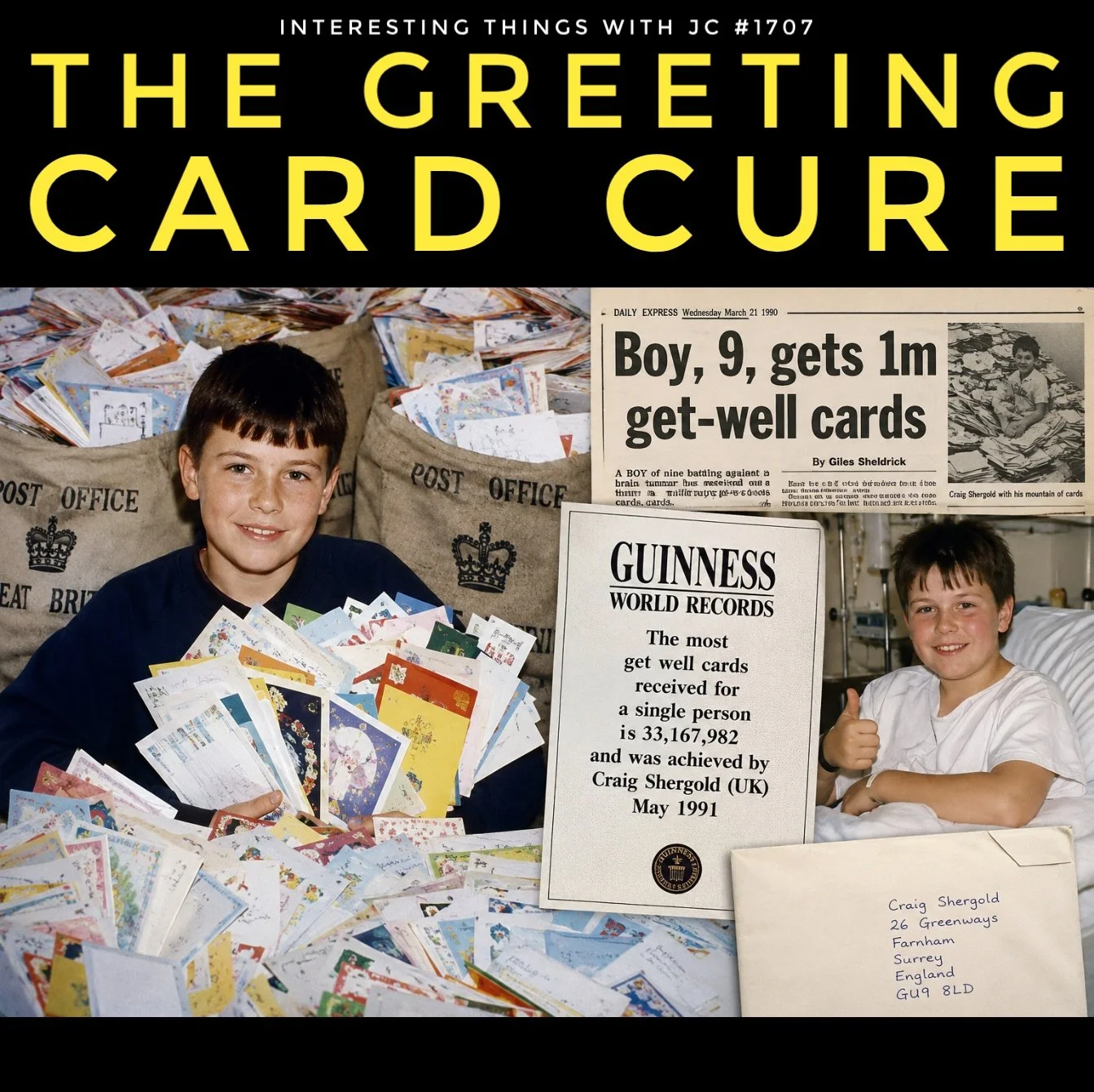
Collage for "Interesting Things with JC #1707: The Greeting Card Cure" showing childhood photos of Craig Shergold surrounded by thousands of greeting cards, a Guinness World Records certificate, a 1990 newspaper headline about one million get-well cards, and a handwritten mailing address. Images and visual materials are included solely to support education, research, historical documentation, criticism, and commentary. They are presented for non-commercial, informational purposes only. All copyrights, trademarks, and other intellectual property rights remain the property of their respective owners. No ownership or endorsement is claimed or implied.
Transcript
Interesting Things with JC #1707:
"Craig Shergold and the Greeting Card Cure"
In 1989, nine-year-old Craig Shergold of Surrey, England, was diagnosed with a brain tumor. After the diagnosis, Craig asked for one thing. He wanted to break the Guinness World Record for receiving the most get-well cards.
Photocopied chain letters carried his request from family to family, school to school, and church to church. Cards arrived from around the world until the local post office could no longer handle the volume. Royal Mail eventually assigned the Shergold family its own postal code simply to keep the mail moving.
Craig's story reached John Kluge, the American media entrepreneur who was the wealthiest man in the United States at the time. Kluge flew Craig and his parents to the University of Virginia, where neurosurgeon Dr. Neal Kassell removed nearly all of the egg-sized tumor. During the operation, doctors discovered it was benign, and Craig recovered.
By May 1991, Guinness World Records credited Craig with receiving more than 33 million greeting cards. The record was so far beyond anything anyone could reasonably surpass that Guinness retired the category.
The operation was over. The record had been set.
The letters kept coming.
They moved from photocopies to fax machines, then to email, internet forums, and eventually social media. Craig's family spent years asking people to stop sending cards, but each new generation discovered the same outdated appeal and passed it along again.
Craig Shergold passed away in April 2020 at the age of 40 after developing COVID-19-related pneumonia.
The chain letter outlived the illness, the world record, and the little boy who inspired it. It still appears online, asking people to send get-well cards to a child whose recovery was celebrated more than three decades ago.
These are interesting things, with JC.
Student Worksheet
Comprehension Questions:
Who was Craig Shergold, and what did he ask people to send?
How did the request spread before the internet became common?
What role did John Kluge play in the story?
What did doctors discover during Craig’s operation?
Why did Guinness World Records retire the category?
Analysis Questions:
Why did the chain letter continue after Craig recovered?
How did changing technology help the message survive?
What makes this story different from a normal act of kindness?
What should a responsible person check before sharing a similar appeal today?
Reflection Prompt: Write one paragraph explaining how compassion and verification can work together.
Difficulty Scaling:
Support: Use sentence starters and identify three facts from the transcript.
Standard: Answer all questions with evidence from the story.
Challenge: Compare this case to a modern viral post, fundraiser, or reposted warning.
Student Output: Submit written answers plus one 5–7 sentence reflection.
Academic Integrity Guidance: Use your own words, cite the episode when using facts, and do not invent details beyond the transcript.
Teacher Guide
Quick Start: Begin with the podcast audio, then ask students what changed between the original request and the later chain-letter problem.
Pacing Guide Audio-First:
Listen to episode: 3–5 minutes.
Silent recall notes: 3 minutes.
Vocabulary check: 5 minutes.
Worksheet: 15–20 minutes.
Discussion: 10–15 minutes.
Exit ticket: 3 minutes.
Bell Ringer: “When should a person stop sharing a message, even if the message seems kind?”
Audio Guidance: Ask students to listen for dates, technologies, and consequences.
Audio Fallback: If audio is unavailable, read the transcript aloud and pause after each paragraph for brief notes.
Time on Task: 45–55 minutes.
Materials: Transcript, worksheet, writing tool, projector or board, optional fact-checking device.
Vocabulary Prep: Preview chain letter, verification, misinformation, and digital citizenship.
Misconceptions: Students may assume all kind messages are harmless; clarify that outdated information can create real burdens.
Discussion Prompts:
Why do people forward emotional appeals quickly?
What responsibility does a sender have before sharing?
How can a message be true in origin but misleading later?
Formative Checkpoints:
Students identify the original request.
Students explain the communication timeline.
Students name one responsible sharing practice.
Differentiation: Provide guided notes for emerging readers, extension comparison for advanced students, and oral response options when needed.
Assessment Differentiation: Allow paragraph, audio response, or organizer format while keeping evidence requirements consistent.
Time Flexibility: For 30 minutes, skip the full worksheet and use only comprehension questions plus exit ticket. For 90 minutes, add a modern verification activity.
Substitute Readiness: Play or read the transcript, assign worksheet questions, collect exit tickets.
Engagement Strategy: Use a “share or stop?” scenario: students decide whether they would forward a viral appeal and explain why.
Extensions: Students create a verification checklist for emotional online requests.
Cross-Curricular: Connect to health literacy, communications, media studies, ethics, and history of technology.
SEL: Emphasize empathy paired with boundaries, accuracy, and responsible action.
Skill Emphasis: Evidence evaluation, communication, reasoning, judgment, and digital responsibility.
Answer Key:
Craig Shergold was a nine-year-old boy from Surrey diagnosed with a brain tumor who wanted get-well cards.
It spread through photocopied chain letters.
John Kluge helped bring Craig to the University of Virginia for surgery.
Doctors discovered the tumor was benign.
The record became so large that Guinness retired the category.
The message continued because people kept rediscovering and forwarding outdated versions.
Technology carried it from paper to fax, email, forums, and social media.
Responsible sharing requires checking date, source, current need, and consequences.
Quiz
What was Craig Shergold trying to receive?
A. Books
B. Get-well cards
C. Medical equipment
D. Newspaper articlesHow did the original request spread?
A. Television commercials only
B. Photocopied chain letters
C. Government notices
D. School textbooksWhere did Craig receive major surgery?
A. University of Virginia
B. Oxford University
C. Royal Mail Hospital
D. Guinness headquartersWhy did the chain letter become a problem?
A. It asked for money
B. It kept spreading after the need had passed
C. It was never connected to a real person
D. It was only shared in one townWhat is the main lesson of the episode?
A. Never help people
B. Records are always harmful
C. Kindness should be paired with verification
D. Mail systems cannot handle cards
Assessment
Open-Ended Questions:
Explain how Craig Shergold’s story shows the difference between helpful sharing and irresponsible forwarding.
Describe a modern situation where checking information before sharing could prevent harm or confusion.
3–2–1 Rubric:
3: Uses accurate evidence, explains consequences clearly, and connects the lesson to modern communication.
2: Uses some accurate evidence and explains the basic lesson with limited detail.
1: Gives a partial answer with little evidence or unclear reasoning.
Exit Ticket: Write one rule you will use before forwarding an emotional appeal online.
Standards Alignment
NGSS HS-ETS1-3 — Evaluate a Solution to a Complex Real-World Problem: Students evaluate how communication choices created unintended consequences; measurable outcome: identify risks and propose responsible sharing practices.
CCSS.ELA-LITERACY.RI.9-10.1 — Cite Strong and Thorough Textual Evidence: Students answer comprehension and analysis questions using transcript evidence; measurable outcome: support claims with specific episode details.
CCSS.ELA-LITERACY.RI.11-12.7 — Integrate and Evaluate Multiple Sources of Information: Students compare the episode with reference sources; measurable outcome: verify factual claims across media.
CCSS.ELA-LITERACY.W.9-10.2 — Write Informative/Explanatory Texts: Students write a reflection explaining compassion and verification; measurable outcome: produce a clear evidence-based paragraph.
CCSS.ELA-LITERACY.SL.9-10.1 — Collaborative Discussion: Students discuss forwarding decisions and consequences; measurable outcome: build on others’ ideas with reasoned evidence.
C3 D2.Civ.10.9-12 — Analyze Public Communication: Students examine how public messages affect communities; measurable outcome: explain civic responsibility in sharing information.
ISTE 1.2.b — Digital Citizen, Online Behavior: Students learn how online actions affect others; measurable outcome: create a responsible verification rule.
ISTE 1.3.b — Knowledge Constructor, Evaluate Information: Students assess the currency and reliability of a viral message; measurable outcome: identify whether an appeal is current and credible.
Career Readiness — Analytical Thinking: Students separate original facts from later consequences; measurable outcome: explain cause and effect.
Career Readiness — Communication: Students practice accurate, responsible messaging; measurable outcome: write a concise verification-based response.
Career Readiness — Problem Solving: Students propose ways to stop outdated appeals; measurable outcome: recommend a practical intervention.
Career Readiness — Adaptability: Students track the message across changing technologies; measurable outcome: explain how communication tools alter impact.
Career Readiness — Professional Judgment: Students decide whether to forward, verify, or stop a message; measurable outcome: justify a responsible choice.
Homeschool/Lifelong Learning — Independent Learning and Information Literacy: Learners practice checking claims before acting; measurable outcome: use a verification checklist.
Homeschool/Lifelong Learning — Real-World Application and Self-Directed Inquiry: Learners connect the episode to everyday online decisions; measurable outcome: transfer the lesson to a current communication example.
Show Notes
This episode turns the story of Craig Shergold’s get-well card campaign into a classroom lesson on compassion, communication, and verification. Students explore how a sincere request became a record-setting global response, then examine how the same message continued long after it was helpful. The lesson matters because modern students live in a world where emotional appeals can spread instantly, and responsible citizenship requires both empathy and accuracy.
References
Guinness World Records. (n.d.). Most greeting cards received. https://www.guinnessworldrecords.com/world-records/most-greeting-cards-received
Los Angeles Times. (1995). Beloved British teen cured of cancer thought fatal. https://www.latimes.com/archives/la-xpm-1995-12-01-mn-9253-story.html
Snopes. (2001). Sick child Christmas card request. https://www.snopes.com/fact-check/sick-child-christmas-card-request/
The New Yorker. (2020). How we became infected by chain e-mail. https://www.newyorker.com/culture/cultural-comment/youve-got-chain-e-mail
The Washington Post. (1995). Boy declared cured of brain tumor. https://www.washingtonpost.com/archive/local/1995/12/01/boy-declared-cured-of-brain-tumor/8e27b12f-4b51-4e28-a6d7-722d4db200a2/