1708: "The System That Made Blood Banking Scalable"
Interesting Things with JC #1708: "The System That Made Blood Banking Scalable"
Blood donations begin moving through a standardized collection and distribution system instead of depending on finding the right donor at the right time, and the same principles continue to shape modern blood banking more than 80 years later.
Curriculum - Episode Anchor
Episode Title: The System That Made Blood Banking Scalable
Episode Number: 1708
Host: JC
Audience: Grades 9–12, Introductory College, Homeschool, Lifelong Learners
Subject Area: Medical History • Biomedical Science • Public Health • Systems Engineering
Lesson Overview
Objectives
Students will:
Explain why blood transfusions were difficult before World War II.
Describe Charles Richard Drew's development of scalable plasma banking.
Analyze how standardized systems improve healthcare outcomes.
Evaluate the importance of scientific evidence in medical policy.
Essential Question
How can improving a system save more lives than inventing an entirely new technology?
Success Criteria
Students can:
Explain the difference between whole blood and plasma.
Describe how Drew standardized blood banking.
Connect logistics and quality control to modern healthcare.
Support conclusions using evidence from the episode.
Student Relevance
Students encounter organized systems every day—from package delivery to emergency response. Understanding how medical systems operate demonstrates that innovation often comes from improving processes rather than inventing new devices.
Real-World Connection
Modern trauma centers, emergency medicine, organ transplantation, disaster response, and military medicine all depend upon standardized blood banking systems developed from principles Charles Drew helped establish.
Workforce Reality
Healthcare professionals, laboratory scientists, logistics specialists, biomedical engineers, and quality assurance managers all rely upon standardized procedures to ensure patient safety.
Key Vocabulary
Blood Plasma(BLUHD PLAZ-muh) — The liquid component of blood that transports cells, nutrients, hormones, and proteins.
Whole Blood(HOHL bluhd) — Blood containing plasma, red cells, white cells, and platelets.
Transfusion(trans-FYOO-zhun) — The transfer of blood or blood products into a patient's circulation.
Standardization(stan-der-duh-ZAY-shun) — Establishing consistent procedures that produce reliable results.
Supply Chain(suh-PLY chayn) — The organized movement of materials from collection to final use.
Quality Control(KWOL-ih-tee kun-TROHL) — Procedures used to ensure products meet required standards.
Blood Bank(bluhd bangk) — A facility that collects, tests, stores, and distributes blood products.
Donor Screening(DOH-nor SKREEN-ing) — Medical evaluation used to determine donor eligibility.
Bloodmobile(BLUHD-moh-beel) — A mobile unit used to collect blood donations from communities.
Logistics(loh-JISS-tiks) — Planning and coordinating transportation, storage, and distribution.
Narrative Core
Open
Before World War II, receiving a blood transfusion often depended upon chance. Blood spoiled quickly, matching donors was difficult, and transportation limited where lifesaving treatment could occur.
Information
Charles Richard Drew recognized that blood plasma could be preserved longer and transported more efficiently than whole blood. Rather than inventing a single machine or medicine, he designed an organized system for collecting, testing, processing, storing, and distributing plasma safely.
Details
As director of the Blood for Britain program during 1940, Drew supervised thousands of blood donations collected across the United States and shipped overseas during the Blitz. The project's success demonstrated that blood products could move through a carefully managed national supply chain.
Soon afterward, Drew became the first medical director of the American Red Cross national blood bank. He standardized donor screening, laboratory testing, refrigeration, transportation, storage, recordkeeping, and quality assurance while expanding the use of mobile blood collection units.
He also opposed the segregation of blood by race within the U.S. military because scientific evidence did not support the policy. Rather than administer a scientifically unsupported system, he resigned.
Reflection
Many scientific breakthroughs are remembered because of an invention. Charles Drew's greatest contribution was demonstrating that carefully designed systems can save millions of lives by making existing knowledge practical, reliable, and scalable.
Closing
Today, every modern blood bank reflects principles of standardization, quality control, and coordinated logistics that Drew helped establish.
These are interesting things, with JC.
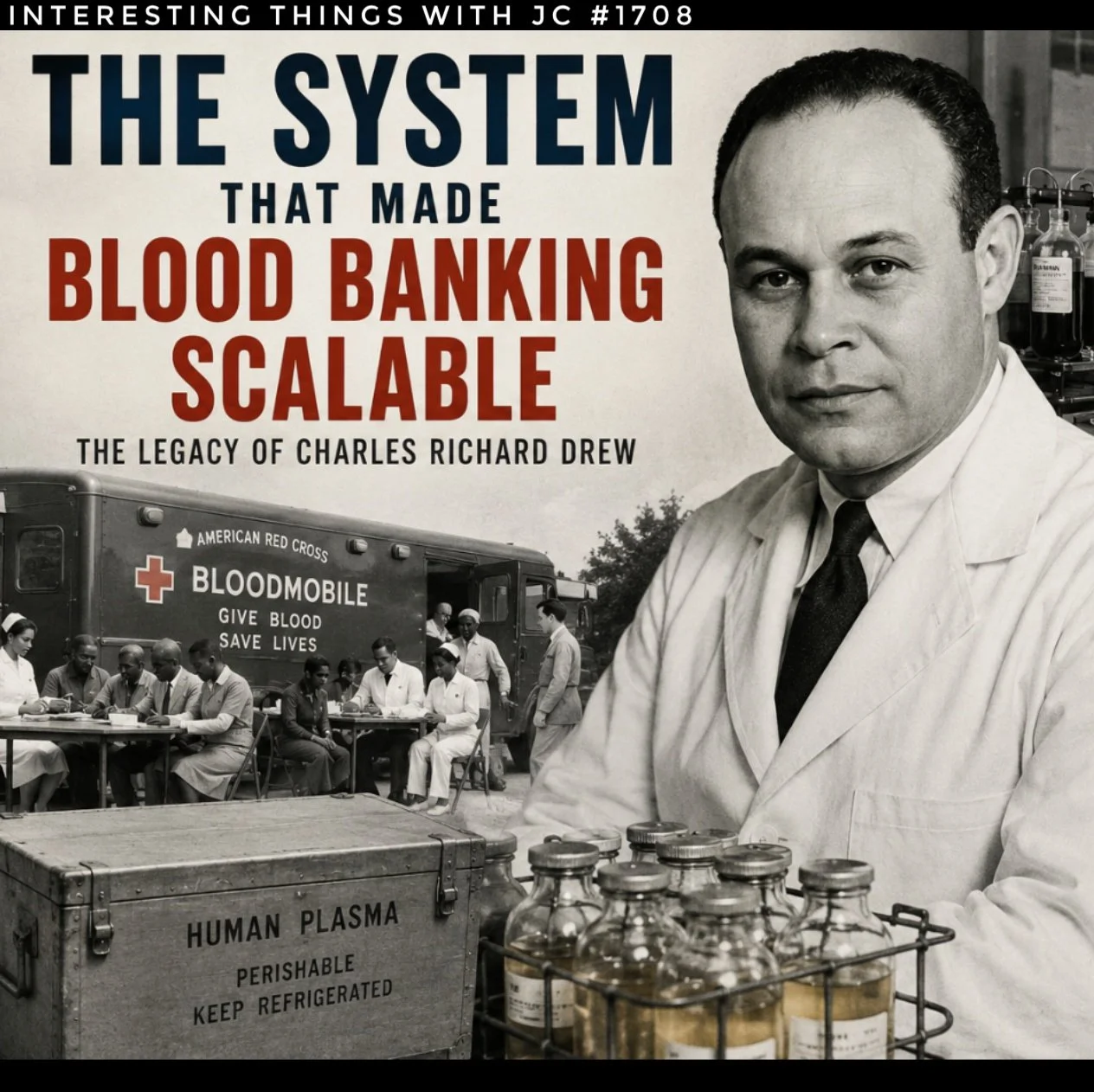
Promotional cover for Interesting Things with JC Episode #1708, "The System That Made Blood Banking Scalable." A large portrait of physician Charles Richard Drew appears beside historical images of an American Red Cross bloodmobile, medical staff collecting blood donations, and containers of blood plasma. The subtitle reads, "The Legacy of Charles Richard Drew."
Transcript
Interesting Things with JC #1708:
"The System That Made Blood Banking Scalable"
Before World War II, saving someone with a blood transfusion often depended on time, distance, and luck. Whole blood spoiled quickly, required refrigeration, had to be matched by blood type, and couldn't be stored for long. Even when doctors knew what a patient needed, getting blood to the right place in time was often impossible.
Charles Richard Drew found a way to change that.
While conducting research at Columbia University, Drew focused on blood plasma, the liquid portion of blood that can be preserved much longer than whole blood and transported without the same blood-type restrictions. His work wasn't a single invention. It was a complete system for collecting, testing, processing, storing, and transporting plasma safely and consistently on a large scale.
That system was put to the test in 1940 when Britain desperately needed blood products during the Blitz. As director of the "Blood for Britain" program, Drew oversaw the collection of thousands of blood donations in the United States, their conversion into plasma, and their shipment across the Atlantic. The project demonstrated that blood products could move through an organized supply chain instead of depending on local donors and improvised procedures.
The American Red Cross soon appointed Drew as the first medical director of its national blood bank. He standardized donor screening, laboratory testing, refrigeration, storage, transportation, recordkeeping, and quality control. He also expanded the use of mobile collection units, later known as bloodmobiles, making it possible to collect blood where donors lived and worked instead of waiting for them to come to hospitals.
Drew also challenged the U.S. military's policy of segregating blood by the race of the donor, pointing out that there was no scientific basis for the practice. Rather than oversee a system built on bad science, he resigned.
Today, blood collected in one city can save a life hundreds of miles away because medicine no longer depends on finding the right donor at the right moment. It depends on a coordinated system. Charles Drew helped build that system, and every modern blood bank still reflects the principles he established more than 80 years ago.
These are interesting things, with JC.
Student Worksheet
Instructions: Listen to the podcast first. If audio is unavailable, read the transcript. Complete all sections using evidence from the episode.
Comprehension
Why were blood transfusions difficult before World War II?
What is blood plasma, and why was it easier to transport than whole blood?
What was the purpose of the "Blood for Britain" program?
List four procedures Charles Drew standardized.
Why did Drew resign from his position with the American Red Cross blood program?
Analysis
Charles Drew is often remembered for creating a system rather than inventing a new device. Explain why systems can sometimes have a greater impact than individual inventions.
How did standardization improve both safety and efficiency in blood banking?
Why is quality control essential in healthcare?
Compare Drew's blood banking system to another large-scale system you use or encounter today (shipping, public transportation, internet, emergency services, etc.).
Reflection
Imagine you are responsible for designing a system that must reliably save lives every day. Which part would you consider most important, collection, testing, transportation, storage, or recordkeeping? Defend your answer using evidence from the episode.
Challenge Activity
Design a simple flowchart illustrating the journey of donated blood from donor to patient.
Include:
Donor
Collection
Laboratory Testing
Processing
Storage
Transportation
Hospital
Patient
Student Output Expectations
Students should demonstrate:
Accurate recall
Evidence-based reasoning
Logical organization
Clear written communication
Difficulty Scaling
Core
Complete comprehension questions.
Intermediate
Complete comprehension and analysis.
Advanced
Complete all sections including the flowchart and reflection with supporting evidence.
Academic Integrity
Support answers with information from the lesson. Explain ideas using your own words except when directly quoting the transcript.
Teacher Guide
Quick Start
Bell ringer (5 minutes)
Listen to the episode (5–7 minutes)
Guided discussion (10 minutes)
Student worksheet (20–25 minutes)
Review and exit ticket (5 minutes)
Pacing Guide (Audio First)
Bell Ringer — 5 min
Podcast Listening — 7 min
Clarification — 5 min
Worksheet — 20 min
Discussion — 10 min
Assessment — 8 min
Audio Guidance
Encourage students to identify examples of systems thinking while listening.
Ask them to note:
Problems before Drew's work
Solutions introduced
Evidence that the system worked
Long-term impact
Audio Fallback
Use the transcript if audio cannot be played.
Time on Task
Approximately 55–60 minutes.
Materials
Podcast or transcript
Student worksheet
Whiteboard
Diagram paper
Internet access (optional)
Vocabulary Preparation
Review:
Plasma
Whole blood
Standardization
Logistics
Supply chain
Quality control
Common Misconceptions
Drew did not invent blood itself.
Plasma is not the same as whole blood.
Blood banks require extensive laboratory testing.
Innovation often involves improving systems rather than inventing entirely new technologies.
Discussion Prompts
What makes a system reliable?
How can logistics save lives?
Why are standardized procedures important?
What risks occur if quality control is ignored?
How does scientific evidence influence public policy?
Formative Checks
Students should be able to:
Explain plasma.
Describe standardization.
Identify Drew's major contributions.
Explain why logistics mattered.
Connect evidence to conclusions.
Differentiation
Support
Provide vocabulary cards.
Use guided notes.
Pair students for discussion.
Extension
Research modern blood banking.
Compare blood banking with vaccine distribution.
Investigate disaster-response logistics.
Assessment Differentiation
Allow students to demonstrate understanding through:
Written responses
Oral presentation
Flowchart
Infographic
Short essay
Time Flexibility
30-minute version:
Audio
Discussion
Exit ticket
90-minute version:
Audio
Full worksheet
Research extension
Group presentation
Substitute Readiness
Lesson may be completed independently using transcript and worksheet.
Engagement Strategy
Have students imagine a hospital during a natural disaster. Ask:
"What happens if blood cannot arrive in time?"
Guide discussion toward why systems matter.
Cross-Curricular Connections
Biology
Engineering
Logistics
History
Public Health
Supply Chain Management
SEL Connection
Emphasize responsibility, teamwork, ethical decision-making, and service to others through evidence-based medical practice.
Skill Emphasis
Students practice:
Critical thinking
Evidence evaluation
Systems analysis
Scientific reasoning
Communication
Historical interpretation
Answer Key
Comprehension
Blood spoiled quickly, required refrigeration, matched blood types, and could not be stored long.
Plasma is the liquid portion of blood and lasts longer while requiring fewer compatibility restrictions.
To collect plasma in the United States and transport it safely to Britain during World War II.
Accept any four:
Donor screening
Laboratory testing
Refrigeration
Storage
Transportation
Recordkeeping
Quality control
He opposed racial segregation of donated blood because it lacked scientific evidence.
Analysis (Sample Responses)
Systems multiply the effectiveness of existing knowledge by making it reliable and repeatable.
Standardization reduced errors while increasing consistency and efficiency.
Quality control protects patients from unsafe products.
Answers will vary but should compare organized logistics and standardized procedures.
Reflection
Responses should reference evidence from the episode and explain the student's reasoning using clear examples.
Quiz
Instructions: Choose the best answer for each question.
Before World War II, blood transfusions were difficult primarily because:
A. Blood could not be donated.
B. Whole blood spoiled quickly and was difficult to transport.
C. Doctors did not understand blood types.
D. Hospitals refused blood donations.
Charles Richard Drew's research focused primarily on:
A. Artificial blood
B. Blood plasma
C. Surgical instruments
D. Antibiotics
The "Blood for Britain" program demonstrated that:
A. Blood could only be collected locally.
B. Plasma could move through an organized supply chain.
C. Blood transfusions were unnecessary.
D. Refrigeration was no longer needed.
Which of the following was part of Drew's standardized blood banking system?
A. Quality control
B. Donor screening
C. Recordkeeping
D. All of the above
Charles Drew resigned because:
A. He retired from medicine.
B. He accepted another research position.
C. He objected to blood segregation policies that lacked scientific evidence.
D. The Blood for Britain program ended.
Assessment
Open-Ended Questions
Explain how Charles Richard Drew transformed blood banking from a local medical procedure into a national healthcare system. Use evidence from the episode to support your explanation.
Describe how standardization and quality control contribute to patient safety. Include examples from Charles Drew's work and explain why these principles remain important in modern healthcare.
3–2–1 Reflection Rubric
3 – Exceeds Expectations
Accurately explains Drew's contributions.
Uses multiple pieces of evidence.
Demonstrates systems thinking.
Clearly communicates ideas using appropriate vocabulary.
2 – Meets Expectations
Explains the main concepts accurately.
Uses at least one supporting example.
Shows understanding of standardization and logistics.
1 – Developing
Demonstrates partial understanding.
Includes limited evidence.
Requires additional support to explain the historical significance.
Exit Ticket
Complete the following before leaving class:
One new fact I learned today:
One reason Charles Drew's work still matters:
One example of another system that depends on standardization:
Standards Alignment
NGSS Science & Engineering Practice: Analyzing and Interpreting Data
Connection: Students evaluate historical evidence describing improvements in blood banking.
Student Outcome: Explain how scientific research can improve public health through systematic processes.
Justification: Students analyze evidence demonstrating the relationship between research, engineering, and healthcare systems.
CCSS.ELA-LITERACY.RH.9-10.2
Determine the central ideas of a primary or secondary source.
Connection: Students identify the central argument that Drew's greatest contribution was developing a scalable medical system.
Student Outcome: Summarize complex informational text using supporting evidence.
Justification: Students distinguish major concepts from supporting details.
CCSS.ELA-LITERACY.RH.11-12.1
Cite specific textual evidence.
Connection: Worksheet, discussion, assessment.
Student Outcome: Support conclusions with evidence from the transcript.
Justification: Encourages evidence-based historical reasoning.
CCSS.ELA-LITERACY.WHST.9-12.2
Write informative/explanatory texts.
Connection: Reflection and assessment responses.
Student Outcome: Explain scientific concepts clearly using academic language.
Justification: Strengthens scientific communication skills.
CCSS.ELA-LITERACY.SL.9-10.1
Collaborative discussions.
Connection: Guided classroom discussion.
Student Outcome: Participate respectfully while supporting ideas with evidence.
Justification: Develops communication and critical thinking.
C3 Framework D2.His.1.9-12
Evaluate historical change over time.
Connection: Students compare blood transfusion practices before and after Drew's work.
Student Outcome: Explain how technological and organizational improvements reshape society.
Justification: Reinforces historical inquiry.
ISTE Standard 1.3 Knowledge Constructor
Connection: Students organize evidence from the podcast into written explanations.
Student Outcome: Evaluate information from credible educational sources.
Justification: Supports information literacy.
Career Readiness Competencies
Analytical Thinking: Evaluate complex healthcare systems.
Communication: Explain technical concepts clearly.
Problem Solving: Analyze logistical challenges.
Adaptability: Understand how systems evolve to solve new problems.
Professional Judgment: Recognize the importance of evidence-based decision-making.
Homeschool / Lifelong Learning Alignment
Independent inquiry using historical evidence.
Information literacy through evaluation of scientific claims.
Real-world application by connecting logistics to healthcare.
Self-directed learning through reflection and research.
Transferable systems-thinking applicable across careers and everyday life.
Show Notes
Charles Richard Drew transformed medicine not by inventing a new treatment but by creating a reliable system that made lifesaving blood products available wherever they were needed. This lesson demonstrates how standardization, logistics, scientific research, and evidence-based decision-making continue to shape modern healthcare. Students explore how organized systems can have lasting global impacts and why critical thinking remains essential when evaluating scientific practices.
References
American Chemical Society. (n.d.). Charles Richard Drew.https://www.acs.org/education/whatischemistry/african-americans-in-sciences/charles-richard-drew.html
EBSCO Information Services. (n.d.). Charles Richard Drew (Research Starter).https://www.ebsco.com/research-starters/history/charles-richard-drew
Google. (n.d.). Dr. Charles R. Drew (Google Knowledge Panel).https://www.google.com/search?q=dr.+charles+r.+drew&kgmid=/m/018t67
Lowell Milken Center for Unsung Heroes. (n.d.). The Color of Blood: Dr. Charles Drew.https://www.lowellmilkencenter.org/newsroom/videos/view/the-color-of-blood-dr-charles-drew-an-unsung-hero-in-blood-preservation
The National WWII Museum. (n.d.). Medical Innovations: Blood Banking.https://www.nationalww2museum.org/war/articles/medical-innovations-blood-banking