1709: "A Yard of Flightline"
Interesting Things with JC #1709: "A Yard of Flightline"
A new Air Force airman is sent to pick up a routine item, but every office on the base insists someone else has it.
This episode is inspired by Chris.
Curriculum - Episode Anchor
Episode Title: A Yard of Flightline
Episode Number: 1709
Host: JC
Audience: Grades 9–12, Introductory College, Homeschool, Lifelong Learners
Subject Area: Military History, Aviation, Workplace Culture, Organizational Behavior
Lesson Overview
Objectives:
Explain what a flightline is and its purpose on a military air base.
Describe how military traditions help build teamwork and unit cohesion.
Distinguish between practical training and informal rites of passage.
Evaluate how humor contributes to workplace culture and group identity.
Essential Question:
How can shared traditions and humor strengthen teamwork within professional organizations?
Success Criteria:
Students will successfully:
Define the term flightline.
Describe the purpose of the military prank featured in the episode.
Analyze how traditions influence organizational culture.
Support their conclusions using evidence from the episode.
Student Relevance:
Students encounter traditions, initiation experiences, and workplace culture throughout school, sports, clubs, and future careers. Understanding these experiences promotes better communication and teamwork.
Real-World Connection:
Every profession develops customs that help newcomers become part of the team. Learning the difference between healthy traditions and inappropriate behavior is an important workplace skill.
Workforce Reality:
Military organizations depend on trust, communication, professionalism, and teamwork. Informal traditions often help introduce new members while reinforcing unit identity.
Key Vocabulary
Flightline(FLYTE-line) — The aircraft parking and maintenance area where aircraft are serviced, fueled, inspected, and prepared for flight.
Airman(AIR-man) — An enlisted member of the United States Air Force or Air National Guard.
Supervisor(SOO-per-vy-zur) — A person responsible for directing and overseeing the work of others.
Supply(suh-PLY) — The organization responsible for issuing equipment and materials.
Civil Engineering(SIV-il en-juh-NEER-ing) — The military unit responsible for maintaining facilities, roads, utilities, and infrastructure.
Motor Pool(MOH-ter pool) — The organization responsible for maintaining government vehicles.
Operations(op-er-AY-shunz) — The organization responsible for coordinating mission activities.
Master Sergeant(MAS-ter SAR-junt) — A senior noncommissioned officer responsible for leadership and mentoring.
Rite of Passage(RYTE of PASS-ij) — A traditional event marking acceptance into a group.
Unit Cohesion(YOO-nit koh-HEE-zhun) — The trust, teamwork, and mutual support shared within a military unit.
Narrative Core
Open
Every workplace develops traditions. Some are formal, while others become legendary stories passed from one generation to the next. Military organizations are especially well known for humorous initiation traditions that welcome newcomers into the team.
Info
In this episode, a new Airman receives what appears to be a routine assignment: obtain "a yard of flightline." Believing the request to be legitimate, he follows directions from one office to another as personnel across the base continue the joke without revealing the truth.
Details
Only after hours of searching does a senior master sergeant end the prank by explaining that the Airman has already walked across plenty of flightline. The humor comes from treating an impossible request as perfectly normal while allowing the newcomer to experience one of the military's oldest practical jokes.
The episode also teaches an important aviation term. The flightline is not equipment or a supply item. It is the designated aircraft parking and maintenance area where aircraft are inspected, serviced, fueled, repaired, and prepared for missions. It is one of the busiest and most important operational areas on any military airfield.
Reflection
The story illustrates how organizations build identity through shared experiences. While the prank may leave a new member temporarily confused, the tradition concludes with explanation, laughter, and acceptance into the group. Shared humor can strengthen relationships when conducted safely and respectfully.
Closing
These are interesting things, with JC.
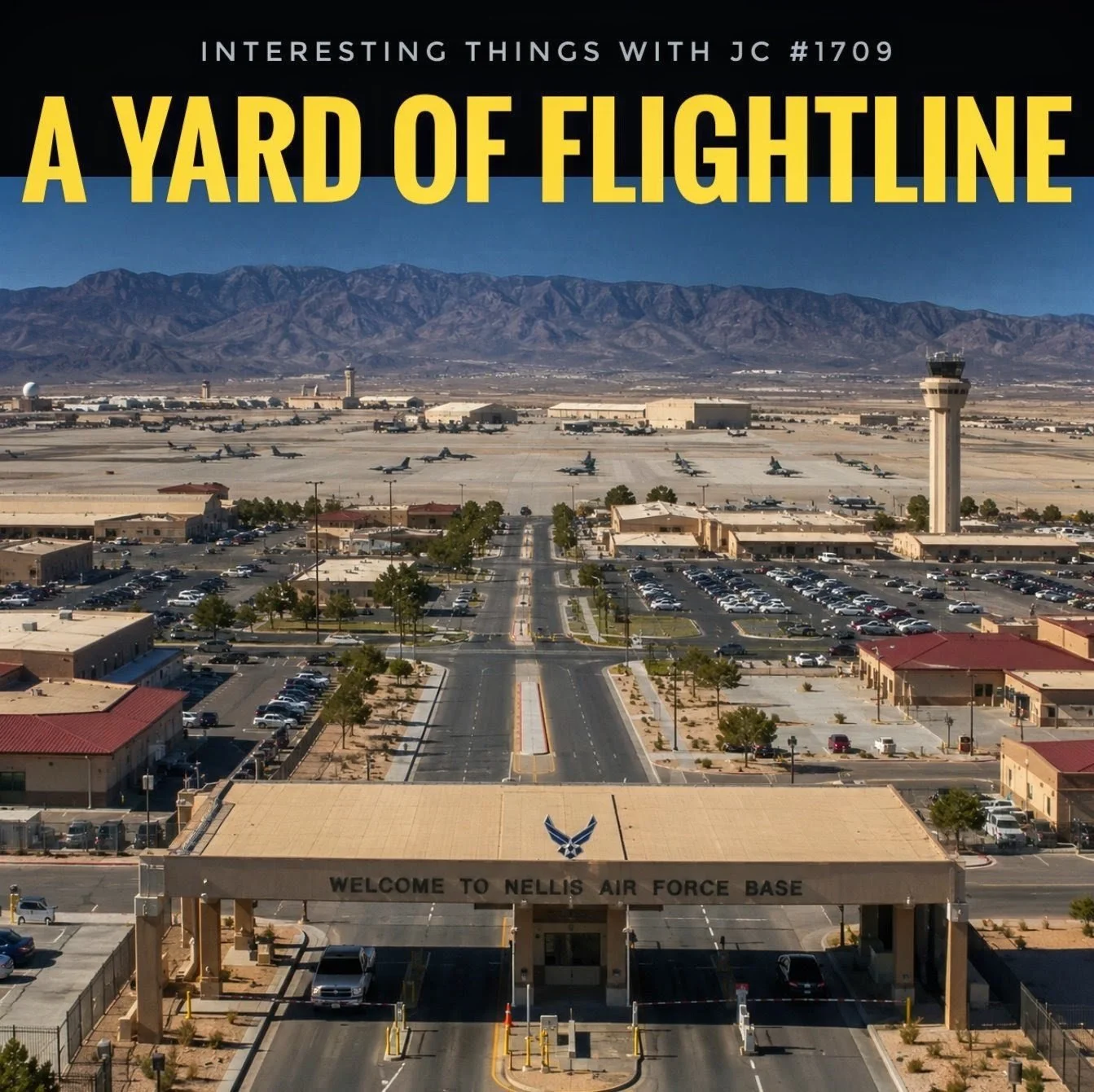
Promotional cover for Interesting Things with JC episode #1709 titled "A Yard of Flightline." The image shows an aerial view of Nellis Air Force Base in Nevada, with the main entrance gate in the foreground, multiple military aircraft parked on the flightline, hangars, a control tower, and mountains in the distance beneath a clear blue sky.
Transcript
Interesting Things with JC #1709:
"A Yard of Flightline"
It was Airman Miller's first week on the base when his supervisor handed him a simple assignment.
"Go over to supply and get me a yard of flightline."
Miller hurried off without a second thought.
The supply sergeant checked a clipboard, frowned, and said, "Thought we had one left. Better try Civil Engineering."
Civil Engineering sent him to the motor pool. The motor pool sent him to airfield maintenance. Airfield maintenance suggested he check with operations.
At every stop, someone treated the request as perfectly ordinary and pointed him toward the next building. No one smiled. No one hinted that anything was wrong.
After nearly two hours of walking from one end of the base to the other, Miller finally found himself standing in front of an old master sergeant.
"Morning, Sergeant. I've been looking all over the base for a yard of flightline."
The master sergeant looked up from his desk, smiled, and said, "Son, you've probably covered enough flightline today. Head back to your unit and tell Sergeant Vance I said you're all set."
Miller thanked him, turned around more confused than ever, and headed back to the shop.
The moment he repeated the message, the room erupted in laughter.
Only then did someone explain that there was no such thing as a yard of flightline. The flightline isn't a tool or a piece of equipment. It's the paved area where aircraft are parked, serviced, refueled, and prepared for flight. For generations, sending the newest airman to find a yard of it has been one of the military's favorite rites of passage.
By the end of the day, Miller understood the joke, shared a few beers with the crew, and knew he had finally stopped being the new guy.
These are interesting things, with JC.
Student Worksheet
Purpose: Listen to the podcast episode before completing the worksheet. If audio is unavailable, read the transcript carefully.
Comprehension
Who was the main character in the story?
What assignment was Airman Miller given?
Which departments did Miller visit during his search?
Who finally explained the situation?
What is a flightline?
Analysis
Why did everyone continue sending Miller to another location instead of immediately explaining the joke?
What does this tradition reveal about military teamwork and organizational culture?
How did Miller's understanding of the experience change by the end of the story?
In what ways can humor strengthen a workplace? When might it become inappropriate?
Reflection
Describe a time when you were new to a school, team, club, or workplace. What helped you feel accepted? Compare your experience to Airman Miller's.
Difficulty Scaling
Developing
Complete the comprehension questions using evidence from the transcript.
Proficient
Complete all comprehension and analysis questions using complete sentences.
Advanced
Write a one-page explanation describing how traditions influence organizations while distinguishing positive team-building from inappropriate hazing.
Student Output Expectations
Students should demonstrate:
Accurate understanding of the episode.
Evidence-based reasoning.
Appropriate use of vocabulary.
Clear written communication.
Academic Integrity Guidance
Complete all written responses using your own words. Support conclusions with information from the episode rather than outside summaries or AI-generated responses.
Teacher Guide
Quick Start: Play the podcast first. Allow students to enjoy the story before discussing its educational themes.
Pacing Guide (Audio-First):
Bell Ringer – 5 minutes
Podcast Listening – 5 minutes
Vocabulary Review – 10 minutes
Discussion – 15 minutes
Worksheet – 15 minutes
Review – 10 minutes
Bell Ringer:
Ask students:
"Have you ever heard of an impossible errand or practical joke given to a new employee or teammate? Why do you think organizations create traditions like these?"
Audio Guidance:
Encourage students to listen for:
The sequence of departments.
The reactions of each person Miller encounters.
The moment the joke is revealed.
The lesson learned.
Audio Fallback:
If audio is unavailable, use the transcript as a guided reading exercise.
Time on Task: Approximately 60 minutes.
Materials:
Podcast episode or transcript
Student worksheet
Writing materials
Vocabulary Preparation:
Review military organizational terms before listening.
Common Misconceptions:
A flightline is not a physical object.
Practical jokes are not official military training.
Healthy traditions differ from hazing and unsafe behavior.
Discussion Prompts:
Why didn't anyone reveal the joke early?
How did the master sergeant end the prank professionally?
Why are traditions important in organizations?
What limits should exist on workplace humor?
Formative Checkpoints:
Correct definition of flightline.
Identification of the military departments visited.
Explanation of the rite of passage.
Differentiation:
Provide vocabulary support for emerging readers.
Allow verbal responses for discussion questions.
Challenge advanced learners to compare traditions across professions.
Assessment Differentiation:
Students may demonstrate learning through writing, discussion, or presentation.
Time Flexibility:
Can be completed in one 60-minute lesson or divided into two shorter sessions.
Substitute Readiness:
The transcript allows the lesson to proceed even without podcast access.
Engagement Strategy:
Have students brainstorm other fictional "impossible errands" before revealing similar historical examples from military tradition.
Extensions:
Research other harmless military traditions and compare them with onboarding traditions in civilian careers.
Cross-Curricular Connections:
History
Aviation
Psychology
Sociology
Business Management
SEL Connection:
Develop empathy for newcomers and recognize respectful ways to welcome new members into a group.
Skill Emphasis:
Critical thinking
Reading comprehension
Communication
Organizational analysis
Evidence-based reasoning
Answer Key:
Comprehension:
Airman Miller.
To obtain a yard of flightline.
Supply, Civil Engineering, Motor Pool, Airfield Maintenance, and Operations.
A master sergeant.
The aircraft parking and maintenance area of an airfield.
Quiz
Directions: Choose the best answer for each question. Select only one answer.
What was Airman Miller instructed to retrieve?
A. A replacement aircraft tire
B. A yard of flightline
C. A fuel nozzle
D. A flight checklist
Which department did the supply sergeant direct Miller to visit next?
A. Operations
B. Security Forces
C. Civil Engineering
D. Medical
Why did Miller continue searching from building to building?
A. Every person treated the request as legitimate.
B. He misunderstood the assignment paperwork.
C. The item had been misplaced.
D. The base had multiple supply warehouses.
What is a flightline?
A. A specialized aircraft tool
B. A measurement used by pilots
C. The paved area where aircraft are parked, serviced, refueled, and prepared for flight
D. A communication cable used on airfields
What lesson does the story primarily illustrate?
A. Aircraft maintenance procedures
B. Military budgeting
C. The role of traditions and teamwork in organizational culture
D. Airfield construction techniques
Assessment
Open-Ended Questions
Explain how the "yard of flightline" prank functions as a rite of passage. Discuss how the experience affected Airman Miller's understanding of his new unit and what it reveals about military culture.
Compare the tradition described in the episode with a welcoming tradition from another organization, school, sports team, or workplace. Explain both the benefits and the importance of maintaining respect and professionalism.
3–2–1 Rubric
3 – Exceeds Expectations
Demonstrates a thorough understanding of the episode.
Uses specific evidence from the transcript.
Clearly explains teamwork, organizational culture, and rites of passage.
Uses appropriate vocabulary accurately.
2 – Meets Expectations
Demonstrates a general understanding.
Includes some supporting details.
Explains the main lesson with minor omissions.
1 – Approaching Expectations
Demonstrates limited understanding.
Includes few supporting details.
Responses lack clarity or contain factual errors.
Exit Ticket
Before leaving class, answer the following in one or two complete sentences:
What is one positive way organizations can welcome newcomers while maintaining professionalism and respect?
Standards Alignment
NGSS Science & Engineering Practices
SEP 8 – Obtaining, Evaluating, and Communicating Information
Students evaluate information presented in a narrative and accurately communicate the operational purpose of a flightline. This is measured through worksheet responses and the assessment.
CCSS Reading
CCSS.ELA-LITERACY.RI.9-10.2
Determine a central idea of an informational text and analyze its development. Students identify the episode's central message regarding organizational traditions and teamwork.
CCSS.ELA-LITERACY.RI.11-12.3
Analyze a complex sequence of events and explain how individuals interact throughout the narrative. Students trace Miller's journey across the base and evaluate the responses of each department.
CCSS Writing
CCSS.ELA-LITERACY.W.9-10.2
Write informative texts that examine a topic using relevant evidence. Students explain the military tradition using information from the transcript.
CCSS Speaking & Listening
CCSS.ELA-LITERACY.SL.9-10.1
Initiate and participate effectively in collaborative discussions. Students analyze the ethical boundaries of workplace humor and organizational traditions.
C3 Framework
D2.His.1.9-12
Evaluate how historical traditions and institutional practices shape organizations. Students examine long-standing military customs as examples of organizational culture.
ISTE Standards for Students
ISTE 3 – Knowledge Constructor
Students critically evaluate information from the podcast and distinguish factual aviation terminology from fictional elements within the prank.
Career Readiness Competencies
Analytical Thinking
Students separate factual information from humor while interpreting organizational behavior.
Communication
Students explain concepts using appropriate military and workplace vocabulary.
Problem Solving
Students analyze why each participant continued the prank and how the situation was ultimately resolved.
Adaptability
Students examine how newcomers adjust to unfamiliar workplace environments.
Professional Judgment
Students distinguish acceptable team-building traditions from inappropriate hazing or unsafe conduct.
Homeschool / Lifelong Learning Alignment
Independent Learning
Students independently interpret historical anecdotes and workplace traditions.
Information Literacy
Students differentiate operational aviation terminology from fictional requests.
Real-World Application
Students connect organizational culture to future careers and community involvement.
Self-Directed Inquiry
Students investigate additional examples of professional traditions and onboarding practices.
Transferable Life Skills
Students develop communication, observation, critical thinking, and workplace awareness applicable across professions.
Show Notes
This episode introduces listeners to one of the military's best-known practical jokes while explaining the real meaning of a flightline and the role of traditions in building teamwork. Students explore organizational culture, communication, and professional relationships while learning how humor, when used respectfully, can help newcomers become valued members of a team. The lesson encourages thoughtful discussion about workplace customs, leadership, and the importance of maintaining professionalism.
References
Federal Aviation Administration. (2023). Pilot's Handbook of Aeronautical Knowledge. https://www.faa.gov/regulations_policies/handbooks_manuals/aviation/phak
U.S. Air Force. (2024). Careers and Mission. https://www.airforce.com
U.S. Department of Defense. (2024). Military OneSource: Building Strong Teams and Leadership. https://www.militaryonesource.mil
National Museum of the U.S. Air Force. (2024). Museum Fact Sheets. https://www.nationalmuseum.af.mil/Visit/Museum-Exhibits/