1710: "The First New Blue in 200 Years"
Interesting Things with JC #1710: "The First New Blue in 200 Years"
Chemists heating a mixture of metal oxides for a magnetism experiment watched it cool into a vivid blue pigment no one expected, and the accidental discovery became the first new inorganic blue added to artists' palettes in roughly 200 years while finding uses far beyond paint.
Curriculum - Episode Anchor
Episode Title: The First New Blue in 200 Years
Episode Number: 1710
Host: JC
Audience: Grades 9–12, Introductory College, Homeschool, Lifelong Learners
Subject Area: Chemistry, Materials Science, Physics, Art History
Lesson Overview
Objectives:
Explain how YInMn Blue was discovered through scientific research rather than intentional invention.
Describe why crystal structure determines the color of inorganic pigments.
Compare YInMn Blue with earlier historical blue pigments.
Evaluate how unexpected discoveries can lead to important technological applications.
Essential Question:
How can accidental discoveries in scientific research lead to innovations that change multiple industries?
Success Criteria:
Explain why YInMn Blue appears blue.
Describe at least three advantages of YInMn Blue over historic pigments.
Identify real-world applications of the pigment.
Discuss the role of curiosity and observation in scientific discovery.
Student Relevance Statement:
Students encounter pigments every day in paints, plastics, electronics, automobiles, and building materials. Understanding how new materials are discovered demonstrates how science influences everyday products.
Real-World Connection:
Modern pigments are engineered for durability, safety, and energy efficiency. The same materials science principles used to create pigments are applied in aerospace, renewable energy, manufacturing, and consumer products.
Workforce Reality:
Many major scientific discoveries occur while researchers are investigating entirely different questions. Careers in chemistry, engineering, materials science, and manufacturing often reward careful observation, experimentation, and problem-solving.
Key Vocabulary
Pigment(PIG-ment) — A material that produces color by selectively absorbing and reflecting light.
Inorganic(in-or-GAN-ik) — A material not primarily based on carbon chemistry.
Crystal Structure(KRIS-tuhl STRUK-chur) — The orderly arrangement of atoms within a solid material.
Infrared Radiation(in-fruh-RED ray-dee-AY-shun) — Invisible electromagnetic energy associated with heat.
Ultramarine(ul-truh-muh-REEN) — A historic blue pigment originally produced from lapis lazuli.
Lapis Lazuli(LAP-iss LAZ-yoo-lye) — A blue metamorphic rock historically valued for producing ultramarine pigment.
Oxide(OK-side) — A compound formed when oxygen combines with another element.
Reflectance(ri-FLEK-tuhns) — The amount of light reflected from a surface.
Materials Science(muh-TEER-ee-ulz SY-ence) — The study of how a material's structure determines its properties and uses.
Narrative Core
Open
Throughout history, blue has been one of the most difficult colors to create. Artists treasured it, scientists studied it, and manufacturers searched for better versions.
Info
In 2009, researchers at Oregon State University were studying magnetic materials. They combined oxides of yttrium, indium, and manganese and heated the mixture to nearly 2,000 degrees Fahrenheit—about 1,093 degrees Celsius.
Details
When the sample cooled, it revealed an intense blue unlike existing inorganic pigments. Professor Mas Subramanian recognized that the experiment had produced something unusual. Further analysis showed the material absorbed red and green wavelengths while reflecting exceptionally pure blue light.
The pigment also proved highly durable. It resisted heat, ultraviolet radiation, acids, and weathering while avoiding the toxic heavy metals found in several historical pigments. Scientists named the material YInMn Blue after its three principal elements.
Its usefulness extended well beyond artists' paints. Because it reflects more infrared radiation than many other pigments, it helps keep coated surfaces cooler. Today it is used in plastics, ceramics, architectural coatings, and automotive finishes.
Reflection
Scientific breakthroughs are not always the result of searching for a specific answer. Sometimes the greatest discoveries come from recognizing the importance of an unexpected result. YInMn Blue reminds us that curiosity and careful observation remain among science's most valuable tools.
Closing
These are interesting things, with JC.
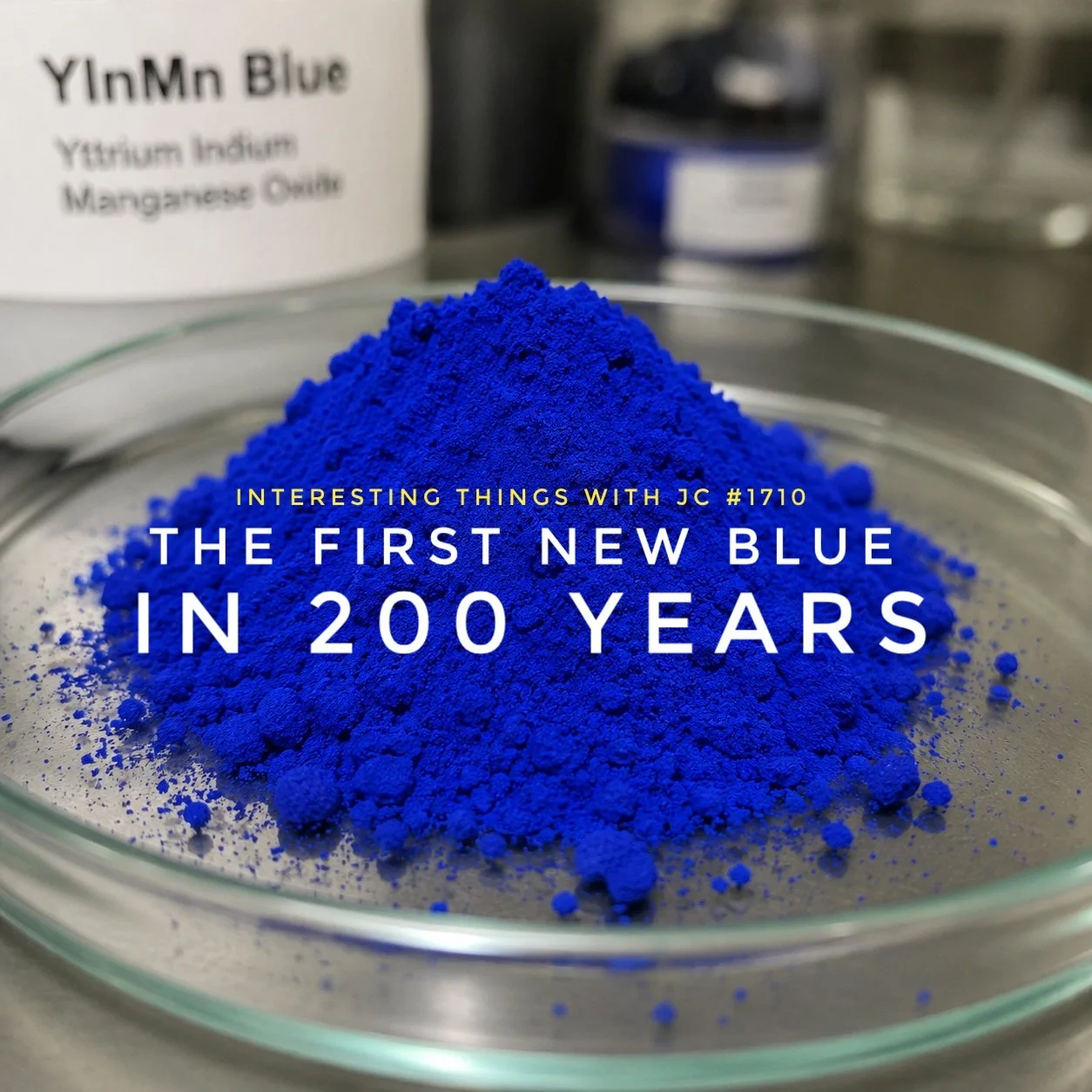
A close-up photograph shows a vivid pile of YInMn Blue pigment on a clear glass laboratory dish. The background is softly blurred, revealing a container labeled "YInMn Blue – Yttrium Indium Manganese Oxide," suggesting a laboratory setting. Overlaid text reads: "Interesting Things with JC #1710 – The First New Blue in 200 Years."
Transcript
Interesting Things with JC #1710:
The First New Blue in 200 Years
In 2009, a team of chemists at Oregon State University placed a mixture of yttrium, indium, and manganese oxides into a furnace heated to nearly 2,000 degrees Fahrenheit, or about 1,093 degrees Celsius. They were studying magnetic materials, not searching for a new color.
When the sample cooled, it emerged a vivid, intense blue.
Professor Mas Subramanian (MAHS Soo-bruh-MAHN-ee-un) knew immediately that something unusual had happened. Further testing showed the compound's crystal structure absorbed red and green light while reflecting an exceptionally pure blue. It also proved remarkably stable. Heat, ultraviolet light, acids, and weather had little effect on it, and unlike several historic blue pigments, it contained no toxic heavy metals.
That was an uncommon combination. Blue pigments have challenged artists and chemists for centuries. Natural ultramarine, made from lapis lazuli, was once more valuable than gold by weight, while later synthetic blues often faded, reacted with other chemicals, or raised health concerns. A genuinely new inorganic blue pigment hadn't been added to the palette in roughly 200 years.
The discovery became known as YInMn Blue, named for its three key elements. Beyond artists' paints, it found practical uses in plastics, ceramics, automotive coatings, and reflective roof coatings because it absorbs less infrared radiation, helping buildings stay cooler under the sun.
The team set out to understand magnetism. Instead, they expanded one of the oldest color palettes in human history with a shade no one had seen before.
These are interesting things, with JC.
Student Worksheet
Instructions: Listen to the podcast episode before completing the worksheet. If audio is unavailable, read the transcript carefully. Support your responses with evidence from the episode.
Comprehension
What were the Oregon State University researchers originally studying?
Which three chemical elements give YInMn Blue its name?
What happened when the experimental sample cooled?
What property of the crystal structure causes the pigment to appear blue?
Name four environmental conditions that have little effect on YInMn Blue.
Why was natural ultramarine once so valuable?
Approximately how long had it been since a new inorganic blue pigment had been discovered?
Besides artists' paints, identify at least three modern applications of YInMn Blue.
Analysis
Why is the discovery of YInMn Blue considered accidental rather than intentional?
Compare YInMn Blue with one historical blue pigment discussed in the episode.
Explain why scientists value pigments that resist ultraviolet light and weathering.
Why might a roofing company be interested in a pigment that reflects more infrared radiation?
What does this discovery teach about the scientific method?
Reflection
Describe a time when an unexpected result led to learning something valuable.
Why is curiosity an important characteristic for scientists and engineers?
If you were researching one scientific topic but accidentally discovered another important material, how would you decide whether it deserved further study?
Difficulty Scaling
Level 1: Identify facts directly from the transcript.
Level 2: Explain scientific concepts using complete sentences.
Level 3: Apply what you learned to modern engineering, manufacturing, or environmental challenges.
Student Output
Complete all questions using complete sentences. Cite specific evidence from the transcript whenever appropriate. Responses should demonstrate both factual understanding and scientific reasoning.
Academic Integrity Guidance
Complete your own work. Use the transcript and lesson materials for evidence, but explain ideas in your own words. If additional sources are consulted, properly acknowledge them according to your instructor's expectations.
Teacher Guide
Quick Start: Begin class by playing the podcast episode (approximately two minutes). Ask students to listen specifically for why the researchers were surprised by the experiment's outcome.
Pacing Guide (Audio-First):
Bell Ringer – 5 minutes
Podcast Listening – 3 minutes
Clarify Vocabulary – 7 minutes
Guided Discussion – 10 minutes
Student Worksheet – 20 minutes
Review and Reflection – 10 minutes
Bell Ringer:
Display the question:
"If you accidentally discovered a completely new material while studying something unrelated, what would you do next?"
Allow students to write for three minutes before discussing responses.
Audio Guidance:
Play the podcast without interruption. Encourage students to jot down:
What the scientists intended to study.
What unexpected observation occurred.
Why the discovery became important.
Audio Fallback:
If audio is unavailable, distribute the transcript. Have students read independently or in pairs before beginning discussion.
Time on Task: Approximately 55 minutes
Materials:
Podcast audio or transcript
Student worksheet
Whiteboard or projector
Colored images of historical blue pigments (optional)
Visible light spectrum diagram (optional)
Vocabulary Strategy:
Introduce vocabulary before listening. Emphasize the relationship between crystal structure, light absorption, and reflected color.
Common Misconceptions:
Scientists always know exactly what they will discover.
Color comes from dyes rather than interactions between light and matter.
All blue pigments are chemically similar.
Scientific discoveries occur only after intentional searches.
Discussion Prompts:
Why are accidental discoveries common in scientific research?
What qualities made YInMn Blue commercially valuable?
Why have blue pigments historically been difficult to produce?
How does materials science connect chemistry, physics, and engineering?
What industries benefit from improved pigments?
Formative Checkpoints:
Students can explain selective light absorption.
Students identify the three elements in YInMn Blue.
Students distinguish intended research from accidental discovery.
Students explain why infrared reflectivity helps reduce heat.
Differentiation:
Support
Provide a vocabulary organizer.
Pair students for discussion.
Highlight key passages within the transcript.
Extension
Research another accidental scientific discovery.
Compare YInMn Blue with Egyptian Blue or Prussian Blue.
Investigate modern "cool roof" technologies.
Assessment Differentiation:
Allow students to demonstrate understanding through:
Written responses
Oral presentation
Infographic
Concept map
Time Flexibility:
One 55-minute class period
Two 30-minute class periods
Independent homeschool lesson
Substitute Readiness:
This lesson requires only the transcript, worksheet, and discussion prompts. No specialized chemistry equipment is necessary.
Engagement Strategy:
Show images of famous blue artworks and ask students whether the artists would have had access to YInMn Blue. Use this to connect chemistry with art history.
Extensions:
Investigate the electromagnetic spectrum.
Explore how semiconductors and crystals influence electronics.
Research sustainable building materials.
Compare natural versus synthetic pigments throughout history.
Cross-Curricular Connections:
Chemistry: Crystal structures and inorganic compounds.
Physics: Light absorption and reflection.
Art: History of pigments.
Engineering: Materials design.
Environmental Science: Energy-efficient coatings.
SEL Connection:
Students recognize that persistence, curiosity, and openness to unexpected results are valuable habits in both scientific work and everyday problem-solving.
Skill Emphasis:
Scientific observation
Evidence-based reasoning
Critical thinking
Communication
Problem solving
Application of scientific concepts to real-world technologies
Answer Key
Comprehension
Magnetic materials.
Yttrium, indium, and manganese.
It became a vivid blue.
It absorbed red and green wavelengths while reflecting blue light.
Heat, ultraviolet light, acids, and weather.
It was produced from rare lapis lazuli and was extremely expensive.
About 200 years.
Plastics, ceramics, automotive coatings, reflective roof coatings.
Analysis (Sample Responses)
The researchers were investigating magnetism rather than color.
Historical pigments often faded, reacted chemically, or contained toxic materials, while YInMn Blue is stable and non-toxic.
Durability allows pigments to maintain appearance and performance for many years.
Greater infrared reflection reduces heat absorption, lowering cooling demands.
Careful observation and investigation of unexpected results can produce important discoveries.
Quiz
Directions: Choose the best answer for each question. Select only one answer for each.
What were the Oregon State University researchers originally investigating?
A. New textile dyes
B. Magnetic materials
C. Solar panels
D. Ceramic glazes
YInMn Blue is named after which three elements?
A. Ytterbium, Iron, Magnesium
B. Yttrium, Indium, Manganese
C. Yttrium, Iodine, Molybdenum
D. Ytterbium, Indium, Nickel
Why does YInMn Blue appear such a vivid blue?
A. It emits blue light.
B. It absorbs all visible light.
C. Its crystal structure absorbs red and green light while reflecting blue light.
D. It contains microscopic blue dye particles.
Which characteristic makes YInMn Blue especially useful for buildings?
A. It dissolves easily in water.
B. It reflects more infrared radiation, reducing heat absorption.
C. It changes color with temperature.
D. It produces electricity from sunlight.
What broader lesson does the discovery of YInMn Blue demonstrate?
A. Scientific discoveries always occur as planned.
B. Chemistry has solved every materials problem.
C. Unexpected observations can lead to major innovations.
D. Only artists benefit from new pigments.
Assessment
Open-Ended Questions
Explain how the discovery of YInMn Blue illustrates the importance of observation and curiosity during scientific research. Use evidence from the episode to support your explanation.
Evaluate how one discovery in chemistry can influence multiple fields such as engineering, architecture, manufacturing, and art. Include specific examples from the lesson.
3–2–1 Rubric
3 – Exceeds Expectations
Demonstrates complete understanding of the scientific concepts.
Uses multiple pieces of evidence from the episode.
Clearly explains real-world applications.
Communicates ideas accurately using scientific vocabulary.
2 – Meets Expectations
Demonstrates general understanding.
Includes at least one supporting example.
Uses appropriate vocabulary with minor errors.
Shows logical reasoning.
1 – Developing
Demonstrates partial understanding.
Provides limited evidence.
Contains inaccuracies or incomplete explanations.
Needs additional support to explain scientific concepts.
Exit Ticket
Before leaving class, answer the following in two or three sentences:
What surprised you most about the discovery of YInMn Blue, and why do you think accidental discoveries continue to play an important role in science?
Standards Alignment
NGSS
HS-PS1-3 — Matter and Its Interactions
Students analyze how atomic arrangement influences material properties by examining how YInMn Blue's crystal structure determines its optical behavior. Students explain the relationship between structure and function using evidence from the lesson.
Science and Engineering Practice: Analyzing and Interpreting Data
Students interpret observations from the experiment and connect those observations to scientific conclusions about light absorption, reflection, and material performance.
CCSS Reading
CCSS.ELA-LITERACY.RST.11-12.2
Determine central ideas of scientific texts and summarize complex concepts accurately.
Students identify the major ideas presented in the transcript and distinguish supporting scientific details.
CCSS.ELA-LITERACY.RST.11-12.4
Determine the meaning of scientific and technical vocabulary in context.
Students correctly apply terminology such as pigment, crystal structure, oxide, and infrared radiation.
CCSS Writing
CCSS.ELA-LITERACY.WHST.11-12.2
Write informative explanations using evidence.
Students compose evidence-based responses describing the discovery and applications of YInMn Blue.
CCSS.ELA-LITERACY.WHST.11-12.9
Draw evidence from informational texts.
Students cite specific details from the transcript when answering worksheet and assessment questions.
CCSS Speaking & Listening
CCSS.ELA-LITERACY.SL.11-12.1
Initiate and participate effectively in collaborative discussions.
Students discuss how unexpected discoveries contribute to scientific advancement while supporting claims with evidence.
C3 Framework
D2.ETS.1.9-12
Evaluate the impact of technology and engineering on society.
Students examine how advances in materials science improve products, infrastructure, and energy efficiency.
ISTE Standards
ISTE 1.3 Knowledge Constructor
Students evaluate information from the podcast and supporting materials to develop evidence-based conclusions about scientific discovery.
Career Readiness Competencies
Analytical Thinking
Students analyze scientific observations and distinguish between intended research objectives and unexpected outcomes.
Communication
Students explain scientific concepts using accurate terminology in written and verbal formats.
Problem Solving
Students evaluate why researchers investigated an unexpected result instead of dismissing it.
Adaptability
Students recognize that scientific investigations often require adjusting hypotheses when new evidence emerges.
Professional Judgment
Students understand the importance of careful observation, accurate documentation, and ethical reporting during scientific research.
Homeschool / Lifelong Learning Alignment
Independent Learning
Learners independently analyze the transcript and complete evidence-based activities.
Information Literacy
Learners distinguish factual scientific information from assumptions and unsupported conclusions.
Real-World Application
Learners connect chemistry concepts to products encountered in everyday life, including paints, vehicles, plastics, and buildings.
Self-Directed Inquiry
Learners are encouraged to investigate additional examples of accidental scientific discoveries beyond the lesson.
Transferable Life Skills
Learners practice observation, critical thinking, communication, and evidence-based reasoning applicable across academic and professional settings.
Show Notes
This lesson explores one of the most remarkable accidental discoveries in modern chemistry: YInMn Blue, the first new inorganic blue pigment introduced in roughly two centuries. Students learn how a materials science experiment unexpectedly expanded humanity's color palette while demonstrating the importance of curiosity, observation, and evidence-based investigation. By connecting chemistry, physics, engineering, architecture, and art history, the lesson illustrates how a single scientific breakthrough can create lasting impacts across multiple industries and everyday life.
References
Burrows, A. (2020). The story of YInMn Blue pigment. American Chemical Society. https://www.acs.org/education/whatischemistry/landmarks/yinmn-blue.html
Oregon State University. (2017). Accidental discovery leads to first new blue pigment in more than 200 years. https://today.oregonstate.edu/news/accidental-discovery-leads-first-new-blue-pigment-more-200-years
Subramanian, M. A., et al. (2009). New manganese-based blue pigment. Journal of the American Chemical Society. https://pubs.acs.org/doi/10.1021/ja810795d
The Royal Society of Chemistry. (n.d.). Pigments and colour chemistry. https://edu.rsc.org/