Interesting Things with JC #1711: "Why McDonald's Coke Tastes Different"
McDonald's serves Coca-Cola using refrigerated stainless steel syrup tanks, insulated delivery lines, filtered water, and a fountain calibrated for melting ice while a wider straw changes how the drink reaches you, creating a different experience long before the first sip.
Curriculum - Episode Anchor
Episode Title: Why McDonald's Coke Tastes Different
Episode Number: 1711
Host: JC
Audience: Grades 9–12, Introductory College, Homeschool, Lifelong Learners
Subject Area: Food Science, Chemistry, Consumer Science, Engineering
Lesson Overview
Objectives:
Explain why Coca-Cola served at McDonald's tastes different despite using the same recipe.
Describe how temperature, carbonation, packaging, and equipment influence beverage quality.
Analyze how engineering decisions affect customer experience.
Connect scientific principles to everyday products and consumer expectations.
Essential Question:
How can identical ingredients produce a noticeably different experience through engineering and process control?
Success Criteria:
Students can explain the roles of syrup storage, refrigeration, carbonation, water filtration, fountain calibration, and straw design in creating a consistent beverage experience.
Student Relevance:
Students encounter engineered consumer products every day. This lesson demonstrates how science and engineering influence even familiar experiences.
Real-World Connection:
Food service companies rely on chemistry, refrigeration, quality assurance, and engineering to deliver consistent products across thousands of locations.
Workforce Reality:
Professionals in food science, chemical engineering, quality assurance, manufacturing, refrigeration technology, and restaurant operations use these same principles to maintain product quality and customer satisfaction.
Key Vocabulary
Carbonation(kar-buh-NAY-shun) — Carbon dioxide dissolved in a liquid.
Carbon Dioxide (CO₂)(KAR-bun dye-OK-side) — The gas responsible for carbonation in soft drinks.
Syrup(SEER-up) — The concentrated flavoring mixed with carbonated water to produce fountain beverages.
Stainless Steel Tank(STAYN-liss steel tank) — A metal storage container that protects syrup from environmental changes.
Bag-in-Box(bag in boks) — A plastic syrup container commonly used in restaurants.
Python System(PIE-thon SIS-tem) — An insulated bundle of beverage lines that keeps liquids cold while traveling to dispensing equipment.
Calibration(kal-uh-BRAY-shun) — Adjusting equipment to produce accurate, consistent results.
Filtration(fil-TRAY-shun) — The removal of impurities from water.
Consistency(kun-SIS-ten-see) — Producing the same quality repeatedly.
Dispense(dis-PENS) — To deliver a beverage through a fountain system.
Narrative Core
Open:
Many people insist Coca-Cola tastes better at McDonald's. Surprisingly, the recipe isn't different at all.
Info:
The difference comes from how the drink is stored, prepared, and served. Every step is carefully controlled to preserve flavor and carbonation.
Details:
Many McDonald's restaurants receive syrup in stainless steel tanks instead of plastic bag-in-box containers. The syrup and water are refrigerated before mixing and travel through insulated "python" lines that maintain temperatures between 33 and 38 degrees Fahrenheit (about 0.5 to 3 degrees Celsius). Cold temperatures help carbon dioxide remain dissolved in the beverage, keeping it fizzier longer. Water filtration improves consistency, the fountain is calibrated to account for melting ice, and the wider straw delivers more beverage and carbonation with each sip.
Reflection:
Although none of these changes alter Coca-Cola's recipe, together they create a drinking experience many customers perceive as fresher, colder, and more flavorful. Small engineering choices can significantly influence how products are experienced.
Closing:
These are interesting things, with JC.
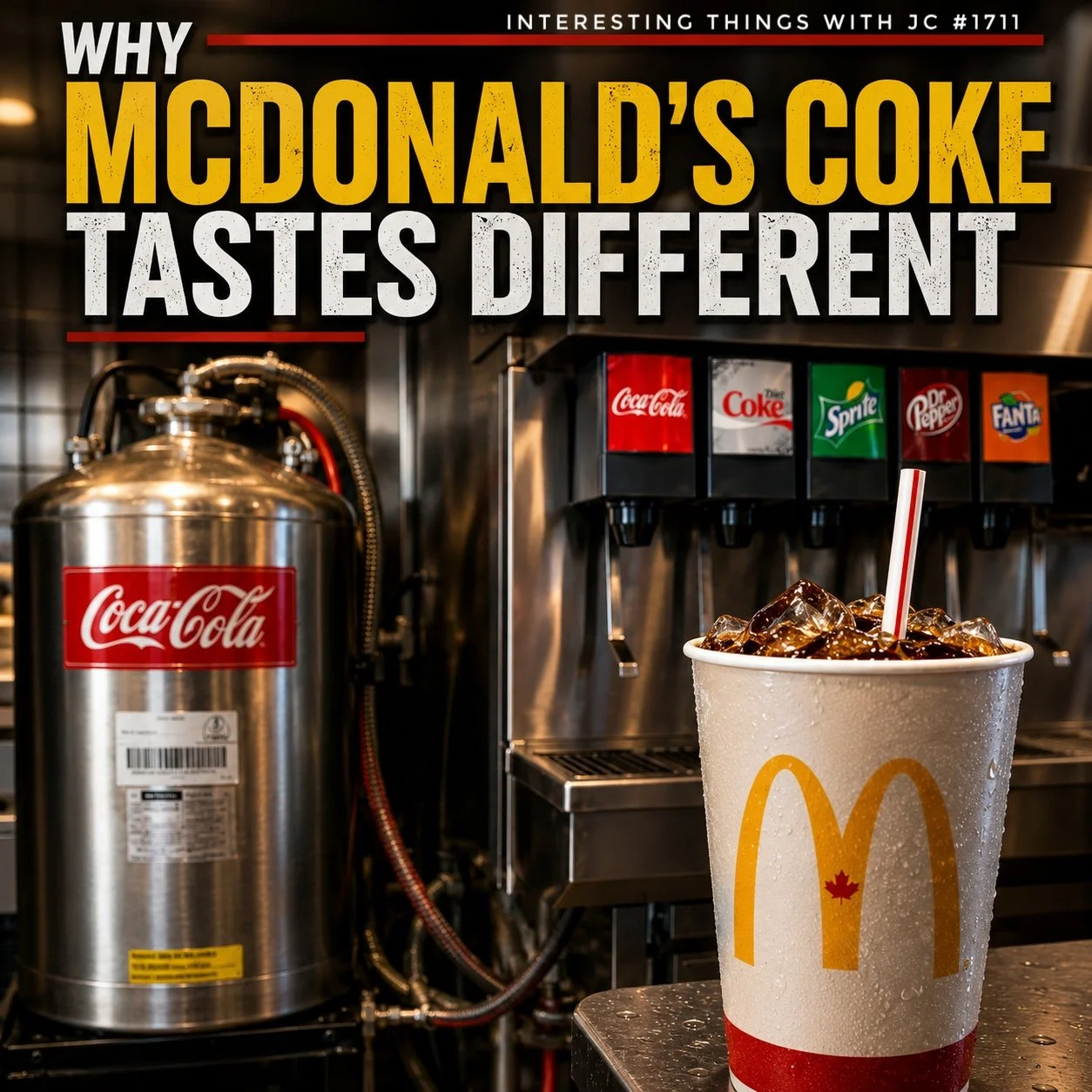
Cover art for Interesting Things with JC #1711 showing a McDonald's fountain Coke, a Coca-Cola syrup tank, and the headline: "Why McDonald's Coke Tastes Different."
Transcript
Interesting Things with JC #1711:
“Why McDonald's Coke Tastes Different”
Millions of people swear Coca-Cola tastes better at McDonald's. The recipe isn't different. The process is.
Many McDonald's restaurants in the United States receive Coca-Cola syrup in stainless steel tanks instead of the plastic bag-in-box containers used by most restaurants. The tanks help protect the syrup from light, air, and temperature changes before it's dispensed.
The syrup and the water are both refrigerated, then pumped through insulated lines called a python system that keeps them between 33 and 38 degrees Fahrenheit, or about 0.5 to 3 degrees Celsius, until they reach the fountain.
That cold isn't just for your first sip. Carbon dioxide stays dissolved more easily in cold liquid, so the Coke holds its carbonation longer and keeps its crisp taste.
McDonald's also filters its water to keep the flavor consistent from one location to another. The fountain is calibrated for melting ice, so the drink stays balanced instead of tasting watered down as you finish it.
Even the straw is different. Its wider opening delivers more Coke and more carbonation with every sip.
By the time that Coke reaches your hand, dozens of small decisions have already shaped the experience.
These are interesting things, with JC.
Student Worksheet
Purpose: Use the podcast episode to investigate how engineering and science improve everyday consumer products.
Comprehension
Does McDonald's use a different Coca-Cola recipe?
Why are stainless steel syrup tanks used in many McDonald's restaurants?
What temperature range is maintained inside the python system?
Why does colder Coke retain carbonation longer?
What purpose does water filtration serve?
Why is the fountain calibrated for melting ice?
How does the straw affect the drinking experience?
Analysis
Which engineering improvement do you think contributes most to the perceived taste? Explain your reasoning.
How do several small improvements combine to create a noticeably different customer experience?
Why is consistency important for a global restaurant chain?
Reflection
Describe another everyday product whose quality depends more on engineering than on changing its ingredients or materials.
Difficulty Scaling
Foundational: Identify the six engineering improvements mentioned.
Intermediate: Explain the science behind carbonation and refrigeration.
Advanced: Design an improved beverage dispensing system using concepts from the episode.
Student Output Expectations
Students should provide complete sentences supported by evidence from the podcast and demonstrate clear reasoning when explaining scientific concepts.
Academic Integrity Guidance
Responses should reflect the student's own understanding. If outside sources are used, they should be properly cited.
Teacher Guide
Quick Start: Play the podcast before any discussion. Encourage students to simply listen without taking notes during the first playback.
Pacing Guide (Audio-First):
Bell Ringer (5 minutes)
Podcast Listening (3 minutes)
Vocabulary Review (7 minutes)
Worksheet Completion (15 minutes)
Discussion (10 minutes)
Quiz (10 minutes)
Assessment/Exit Ticket (10 minutes)
Bell Ringer: Ask students whether they have ever noticed two identical products tasting different depending on where they were purchased.
Audio Guidance: Encourage students to identify each engineering decision while listening.
Audio Fallback: Read the transcript aloud if audio is unavailable.
Materials
Podcast or transcript
Student worksheet
Whiteboard
Optional cold carbonated beverages for demonstration
Vocabulary Preparation: Review carbonation, calibration, filtration, and consistency before instruction.
Common Misconceptions
Different taste means a different recipe.
Colder drinks always contain more carbonation.
Water quality has no impact on fountain beverages.
The straw is only for convenience.
Discussion Prompts
Why does engineering often matter more than ingredients?
How does quality control affect customer trust?
Which improvement surprised you the most?
Formative Checkpoints
Students correctly identify all engineering factors.
Students explain carbonation using scientific vocabulary.
Students connect engineering choices to customer experience.
Differentiation
Provide vocabulary supports for emerging learners.
Pair students for discussion.
Offer extension activities involving beverage engineering.
Assessment Differentiation
Oral responses permitted.
Graphic organizers available.
Extended written responses for advanced learners.
Time Flexibility
30-minute abbreviated lesson or full 60-minute lesson.
Substitute Readiness
The transcript and worksheet allow the lesson to proceed without specialized preparation.
Engagement Strategy
Invite students to compare multiple beverage experiences and identify possible engineering explanations.
Extensions
Investigate Henry's Law.
Research commercial refrigeration systems.
Explore quality assurance in food manufacturing.
Cross-Curricular Connections
Chemistry
Engineering
Marketing
Consumer behavior
Business operations
SEL Connection
Recognize that careful observation and evidence-based reasoning improve decision-making.
Skill Emphasis
Scientific observation, analytical thinking, evidence evaluation, systems thinking, communication.
Answer Key
Worksheet (Sample Responses)
No.
To better protect syrup from environmental changes.
33–38°F (0.5–3°C).
Cold liquids retain dissolved carbon dioxide longer.
To improve flavor consistency.
To account for melting ice.
It delivers more beverage and carbonation per sip.
Analysis questions should reference engineering decisions and scientific principles.
Quiz
Choose the best answer.
Why does McDonald's Coke often taste different?
A. Different ingredients
B. Different recipe
C. Different storage and dispensing process
D. More sugarStainless steel syrup tanks primarily help:
A. Increase sweetness
B. Protect syrup quality
C. Freeze the syrup
D. Reduce caffeineCold temperatures help:
A. Remove carbonation
B. Increase sugar content
C. Keep carbon dioxide dissolved
D. Change flavoringWater filtration is mainly intended to:
A. Add minerals
B. Improve consistency
C. Increase carbonation
D. Reduce caffeineThe wider straw primarily:
A. Uses less syrup
B. Delivers more beverage and carbonation
C. Warms the drink
D. Makes the drink sweeter
Assessment
Open-Ended Questions
Explain how engineering decisions can change a customer's experience without changing a product's ingredients.
Describe how refrigeration, carbonation, and calibration work together to maintain beverage quality.
3–2–1 Rubric
3 – Proficient: Thorough scientific explanation with evidence from the lesson.
2 – Developing: Mostly accurate explanation with minor omissions.
1 – Beginning: Limited understanding with minimal supporting evidence.
Exit Ticket
In one or two sentences, explain which engineering decision discussed in today's lesson you believe has the greatest effect on the final taste of McDonald's Coca-Cola and why.
Standards Alignment
NGSS
HS-PS1-3: Matter and Its Interactions — Students explain how temperature affects dissolved gases and beverage carbonation. Measurable outcome: Describe the relationship between temperature and CO₂ solubility.
CCSS Reading
RST.11-12.2 — Determine central ideas of scientific texts. Students identify the engineering factors that influence beverage quality.
CCSS Writing
WHST.11-12.2 — Write informative explanations using evidence from the podcast and worksheet responses.
CCSS Speaking & Listening
SL.11-12.1 — Participate effectively in collaborative scientific discussions about engineering and quality control.
C3 Framework
D2.Eng.6.9-12 — Evaluate how engineering solutions solve practical problems. Students assess beverage dispensing systems as examples of applied engineering.
ISTE Standards
1.3 Knowledge Constructor — Students evaluate information from multiple sources and explain scientific concepts using evidence.
Career Readiness Competencies
Analytical Thinking: Evaluate engineering decisions.
Communication: Explain scientific reasoning clearly.
Problem Solving: Identify improvements to dispensing systems.
Adaptability: Apply scientific concepts to unfamiliar consumer products.
Professional Judgment: Use evidence rather than assumptions when evaluating claims.
Homeschool / Lifelong Learning Alignment
Independent investigation of everyday science.
Information literacy through evidence evaluation.
Application of chemistry to real-world experiences.
Self-directed inquiry into food engineering.
Development of transferable critical-thinking skills.
Show Notes
This lesson explores how engineering, chemistry, and quality control combine to influence one of the world's most recognizable beverages. Students discover that product consistency depends not only on ingredients but also on storage, refrigeration, calibration, and delivery systems. By examining a familiar everyday experience, learners gain a practical understanding of scientific principles and engineering design while strengthening analytical thinking and evidence-based reasoning.
References
Coca-Cola Company. (n.d.). Coca-Cola Frequently Asked Questions.https://www.coca-colacompany.com/faqs
McDonald's Corporation. (n.d.). Why does Coca-Cola taste so good at McDonald's?https://www.mcdonalds.com/us/en-us/faq.html
U.S. Food and Drug Administration. (2022). Food Code.https://www.fda.gov/food/fda-food-code/food-code-2022
Britannica. (n.d.). Carbonation.https://www.britannica.com/science/carbonation