1723: "Ancient Roman Laundry"
Interesting Things with JC #1723: "Ancient Roman Laundry"
Roman laundries cleaned clothing by stomping it in vats of aged urine because the ammonia removed grease and stains. Public urinals supplied the industry, and the trade became valuable enough for the Roman government to tax it before anyone understood the chemistry behind why it worked.
Curriculum - Episode Anchor
Episode Title: When Laundry Smelled Like the Latrine
Episode Number: 1723
Host: JC
Audience: Grades 9–12, Introductory College, Homeschool, Lifelong Learners
Subject Area: Ancient History, Chemistry, Technology, Economics
Lesson Overview
Objectives:
Explain why aged urine was valuable in Roman laundry and textile industries.
Describe how observation led to practical technological advances before modern chemistry.
Analyze the relationship between science, industry, and economics in ancient Rome.
Connect historical cleaning practices to modern chemical principles.
Essential Question:
How can careful observation lead to useful technology even before the underlying science is understood?
Success Criteria:
Describe the role of Roman fullones and fullonicae.
Explain how ammonia removes grease and stains.
Discuss why urine became an economic commodity.
Compare ancient and modern cleaning chemistry.
Student Relevance:
Students encounter chemistry every day through soaps, detergents, and household cleaners. This lesson demonstrates that many modern technologies have roots in ancient observations.
Real-World Connection:
Modern detergents, industrial chemistry, environmental recycling, and manufacturing all rely on understanding chemical reactions that early civilizations discovered through experimentation.
Workforce Reality:
Many careers, including chemists, environmental engineers, textile manufacturers, conservators, archaeologists, and industrial designers, depend upon observing problems and developing practical solutions before every scientific detail is fully understood.
Key Vocabulary
Fullones(full-OH-nes) — Professional Roman cloth cleaners and finishers.
Fullonicae(full-oh-LOHN-ih-kye) — Roman laundry workshops.
Ammonia(uh-MOH-nee-uh) — Nitrogen compound effective at breaking down oils and grease.
Urea(yoo-REE-uh) — Compound naturally present in urine that bacteria convert into ammonia.
Fuller's Earth(FULL-erz ERTH) — Absorbent clay used to clean and whiten cloth.
Commodity(kuh-MOD-ih-tee) — A product bought and sold commercially.
Textile(TEK-style) — Cloth or woven fabric.
Tanning(TAN-ing) — Chemical treatment used to preserve animal hides.
Observation(ob-zur-VAY-shun) — Careful noticing of patterns or results.
Practical Knowledge(PRAK-tih-kul NOL-ij) — Information gained through experience rather than theory.
Narrative Core
Open:
Ancient Roman cities were filled with familiar sights and sounds, but on laundry day one smell stood out above the rest—not the sewers, but the neighborhood laundry.
Info:
Roman cloth cleaners discovered that aged urine produced ammonia, making it highly effective for removing oils and stains. Although they did not understand the chemistry, they recognized its usefulness through repeated observation.
Details:
Professional cleaners called fullones operated workshops known as fullonicae. Clothing soaked in vats of aged urine was stomped underfoot before being rinsed and treated with fuller's earth or sulfur fumes. Urine also supported leather tanning and textile production, eventually becoming valuable enough for Emperor Vespasian to tax. His famous phrase, Pecunia non olet ("Money does not stink"), survives nearly two thousand years later.
Reflection:
Roman laundry illustrates that practical innovation often begins with observation. Scientific explanations may come centuries later, but useful discoveries can still transform industries and everyday life.
Closing:
These are interesting things, with JC.
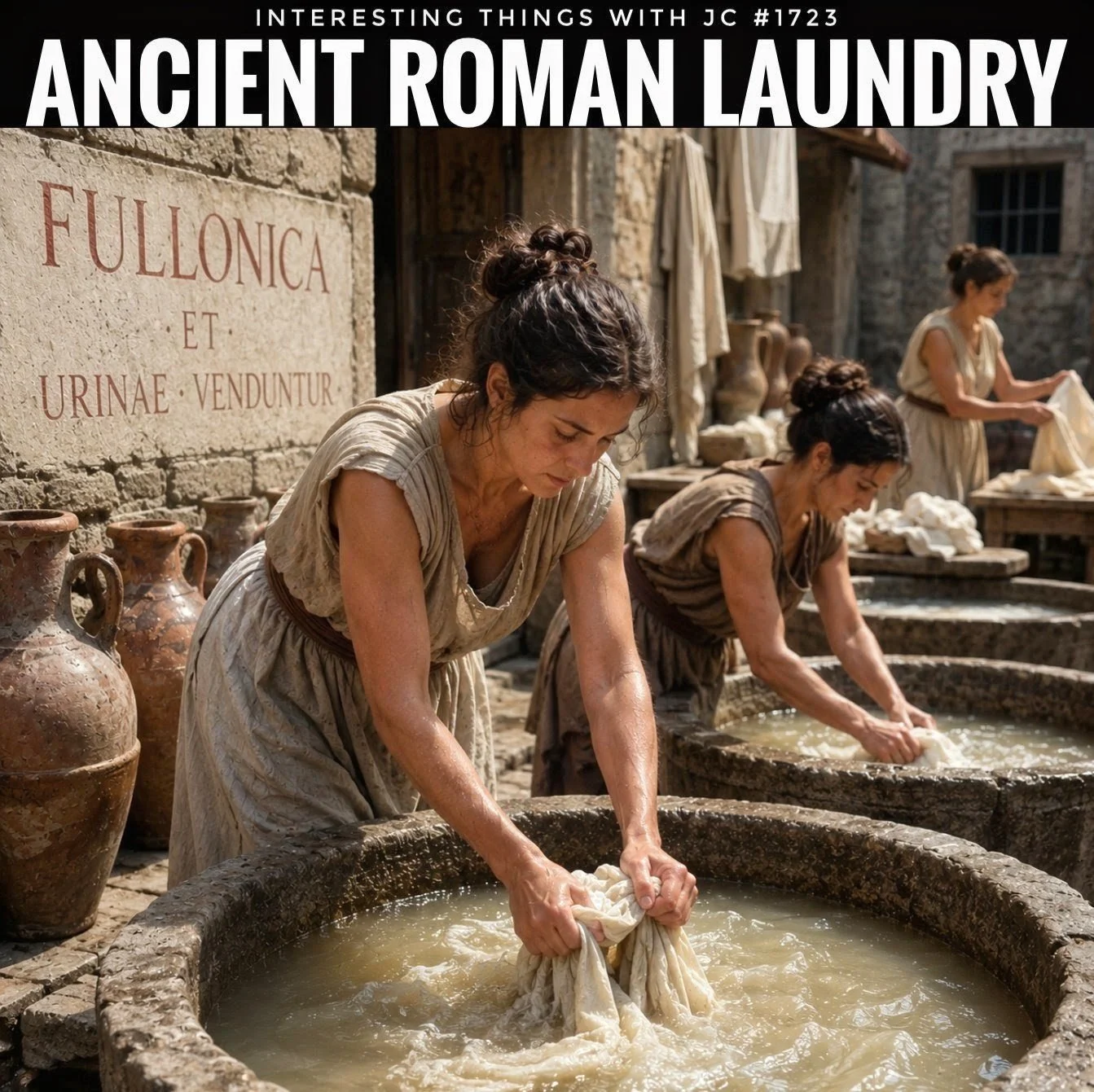
Women wearing simple Roman tunics wash clothing in large circular stone vats at an ancient Roman laundry. They scrub and wring light-colored fabric in cloudy water while clay jars, stone buildings, and hanging laundry surround the busy courtyard. A carved stone sign reading "Fullonica" identifies the workshop, illustrating how laundry was cleaned in ancient Rome before modern detergents.
Transcript
Interesting Things with JC #1723:
“Ancient Roman Laundry”
…When Laundry Smelled Like the Latrine…
If you walked through an ancient Roman city on laundry day, one of the strongest smells probably wasn't coming from a sewer. It was coming from the neighborhood laundry.
The Romans discovered that something most people wanted to get rid of was surprisingly useful. Human and animal urine contains compounds that eventually produce ammonia, and before anyone understood the chemistry behind it, Roman fullones (full-OH-nes), the professional cloth cleaners, had learned through experience that aged urine was remarkably good at breaking down grease and lifting stains from fabric.
Their workshops, known as fullonicae (full-oh-LOHN-ih-kye), were a common sight in Roman cities. Public urinals were often placed nearby, and the contents were collected and sold to the laundries. Fresh urine wasn't the prize. As it aged, naturally occurring bacteria converted the urea into ammonia, making it an even more effective cleaning agent.
Workers poured the liquid into large stone vats, where clothing was soaked and then stomped underfoot to work the ammonia through the fibers. Once the stains and oils had loosened, the garments were rinsed thoroughly, then treated with substances such as fuller's earth—a naturally absorbent clay—or sulfur fumes to brighten white fabrics before they were dried and returned to their owners.
Urine wasn't valuable only to laundries. It was also used in parts of the Roman leather-tanning and textile industries, making it an everyday industrial commodity. The trade became valuable enough that Emperor Vespasian imposed a tax on its collection and sale during the first century AD. When his son Titus reportedly criticized the idea, Vespasian held up a coin collected from the tax and asked whether it smelled. When Titus admitted it did not, the emperor replied, Pecunia non olet—"Money does not stink." The phrase has survived for nearly 2,000 years.
Modern laundry detergents no longer rely on buckets collected from public urinals, but many still use ammonia-based compounds because the underlying chemistry hasn't changed. Roman fullers didn't know why aged urine worked so well. They only knew that it did, and they built an industry around that observation centuries before chemistry could explain it.
Sometimes the foundations of practical knowledge are laid long before science catches up. The Romans turned an everyday waste product into one of the most useful cleaning agents they had, proving that careful observation can be just as valuable as theory.
These are interesting things, with JC.
Student Worksheet
Purpose: Listen to the podcast first if available. If audio is unavailable, read the transcript carefully before completing the activities.
Student Name: ____________________ Date: ____________
Comprehension
What substance made Roman laundry cleaning more effective as it aged?
Who were the fullones?
What were fullonicae?
Why was fresh urine less valuable than aged urine?
Besides laundry, what other Roman industries used urine?
Who imposed a tax on urine collection?
What does the Latin phrase Pecunia non olet mean?
What material was sometimes used after washing to brighten clothing?
Analysis
Why do you think Roman workers trusted their methods even though they did not understand the chemistry involved?
Explain how observation contributed to technological development in ancient Rome.
Compare Roman laundry practices with modern laundry methods. What has changed, and what scientific principle has remained the same?
Why would something considered waste become an important economic resource?
How does this story demonstrate the relationship between science and practical experience?
Reflection
Write one paragraph explaining a modern example where people used something successfully before fully understanding why it worked.
Challenge Activity
Research another ancient technology that was developed through observation rather than scientific theory. Describe:
What it was.
How it worked.
Why it was important.
What science later explained about it.
Difficulty Scaling
Level 1: Complete the comprehension questions.
Level 2: Complete comprehension and analysis.
Level 3: Complete all sections including the challenge activity using outside research.
Student Output Expectations
Students should produce:
Complete written responses using evidence from the transcript.
A thoughtful reflection supported with examples.
Accurate use of vocabulary terms.
Academic Integrity Guidance
Answer using your own words.
Support conclusions with evidence from the lesson.
Properly cite any outside research used for the challenge activity.
Teacher Guide
Quick Start: Begin by playing the podcast episode. Ask students to record one surprising fact while listening. If audio is unavailable, distribute the transcript for guided reading.
Pacing Guide (Audio-First):
Bell Ringer – 5 minutes
Podcast Listening – 6 minutes
Vocabulary Review – 5 minutes
Guided Discussion – 10 minutes
Worksheet Completion – 20 minutes
Review and Exit Ticket – 4 minutes
Bell Ringer:
Ask students:
"What common household product do you think would surprise people 2,000 years from now?"
Allow brief discussion before revealing the topic.
Audio Guidance:
Encourage students to listen for:
Roman innovation
Chemical processes
Economic value
Historical problem-solving
Audio Fallback:
Use the transcript as a close-reading activity. Have students highlight examples of observation leading to innovation.
Time on Task: Approximately 50 minutes.
Materials:
Podcast audio or transcript
Student worksheet
Whiteboard
Vocabulary handout
Optional periodic table showing nitrogen compounds
Vocabulary Strategy:
Introduce pronunciation first, then definitions. Reinforce vocabulary during discussion and worksheet activities.
Common Misconceptions:
Romans did not understand modern chemistry.
Urine itself was not magical; ammonia formed as it aged.
Roman laundry involved multiple cleaning and finishing stages.
Ancient people often made reliable observations without scientific theory.
Discussion Prompts:
Why might unpleasant materials sometimes become valuable?
What does this story reveal about experimentation?
Can practical knowledge exist before scientific understanding?
Why did governments tax useful commodities?
What modern industries depend upon chemical reactions?
Formative Checkpoints:
Students correctly define fullones.
Students explain ammonia formation.
Students connect observation with innovation.
Students identify economic implications.
Differentiation:
Provide vocabulary support for emerging readers.
Allow oral responses when appropriate.
Pair students for collaborative discussion.
Offer enrichment research for advanced learners.
Assessment Differentiation:
Short written responses.
Oral presentation.
Graphic organizer.
Comparative essay.
Time Flexibility:
30-minute version: Bell ringer, podcast, discussion, comprehension questions.
90-minute version: Add laboratory discussion on ammonia chemistry and Roman industry.
Substitute Readiness:
Lesson can be taught entirely from the transcript if audio is unavailable. Instructions are self-contained.
Engagement Strategy:
Reveal the cleaning agent only after students speculate how ancient Romans removed grease from clothing.
Extensions:
Investigate Roman sanitation systems.
Study the chemistry of ammonia.
Compare historical detergents across civilizations.
Explore the history of industrial recycling.
Cross-Curricular Connections:
Chemistry: Bases and cleaning reactions.
Biology: Bacterial decomposition.
Economics: Taxation and commodities.
World History: Roman daily life.
Environmental Science: Recycling waste materials.
SEL Connection:
Encourages curiosity, evidence-based reasoning, and appreciation for historical problem-solving from different cultures.
Skill Emphasis:
Critical thinking
Historical reasoning
Scientific observation
Reading informational text
Evidence evaluation
Communication
Answer Key:
Comprehension
Ammonia produced from aged urine.
Professional Roman cloth cleaners.
Roman laundry workshops.
Aging allowed bacteria to convert urea into ammonia.
Leather tanning and textile production.
Emperor Vespasian.
"Money does not stink."
Fuller's earth or sulfur fumes.
Analysis (Sample Responses)
Repeated success built confidence in the method.
Observation led to effective industrial practices before scientific explanation.
Modern detergents use refined chemistry, but grease removal still depends on similar chemical principles.
Valuable properties transformed waste into a marketable commodity.
Practical experience often precedes scientific understanding.
Quiz
Instructions: Choose the best answer for each question. (Do not reveal answers until the quiz has been completed.)
What chemical made aged urine useful for Roman laundries?
A. Vinegar
B. Ammonia
C. Salt
D. Sulfur
What were Roman professional cloth cleaners called?
A. Centurions
B. Artifices
C. Fullones
D. Praetorians
Why was aged urine preferred over fresh urine?
A. It smelled less.
B. It contained more water.
C. Bacteria converted urea into ammonia.
D. It was easier to transport.
Which emperor taxed the collection and sale of urine?
A. Augustus
B. Nero
C. Trajan
D. Vespasian
What is the central lesson of this episode?
A. Ancient people avoided scientific thinking.
B. Roman laundry was cleaner than modern laundry.
C. Careful observation can produce useful knowledge long before science explains why something works.
D. Urine was the only cleaning agent used by the Romans.
Assessment
Open-Ended Questions
Explain how Roman fullers transformed an everyday waste product into an important industrial resource. Include evidence from the lesson to support your explanation.
Describe how this episode demonstrates the relationship between observation, experimentation, and scientific understanding. Include one modern example that illustrates a similar process.
3–2–1 Rubric
3 – Exceeds Expectations
Accurately explains historical facts.
Demonstrates clear understanding of ammonia's role.
Connects historical practices to modern science using evidence.
Uses appropriate vocabulary throughout.
2 – Meets Expectations
Correctly explains the major ideas.
Uses some supporting evidence.
Demonstrates basic understanding of the historical and scientific concepts.
1 – Developing
Provides limited or incomplete explanations.
Uses little supporting evidence.
Demonstrates misconceptions or gaps in understanding.
Exit Ticket
Before leaving class, answer the following in two or three sentences:
What surprised you most about Roman laundry, and what does this tell us about the value of observation in solving real-world problems?
Standards Alignment
NGSS Science & Engineering Practices
SEP 1 – Asking Questions and Defining Problems
Connection: Students investigate why Roman cleaners used aged urine rather than fresh urine.
Measurable Skill: Develop scientific questions based on historical observations.
Justification: Encourages inquiry into chemical processes before formal scientific explanation.
SEP 6 – Constructing Explanations and Designing Solutions
Connection: Students explain how ammonia removes oils and stains.
Measurable Skill: Construct evidence-based explanations using historical examples.
Justification: Reinforces the relationship between observation and scientific reasoning.
CCSS Reading
CCSS.ELA-LITERACY.RH.9-10.2
Determine the central ideas of a primary or secondary source.
Connection: Students identify the central message of the podcast transcript.
Measurable Skill: Summarize historical information using textual evidence.
Justification: Supports comprehension of informational texts.
CCSS.ELA-LITERACY.RH.11-12.1
Cite specific textual evidence.
Connection: Worksheet and assessment responses require evidence from the transcript.
Measurable Skill: Support claims with textual evidence.
Justification: Strengthens historical reasoning.
CCSS Writing
CCSS.ELA-LITERACY.WHST.9-10.2
Write informative texts.
Connection: Reflection and assessment responses.
Measurable Skill: Produce organized explanatory writing.
Justification: Reinforces evidence-based communication.
CCSS Speaking & Listening
CCSS.ELA-LITERACY.SL.9-10.1
Initiate and participate effectively in collaborative discussions.
Connection: Guided classroom discussion.
Measurable Skill: Build on classmates' ideas using evidence.
Justification: Develops communication and analytical thinking.
C3 Framework
D2.His.1.9-12
Evaluate historical sources and evidence.
Connection: Students evaluate Roman industrial practices.
Measurable Skill: Interpret historical evidence.
Justification: Strengthens historical inquiry skills.
ISTE Standards
ISTE 1.3 – Knowledge Constructor
Connection: Students research additional examples of ancient technologies.
Measurable Skill: Gather and evaluate reliable information.
Justification: Encourages responsible research practices.
Career Readiness Competencies
Analytical Thinking: Evaluate why Roman industries adopted effective methods through observation.
Communication: Explain scientific and historical concepts using appropriate vocabulary.
Problem Solving: Analyze how ancient societies addressed practical challenges.
Adaptability: Recognize how industries improve through experimentation and innovation.
Professional Judgment: Understand how evidence guides practical decision-making.
Homeschool / Lifelong Learning Alignment
Independent Learning: Students extend learning through independent research.
Information Literacy: Distinguish historical evidence from assumptions.
Real-World Application: Connect ancient chemistry to modern detergents.
Self-Directed Inquiry: Develop questions for further exploration.
Transferable Life Skills: Apply observation and evidence-based reasoning to everyday decision-making.
Show Notes
This lesson explores an unusual but scientifically important aspect of daily life in ancient Rome. Students discover how Roman cloth cleaners transformed a common waste product into a valuable industrial resource through careful observation, long before the science of chemistry explained why it worked. By connecting history, chemistry, economics, and critical thinking, learners gain a deeper appreciation for how innovation often begins with practical experience and curiosity.
References
Encyclopaedia Britannica. (2024). Fulling. https://www.britannica.com/technology/fulling
Encyclopaedia Britannica. (2024). Ammonia. https://www.britannica.com/science/ammonia
Cartwright, M. (2018). Roman Daily Life. World History Encyclopedia. https://www.worldhistory.org/article/637/roman-daily-life/
Mark, J. J. (2018). Vespasian. World History Encyclopedia. https://www.worldhistory.org/Vespasian/
U.S. National Library of Medicine. (2023). Ammonia. https://medlineplus.gov/lab-tests/ammonia-levels/
Royal Society of Chemistry. (2023). Ammonia and Nitrogen Chemistry. https://edu.rsc.org/resources