1724: "The History of Yo Mama Jokes"
Interesting Things with JC #1724: "The History of Yo Mama Jokes"
A "Yo Mama" joke appears on a Babylonian clay tablet from about 1500 BC, showing that one of today's most familiar insults was already making people laugh thousands of years before playgrounds, stand-up comedy, or the internet.
Curriculum - Episode Anchor
Episode Title: The History of Yo Mama Jokes
Episode Number: 1724
Host: JC
Audience: Grades 9–12, Introductory College, Homeschool, Lifelong Learners
Subject Area: English Language Arts, Cultural History, Sociology, Oral Tradition, Media Studies
Lesson Overview
Objectives:
Analyze how oral traditions preserve humor across thousands of years.
Explain the historical development of "Yo Mama" jokes from ancient civilizations to modern popular culture.
Evaluate the social purpose of ritualized verbal competition.
Compare historical evidence with contemporary forms of humor and communication.
Essential Question:
How can a simple joke preserve thousands of years of cultural history?
Success Criteria:
Students can identify major historical milestones in the evolution of mother-directed insults.
Students can explain the purpose of "playing the dozens."
Students can distinguish between playful verbal competition and harmful personal attacks.
Students can support conclusions using evidence from the episode.
Student Relevance:
Students encounter humor daily through conversations, social media, memes, and entertainment. This lesson demonstrates that even familiar jokes often have deep historical roots and cultural significance.
Real-World Connection:
Understanding verbal traditions helps students recognize how language evolves, how communities preserve culture, and how communication reflects social values.
Workforce Reality:
Many careers—including education, communications, journalism, marketing, psychology, entertainment, and public speaking—require understanding audience, tone, cultural context, and effective communication.
Key Vocabulary
Oral Tradition(OR-ul truh-DISH-un) — Information, stories, and customs passed from person to person through speech.
Babylonia(bab-ih-LOH-nee-uh) — An ancient civilization located in Mesopotamia, modern-day Iraq.
Clay Tablet(KLAY TAB-lit) — A flat piece of clay used for writing in many ancient civilizations.
Shakespeare(SHAYK-speer) — English playwright whose works frequently reflected popular language and humor.
Titus Andronicus(TYE-tus an-dro-NYE-kus) — One of Shakespeare's earliest tragedies containing an early documented "your mother" insult.
Playing the Dozens(PLAY-ing the DUZ-unz) — A traditional African American verbal game involving humorous exchanges of exaggerated insults.
Verbal Dueling(VER-bul DOO-uhl-ing) — A contest where participants compete using words instead of physical conflict.
Satire(SAT-ire) — Humor used to exaggerate or criticize.
Hyperbole(hy-PER-buh-lee) — Extreme exaggeration used for emphasis or comedic effect.
Cultural Tradition(KUL-chur-ul truh-DISH-un) — Customs or practices passed through generations.
Narrative Core
Open
Most people hear a "Yo Mama" joke and think of school playgrounds or comedy routines. Few realize they're hearing one of humanity's oldest surviving forms of humor.
Information
Evidence suggests that jokes aimed at someone's mother date back nearly 3,500 years. Although many details have been lost, surviving historical records reveal that this style of insult has persisted through multiple civilizations.
Details
The earliest known example appears on a damaged Babylonian clay tablet dating to approximately 1500 BC. Centuries later, Shakespeare included a remarkably similar exchange in Titus Andronicus, demonstrating that audiences already understood the joke. In the United States, these insults became highly developed through the African American tradition known as playing the dozens, where wit, timing, and self-control mattered more than cruelty. That tradition later influenced stand-up comedy, rap battles, and popular culture.
Reflection
The remarkable survival of this joke format illustrates that humor can preserve cultural traditions across thousands of years. While the settings, audiences, and punchlines have changed, the underlying challenge remains the same: think quickly, stay composed, and entertain others through creativity.
Closing
These are interesting things, with JC.
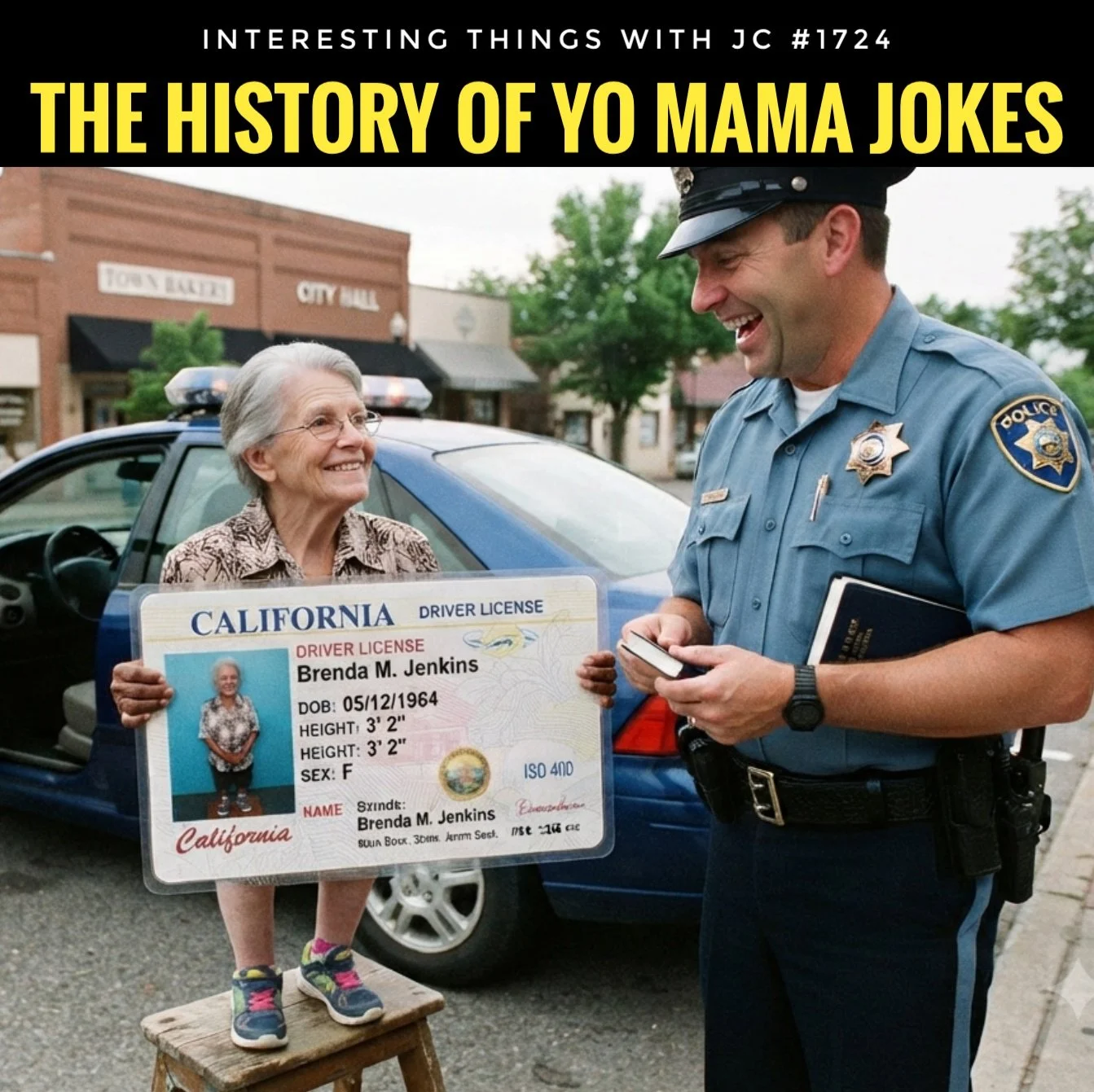
Promotional graphic for “Interesting Things with JC #1724: The History of Yo Mama Jokes.” An elderly woman stands on a small wooden platform beside a police car, holding an oversized novelty California driver’s license that lists her height as 3 feet 2 inches. A smiling police officer looks down at the license. Large yellow title text appears across a black banner at the top.
Transcript
Interesting Things with JC #1724:
The History of Yo Mama Jokes
"Yo Mama's so old, she has a picture of the Last Supper... signed."
Most people hear that and think, "Playground joke." But it's actually the latest chapter in a tradition stretching back thousands of years.
The oldest surviving mother-directed insult appears on a damaged Babylonian clay tablet from about 1500 BC, roughly 3,500 years ago. The full punchline has been lost to time, but enough survives to show someone was taking a shot at another person's mother. Some things, it seems, never change.
Centuries later, the same kind of insult appears in Shakespeare's Titus Andronicus. During an argument, one character says, "Thou hast undone our mother." The reply comes back instantly: "Villain, I have done thy mother." Shakespeare's audience would have recognized the joke because insults aimed at someone's mother were already familiar.
Those insults never disappeared. They simply took different forms in different places. In America, they evolved into something far more structured.
The modern "Yo Mama" joke has its strongest roots in an African American tradition known as playing the dozens. Documented in the early twentieth century, though likely much older, it turned insult trading into a contest of wit. Two people faced off, firing increasingly outrageous jokes, usually about each other's mothers. The winner wasn't the meanest. It was the one who stayed coolest, quickest, and funniest. Lose your temper, and you lost.
"Yo Mama's so short, you can see her feet on her driver's license."
That would have fit perfectly. The joke didn't have to be believable. It just had to be better than the last one.
Many scholars see influences from older West African verbal dueling traditions that evolved into something distinctly African American. From there, the style shaped stand-up comedy, influenced rap battles, and eventually reached television and playgrounds everywhere.
You'll still hear lines like, "Yo Mama's so clumsy, she tripped over a cordless phone." They don't make sense, and that's exactly the point.
That first joke about the Last Supper isn't really the story. It's simply the latest move in a contest that's survived for thousands of years because it rewards imagination, timing, and self-control. The settings changed. The punchlines changed. But the challenge stayed the same: think faster than the other person.
These are interesting things, with JC.
Teacher Guide
Quick Start
Play the podcast before introducing the lesson. Allow students to hear the story uninterrupted. Explain afterward that they will investigate why a familiar joke has an unexpectedly long history.
Pacing Guide (Audio-First)
Bell Ringer: 5 minutes
First Listening: 4 minutes
Guided Discussion: 8 minutes
Second Listening with Note-Taking: 5 minutes
Student Worksheet: 20 minutes
Review and Wrap-Up: 8 minutes
Total Lesson Time: Approximately 50 minutes
Bell Ringer
Display the following prompt before students hear the episode:
Where do you think "Yo Mama" jokes began?
Have students write a brief prediction individually before discussing their ideas.
Audio Guidance
First Listening
Listen without taking notes.
Focus on the overall story and historical progression.
Second Listening
Students should identify:
Historical dates
Important people
Cultural traditions
Examples of exaggeration (hyperbole)
Audio Fallback
If audio cannot be played:
Read the transcript aloud.
Have students alternate paragraphs.
Pause after each historical period for discussion.
Continue with the worksheet as normal.
Time on Task
Bell Ringer: 5 minutes
Podcast: 9 minutes
Vocabulary: 5 minutes
Worksheet: 20 minutes
Discussion: 8 minutes
Wrap-Up: 3 minutes
Materials
Podcast audio
Transcript
Student worksheet
Timeline organizer
Pens or pencils
Vocabulary Strategy
Before listening, introduce:
Oral tradition
Hyperbole
Verbal dueling
After listening, have students define the remaining vocabulary using context clues from the episode.
Common Misconceptions
The oldest surviving joke is not necessarily the first joke ever told.
"Playing the dozens" rewarded wit and self-control rather than cruelty.
Hyperbole is intentional exaggeration.
Cultural traditions can evolve while preserving their original purpose.
Discussion Prompts
Why has this style of humor survived for thousands of years?
Why does exaggeration make people laugh?
How is verbal competition different from bullying?
What historical evidence supports the episode's claims?
Why was keeping your composure important during "playing the dozens"?
Formative Checkpoints
Students should be able to:
Explain the Babylonian evidence.
Identify the Shakespeare reference.
Describe "playing the dozens."
Explain why humor changed while the tradition remained.
Support answers with evidence from the podcast.
Differentiation
Additional Support
Vocabulary cards
Guided notes
Partner discussions
Extended Learning
Research another historical humor tradition.
Compare "playing the dozens" with modern rap battles.
Create an illustrated historical timeline.
Assessment Differentiation
Students may demonstrate understanding through:
Written responses
Oral presentation
Graphic organizer
Timeline
Short research summary
Time Flexibility
30-Minute Lesson
Podcast
Discussion
Comprehension questions
50-Minute Lesson
Complete lesson
90-Minute Lesson
Lesson
Research extension
Group discussion
Reflection writing
Substitute Readiness
Play the episode.
Distribute the worksheet.
Lead discussion using the provided prompts.
Review answers with the class.
Engagement Strategy
Invite students to anonymously submit a school-appropriate exaggerated "Yo Mama" joke before the lesson. After learning the history, discuss why this style of humor has survived for thousands of years.
Cross-Curricular Connections
History: Ancient Mesopotamia
English Language Arts: Shakespeare
Sociology: Oral traditions
Communications: Audience and humor
Psychology: Emotional regulation
SEL Connection
Students practice:
Emotional regulation
Respectful communication
Perspective taking
Active listening
Responsible participation
Skill Emphasis
Students strengthen:
Historical reasoning
Evidence evaluation
Critical thinking
Listening comprehension
Academic discussion
Written communication
Answer Key
Comprehension
Approximately 3,500 years old.
A Babylonian clay tablet.
Titus Andronicus.
A tradition of competitive verbal insults emphasizing wit and composure.
The participant who remained calm while delivering the funniest and quickest responses.
Vocabulary
Accept reasonable, evidence-based definitions consistent with the episode.
Timeline
Babylonian clay tablet
Shakespeare's Titus Andronicus
Playing the dozens
Stand-up comedy and rap battles
Modern "Yo Mama" jokes
Analysis
Responses should explain the continuity of oral tradition, the role of exaggeration in humor, and the evolution of cultural practices using evidence from the episode.
Quiz
Instructions
Choose the best answer for each question. Select only one answer for each question. Do not use notes unless instructed by your teacher.
1. What is the earliest surviving evidence of a mother-directed insult discussed in the episode?
A. An Egyptian papyrus from 1000 BC
B. A Babylonian clay tablet from about 1500 BC
C. A Roman scroll from AD 100
D. A Greek play from 500 BC
2. Which Shakespeare play contains a well-known mother-directed insult?
A. Hamlet
B. Macbeth
C. Titus Andronicus
D. Romeo and Juliet
3. What was the primary goal of "playing the dozens"?
A. To start physical fights
B. To embarrass family members publicly
C. To demonstrate wit, creativity, and self-control through verbal competition
D. To memorize traditional stories
4. According to the episode, many scholars believe "playing the dozens" was influenced by:
A. Medieval European festivals
B. Ancient Roman military traditions
C. Older West African verbal dueling traditions
D. Viking storytelling customs
5. What is the central idea of the episode?
A. "Yo Mama" jokes were invented by television comedians.
B. Shakespeare created the first mother-directed insult.
C. Humor can preserve cultural traditions across thousands of years while adapting to new audiences.
D. Ancient jokes were identical to modern jokes.
Assessment
Open-Ended Questions
1. Explain how the episode demonstrates continuity between ancient civilizations and modern popular culture. Use at least three pieces of evidence from the podcast to support your answer.
2. The episode argues that "Yo Mama" jokes reward imagination, timing, and self-control rather than simply being mean. Evaluate this claim using historical examples presented in the lesson.
3–2–1 Reflection
Three things you learned about the history of "Yo Mama" jokes.
Two connections you made between the episode and modern culture.
One question you still have after completing the lesson.
Exit Ticket
Before leaving class, answer the following in two or three complete sentences:
What surprised you most about the history of "Yo Mama" jokes, and why do you think this tradition has survived for thousands of years?
Standards Alignment
NGSS Science and Engineering Practices (Applicable Cross-Disciplinary Practice)
SEP 8 – Obtaining, Evaluating, and Communicating Information
Connection: Students analyze historical evidence from ancient Mesopotamia through modern America to explain the development of a cultural tradition.
Student Skill: Evaluate information from multiple historical periods and communicate conclusions using evidence from the episode.
Justification: Students demonstrate evidence-based reasoning while tracing continuity across civilizations.
CCSS Reading
CCSS.ELA-LITERACY.RH.11-12.1 – Cite Specific Textual Evidence
Connection: Students support responses using details from the podcast transcript.
Student Skill: Cite historical evidence accurately to support conclusions.
Justification: Worksheet analysis and assessment questions require evidence-based interpretation.
CCSS.ELA-LITERACY.RH.11-12.2 – Determine Central Ideas
Connection: Students identify how humor evolved while preserving its cultural purpose.
Student Skill: Summarize historical developments and identify central themes.
Justification: Students synthesize information spanning more than 3,500 years of history.
CCSS Writing
CCSS.ELA-LITERACY.WHST.11-12.2 – Write Informative/Explanatory Texts
Connection: Students explain historical developments using organized evidence.
Student Skill: Produce clear explanatory writing supported by facts.
Justification: Reflection and assessment responses require structured historical explanations.
CCSS Speaking and Listening
CCSS.ELA-LITERACY.SL.11-12.1 – Collaborative Discussions
Connection: Students participate in classroom discussions about cultural traditions and historical evidence.
Student Skill: Build upon classmates' ideas while supporting claims with evidence.
Justification: Teacher discussion prompts emphasize respectful academic dialogue.
C3 Framework for Social Studies
D2.His.1.9-12 – Evaluate Historical Sources and Evidence
Connection: Students examine evidence from Babylonian records, Shakespeare, and modern cultural traditions.
Student Skill: Analyze historical continuity and change across time.
Justification: Students compare evidence from multiple historical periods to identify enduring cultural practices.
ISTE Standards for Students
ISTE 3 – Knowledge Constructor
Connection: Students gather, evaluate, and interpret historical information presented through the podcast.
Student Skill: Construct evidence-based understanding using credible historical sources.
Justification: The lesson emphasizes informed inquiry and critical evaluation rather than memorization.
Career Readiness Competencies
Analytical Thinking
Students analyze historical evidence to identify patterns across civilizations.
Communication
Students explain ideas clearly through written responses and classroom discussion.
Problem Solving
Students evaluate why cultural traditions evolve while maintaining their original purpose.
Adaptability
Students recognize how communication styles change across different historical and cultural settings.
Professional Judgment
Students distinguish between historical analysis, respectful humor, and inappropriate personal attacks while participating in classroom discussion.
Homeschool / Lifelong Learning Alignment
Independent Learning
Students investigate historical evidence and construct conclusions through guided inquiry.
Information Literacy
Students evaluate historical claims using documented sources and evidence presented in the lesson.
Real-World Application
Students connect historical communication traditions to contemporary media, comedy, and public discourse.
Self-Directed Inquiry
Students extend learning through optional research comparing additional oral traditions.
Transferable Life Skills
Students strengthen critical thinking, historical reasoning, active listening, and effective communication skills applicable beyond the classroom.
Show Notes
This lesson explores the surprisingly long history of "Yo Mama" jokes, revealing that a familiar form of humor traces its roots to ancient Mesopotamia, appears in Shakespeare, and evolved into the African American tradition of playing the dozens. Students examine how oral traditions preserve culture, how humor changes across generations, and why creativity, timing, and self-control have remained central to successful verbal competition. By connecting ancient history with modern popular culture, learners gain a deeper appreciation for the evolution of language, storytelling, and social interaction.
References
Blackmore, S. (1999). The meme machine. Oxford University Press. https://global.oup.com/academic/product/the-meme-machine-9780192862129
Encyclopaedia Britannica. (2024). Playing the dozens. https://www.britannica.com/topic/dozens
Encyclopaedia Britannica. (2024). Titus Andronicus. https://www.britannica.com/topic/Titus-Andronicus
Folger Shakespeare Library. (n.d.). Titus Andronicus: Act 4, scene 2. https://www.folger.edu/explore/shakespeares-works/titus-andronicus/read/4/2/
Lefever, H. G. (1981). Playing the dozens: A mechanism for social control. Phylon, 42(1), 73–85. https://www.jstor.org/stable/274885
Museum of Play. (2023, February 3). The dozens: The art of tender trash talk. https://www.museumofplay.org/blog/the-dozens-the-art-of-tender-trash-talk/
Oxford Reference. (2024). The dozens. https://www.oxfordreference.com/display/10.1093/oi/authority.20110803095728241
Shakespeare, W. (n.d.). Titus Andronicus. Massachusetts Institute of Technology. https://shakespeare.mit.edu/titus/full.html
Streck, M. P., & Wasserman, N. (2011). Dialogues and riddles: Three Old Babylonian wisdom texts. Iraq, 73, 117–125. https://www.gkr.uni-leipzig.de/fileadmin/Fakult%C3%A4t_GKR/Altorientalisches_Institut/Dokumente/Institut/Mitarbeiter/Streck_Dokumente/Streck.Wasserman_11_Dialogues.pdf
The British Museum. (n.d.). Mesopotamia: Writing and cuneiform. https://www.britishmuseum.org/collection/galleries/mesopotamia
University of Pennsylvania Museum. (n.d.). Mesopotamia. https://www.penn.museum/sites/expedition/mesopotamia/
Wald, E. (2012). The dozens: A history of rap's mama. Oxford University Press. https://global.oup.com/academic/product/the-dozens-9780199895403