1725: "The King Who Invented an Invasion"
Interesting Things with JC #1725: "The King Who Invented an Invasion"
Sweden's King Gustav III needed Russia to attack first before he could legally wage war, so his government staged a border incident to create the appearance of an invasion. The deception started a real war, but instead of uniting Sweden, it triggered opposition from officers who believed the king had violated his own constitution.
Curriculum - Episode Anchor
Episode Title: The King Who Invented an Invasion
Episode Number: 1725
Host: Jim Connors (JC)
Audience: Grades 9–12, introductory college, homeschool, and lifelong learners
Subject Area: World History, European History, Civics, Government, Media Literacy
Recommended Instructional Time: One 55–70-minute lesson or two 40-minute sessions
Instructional Focus: Constitutional limits, evidence evaluation, political pretexts, military responsibility, and consequences of executive decision-making
Lesson Overview
Lesson Summary: Students begin by listening to the podcast episode. They then investigate how King Gustav III attempted to overcome constitutional restrictions by creating the appearance of a Russian attack. Students distinguish motive, claim, evidence, action, and consequence while evaluating the responsibilities of political leaders and military officers.
Learning Objectives:
Explain why Gustav III wanted war with Russia and why Swedish law limited his authority to begin one.
Identify the purpose and consequences of the manufactured frontier incident.
Analyze why members of the Swedish officer corps resisted the war through the Anjala Act and Anjala League.
Evaluate Gustav III’s actions using historical evidence, constitutional reasoning, and standards of professional judgment.
Essential Question: What happens when a political leader treats constitutional limits as obstacles to be bypassed rather than rules to be followed?
Supporting Questions:
Why did Gustav III believe war might strengthen Sweden and his own authority?
How did the reported frontier incident provide a legal pretext for war?
Why did some Swedish officers regard the conflict as unconstitutional?
Can military success compensate for a deceptive or unlawful decision to begin a war?
Success Criteria: Students can successfully complete the lesson when they can:
State the difference between Gustav III’s public justification and underlying objectives.
Organize at least four events in a defensible cause-and-effect sequence.
Support an interpretation with at least two details from the episode.
Explain one constitutional, ethical, or professional consequence of manufacturing evidence.
Write a reasoned judgment that acknowledges both military results and political consequences.
Student Relevance: Students regularly encounter claims designed to justify decisions. Learning to separate a claim from the evidence supporting it strengthens judgment in school, employment, civic life, media use, and personal decision-making.
Real-World Connection: Governments, companies, institutions, and individuals may present selective evidence to obtain approval for actions. Responsible decision-makers must verify sources, examine incentives, identify missing information, and consider the consequences of acting on unconfirmed claims.
Workforce Reality: Careers in law, military service, public administration, journalism, intelligence, cybersecurity, management, and emergency response require professionals to document evidence accurately, follow lawful procedures, question unsupported assumptions, and raise concerns through appropriate channels.
Discipline and Responsibility: The lesson emphasizes that leadership involves restraint, lawful process, evidence verification, and responsibility for foreseeable consequences. Authority does not remove the obligation to exercise professional judgment.
Audio-First Requirement: The podcast is the lesson’s opening instructional text. Students listen before reading the transcript or completing analytical tasks.
Audio-Free Functionality: When audio is unavailable, the teacher reads the transcript aloud or assigns a structured silent reading using the same listening-focus questions.
Key Vocabulary
Anjala Act(AHN-yah-lah akt) — A document signed by Swedish officers in 1788 criticizing the war and seeking peace with Russia.
Anjala League(AHN-yah-lah leeg) — The association of officers connected with opposition to Gustav III’s conduct of the war.
Constitution(kon-stih-TOO-shun) — A foundational system of laws and principles that defines governmental powers and limits.
Constitutional limit(kon-stih-TOO-shuh-nuhl LIM-it) — A legal restriction placed on the authority of a government official or institution.
Gustav III(GOO-stahv the Third) — King of Sweden from 1771 to 1792 and the ruler who initiated the Russo-Swedish War of 1788–1790.
Manufactured incident(man-yuh-FAK-churd IN-sih-dent) — An event arranged, altered, or misrepresented to create a desired appearance or justification.
Pretext(PREE-tekst) — A stated reason used to justify an action when the actual motive may be different.
Riksdag(RIKS-dahg) — Sweden’s national parliament.
Svensksund(SVENSK-soond) — The site of a major Swedish naval victory over Russia in 1790.
Treaty of Värälä(VAIR-ah-lah) — The 1790 agreement that ended the Russo-Swedish War without changing the territorial borders.
Verifiable evidence(VAIR-uh-fy-uh-buhl EV-ih-dens) — Information that can be checked against reliable sources or observations.
Professional judgment(pruh-FESH-uh-nuhl JUHJ-ment) — Careful decision-making based on evidence, ethics, responsibility, and applicable rules.
Narrative Core
Open: In the summer of 1788, Gustav III wanted Sweden to fight Russia. The central obstacle was not simply military readiness. Swedish constitutional rules prevented the king from freely beginning an offensive war without political approval.
Info: Sweden had lost territory and influence during earlier conflicts with Russia. Gustav believed that a successful war might restore Swedish prestige, weaken domestic opposition, and strengthen royal authority. The Riksdag, however, showed little enthusiasm for an expensive offensive conflict.
Details: Near the Finnish-Russian frontier, Gustav’s government arranged an incident intended to appear as a Russian attack on Swedish territory. Accounts describe Swedish soldiers wearing Russian uniforms, though historians debate some operational details. The political purpose was to make Sweden appear to be responding defensively. Once war began, Swedish officers challenged its legality and issued the Anjala Act. The resulting conflict lasted from 1788 to 1790 and included Sweden’s major naval victory at Svensksund.
Reflection: The Treaty of Värälä ended the war without territorial change. Gustav obtained the conflict he wanted but also produced military dissent, casualties, expense, and a lasting debate over constitutional authority. The episode demonstrates that a deceptive justification may achieve an immediate objective while damaging institutional trust and lawful governance.
Closing: These are interesting things, with JC.
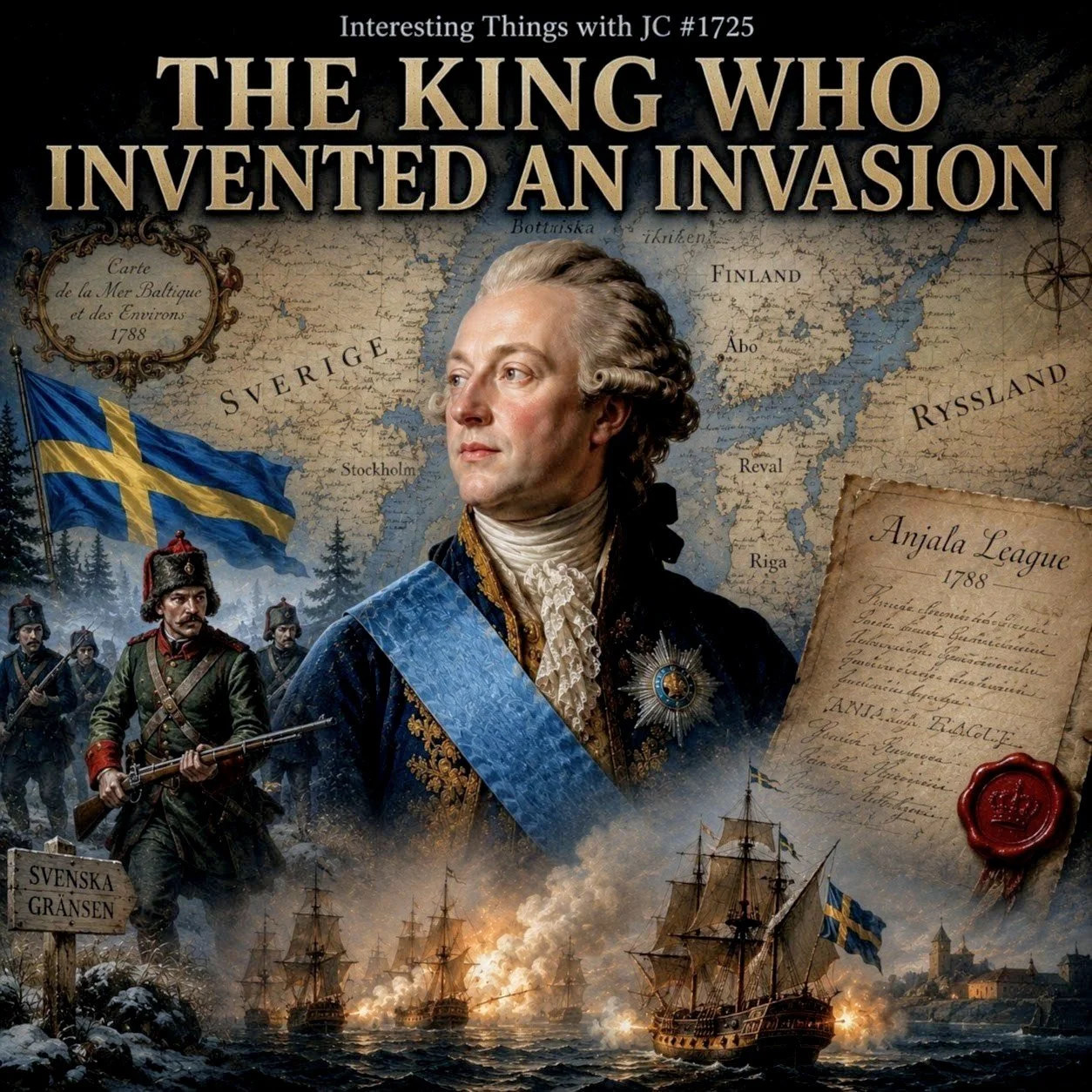
Promotional historical artwork for “Interesting Things with JC #1725: The King Who Invented an Invasion.” A large portrait of an 18th-century Swedish monarch in formal blue-and-gold clothing stands before a 1788 map of Sweden, Finland, and Russia. Swedish soldiers, a waving flag, a sealed “Anjala League 1788” document, and naval ships firing in battle surround him, emphasizing war, political deception, and military unrest.
Transcript
Interesting Things with JC #1725:
“The King Who Invented an Invasion”
In the summer of 1788, Sweden's King Gustav III (GOO-stahv the Third) had a problem. He wanted a war with Russia, but under Sweden's constitution, he couldn't simply start one. If Russia attacked first, however, everything changed. So Gustav set out to create the one thing he didn't have: a reason.
For decades, Sweden had lived with the memory of lost territory. The Great Northern War had ended generations earlier, and Russia had emerged as the dominant power around the Baltic Sea. Gustav believed a successful war could restore Sweden's standing abroad while strengthening his own position at home. The obstacle wasn't military strength as much as Swedish law. The Riksdag, Sweden's Parliament, had little appetite for another expensive conflict, and the constitution sharply limited the king's ability to wage an offensive war.
Near the Finnish-Russian frontier, Gustav's government arranged an incident that appeared to show Russian forces attacking Swedish territory. Contemporary accounts describe Swedish soldiers dressed in Russian uniforms taking part in the deception, although historians continue to debate exactly how every detail unfolded. What isn't disputed is the purpose. The episode was intended to create the appearance that Russia had fired the first shot, giving Gustav the legal justification he wanted to declare war.
The plan worked just well enough to begin the conflict, but it quickly created a different problem. Many Swedish officers believed they were being asked to fight in a war that violated their own constitution. Rather than obey, a group of senior officers signed what became known as the Anjala Act and formed the Anjala League, openly criticizing the king and seeking an end to the conflict. Instead of rallying the country behind him, Gustav found himself facing dissent from within his own army.
The Russo-Swedish War lasted from 1788 to 1790. There were moments of Swedish success, including the decisive naval victory at Svensksund, but neither side achieved the sweeping gains they had hoped for. When the Treaty of Värälä (VAIR-ah-lah) was signed in 1790, the borders remained exactly where they had been before the fighting began. After two years of war, thousands of casualties, and enormous expense, neither country gained any territory.
Gustav III succeeded in starting the war he wanted, but not in the way he intended. The manufactured pretext that was supposed to unite Sweden instead exposed deep divisions over royal authority, constitutional limits, and the cost of ambition. More than two centuries later, the story is remembered not because a king defeated his enemy with a brilliant deception, but because an attempt to manufacture a legal excuse for war became one of history's most unusual political gambles.
These are interesting things, with JC.
Student Worksheet
Student Name: ______________________________
Date: __________________
Class or Course: ______________________________
Episode: The King Who Invented an Invasion
Directions: Listen to the complete episode before consulting the transcript. Record brief notes during the first listening. Use complete sentences and specific evidence for all written responses unless another format is stated.
Listening Focus: While listening, identify:
Gustav III’s goal.
The constitutional obstacle he faced.
The action used to overcome that obstacle.
The reaction of Swedish officers.
The final outcome of the war.
Part A—Comprehension: Answer each question in one or two complete sentences.
Why did Gustav III want Sweden to fight Russia?
What legal or constitutional restriction limited the king’s ability to begin the war?
How was the frontier incident intended to appear?
What was the intended political purpose of the incident?
Why did some Swedish officers oppose the war?
What were the Anjala Act and Anjala League?
What major Swedish military success occurred during the conflict?
What territorial result followed the Treaty of Värälä?
Part B—Cause-and-Effect Analysis: Complete each statement with a specific cause or consequence.
Because the Riksdag did not support an offensive war, Gustav III ______________________________.
Because the border incident appeared to be a Russian attack, Gustav could ______________________________.
Because officers believed the war violated the constitution, they ______________________________.
Although Sweden won at Svensksund, the war ultimately ______________________________.
Because the pretext became connected with deception, Gustav’s decision exposed ______________________________.
Part C—Evidence Classification: Label each statement as Motive, Claim, Evidence, Action, or Consequence.
Gustav believed victory could improve Sweden’s international standing. __________________
Russia appeared to have attacked Swedish territory. __________________
Swedish soldiers reportedly wore Russian uniforms. __________________
Gustav used the incident to justify war. __________________
Officers formed the Anjala League. __________________
The borders remained unchanged after the war. __________________
Part D—Source and Claim Analysis: Respond in two to four sentences per question.
The transcript says historians debate exactly how every detail of the frontier incident unfolded. Why is this qualification important?
Which historical conclusion remains defensible even when some operational details are uncertain?
How does the difference between Gustav’s private motive and public justification affect your evaluation of his decision?
What additional primary sources would help a historian investigate the incident?
Part E—Constitutional Reasoning: Write one well-developed paragraph of six to eight sentences.
Was the constitutional restriction merely an obstacle to Gustav’s policy, or was it an essential safeguard? Defend your answer with at least two details from the episode.
Part F—Professional Judgment Scenario: Read the scenario and respond in four to six sentences.
You are an officer who receives an order that appears lawful on its surface, but reliable information suggests that the evidence used to justify it was manufactured. What responsible steps should you take before acting? Address verification, chain of command, documentation, legal procedure, and public responsibility.
Part G—Structured Historical Judgment: Complete the following claim-evidence-reasoning response.
Claim: Gustav III did or did not achieve his primary objectives.
Evidence: Include at least three relevant details from the episode.
Reasoning: Explain how each detail supports your judgment and address one possible counterargument.
Required Length: 250–350 words.
Part H—Reflection: Respond in five to seven sentences.
Which creates the greater long-term danger: a failed military plan or a successful deception used to bypass lawful limits? Explain your reasoning.
Difficulty Scaling:
Foundation Level: Complete Parts A, B, and H. Use sentence starters and a vocabulary bank.
Standard Level: Complete Parts A through H with the stated evidence and length requirements.
Advanced Level: Complete all parts and add a 300-word comparison between the episode and another historical case involving disputed evidence, executive power, or military authorization.
Introductory College Level: Complete all parts and evaluate the reliability limits of a short narrative source. Identify which claims require corroboration and propose a research plan using primary and secondary sources.
Student Output Expectations:
Use complete sentences unless labeling or charting.
Refer to Gustav III, the Riksdag, the manufactured incident, the Anjala League, Svensksund, or the Treaty of Värälä where relevant.
Distinguish established facts from debated details.
Support analytical claims with evidence from the audio or transcript.
Avoid unsupported comparisons to modern events.
Academic Integrity Guidance: Submit original reasoning. Quoted wording must be placed in quotation marks. Paraphrased information must remain accurate. Do not invent evidence, sources, quotations, or historical details. Any outside research must be credited according to the teacher’s required citation style.
Teacher Guide
Quick Start: Play the complete podcast before distributing the transcript. Ask students to divide a page into five columns labeled Goal, Limit, Pretext, Resistance, and Result. After listening, students compare notes with a partner and then complete the worksheet.
Recommended Lesson Length: 55–70 minutes.
Pacing Guide—Audio-First:
0–5 minutes: Bell ringer and prediction.
5–10 minutes: Vocabulary preview limited to constitution, pretext, Riksdag, and Anjala League.
10–15 minutes: First uninterrupted podcast listening.
15–20 minutes: Individual retrieval notes without transcript access.
20–28 minutes: Second listening or targeted replay with listening-focus questions.
28–38 minutes: Comprehension and cause-and-effect work.
38–50 minutes: Evidence classification and constitutional analysis.
50–62 minutes: Discussion or professional judgment scenario.
62–70 minutes: Written assessment or exit ticket.
Two-Session Option:
Session One: Bell ringer, vocabulary, podcast, retrieval notes, comprehension, and cause-and-effect analysis.
Session Two: Brief replay, source analysis, constitutional reasoning, structured discussion, assessment, and exit ticket.
Bell Ringer: Display the statement: “A leader should be allowed to bypass a legal restriction when the leader believes the action will protect or strengthen the country.” Students write an initial response of three sentences. Do not conduct a full debate until after the podcast.
Audio Guidance: Tell students not to transcribe every sentence. Direct them to listen for the sequence of problem, motive, method, resistance, and outcome. Pause only after the first complete listening unless an accommodation requires segmented playback.
Second-Listening Prompts:
What did Gustav want?
What prevented him from acting directly?
What appearance did the frontier incident create?
Who resisted, and why?
What changed after two years of war?
Audio Fallback: Read the transcript aloud at a measured pace while students use the five-column note organizer. A second reader may voice the final reflective paragraph. For independent work, students silently read once for sequence and again for evidence.
Time on Task: Students should spend approximately 10 minutes listening, 15–20 minutes retrieving and organizing information, 15–20 minutes analyzing evidence, and 10–15 minutes discussing or writing.
Materials:
Podcast audio or teacher-read transcript.
Student worksheet.
Writing materials or digital document.
Board or shared display.
Optional five-column note organizer.
Optional map of the Baltic region in the late eighteenth century.
Optional timer for structured discussion.
Vocabulary Preparation: Preteach only the terms essential for initial comprehension. Ask students to infer the meaning of manufactured incident from context before confirming the definition. Revisit professional judgment during the scenario task.
Background for Teachers: Gustav III’s conflict with Russia arose within a broader struggle over Swedish influence, royal authority, and constitutional restraint. Historical sources consistently identify the war as an offensive action that angered military officers, while descriptions of the staged frontier incident may vary in operational detail. The Treaty of Värälä ended the conflict in 1790 without territorial change. Sweden’s major victory at Svensksund should not be confused with achieving the king’s larger territorial objectives.
Common Misconceptions:
Misconception: Gustav III had no authority at all.
Correction: He possessed substantial royal power, but constitutional restrictions limited his ability to begin an offensive war.
Misconception: Every detail of the staged incident is equally certain.
Correction: The purpose and deceptive character are broadly established, while historians may debate specific operational details.
Misconception: The Anjala officers simply refused all military duty.
Correction: Their opposition centered on the war’s legality, leadership, and the pursuit of peace.
Misconception: Victory at Svensksund meant Sweden won the war decisively.
Correction: It was a major Swedish naval success, but the peace settlement left territorial borders unchanged.
Misconception: An unchanged border means the conflict had no consequences.
Correction: The war produced casualties, expense, military dissent, political consequences, and lasting questions about authority.
Discussion Prompts:
Why might a constitutional government restrict one person’s authority to begin a war?
Does a defensive justification become invalid when the evidence supporting it is manufactured?
What responsibilities do officers have when orders conflict with their understanding of constitutional law?
Which mattered more to Gustav: Sweden’s strategic position or his domestic political authority?
Can a leader make a strategically useful decision through an ethically unacceptable process?
Why should historians preserve uncertainty instead of filling gaps with confident assumptions?
Structured Discussion Protocol:
Students write an individual claim.
Each student cites one episode detail.
Partners identify one assumption in each other’s reasoning.
Groups revise their claims to acknowledge uncertainty or counterevidence.
One speaker reports the group’s strongest conclusion and remaining question.
Formative Checkpoints:
Checkpoint One: Students correctly identify the constitutional restriction.
Checkpoint Two: Students distinguish Gustav’s motive from the public pretext.
Checkpoint Three: Students sequence the incident, declaration of war, officer resistance, naval victory, and treaty.
Checkpoint Four: Students explain why disputed details do not eliminate the need for a historical judgment.
Checkpoint Five: Students support a conclusion with evidence rather than opinion alone.
Rapid Formative Questions:
What did Gustav lack at the beginning of the episode?
Why would an apparent Russian attack change his legal position?
What evidence suggests the pretext did not unite the country?
What outcome challenges the idea that the war achieved its territorial purpose?
Differentiation—Reading and Language Support:
Provide a five-event timeline with two entries completed.
Allow students to annotate the transcript using M for motive, L for legal limit, A for action, and C for consequence.
Supply sentence frames such as “The constitutional limit mattered because…” and “The strongest evidence is…”
Pair vocabulary with short contextual examples.
Permit oral responses before written responses.
Differentiation—Advanced Learners:
Ask students to distinguish legality, legitimacy, strategy, and ethics.
Require analysis of how uncertainty should affect the strength of a historical claim.
Have students write from the perspective of the king, a Riksdag member, and an Anjala officer.
Assign a research comparison involving another disputed pretext for conflict without assuming the cases are equivalent.
Assessment Differentiation:
Reduce the required evidence from three details to two for students with documented writing accommodations.
Permit an audio-recorded claim-evidence-reasoning response.
Provide a paragraph organizer without supplying conclusions.
Extend advanced responses to include source corroboration and counterargument analysis.
Time Flexibility:
25-Minute Version: Bell ringer, one listening, five-column notes, four comprehension questions, one discussion prompt, and exit ticket.
45-Minute Version: One listening, brief replay, Parts A–C, discussion, and exit ticket.
90-Minute Version: Full worksheet, research extension, structured discussion, and open-ended assessment.
Substitute Readiness: The substitute should play or read the podcast first, distribute the worksheet after listening, guide students through Parts A–D, and collect the exit ticket. No additional historical lecture is necessary.
Engagement Strategy: Use a “decision point” pause after the first paragraph. Ask students to privately predict what lawful options Gustav possessed. Do not reveal the manufactured-incident strategy until the audio continues.
Extension Activities:
Construct a timeline from the Great Northern War’s legacy to the Treaty of Värälä.
Create an evidence board separating verified claims, reasonable inferences, and disputed details.
Draft a constitutional advisory memorandum to Gustav III before the war.
Compare the responsibilities of a monarch, legislator, officer, and journalist when evidence is disputed.
Investigate the Battle of Svensksund and explain why tactical victory did not produce territorial gains.
Cross-Curricular Connections:
Government: Separation of powers, executive authority, legislative approval, and constitutional safeguards.
English Language Arts: Claim analysis, source qualification, evidence use, argument writing, and rhetorical purpose.
Ethics: Truthfulness, duty, lawful authority, and responsibility for consequences.
Military Studies: Civil-military relations, lawful orders, discipline, and professional judgment.
Media Literacy: Verification, framing, selective evidence, source reliability, and the difference between appearance and proof.
Geography: Strategic importance of the Baltic Sea, Finland, Russia, and maritime access.
SEL Connection: Students practice responsible disagreement, perspective-taking, impulse control, and reflection on how ambition, fear, loyalty, and uncertainty can influence decisions.
Skill Value Emphasis:
Evidence evaluation.
Analytical thinking.
Constitutional reasoning.
Cause-and-effect analysis.
Professional communication.
Responsible dissent.
Decision-making under uncertainty.
Teacher Answer Key—Student Worksheet:
Part A:
Gustav wanted to restore Sweden’s international standing, recover influence, and strengthen his domestic political position.
Sweden’s constitutional system restricted the king from beginning an offensive war without political authorization.
The incident was intended to appear as an attack by Russian forces on Swedish territory.
Its purpose was to provide a defensive legal justification for war.
Some officers believed the conflict violated Sweden’s constitution and had been initiated improperly.
The Anjala Act expressed officer opposition and a desire for peace; the Anjala League was the group associated with that resistance.
Sweden achieved a decisive naval victory at Svensksund.
The borders remained where they had been before the war.
Part B:
He sought or arranged an apparent Russian attack that could justify defensive action.
Present the conflict as a defensive war and declare hostilities.
Signed the Anjala Act, formed the Anjala League, criticized the king, or sought peace.
Ended without territorial change.
Divisions over royal authority, constitutional limits, military duty, and political ambition.
Part C:
Motive.
Claim.
Evidence.
Action.
Consequence.
Consequence.
Part D:
The qualification prevents uncertain details from being presented as fully established facts and models responsible historical reasoning.
Students may conclude that the incident was intended to create the appearance of Russian aggression and provide Gustav with a justification for war.
The contrast suggests that the official defensive explanation concealed or displaced strategic and domestic motives.
Strong responses may identify orders, uniforms, military reports, officer correspondence, parliamentary records, diaries, diplomatic dispatches, or Russian frontier reports.
Part E: Strong responses identify the restriction as a safeguard because it required broader authorization before exposing the country to war. Evidence should include the Riksdag’s reluctance, the king’s manufactured pretext, officer resistance, or the war’s limited final gains.
Part F: Strong responses include verifying the evidence, documenting concerns, seeking legal review, using the chain of command, refusing to falsify information, and recognizing obligations to lawful authority and public safety.
Part G: Answers may differ. A defensible judgment is that Gustav achieved the immediate objective of beginning war but failed to secure territorial gains or national unity. Students should acknowledge the Svensksund victory as counterevidence.
Part H: Accept varied positions when students distinguish immediate outcomes from long-term institutional consequences and support the conclusion with reasoning.
Quiz Answer Key: 1. B; 2. C; 3. A; 4. D; 5. B.
Open-Ended Assessment Guidance: Full-credit responses must use evidence, address constitutional limits, distinguish immediate and long-term outcomes, and acknowledge uncertainty where appropriate.
Quiz
Directions: Select the best answer for each question. Do not use notes unless directed by the teacher.
What most directly prevented Gustav III from openly beginning the war he wanted?
A. Russia controlled the entire Swedish navy.
B. Sweden’s constitution limited the king’s authority to begin an offensive war.
C. The Anjala League had already removed him from office.
D. The Treaty of Värälä prohibited all Swedish military activity.
Why was the frontier incident politically useful to Gustav III?
A. It proved that Sweden had already defeated Russia.
B. It persuaded Russia to surrender disputed territory.
C. It made Sweden appear to be responding to an attack rather than beginning one.
D. It gave the Riksdag authority to command the Russian army.
What best explains the formation of the Anjala League?
A. Officers believed the war violated constitutional limits and sought an end to it.
B. Officers wanted to replace the Swedish navy with Russian ships.
C. Officers opposed Sweden’s victory at Svensksund.
D. Officers believed the Riksdag had ordered an invasion of Sweden.
Which statement accurately describes the war’s conclusion?
A. Sweden annexed major Russian territory.
B. Russia permanently occupied Sweden.
C. The Anjala League became Sweden’s government.
D. The Treaty of Värälä ended the war without changing the borders.
Which conclusion is best supported by the episode?
A. A major battlefield victory always determines the political result of a war.
B. A manufactured justification can achieve an immediate goal while creating serious legal and institutional consequences.
C. Constitutional restrictions have no effect during international conflict.
D. Military officers are never permitted to question the reasoning behind an order.
Assessment
Open-Ended Question One: Explain how Gustav III transformed a constitutional restriction into a problem of evidence and appearance. Use at least three specific details from the episode and distinguish his underlying motives from his public justification.
Required Output: 300–450 words.
Open-Ended Question Two: Evaluate the response of the officers associated with the Anjala Act. Did their resistance demonstrate responsible constitutional judgment, dangerous insubordination, or elements of both? Support your conclusion with evidence and address one counterargument.
Required Output: 300–450 words.
3–2–1 Rubric:
3—Proficient: Presents a clear claim; uses three or more accurate details; distinguishes fact, inference, and uncertainty; explains constitutional or professional implications; addresses a counterargument; communicates clearly.
2—Developing: Presents a recognizable claim; uses one or two relevant details; provides partial explanation; may blur motive, evidence, or consequence; communication is generally understandable.
1—Beginning: Presents an unsupported or unclear claim; uses little accurate evidence; summarizes without analysis; omits constitutional or professional implications; communication is incomplete.
Exit Ticket: In three sentences, identify:
One constitutional limit in the episode.
One action taken to bypass it.
One consequence that demonstrates why the limit mattered.
Mastery Indicator: A successful exit ticket accurately connects the constitutional restriction, manufactured pretext, and resulting military or political division.
Standards Alignment
Alignment Scope: The lesson applies evidence-centered practices from science and engineering to historical inquiry without presenting the episode as a natural-science lesson. Students evaluate claims, qualify uncertainty, communicate conclusions, and construct arguments from evidence. NGSS identifies argument from evidence and the evaluation and communication of information as core practices transferable to disciplined inquiry.
NGSS Science and Engineering Practice—SEP 7: Engaging in Argument from Evidence
Official Practice Title: Engaging in Argument from Evidence
Lesson Connection: Students evaluate whether the evidence supports Gustav III’s defensive justification and construct a reasoned judgment about his objectives.
Measurable Skill: Students will develop a claim, cite at least three details, address counterevidence, and explain why the evidence supports the conclusion.
Aligned Task: Student Worksheet Part G and Assessment Question Two.
Justification: The task requires students to construct and critique evidence-based arguments rather than rely on unsupported opinion.
NGSS Science and Engineering Practice—SEP 8: Obtaining, Evaluating, and Communicating Information
Official Practice Title: Obtaining, Evaluating, and Communicating Information
Lesson Connection: Students separate established facts from disputed operational details and identify additional sources needed for verification.
Measurable Skill: Students will classify claims, evaluate source limitations, and propose at least three relevant forms of corroborating evidence.
Aligned Task: Student Worksheet Parts C and D.
Justification: Students practice disciplined information evaluation and communicate the limits of historical certainty.
CCSS Reading—CCSS.ELA-LITERACY.RH.9-10.1
Official Standard Title: Cite specific textual evidence to support analysis of primary and secondary sources, attending to such features as the date and origin of the information.
Lesson Connection: Students cite details from the episode transcript when evaluating the king’s motives, actions, and consequences.
Measurable Skill: Students will support an interpretation with at least two accurate pieces of textual evidence.
Aligned Task: Student Worksheet Part E and Open-Ended Assessment Question One.
Justification: The required responses depend on direct evidence rather than generalized opinion.
CCSS Reading—CCSS.ELA-LITERACY.RH.9-10.2
Official Standard Title: Determine the central ideas or information of a primary or secondary source; provide an accurate summary of how key events or ideas develop over the course of the text.
Lesson Connection: Students trace the progression from political motive to constitutional obstacle, manufactured incident, military dissent, war, and treaty.
Measurable Skill: Students will organize at least five events in a correct cause-and-effect sequence.
Aligned Task: Listening organizer and Student Worksheet Part B.
Justification: Understanding the episode requires identifying its central idea and explaining how the narrative develops.
CCSS Reading—CCSS.ELA-LITERACY.RH.11-12.6
Official Standard Title: Evaluate authors’ differing points of view on the same historical event or issue by assessing the authors’ claims, reasoning, and evidence.
Lesson Connection: Advanced and college-level students identify which claims in the episode require corroboration and compare possible viewpoints of Gustav, the Riksdag, and military officers.
Measurable Skill: Students will compare at least two perspectives and evaluate the evidence available to each.
Aligned Task: Advanced differentiation and research extension.
Justification: The episode presents a historical controversy involving competing legal, political, and military interpretations.
CCSS Writing—CCSS.ELA-LITERACY.WHST.9-10.1
Official Standard Title: Write arguments focused on discipline-specific content.
Lesson Connection: Students judge whether the constitutional restriction was an essential safeguard and whether Gustav achieved his objectives.
Measurable Skill: Students will produce a claim-evidence-reasoning response containing a defensible claim, three details, and one counterargument.
Aligned Task: Student Worksheet Parts E and G.
Justification: Students create a historical argument grounded in relevant evidence and reasoning.
CCSS Writing—CCSS.ELA-LITERACY.WHST.11-12.9
Official Standard Title: Draw evidence from informational texts to support analysis, reflection, and research.
Lesson Connection: Students use the transcript and optional historical sources to evaluate constitutional authority and source reliability.
Measurable Skill: Students will integrate evidence from the episode and at least one corroborating source in an advanced response.
Aligned Task: Introductory college research extension.
Justification: The task requires students to connect textual evidence to a broader historical judgment.
CCSS Speaking and Listening—CCSS.ELA-LITERACY.SL.9-10.1
Official Standard Title: Initiate and participate effectively in a range of collaborative discussions with diverse partners on grades 9–10 topics, texts, and issues, building on others’ ideas and expressing their own clearly and persuasively.
Lesson Connection: Students discuss whether officer resistance represented duty, insubordination, or both.
Measurable Skill: Students will state a claim, cite one detail, respond to a peer, and revise their position when warranted.
Aligned Task: Structured Discussion Protocol.
Justification: The protocol requires prepared, evidence-based collaboration rather than unstructured conversation.
CCSS Speaking and Listening—CCSS.ELA-LITERACY.SL.11-12.3
Official Standard Title: Evaluate a speaker’s point of view, reasoning, and use of evidence and rhetoric.
Lesson Connection: Students evaluate how the episode distinguishes Gustav’s motives from the defensive claim presented to justify war.
Measurable Skill: Students will identify the speaker’s central judgment and assess whether the supporting evidence is sufficient and properly qualified.
Aligned Task: Listening Focus and Student Worksheet Part D.
Justification: Students analyze how an audio narrative frames claims, evidence, and uncertainty.
C3 Framework—D2.His.14.9-12
Official Indicator: Analyze multiple and complex causes and effects of events in the past.
Lesson Connection: Students examine the interaction of lost territory, royal ambition, constitutional law, manufactured evidence, officer dissent, naval warfare, and diplomatic settlement.
Measurable Skill: Students will construct a cause-and-effect explanation containing at least four linked factors.
Aligned Task: Student Worksheet Part B.
Justification: The war cannot be understood through a single cause or consequence.
C3 Framework—D2.Civ.10.9-12
Official Indicator: Analyze the impact and the appropriate roles of personal interests and perspectives on the application of civic virtues, democratic principles, constitutional rights, and human rights.
Lesson Connection: Students evaluate how Gustav’s political interests influenced his treatment of constitutional limits.
Measurable Skill: Students will explain how one leader’s interests affected the application of lawful restraint and public responsibility.
Aligned Task: Student Worksheet Part E and Assessment Question One.
Justification: The lesson directly examines tension between personal authority, national policy, and constitutional principle.
C3 Framework—D3.3.9-12
Official Indicator: Identify evidence that draws information directly and substantively from multiple sources to detect inconsistencies in evidence in order to revise or strengthen claims.
Lesson Connection: Students identify disputed details and propose military, parliamentary, diplomatic, and personal records for corroboration.
Measurable Skill: Students will name at least three source types and explain how each could confirm, challenge, or qualify a claim.
Aligned Task: Student Worksheet Part D and college-level extension.
Justification: Students learn that responsible inquiry strengthens claims through corroboration rather than repetition.
ISTE Standard—1.3 Knowledge Constructor
Official Standard Title: Knowledge Constructor
Lesson Connection: Students evaluate the credibility and relevance of historical sources rather than treating all online information as equally reliable.
Measurable Skill: Students will locate, categorize, and evaluate at least three sources using authority, relevance, corroboration, and evidence quality.
Aligned Task: Research extension.
Justification: The task requires strategic information gathering and the construction of historically defensible knowledge.
ISTE Standard—1.6 Creative Communicator
Official Standard Title: Creative Communicator
Lesson Connection: Students communicate a historical judgment through writing, discussion, audio response, or a visual evidence board.
Measurable Skill: Students will select an appropriate format and present a claim, evidence, reasoning, and qualification clearly.
Aligned Task: Assessment differentiation and extension activities.
Justification: Students adapt communication to purpose, evidence, and audience.
Career Readiness Competency—Analytical Thinking
Competency Title: Analytical Thinking
Lesson Connection: Students distinguish motive, claim, evidence, action, and consequence.
Measurable Skill: Students will correctly classify at least five of six statements and explain one relationship among the categories.
Aligned Task: Student Worksheet Part C.
Justification: Professional analysis depends on separating evidence from interpretation and desired outcomes.
Career Readiness Competency—Communication
Competency Title: Communication
Lesson Connection: Students present a reasoned position and respond to competing interpretations.
Measurable Skill: Students will communicate one clear claim, two supporting details, and one response to a counterargument.
Aligned Task: Structured Discussion Protocol and Assessment.
Justification: Clear evidence-based communication is essential in academic, civic, and workplace settings.
Career Readiness Competency—Problem Solving
Competency Title: Problem Solving
Lesson Connection: Students consider lawful options available to officials when evidence or orders are questionable.
Measurable Skill: Students will propose a response that includes verification, documentation, consultation, and lawful escalation.
Aligned Task: Student Worksheet Part F.
Justification: Effective problem solving requires procedures that address both immediate demands and long-term risks.
Career Readiness Competency—Adaptability
Competency Title: Adaptability
Lesson Connection: Students revise claims when evidence is incomplete, disputed, or contradicted.
Measurable Skill: Students will qualify a conclusion and identify what evidence could change it.
Aligned Task: Structured Discussion Protocol and Student Worksheet Part D.
Justification: Adaptability includes changing a position responsibly when better information becomes available.
Career Readiness Competency—Professional Judgment
Competency Title: Professional Judgment
Lesson Connection: Students evaluate obligations when authority, legality, evidence, and institutional duty conflict.
Measurable Skill: Students will formulate a response that follows lawful process, preserves evidence, and recognizes public responsibility.
Aligned Task: Student Worksheet Part F and Assessment Question Two.
Justification: The Anjala controversy provides a disciplined case study in judgment under pressure without glamorizing political or military careers.
Homeschool and Lifelong Learning—Independent Learning
Alignment Title: Independent Learning
Lesson Connection: Learners use the audio, transcript, vocabulary, worksheet, and answer guidance as a self-contained module.
Measurable Skill: Learners will complete the five-column organizer and independently identify one area requiring further research.
Aligned Task: Listening Focus and research extension.
Justification: The lesson supports structured study without requiring continuous instructor direction.
Homeschool and Lifelong Learning—Information Literacy
Alignment Title: Information Literacy
Lesson Connection: Learners distinguish verified information, interpretation, and debated details.
Measurable Skill: Learners will classify claims and explain why corroboration is necessary.
Aligned Task: Student Worksheet Parts C and D.
Justification: Information literacy requires judging both what a source says and how confidently it can be accepted.
Homeschool and Lifelong Learning—Real-World Application\
Alignment Title: Real-World Application
Lesson Connection: Learners apply historical reasoning to situations involving institutional claims, approvals, and evidence.
Measurable Skill: Learners will create a five-step verification process for a high-consequence decision.
Aligned Task: Professional Judgment Scenario.
Justification: The historical case transfers directly to responsible decision-making in work and civic life.
Homeschool and Lifelong Learning—Self-Directed Inquiry
Alignment Title: Self-Directed Inquiry
Lesson Connection: Learners generate research questions about the frontier incident, officer dissent, or peace settlement.
Measurable Skill: Learners will formulate one focused question and identify three sources capable of answering it.
Aligned Task: Introductory college extension.
Justification: The lesson develops the ability to move from curiosity to a manageable evidence-based investigation.
Homeschool and Lifelong Learning—Transferable Life Skills
Alignment Title: Transferable Life Skills
Lesson Connection: Learners practice verification, restraint, communication, documentation, and reasoned disagreement.
Measurable Skill: Learners will explain how at least two lesson principles apply outside a history classroom.
Aligned Task: Reflection and exit ticket.
Justification: These habits support sound judgment in education, employment, community participation, and personal life.
Show Notes
The King Who Invented an Invasion examines how Sweden’s Gustav III sought to overcome constitutional restrictions by creating the appearance of Russian aggression in 1788. Designed for history, civics, government, and media-literacy instruction, the lesson helps students distinguish political motive from public justification, evaluate uncertain evidence, analyze military dissent, and judge the consequences of bypassing lawful limits. The episode matters because it demonstrates that an immediate strategic objective can carry lasting institutional costs when leaders place ambition above verification, lawful process, and public responsibility.
References
Kungliga Slotten. (n.d.). King Gustav III, 1771–1792. https://www.kungligaslotten.se/english/archives/swedish-regents/2018-03-05-king-gustav-iii-1771-1792.html
Opera Holland Park. (2019). The real Gustav III. https://operahollandpark.com/news/the-real-gustav-iii/
Presidential Library. (n.d.). Russo-Swedish War of 1788–1790 began. https://www.prlib.ru/en/history/619352
Presidential Library. (n.d.). The Peace Treaty of Värälä. https://www.prlib.ru/en/history/619456
Historiarum. (n.d.). Gustavus III’s path to war. https://historiarum.fi/en/sjokrig/gustavus-iiis-path-to-war/
HistoryMaps. (n.d.). Anjala Conspiracy. https://history-maps.com/story/History-of-Finland/event/Anjala-Conspiracy
Högman, H. (2017). The many Swedish wars: 1700s. https://www.hhogman.se/swe_wars-1700s.htm