1726: "The Pontiac Banshee"
Interesting Things with JC #1726: "The Pontiac Banshee"
Pontiac kept building sports cars it was never allowed to sell. Even so, every generation left pieces of itself on the performance cars that followed.
Curriculum - Episode Anchor
Episode Title: Pontiac Banshee
Episode Number: 1726
Host: Jim Connors (JC)
Audience: Grades 9–12, Introductory College, Homeschool, Lifelong Learners
Subject Area: Automotive History, Industrial Design, Engineering, Business, American Manufacturing
Lesson Overview
Lesson Summary:
Students explore how the Pontiac Banshee concept car evolved across twenty-four years without ever entering production. Through engineering, business strategy, industrial design, and automotive history, learners discover how concept vehicles often shape future production automobiles despite never reaching consumers.
Learning Objectives
Students will:
Explain why the original Pontiac XP-833 was canceled despite strong engineering advantages.
Analyze how concept cars influence future automotive design.
Evaluate the relationship between engineering innovation and corporate decision-making.
Describe how multiple generations of the Banshee contributed to later General Motors vehicles.
Essential Question
How can a vehicle that never entered production still influence automotive history?
Success Criteria
Students can:
Identify each major Banshee generation.
Explain why GM canceled the original project.
Connect concept vehicle innovations to later production models.
Support conclusions using evidence from the podcast.
Student Relevance Statement
Innovation rarely follows a straight path. Many inventions never become products, yet their ideas shape future technologies students use every day.
Real-World Connection
Automakers still build concept vehicles to test engineering ideas, styling, technology, and consumer reaction before investing millions of dollars in production.
Workforce Reality
Automotive engineers, designers, project managers, executives, and marketing teams must balance innovation with manufacturing cost, business competition, safety, and long-term planning.
Key Vocabulary
Concept Car(KON-sept kar) — A prototype built to test new styling, engineering, or technology.
Prototype(PRO-toh-type) — An early working model used for testing before production.
Grand Touring (GT)(grand TOOR-ing) — A performance automobile designed for speed and long-distance comfort.
Aerodynamics(air-oh-dye-NAM-iks) — The study of how air moves around objects to reduce drag and improve performance.
Platform(PLAT-form) — The shared structural foundation used to build multiple vehicle models.
Overhead Cam (OHC)(OH-ver-head kam) — An engine design placing the camshaft above the cylinder head for improved efficiency.
Heads-Up Display (HUD)(hedz up dis-PLAY) — A display projecting information into the driver's line of sight.
Production Vehicle(pruh-DUK-shun VEE-ih-kul) — A vehicle manufactured for public sale.
Concept Evolution(KON-sept ev-oh-LOO-shun) — The process by which design ideas develop across multiple generations.
Industrial Design(in-DUS-tree-ul de-ZINE) — Designing products that combine function, appearance, and manufacturability.
Narrative Core
Open
Sometimes history isn't written by the products that succeed.
Sometimes it's written by the ones that never make it to market.
Few automobiles illustrate that better than Pontiac's mysterious Banshee.
Information
Beginning in 1964, Pontiac repeatedly explored the idea of a lightweight American sports car. Although every version remained a concept, each generation introduced ideas that later appeared in production automobiles.
Details
Students discover how engineering, styling, business strategy, and corporate planning intersected inside General Motors. They examine why innovation alone does not guarantee success and how the Banshee became an influential design study spanning nearly a quarter century.
Reflection
Innovation often survives even when individual products do not. Engineers and designers frequently contribute ideas that outlive the projects for which they were originally created.
Closing
These are interesting things, with JC.
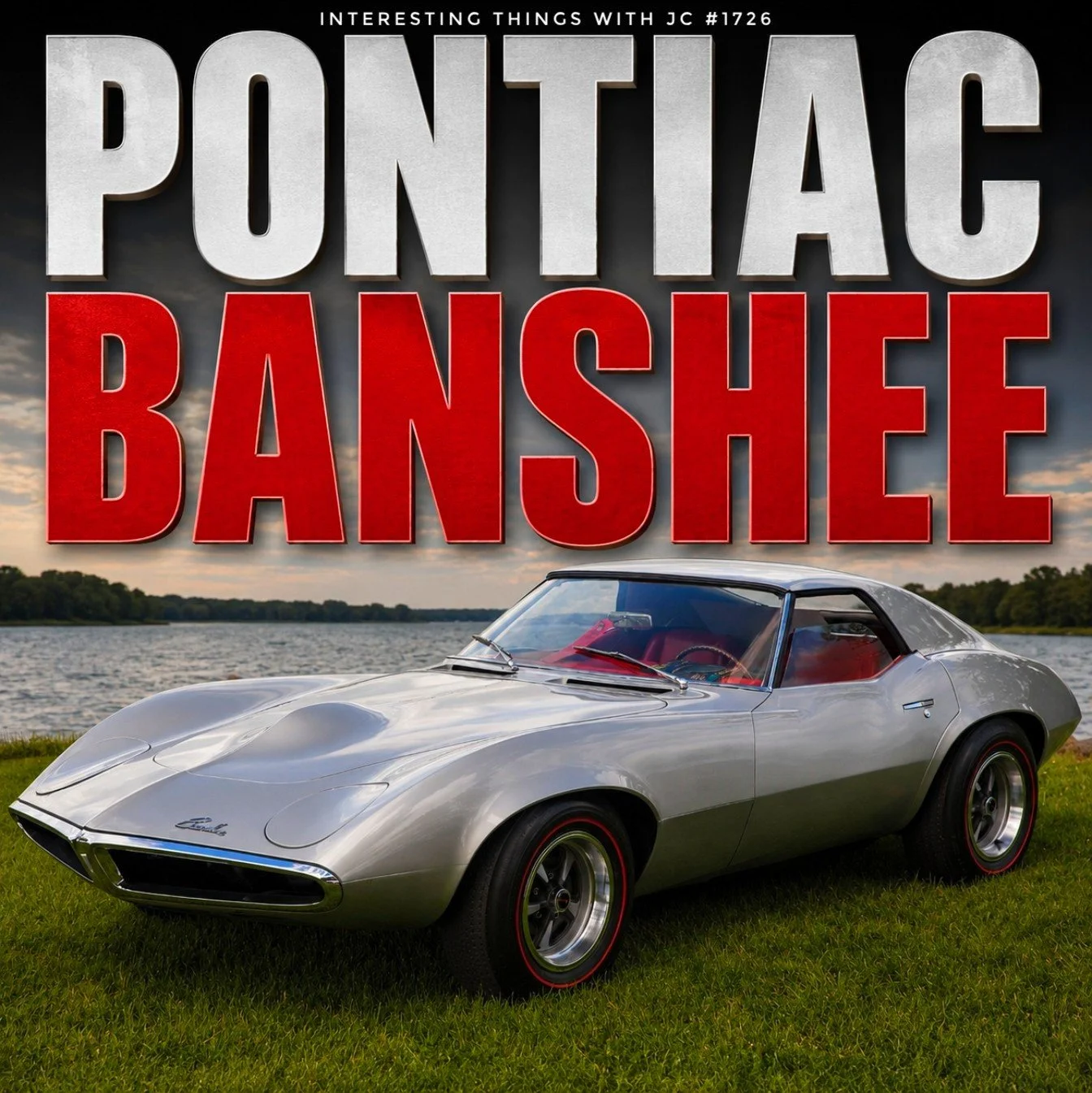
Promotional image for Interesting Things with JC #1726: “The Pontiac Banshee.” Large metallic silver and red text reads “PONTIAC BANSHEE” above a sleek silver concept sports car with red interior, parked on grass beside a lake under a cloudy sky.
Transcript
Interesting Things with JC #1726
Pontiac Banshee
In 1964, Pontiac built a sports car that many people inside the company believed deserved to go into production. It never did. Instead, over the next twenty-four years, Pontiac kept returning to the same idea, building a series of concept cars that never reached a showroom but influenced some of General Motors' most recognizable performance cars.
The first was known internally as the XP-833. Years later, enthusiasts would come to know it as the first Pontiac Banshee, although that name wasn't used during its original development.
The project was championed by John DeLorean, then one of Pontiac's rising executives. He envisioned a sports car that was lighter, simpler, and less expensive than the Chevrolet Corvette while giving Pontiac a true performance flagship of its own.
Two fully functional prototypes were built. One was a silver coupe powered by Pontiac's new overhead-cam inline-six. The other was a white convertible fitted with a 326-cubic-inch V8, or about 5.3 liters. Weighing roughly 2,200 to 2,300 pounds, about 1,000 kilograms, the XP-833 was approximately five hundred pounds lighter than a contemporary Corvette.
That was precisely the problem.
General Motors already had a two-seat sports car, and it wore a Chevrolet badge. Company executives saw little reason to allow another division to build what might become an internal competitor. In 1965, the project was canceled before production could begin. DeLorean later maintained that the XP-833 threatened the Corvette, although GM's divisional structure and product planning almost certainly contributed to the decision as well.
The car disappeared.
The idea didn't.
Its long hood, short rear deck, flowing fenders, and balanced proportions influenced later General Motors designs. Many of those themes appeared on the 1968 Corvette, while Pontiac drew from the same design language when developing the first-generation Firebird.
Rather than abandoning the concept, Pontiac continued exploring it.
In 1966, the company unveiled the XP-798, better known as the Banshee II. Unlike the original two-seater, this was a four-passenger grand touring concept. It featured an innovative roof and door arrangement designed to improve access to the rear seats while exploring a different vision of what a Pontiac performance car could become.
Two years later, Pontiac introduced another Banshee II, this time based on Firebird architecture. It wore sleek fiberglass bodywork wrapped around production underpinnings, allowing Pontiac designers to experiment with new proportions and aerodynamic styling without creating an entirely new platform.
The idea evolved again in 1974 with the Banshee III. Also based on the Firebird, it featured a dramatic aerodynamic body with a long sloping nose, flush glass, concealed headlights, and a hatchback design. Beneath the body sat Pontiac's legendary 455 Super Duty V8. While it remained a concept, many of its styling ideas continued to influence Pontiac's production cars throughout the 1970s and 1980s.
Then the name disappeared for fourteen years.
When it returned in 1988, the Banshee IV looked as though it belonged to another generation entirely.
Its smooth body replaced the sharp edges common during the decade. A sweeping glass canopy blended into the roof, concealed headlights kept the nose clean, and an advanced interior featured electronic controls and an early heads-up display that projected driving information into the driver's line of sight.
Power came from an experimental 4.0-liter overhead-cam V8 producing approximately 230 horsepower. Like every Banshee before it, the car was never intended for production in its existing form.
Its influence, however, was unmistakable.
When Pontiac introduced the fourth-generation Firebird and Trans Am for 1993, many observers immediately recognized the Banshee IV's pointed nose, sweeping profile, and overall proportions. The concept also made a brief appearance among the futuristic vehicles in Back to the Future Part II, while its styling inspired the Knight Industries 4000 built for Knight Rider 2000.
Across twenty-four years, Pontiac built a family of concept cars connected by one name and one idea. None reached a dealership. None entered mass production.
Yet pieces of every generation found their way into the cars that followed.
The Pontiac Banshee never became the sports car John DeLorean first imagined in 1964. Instead, it became something far less common: a concept that spent decades shaping the future of American performance cars without ever becoming part of the present.
These are interesting things, with JC.
Student Worksheet
Lesson Title: The Pontiac Banshee
Student Name: _________________________
Date: _________________________
Directions: Listen to the podcast episode first. If audio is unavailable, read the transcript carefully. Answer using complete sentences and evidence from the episode.
Part I — Comprehension
What was the original internal designation of the first Pontiac Banshee?
Who championed the XP-833 project?
Why did General Motors ultimately cancel the project?
Approximately how much lighter was the XP-833 than the contemporary Corvette?
Which Pontiac production car eventually reflected many of the Banshee's design ideas?
What engine powered the Banshee III?
What advanced driver technology appeared in the Banshee IV?
How many years passed between the original XP-833 and the Banshee IV?
Part II — Analysis
Answer in one well-developed paragraph.
Why might a company continue building concept cars even if they never plan to manufacture them?
Explain how the Banshee demonstrates that innovation can influence the future without becoming a commercial product.
Compare engineering goals with business goals. Were they aligned during the XP-833 project? Explain.
Part III — Design Investigation
Imagine you are Pontiac's chief designer in 1965.
Write a proposal explaining whether you would:
Produce the XP-833 exactly as designed
Modify it before production
Cancel it and explain why
Support your decision using evidence from the episode.
Minimum: 200 words
Part IV — Reflection
Modern companies often develop products that never reach consumers.
Describe another example you know (technology, transportation, medicine, aerospace, or another field). What value can unfinished ideas still provide?
Minimum: 150 words
Challenge Activity (Advanced)
Research another famous concept vehicle.
Compare it with the Pontiac Banshee.
Include:
Purpose
Engineering innovations
Why it was or was not produced
Lasting influence
Create either:
a one-page report,
a presentation,
or a comparison chart.
Difficulty Scaling
Developing Learners
Complete Parts I and IV.
Proficient Learners
Complete Parts I–IV.
Advanced Learners
Complete every section plus the Challenge Activity.
Student Output Expectations
Students should demonstrate:
Evidence-based reasoning
Historical understanding
Engineering analysis
Clear written communication
Proper use of vocabulary
Academic Integrity
Use your own words.
Support answers with evidence from the podcast.
Properly cite any outside research.
AI tools may assist with proofreading but should not replace original thinking.
Teacher Guide
Quick Start
Begin class with the podcast.
Students take notes while listening.
Conduct a brief class discussion.
Complete the worksheet.
Finish with the assessment and exit ticket.
Total: Approximately 60 minutes
Bell Ringer
Display:
"Why do companies spend millions of dollars developing products that may never be sold?"
Students write for three minutes before discussion.
Audio Guidance
Ask students to listen specifically for:
Engineering decisions
Business decisions
Design evolution
Historical timeline
Cause-and-effect relationships
Encourage students to pause and record major milestones.
Audio Fallback
If audio cannot be played:
Read the transcript aloud.
Assign paired reading.
Highlight vocabulary before beginning.
Learning objectives remain unchanged.
Time on Task
Listening: 15%
Discussion: 20%
Reading: 15%
Writing: 35%
Reflection: 15%
Materials
Podcast audio
Transcript
Student worksheet
Whiteboard
Timeline handout (optional)
Images of the Banshee generations (optional)
Vocabulary Strategy
Introduce vocabulary before listening.
After the podcast:
Match vocabulary to examples.
Discuss why each engineering term mattered.
Reinforce pronunciation.
Common Misconceptions
Misconception: Concept cars are failures.
Correction:
Concept vehicles frequently test technology and styling that later appears on production models.
Misconception: Every prototype is intended for production.
Correction:
Many prototypes exist only to evaluate engineering possibilities.
Misconception: Better engineering always wins.
Correction:
Business planning, manufacturing costs, market strategy, and internal competition often influence final decisions.
Discussion Prompts
Why might General Motors have viewed the XP-833 as a threat?
Should divisions within the same company compete with one another?
Was cancelling the Banshee the correct business decision?
Which Banshee generation introduced the most influential innovations?
Can an unsuccessful product still be historically important?
Formative Checkpoints
During instruction, verify students can:
Explain why the XP-833 was canceled.
Describe how concept cars differ from production vehicles.
Connect one Banshee generation to a later production vehicle.
Support claims using evidence.
Differentiation
For emerging learners:
Provide guided notes.
Pair with peer mentors.
Allow verbal responses.
For advanced learners:
Compare Pontiac with Ford, Chrysler, or European concept programs.
Research John DeLorean's later career.
Investigate modern automotive concept development.
Assessment Differentiation
Students may demonstrate learning through:
Essay
Oral presentation
Digital timeline
Infographic
Engineering sketch
Video explanation
Time Flexibility
45-minute class
Podcast
Discussion
Comprehension questions
60-minute class
Standard lesson
90-minute class
Add research activity and design comparison.
Substitute Readiness
This lesson requires no specialized automotive knowledge.
Provide:
Transcript
Worksheet
Discussion questions
Students can complete independently.
Engagement Strategy
Conduct a classroom vote:
"If you were GM's CEO in 1965, would you approve production?"
Students defend their decision using historical evidence.
Extensions
Students research:
Corvette development
Firebird history
Automotive aerodynamics
John DeLorean
Modern electric vehicle concept cars
Cross-Curricular Connections
History
Industrial competition during the 1960s.
Engineering
Prototype development.
Business
Product planning and market positioning.
Art
Automotive styling and industrial design.
Physics
Weight reduction and aerodynamics.
SEL Connection
Students examine:
Decision-making under uncertainty
Innovation versus risk
Collaboration among engineers, designers, and executives
Accepting setbacks while continuing to innovate
Skill Value Emphasis
Students strengthen:
Critical thinking
Evidence evaluation
Engineering literacy
Technical reading
Historical reasoning
Business analysis
Written communication
Decision-making
Problem solving
Answer Key
Comprehension
XP-833
John DeLorean
GM believed it could compete internally with the Chevrolet Corvette, and corporate product planning favored protecting the Corvette.
Approximately 500 pounds lighter.
Pontiac Firebird (especially later generations) and numerous GM performance vehicles.
Pontiac 455 Super Duty V8.
An early heads-up display (HUD).
Twenty-four years (1964–1988).
Analysis (Sample Responses)
Students should explain that concept cars:
test technology,
explore styling,
evaluate engineering ideas,
influence future production vehicles,
reduce long-term development risk.
Strong responses include evidence from multiple Banshee generations.
Reflection
Accept thoughtful, evidence-supported answers connecting innovation to broader technological development.
Examples may include:
NASA prototypes
Electric vehicle concepts
Consumer electronics
Aviation projects
Medical technologies
Quiz
Directions: Select the best answer for each question. Do not reveal the answers until after students complete the quiz.
What was the internal project designation of the first Pontiac Banshee?
A. XP-798
B. XP-833
C. XP-455
D. XP-326
Why was the original XP-833 canceled before production?
A. It failed safety testing.
B. It was too expensive to manufacture.
C. GM believed it could compete with the Chevrolet Corvette.
D. Pontiac decided to leave the sports car market.
Which feature was introduced on the 1988 Banshee IV?
A. Pop-up rear spoiler
B. Hybrid powertrain
C. Heads-up display
D. Four-wheel steering
Which statement best describes the Pontiac Banshee program?
A. Every generation entered full production.
B. Only the first generation reached dealerships.
C. The concepts influenced later production vehicles despite never being sold.
D. The project ended after the first prototype.
Which production Pontiac most clearly reflected styling ideas from the later Banshee concepts?
A. GTO
B. Bonneville
C. Grand Prix
D. Firebird / Trans Am
Assessment
Performance Assessment
Students will demonstrate understanding of the relationship between engineering innovation, corporate decision-making, and automotive design by applying evidence from the podcast.
Open-Ended Question 1
Explain why General Motors canceled the XP-833. Was the decision based primarily on engineering, business strategy, or both? Support your answer with evidence from the episode.
Open-Ended Question 2
The Pontiac Banshee never entered production, yet historians often describe it as influential.
Explain why this statement is accurate using examples from multiple generations of the Banshee.
3–2–1 Reflection
Students complete the following:
3 things I learned about automotive innovation.
2 reasons concept cars are important even when they are never sold.
1 question I still have about the Pontiac Banshee or automotive design.
Exit Ticket
Before leaving class, answer in one or two sentences:
What is one lesson modern engineers or business leaders can learn from the history of the Pontiac Banshee?
Standards Alignment
Lesson Alignment Summary: This lesson integrates engineering, automotive history, business decision-making, industrial design, historical inquiry, and technical communication. Students analyze how technological innovation, corporate strategy, and design evolution influenced the American automotive industry.
NGSS – Science & Engineering Practices
SEP 6 – Constructing Explanations and Designing Solutions
Standard: Develop evidence-based explanations for engineering decisions.
Lesson Connection: Students explain why the XP-833 was canceled despite its engineering advantages.
Student Outcome: Construct a logical explanation using evidence from the podcast and transcript.
Justification: Demonstrates that engineering success must be balanced with manufacturing and business realities.
SEP 7 – Engaging in Argument from Evidence
Standard: Evaluate competing engineering solutions using evidence.
Lesson Connection: Students debate whether GM should have approved production of the XP-833.
Student Outcome: Support claims with historical facts and engineering evidence.
Justification: Reinforces analytical thinking and evidence-based decision making.
Common Core State Standards – Reading
CCSS.ELA-LITERACY.RI.11-12.1
Standard: Cite strong textual evidence.
Lesson Connection: Students reference details from the podcast transcript.
Student Outcome: Support historical conclusions with specific evidence.
Justification: Develops close reading and source analysis skills.
CCSS.ELA-LITERACY.RI.11-12.3
Standard: Analyze complex interactions among ideas and events.
Lesson Connection: Students examine engineering, business, and design decisions within General Motors.
Student Outcome: Explain relationships between technological innovation and corporate strategy.
Justification: Strengthens historical reasoning and systems thinking.
Common Core State Standards – Writing
CCSS.ELA-LITERACY.W.11-12.2
Standard: Write informative and explanatory texts.
Lesson Connection: Students complete analytical written responses and design proposals.
Student Outcome: Produce organized, evidence-based writing.
Justification: Builds technical and historical writing skills.
Common Core State Standards – Speaking & Listening
CCSS.ELA-LITERACY.SL.11-12.1
Standard: Participate effectively in collaborative discussions.
Lesson Connection: Students defend whether GM made the correct business decision.
Student Outcome: Present evidence-supported arguments during classroom discussion.
Justification: Strengthens communication and collaborative reasoning.
C3 Framework for Social Studies
D2.His.1.9-12
Standard: Evaluate historical change and continuity.
Lesson Connection: Students trace the evolution of the Pontiac Banshee from 1964 through 1988.
Student Outcome: Explain how design concepts influenced later production vehicles.
Justification: Encourages historical analysis across multiple decades.
D3.1.9-12
Standard: Gather and evaluate evidence from sources.
Lesson Connection: Students combine information from the podcast with independent research.
Student Outcome: Distinguish between primary historical evidence and secondary interpretations.
Justification: Reinforces historical inquiry and source evaluation.
ISTE Standards
ISTE 1.3 – Knowledge Constructor
Standard: Evaluate and curate information from digital resources.
Lesson Connection: Students research additional concept vehicles.
Student Outcome: Produce an evidence-based comparison of automotive innovations.
Justification: Promotes responsible digital research.
ISTE 1.6 – Creative Communicator
Standard: Communicate complex ideas using appropriate media.
Lesson Connection: Students present findings through reports, presentations, or infographics.
Student Outcome: Clearly communicate technical information.
Justification: Develops professional communication skills.
Career Readiness Competencies
Analytical Thinking
Compare engineering achievements with business priorities.
Evaluate competing design solutions using evidence.
Communication
Present technical information clearly in written and verbal formats.
Support conclusions using historical evidence.
Problem Solving
Recommend engineering or business solutions based on multiple constraints.
Analyze trade-offs between innovation and market realities.
Adaptability
Explain how automotive designs evolved over multiple decades.
Recognize iterative improvement as a core engineering practice.
Professional Judgment
Assess how executives balanced engineering, competition, cost, and market strategy.
Demonstrate responsible decision-making using historical examples.
Homeschool / Lifelong Learning Alignment
Students will:
Develop independent research skills.
Strengthen information literacy through evaluation of credible historical sources.
Connect historical innovation to modern automotive engineering.
Practice self-directed inquiry through optional extension activities.
Apply transferable skills including critical thinking, communication, evidence evaluation, and informed decision-making.
Show Notes
The Pontiac Banshee demonstrates that some of history's most influential vehicles never reach production. Through engineering innovation, industrial design, and corporate decision-making, students discover how concept cars serve as laboratories for future technology and styling. This lesson encourages learners to think critically about the relationship between creativity, business strategy, and technological progress while illustrating that even projects considered "failures" can leave a lasting impact on an entire industry.
References
General Motors Heritage Center. (n.d.). GM Heritage Collection.
https://gmheritagecenter.com/MotorTrend. (2013). 1965 Pontiac Banshee: The Story of XP-833.
https://www.motortrend.com/features/12q1-1965-pontiac-banshee-xp-833/ Pontiac-Oakland Club International (POCI). (n.d.). The Story of the Pontiac Banshee.
https://www.poci.org/vehicle-stories/the-story-of-the-pontiac-banshee MotorCities National Heritage Area. (2024). Remembering the 1964 Pontiac Banshee XP-833 Concept Design.
https://www.motorcities.org/story-of-the-week/2024/remembering-the-1964-pontiac-banshee-xp-833-concept-design DeLorean, J. Z., & Zinn, P. (1985). On a Clear Day You Can See General Motors.
https://archive.org/details/oncleardayyoucan00delo