1722: "Does Hair Grow Back Thicker if You Shave It?"
Interesting Things with JC #1722: "Does Hair Grow Back Thicker if You Shave It?"
Freshly shaved hair feels thicker because the razor leaves every strand with a blunt end instead of its natural tapered tip, creating the same illusion that has kept this myth alive for generations.
Curriculum - Episode Anchor
Episode Title: Does Hair Grow Back Thicker if You Shave It?
Episode Number: 1722
Host: JC
Audience: Grades 9–12, Introductory College, Homeschool, Lifelong Learners
Subject Area: Biology, Human Anatomy and Physiology, Scientific Inquiry
Lesson Overview
Objectives:
Explain how hair grows from follicles and distinguish between living and non-living parts of a hair.
Describe why shaved hair appears thicker even though shaving does not change hair growth.
Evaluate how scientific experiments can test common myths using evidence.
Apply biological concepts to distinguish observation from scientific fact.
Essential Question:
Why does shaved hair seem thicker if shaving does not actually change the hair follicle?
Success Criteria:
Students can explain the structure of a hair shaft and follicle.
Students can identify why blunt hair ends feel different from tapered ends.
Students can summarize the findings of historical scientific studies on shaving and hair growth.
Students can distinguish between perception and measurable biological change.
Student Relevance:
Many people hear or repeat the claim that shaving makes hair grow back thicker. Understanding why this myth persists helps students become more informed consumers of health information and demonstrates the importance of scientific evidence over anecdotal experience.
Real-World Connection:
Medical professionals, dermatologists, cosmetologists, barbers, and researchers rely on evidence-based knowledge of hair biology when advising patients and clients. This lesson demonstrates how science can answer everyday questions through controlled experimentation.
Workforce Reality:
Professionals in healthcare, dermatology, biomedical research, and cosmetology must separate long-standing beliefs from scientifically verified evidence. Critical thinking and evidence evaluation are essential workplace skills.
Key Vocabulary
Follicle(FAHL-ih-kuhl) – A structure beneath the skin where hair grows from living cells.
Hair Shaft(shaft) – The visible portion of the hair above the skin made of dead keratinized cells.
Keratin(KAIR-uh-tin) – A strong structural protein that makes up hair, nails, and the outer layer of skin.
Taper(TAY-per) – A gradual narrowing toward the natural tip of a hair.
Blunt End(blunt end) – The flat edge created when a hair is cut by a razor.
Coarseness(KORSS-ness) – The perceived thickness or roughness of a hair.
Diameter(dy-AM-uh-ter) – The measured width of a strand of hair.
Scientific Control(sy-en-TIF-ik kuhn-TROHL) – A comparison used in experiments to isolate the effect of one variable.
Perception(per-SEP-shun) – How something appears or feels, which may differ from measurable reality.
Hypothesis(hy-POTH-uh-sis) – A testable explanation or prediction investigated through scientific study.
Narrative Core
Open
Have you ever been told that shaving makes your hair grow back thicker? It's one of the most common pieces of advice people hear growing up, yet almost everyone who repeats it is mistaken. So why has this myth survived for generations?
Info
Hair feels different after shaving because the razor changes the shape of the hair that already exists—not the hair that grows next. A naturally grown hair tapers to a fine point, making it feel soft and appear thinner. Shaving slices through the shaft, leaving behind a flat, blunt end that feels rougher as it emerges from the skin.
Details
Hair growth begins beneath the skin inside follicles, where living cells divide and produce new hair. The razor never reaches these follicles. Since it only removes the dead hair shaft above the skin's surface, shaving cannot change the follicle's genetics or biological activity. Researchers began testing this belief nearly a century ago. Controlled studies, including one in 1928 and another in 1970, consistently demonstrated that shaving does not increase hair growth rate, thickness, weight, or coarseness. Modern research continues to support these findings. Newly growing hair may appear darker because it has not yet been lightened by sunlight, and the wider base of the hair is more visible than its naturally tapered tip.
Reflection
This myth illustrates an important lesson in science: our senses can sometimes mislead us. What feels true is not always biologically true. Careful experimentation allows scientists to distinguish perception from measurable fact.
Closing
A razor changes only the shape of the hair you cut. It never changes the follicle growing the next one.
These are interesting things, with JC.
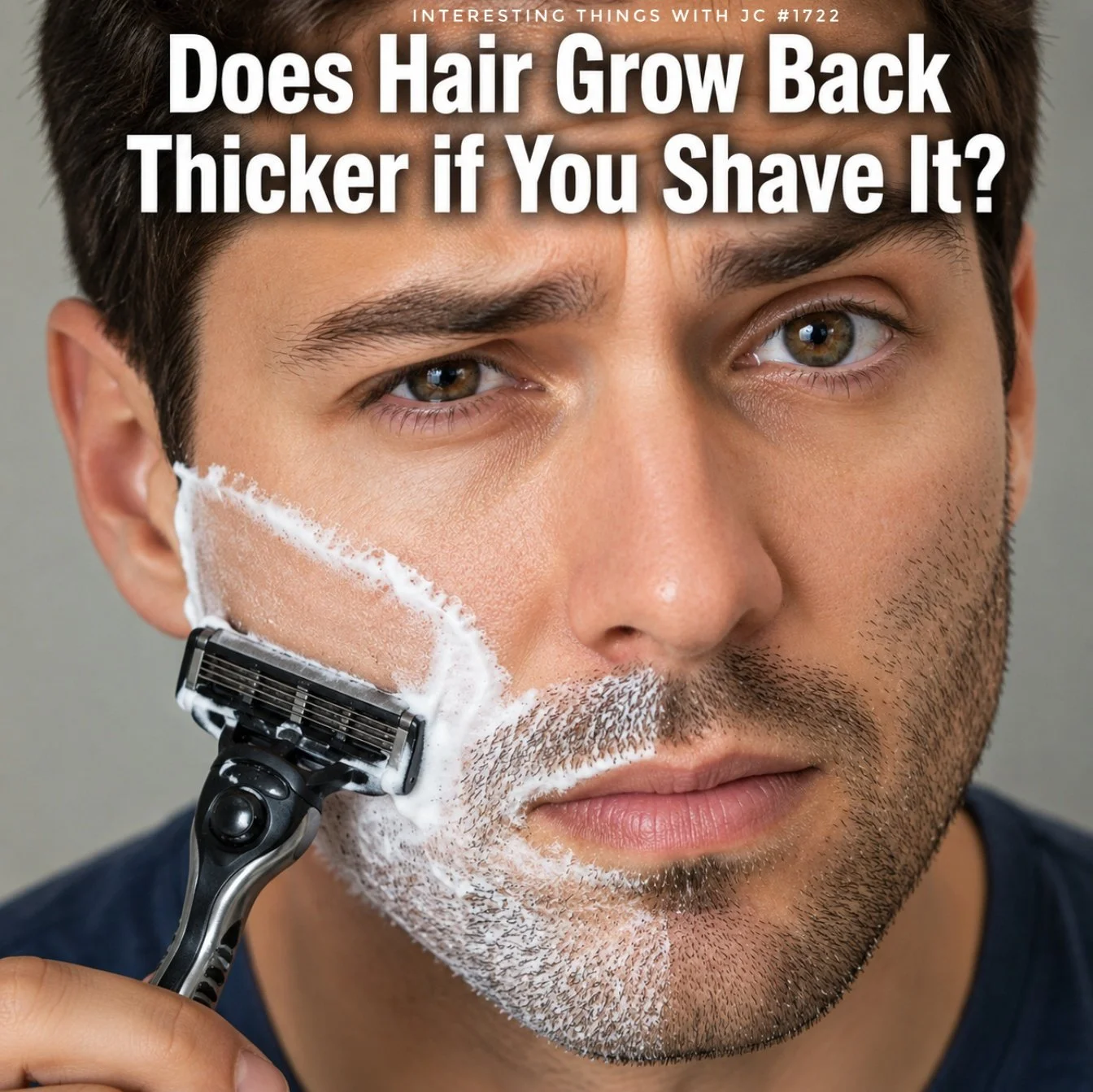
Close-up of a person shaving one side of their face while the other side shows short beard stubble. Large text at the top reads, "Does Hair Grow Back Thicker if You Shave It?" with the series label "Interesting Things with JC #1722." The image illustrates the common myth that shaving changes hair growth.
Transcript
Interesting Things with JC #1722:
"Does Hair Grow Back Thicker if You Shave It?"
Fresh stubble feels thicker than the hair you just shaved off. That's the reason this myth has survived for generations.
It isn't because the hair changed. It's because the end of the hair did.
A strand of hair naturally tapers to a fine point. That narrow tip feels soft against your skin and makes the hair look finer. When you shave, the razor slices through the shaft, leaving a blunt, flat end. As the hair grows back, that cut end feels stiffer and looks wider than the original tip, even though it's the same strand.
That's also why a freshly shaved beard feels scratchy. You're touching hundreds of tiny blunt ends instead of naturally tapered hairs.
The razor never reaches the part of the hair that's alive. Hair grows from follicles beneath the skin, where living cells determine its thickness, color, texture, and rate of growth. Shaving only cuts the dead shaft above the surface, so it has no way to change the next hair the follicle produces.
The belief was already widespread by the early 1900s, so in 1928 researchers decided to test it instead of simply repeating it. Their work showed that shaving did not make hair grow faster. In 1970, another controlled study compared shaved and unshaved legs and found no differences in hair growth rate, diameter, weight, or coarseness. Decades of research since then have reached the same conclusion.
The illusion gets another boost because newly grown hair has not spent weeks or months exposed to sunlight, so it can appear slightly darker. The thicker base of the hair shaft is also more visible after shaving than the naturally tapered tip. If hair truly becomes thicker or coarser, the cause is usually hormones, genetics, aging, certain medications, or medical conditions that affect the follicle itself, not the razor.
Every hair that grows after you shave comes from the same follicle that produced the one before it. A razor changes the shape of the hair you cut. It never changes the follicle growing the next one.
These are interesting things, with JC.
Student Worksheet
Instructions: Listen to the podcast episode first. If audio is unavailable, read the transcript carefully. Complete all sections using evidence from the episode. Answer in complete sentences unless otherwise instructed.
Part A – Comprehension
Why do freshly shaved hairs feel thicker than unshaved hairs?
What is the difference between a naturally tapered hair tip and a shaved hair tip?
Where does hair actually grow from?
Why can't shaving change the thickness of future hair growth?
What did scientific studies conducted in 1928 and 1970 conclude about shaving?
Part B – Analysis
Explain why the myth that shaving makes hair grow back thicker has lasted for generations.
Identify two observations people commonly make after shaving and explain the biological reason behind each observation.
How does this episode demonstrate the importance of controlled scientific experiments?
Part C – Reflection
Describe a belief or myth you have heard that could be tested scientifically.
Why is it important to distinguish between personal experience and scientific evidence?
Difficulty Scaling
Level 1
Define "hair follicle."
Explain why shaved hair feels rough.
Level 2
Describe the relationship between the hair shaft and the follicle.
Summarize one scientific study mentioned in the episode.
Level 3
Explain how perception can differ from measurable biological reality.
Discuss why evidence-based thinking is important in medicine and everyday life.
Student Output Expectations
Complete sentences.
Support answers with evidence from the episode.
Use at least three vocabulary terms correctly.
Academic Integrity Guidance
Complete your own work.
Support answers using information from the podcast or transcript.
Distinguish clearly between evidence and personal opinion.
Teacher Guide
Quick Start
Begin class by asking students whether they have ever heard that shaving makes hair grow back thicker. Conduct an informal show of hands before revealing that scientists have tested this belief for nearly a century.
Pacing Guide (Audio-First)
Bell Ringer: 5 minutes
Podcast Listening: 5 minutes
Vocabulary Review: 5 minutes
Guided Discussion: 10 minutes
Student Worksheet: 20 minutes
Quiz: 10 minutes
Assessment/Exit Ticket: 10 minutes
Bell Ringer
Write on the board:
"Does shaving change the biology of your hair?"
Students write a brief prediction and explain why they think their answer is correct.
Audio Guidance
Students should listen once without taking notes.
During the second listening (or transcript review), students should identify:
Claims
Evidence
Scientific explanations
Audio Fallback
If audio is unavailable, students read the transcript aloud in small groups before beginning activities.
Time on Task
Approximately 60–70 minutes.
Materials
Podcast audio
Transcript
Student Worksheet
Quiz
Writing utensils or digital devices
Vocabulary Strategy
Introduce vocabulary before listening. Encourage students to identify each term as it appears during the episode.
Common Misconceptions
Hair grows from the visible shaft.
Hair is alive above the skin.
Razors affect hair follicles.
Scratchy hair is thicker hair.
Personal experience is always reliable scientific evidence.
Discussion Prompts
Why can our senses sometimes mislead us?
What makes a scientific experiment more trustworthy than anecdotal evidence?
Why is repetition important in scientific research?
How can myths continue even after scientific evidence disproves them?
Formative Checkpoints
Students correctly identify where hair grows.
Students explain the difference between the hair shaft and follicle.
Students distinguish observation from scientific measurement.
Differentiation
Support
Provide vocabulary cards.
Allow partner discussions.
Use guided note sheets.
Extension
Research another common biology myth and evaluate the available scientific evidence.
Compare myths that originated before controlled scientific testing became common.
Assessment Differentiation
Students may respond through:
Written responses
Oral presentation
Graphic organizer
Short video explanation
Time Flexibility
30-minute version:
Podcast
Discussion
Quiz
Exit Ticket
90-minute version:
Add research activity
Group presentations
Scientific literacy discussion
Substitute Readiness
This lesson is fully self-contained. The transcript provides all required instructional content if audio cannot be played.
Engagement Strategy
Conduct a class poll before and after the lesson to compare how student understanding changes after reviewing scientific evidence.
Cross-Curricular Connections
Biology
Human Anatomy
Health Science
Scientific Research
Critical Thinking
Media Literacy
SEL Connection
Students practice intellectual humility by recognizing that changing one's mind based on evidence is a strength rather than a weakness.
Skill Emphasis
Scientific reasoning
Evidence evaluation
Critical thinking
Reading informational text
Scientific communication
Answer Key
Worksheet
Part A
The blunt end feels thicker.
Natural hairs taper to fine points; shaved hairs have flat ends.
Hair follicles beneath the skin.
Razors never affect the living follicle.
Shaving does not increase growth rate, thickness, weight, or coarseness.
Part B
(Expected responses should reference perception versus biology, experimental evidence, and controlled studies.)
Reflection
(Answers will vary but should distinguish evidence from opinion.)
Quiz
Multiple Choice
Why does shaved hair often feel rougher?
A. It becomes thicker.
B. It grows faster.
C. It has a blunt cut end.
D. It contains more keratin.
Where is the living portion of hair located?
A. Hair shaft
B. Hair tip
C. Follicle beneath the skin
D. Surface of the scalp
Which factor actually determines hair thickness?
A. Razor sharpness
B. Shampoo
C. Hair follicle biology
D. Frequency of shaving
Why might newly grown hair appear darker?
A. It contains more pigment after shaving.
B. It has not yet been lightened by sunlight.
C. It absorbs more moisture.
D. It grows more slowly.
What did controlled scientific studies conclude?
A. Hair doubles in thickness.
B. Hair grows twice as fast.
C. Shaving changes follicle genetics.
D. Shaving does not change hair growth characteristics.
(Answers intentionally omitted.)
Assessment
Open-Ended Questions
Using evidence from the lesson, explain why shaving cannot change the biological properties of future hair growth.
Explain how scientific experiments helped correct a belief that persisted for generations.
3–2–1 Rubric
3 – Proficient
Uses accurate scientific vocabulary.
Supports conclusions with evidence.
Demonstrates clear understanding.
2 – Developing
Mostly accurate explanation.
Some supporting evidence.
Minor misconceptions.
1 – Beginning
Limited understanding.
Minimal evidence.
Significant misconceptions remain.
Exit Ticket
In one or two sentences:
What is one scientific fact you learned today that changed or confirmed your thinking?
Standards Alignment
NGSS Science & Engineering Practices
Standard: SEP 4 – Analyzing and Interpreting Data
Connection: Students evaluate evidence from historical and modern scientific studies investigating the effects of shaving on hair growth.
Measurable Skill: Interpret scientific findings and compare conclusions from multiple investigations.
Justification: Students distinguish measurable biological evidence from commonly held beliefs.
Standard: SEP 6 – Constructing Explanations and Designing Solutions
Connection: Students explain why shaving cannot alter the biology of hair follicles.
Measurable Skill: Develop evidence-based scientific explanations using anatomical knowledge.
Justification: Reinforces the relationship between biological structure and function.
CCSS Reading
CCSS.ELA-LITERACY.RST.11-12.2 – Determine Central Ideas
Connection: Students identify the main scientific explanation presented in the podcast.
Measurable Skill: Summarize complex informational text while distinguishing supporting evidence from examples.
Justification: Strengthens comprehension of scientific communication.
CCSS.ELA-LITERACY.RST.9-10.4 – Vocabulary Acquisition
Connection: Students interpret domain-specific scientific terminology.
Measurable Skill: Correctly define and apply biology vocabulary in written responses.
Justification: Builds scientific literacy.
CCSS Writing
CCSS.ELA-LITERACY.WHST.9-10.2 – Informative Writing
Connection: Students explain biological concepts using evidence from the episode.
Measurable Skill: Produce organized, evidence-based scientific explanations.
Justification: Develops scientific writing skills.
CCSS Speaking & Listening
CCSS.ELA-LITERACY.SL.9-10.1 – Collaborative Discussion
Connection: Students discuss why scientific evidence is more reliable than anecdotal observations.
Measurable Skill: Participate respectfully while supporting ideas with evidence.
Justification: Encourages scientific discourse and critical listening.
C3 Framework
Dimension 3: Evaluating Sources and Using Evidence
Connection: Students compare personal observations with controlled experimental research.
Measurable Skill: Evaluate evidence before reaching conclusions.
Justification: Reinforces inquiry-based learning.
ISTE Standards for Students
ISTE 1.3 – Knowledge Constructor
Connection: Students gather information from the podcast and transcript to answer questions using credible evidence.
Measurable Skill: Evaluate information sources and synthesize factual conclusions.
Justification: Promotes responsible use of scientific information.
Career Readiness Competencies
Analytical Thinking
Evaluate claims using measurable evidence rather than assumptions.
Communication
Explain biological concepts using accurate scientific vocabulary.
Problem Solving
Identify the biological mechanism responsible for the appearance of thicker hair after shaving.
Adaptability
Revise previously held beliefs when presented with reliable scientific evidence.
Professional Judgment
Base conclusions on peer-reviewed research rather than anecdotal experience.
Homeschool / Lifelong Learning Alignment
Independent Learning
Investigate additional scientific myths using credible research methods.
Information Literacy
Differentiate between observation, opinion, and scientific evidence.
Real-World Application
Apply scientific reasoning to evaluate everyday health claims.
Self-Directed Inquiry
Develop questions that can be tested through controlled experimentation.
Transferable Life Skills
Use evidence-based reasoning when making health and personal care decisions.
Show Notes
Many people have heard that shaving makes hair grow back thicker, yet scientific research has consistently shown that this belief is a myth. This lesson explores the anatomy of hair, explains why shaved hair feels different, and demonstrates how controlled experiments help scientists separate perception from biological reality. Students strengthen their understanding of human biology while developing critical thinking and scientific literacy skills that apply far beyond this single question.
References
American Academy of Dermatology Association. (n.d.). Shaving myths and facts. https://www.aad.org/public/everyday-care/hair-scalp-care/hair/shaving-facts
Attenello, N., & Mirmirani, P. (2025, September 16). What happens to your hair if you shave, cut or pluck it. The Washington Post. https://www.washingtonpost.com/wellness/2025/09/16/cutting-shaving-plucking-waxing-hair-growth/
Cherney, K. (2019). Does shaving make your hair thicker or faster? Healthline. https://www.healthline.com/health/does-shaving-make-hair-thicker
Cleveland Clinic. (2023). Does shaving make your hair thicker? https://health.clevelandclinic.org/does-shaving-make-hair-thicker
Kwatra, S. G., et al. (2024). Hair Biology. In StatPearls. StatPearls Publishing. https://www.ncbi.nlm.nih.gov/books/NBK513312/
Lynfield, Y. L., & MacWilliams, P. (1970). Shaving and hair growth. Journal of Investigative Dermatology, 55(3), 170–172.
Mayo Clinic. (2024). Hair loss. https://www.mayoclinic.org/diseases-conditions/hair-loss/symptoms-causes/syc-20372926
Mayo Clinic. (2024). Shaving hair: Does shaved hair grow back thicker? https://www.mayoclinic.org/healthy-lifestyle/adult-health/expert-answers/hair-removal/faq-20058427
Scientific American. (2010). Fact or fiction?: If you shave (or wax), your hair will come back thicker. https://www.scientificamerican.com/article/fact-or-fiction-if-you-shave-or-wax-your-hair-will-come-back-thicker/
Trotter, M. (1928). Hair growth and shaving. The Anatomical Record, 37(4), 373–379. https://doi.org/10.1002/ar.1090370405