1741: "The Night Hip-Hop Was Born"
Interesting Things with JC #1741: "The Night Hip-Hop Was Born"
At a Bronx party in 1973, DJ Kool Herc notices that dancers come alive during the short drum breaks, but the breaks end within seconds. He uses two turntables to keep those sections going, giving the dancers more of the part they want as the technique begins moving from party to party.
Curriculum - Episode Anchor
Episode Title: The Night Hip-Hop Was Born
Episode Number: 1741
Host: JC
Audience: Grades 9–12, introductory college, homeschool, lifelong learners
Subject Area: U.S. History, Music History, Cultural History, Media Studies
Curriculum Basis: Structured according to the supplied Interesting Things with JC™ Curriculum Framework System and locked curriculum schema.
Lesson Overview
Learning Objectives: By the end of the lesson, students will be able to:
Explain why the August 11, 1973 party at 1520 Sedgwick Avenue is considered a defining early moment in hip-hop history.
Describe how DJ Kool Herc used breaks, two turntables, and the Merry-Go-Round technique to respond to dancers.
Analyze how individual creativity, audience response, existing musical traditions, and community exchange contributed to hip-hop's development.
Evaluate how recording technology changed hip-hop's ability to move from local gatherings to wider audiences.
Essential Question: How can a practical solution created for one local audience become part of a much larger cultural movement?
Success Criteria: Students can identify at least three historically supported details from the episode, accurately explain the relationship between DJs, MCs, dancers, and audiences, and construct an evidence-based explanation of how innovation spread beyond one Bronx party.
Student Relevance Statement: Music, dance, language, fashion, digital media, and other forms of culture often develop through people adapting existing ideas for new situations. This lesson gives students a concrete case for examining how innovation can begin with observation, experimentation, and audience feedback rather than a formal institution.
Real-World Connection: Herc noticed what dancers responded to, identified a limitation in the available music, and changed his technique to solve it. The same cycle—observe, identify a need, test a response, refine it, and share it—appears in creative work, entrepreneurship, engineering, media production, and other professions.
Workforce Reality: Cultural influence does not eliminate the need for technical competence, preparation, judgment, reliability, or sustained practice. DJs, performers, producers, historians, archivists, curators, and media professionals all depend on disciplined skills as well as creative ideas.
Key Vocabulary
Break(brāk): A section of a recording in which vocals and much of the melody recede and percussion becomes prominent.
Turntable(TURN-tay-buhl): A device for playing records; DJs can use turntables to select, cue, repeat, and transition between recorded passages.
Merry-Go-Round(MAIR-ee-goh-round): DJ Kool Herc's name for an approach that extended desired instrumental breaks by moving between records or copies of records.
DJ(DEE-jay): A disc jockey who selects and manipulates recorded music for an audience.
MC(EM-see): A microphone performer who addresses a crowd and may use rhythmic speech, rhymes, introductions, or callouts over music.
Breaking(BRAY-king): A dance form associated with early hip-hop culture and strongly connected to rhythmic breaks.
Sound system(SOUND SIS-tuhm): Amplification equipment used to play music for a crowd; Jamaican sound-system culture was part of Herc's musical background.
Hip-hop(HIP-hop): A culture that developed through interconnected practices including DJing, MCing, breaking, visual expression, and other creative forms.
Cultural diffusion(KUL-chur-uhl dih-FYOO-zhun): The movement of ideas, practices, or cultural forms from one person, group, or location to another.
Narrative Core
Open: On August 11, 1973, a teenager named Cindy Campbell rented a recreation room in her Bronx apartment building because she wanted to raise money for new school clothes. Her brother Clive Campbell—DJ Kool Herc—handled the music.
Info: Herc had grown up in Kingston, Jamaica, and brought experience with powerful sound-system culture to New York. At neighborhood parties, he noticed that dancers responded especially strongly when songs reached their instrumental breaks.
Details: Because those breaks were short, Herc used two turntables and multiple records to extend them. His Merry-Go-Round approach gave dancers more time while Coke La Rock used the microphone for callouts, short phrases, and rhymes. These practices developed within a wider environment of funk, soul, African American musical and spoken-word traditions, Caribbean influences, breaking, graffiti, and neighborhood creativity.
Reflection: The party demonstrates that cultural change can emerge through observation and adaptation. No one in the room needed to know that the techniques being developed would later have worldwide influence. The immediate goal was simpler: make the party work and give the dancers more of the music they wanted.
Closing: These are interesting things, with JC.
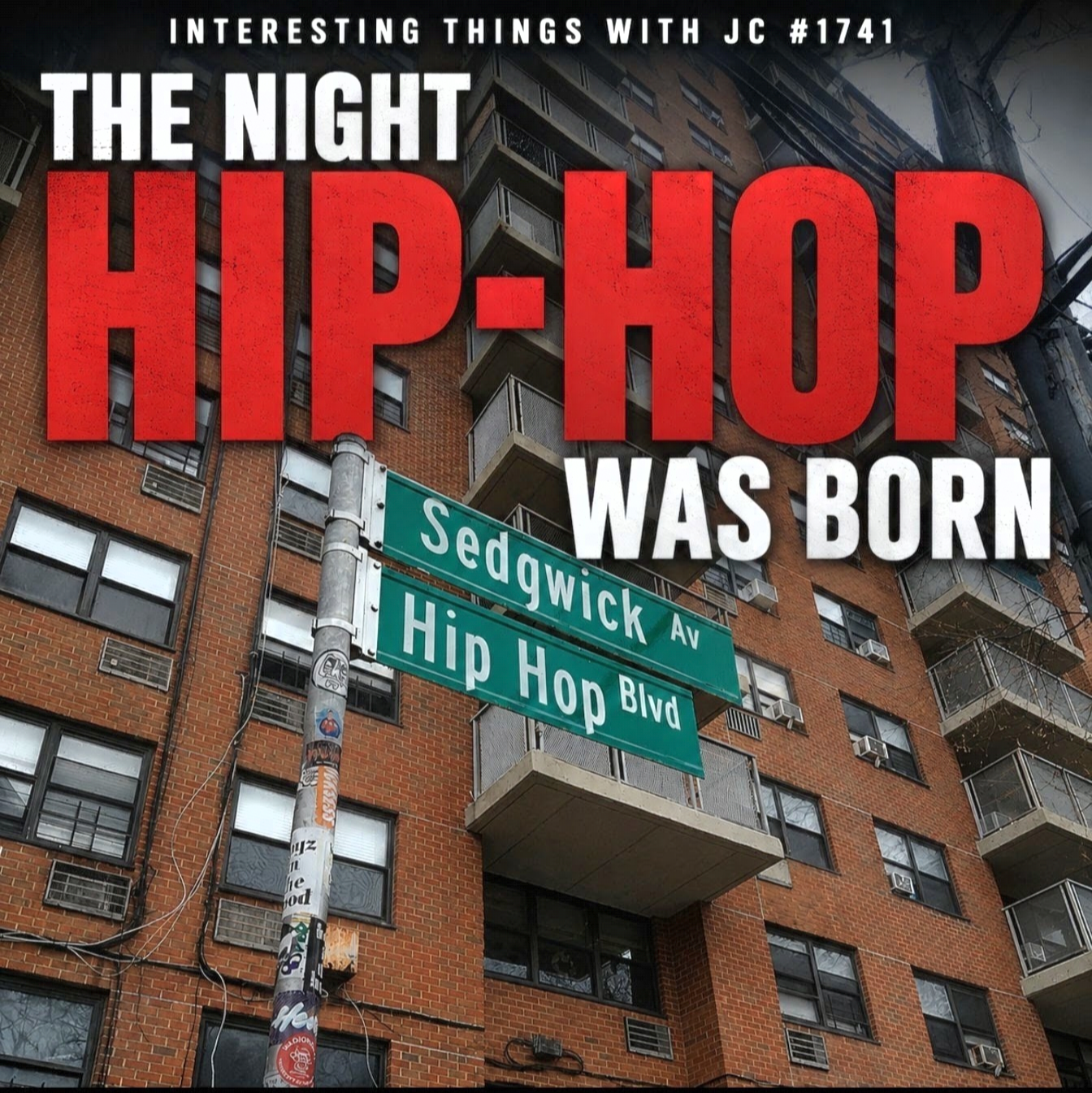
Promotional image for Interesting Things with JC #1741: The Night Hip-Hop Was Born. A red-brick apartment building fills the background. In the foreground, green street signs read “Sedgwick Av” and “Hip Hop Blvd.” Large distressed text across the image reads “THE NIGHT HIP-HOP WAS BORN,” with “HIP-HOP” in oversized red letters and the remaining words in white. Across the top, smaller white text reads “INTERESTING THINGS WITH JC #1741.”
Transcript
Interesting Things with JC #1741:
"The Night Hip-Hop Was Born"
On August 11, 1973, Cindy Campbell rented the recreation room in her apartment building at 1520 Sedgwick Avenue in the Bronx. She wanted money for new clothes before school started, so she threw a party. Admission was 25 cents for the ladies and 50 cents for the fellas, and her older brother Clive handled the music. Around the neighborhood, people knew him as DJ Kool Herc.
Herc was 18. He'd been born in Kingston, Jamaica, where big sound systems were part of the music culture, and he'd brought some of that thinking with him to New York. He had a powerful setup, plenty of funk and soul records, and he'd noticed something happening on the dance floor.
When a record reached the break, where the singing and much of the melody dropped out and the drums took over, that's when some of the dancers really went to work. The problem was that the part they wanted might last only a few seconds.
Using two turntables, Herc found a way to keep it going, moving between records, and sometimes two copies of the same record, to extend the part the dancers wanted. He developed the approach into what he called the Merry-Go-Round. Instead of simply playing a record from beginning to end, he could pull out the part that worked on the dance floor and give the crowd more of it.
The longer breaks gave dancers more room, while Herc's friend Coke La Rock worked the microphone, calling out people in the room and using short phrases and rhymes over the music. Around them were African American musical and spoken-word traditions, funk and soul, Caribbean influences, breaking and graffiti. The party at 1520 Sedgwick Avenue became one of the defining early moments in a culture already taking shape around them.
Herc's parties got bigger and moved into larger spaces and outdoors. Other DJs developed the techniques further, MCs became more important, dancers developed new styles and crews, and much of it spread without the recording industry. You heard it because you were there, because somebody had a tape, or because somebody brought an idea from one party to another.
By 1979, the Sugarhill Gang's "Rapper's Delight" showed what could happen once hip-hop was put on a commercial record. People far beyond New York could hear something that, only a few years earlier, you mostly had to be in the room to experience.
One piece of that room still survives. The Smithsonian's National Museum of African American History and Culture has a disco ball used at parties thrown by Herc and Cindy at Sedgwick Avenue. It's about 14 inches, or 36 centimeters, across, covered with hundreds of little mirrored tiles. It wasn't made to become a museum object. It was just part of the party.
And the people underneath it weren't trying to start a worldwide culture. Cindy was raising money for school clothes. Herc was working his records and watching the dancers. The crowd knew which part of the music they wanted, and Herc had figured out how to give them more of it.
A teenager rented a room. Her brother brought his records and his sound system. People came to dance.
When the break arrived, Herc kept it going.
And people have been building on it ever since.
These are interesting things, with JC.
Student Worksheet
Comprehension: Answer each question in 1–3 complete sentences.
Why did Cindy Campbell organize the August 11, 1973 party?
What role did DJ Kool Herc perform at the party?
What did Herc notice about dancers when records reached their breaks?
How did two turntables help Herc respond to what the dancers wanted?
What was the Merry-Go-Round?
What role did Coke La Rock play?
How did early hip-hop ideas spread before commercial recordings became common?
Why does the transcript mention "Rapper's Delight" in connection with 1979?
Analysis: Support each response with at least two specific details from the transcript.
Explain how audience behavior influenced Herc's technical decisions.
Which mattered more in this episode: invention from nothing or adaptation of existing materials? Defend your answer.
Explain how DJing, MCing, and dancing operated as connected activities rather than isolated practices.
Compare the way hip-hop spread through parties and tapes with the way a commercial recording could spread it.
Why is the surviving disco ball historically useful even though it was originally an ordinary party object?
Reflection: Write 150–250 words explaining what the episode suggests about how important cultural changes can begin. Include one connection to another field, activity, technology, or community you know.
Difficulty Scaling: Level 1 students may answer comprehension questions using direct transcript details. Level 2 students should connect multiple details and explain cause-and-effect relationships. Level 3 students should evaluate competing explanations, distinguish evidence from inference, and develop a defensible interpretation.
Student Output: Submit eight comprehension responses, three teacher-selected analysis responses, and the reflection. Unless instructed otherwise, written analysis responses should be approximately 100–150 words each.
Academic Integrity Guidance: Use the episode, assigned class materials, and your own reasoning. Identify any outside source you consult. Do not present copied, generated, or another person's language as your own work.
Teacher Guide
Quick Start: Begin with the podcast before providing historical explanation. Ask students to listen for one problem, one response, and one consequence. Follow with a brief evidence check before distributing or discussing the worksheet.
Pacing Guide — Audio First:
0–5 minutes: Bell ringer and prediction.
5–12 minutes: Play the podcast episode without interruption.
12–17 minutes: Students independently record three details they remember.
17–27 minutes: Replay selected passages if needed; students verify or correct their notes.
27–42 minutes: Complete comprehension and selected analysis questions.
42–52 minutes: Structured discussion focused on innovation, audience response, and cultural diffusion.
52–60 minutes: Reflection or exit ticket.
Bell Ringer: "Think of a tool, product, song, game, sport, or practice that improved because someone noticed what users wanted. What was changed, and why?" Students write 3–4 sentences before discussion.
Audio Guidance: On the first listen, students should not attempt to transcribe the episode. Direct them to identify the setting, the problem Herc observed, his response, and how the practice spread. On a second listen, students may capture names, dates, and technical vocabulary.
Audio Fallback: If audio is unavailable, the teacher reads the transcript aloud or assigns alternating paragraphs to readers. Preserve the audio-first logic by having students listen without annotating during the initial reading, then review the written transcript afterward.
Time on Task: Standard lesson length is approximately 55–60 minutes. The lesson can expand to 90 minutes by adding source evaluation, a short research component, or extended discussion.
Materials:
Podcast audio or transcript
Student worksheet
Writing materials or digital document
Optional access to Smithsonian or Library of Congress sources for source evaluation
Optional turntable or DJ-technique demonstration approved for classroom use
Vocabulary Strategy: Preteach break, turntable, Merry-Go-Round, DJ, MC, and cultural diffusion. Have students explain each term in relation to the episode rather than memorizing definitions in isolation.
Misconceptions:
Avoid reducing hip-hop's development to a single isolated act by one person; the episode identifies the Sedgwick Avenue party as a defining early moment within a culture already taking shape.
Do not treat a "break" simply as silence; the episode describes it as the portion where singing and much of the melody drop away while the drums become prominent.
Do not assume early hip-hop depended on commercial recordings for circulation; parties, tapes, personal exchange, crews, and local performance were important.
Do not confuse DJ Kool Herc with Coke La Rock; Herc handled the records, while Coke La Rock worked the microphone.
Do not treat museum objects as important only because they were originally expensive or ceremonial. Ordinary objects can gain historical value through association and documentation.
Discussion Prompts:
What exactly was the problem Herc solved for the dancers?
Does extending a break count as creativity even though the records already existed? Why?
How did the audience participate in shaping what happened?
What changed when hip-hop moved from being experienced primarily in local spaces to being distributed on records?
Why should historians preserve ordinary objects connected with everyday events?
What responsibilities come with telling the history of a culture that developed through many people and influences?
Formative Checkpoints:
After the audio, students state the event's date and location.
Students explain the Merry-Go-Round without looking at the vocabulary definition.
Students identify one piece of direct evidence and one inference.
Students produce a cause-and-effect chain: dancer response → Herc's technique → longer breaks → expanded performance possibilities.
Before assessment, students explain why 1979 represents a distribution change rather than the beginning of everything described in the episode.
Differentiation: Provide a transcript with key names highlighted for students who need reading support. Offer a cause-and-effect organizer for developing writers. Allow advanced students to distinguish between a historical "origin point," a "defining early moment," and a longer cultural-development process.
Assessment Differentiation: Students may demonstrate understanding through a written response, structured oral explanation, or teacher-approved audio response, provided each format requires the same historical evidence and reasoning.
Time Flexibility: For a 30-minute lesson, play the episode, use Questions 1–5 from comprehension, conduct one discussion prompt, and complete the exit ticket. For a block period, add source comparison and a short evidence-evaluation activity.
Substitute Readiness: The substitute should play or read the episode first, assign the comprehension questions, then use Discussion Prompts 1, 3, and 4. Students finish with the exit ticket. No specialized music knowledge is required.
Engagement Strategy: Use the "problem–response–impact" lens throughout the lesson. Students identify what the dancers wanted, what constraint existed, what Herc changed, and what consequences followed. This keeps attention on observable actions rather than celebrity or mythology.
Extensions:
Compare an artifact record from the Smithsonian with the episode's description of the disco ball.
Research how another DJ or MC developed early hip-hop practices and construct a sourced comparison.
Map the movement from local party culture to commercial recordings and later national distribution.
Analyze another innovation in which users shaped the development of a product or technique.
Cross-Curricular Connections: U.S. history can examine urban cultural development; music can examine rhythm, breaks, and performance techniques; English can analyze narrative structure and evidence; media studies can examine distribution; business courses can consider audience response, value creation, and dissemination.
SEL: Students practice attentive listening, respectful discussion, perspective taking, and recognition that collaborative cultural environments can involve many contributors rather than a single hero narrative.
Skill Emphasis: Analytical thinking, communication, source evaluation, problem solving, adaptability, historical reasoning, evidence use, and professional judgment.
Answer Key — Student Worksheet:
Cindy Campbell organized the party to raise money for new clothes before school began.
DJ Kool Herc handled the music using his records and sound system.
He noticed that dancers became especially active during instrumental breaks.
Two turntables let him move between records or copies so that he could extend the desired section.
The Merry-Go-Round was Herc's approach to extending breaks rather than playing records only from beginning to end.
Coke La Rock worked the microphone, calling out people and using short phrases and rhymes.
Ideas spread through parties, larger gatherings, outdoor events, tapes, performers, crews, and person-to-person exchange.
"Rapper's Delight" illustrates how a commercially released recording could carry hip-hop to audiences beyond the local spaces where it had developed.
Analysis Guidance: Strong responses should connect audience behavior to technical adaptation, recognize both existing traditions and new uses of technology, explain interaction among DJs/MCs/dancers, distinguish local circulation from mass distribution, and recognize the disco ball as material evidence because of its documented association with Sedgwick Avenue parties.
Quiz Answer Key: 1-C, 2-B, 3-D, 4-A, 5-C.
Quiz
What was Cindy Campbell's immediate purpose for organizing the August 11, 1973 party?
A. To obtain a recording contract
B. To promote a new nightclub
C. To raise money for school clothes
D. To organize a dance competitionWhat observation influenced DJ Kool Herc's approach to playing records?
A. Audiences preferred complete albums without interruption
B. Dancers became especially active during instrumental breaks
C. MCs wanted all percussion removed
D. Dancers preferred quieter sound systemsWhat did Herc's Merry-Go-Round technique allow him to do?
A. Record a live album directly onto vinyl
B. Replace turntables with live drums
C. Remove rhythm from funk records
D. Extend the portions of records dancers responded toAccording to the episode, how did much early hip-hop spread before commercial recording became central?
A. Through parties, tapes, performers, and person-to-person exchange
B. Primarily through national television networks
C. Primarily through major-label radio campaigns
D. Through music conservatoriesWhy is "Rapper's Delight" important to the episode's narrative?
A. It was played at the 1973 Sedgwick Avenue party
B. It invented the two-turntable technique
C. It demonstrated how recorded hip-hop could reach audiences far beyond local parties
D. It was recorded by DJ Kool Herc
Assessment
Open-Ended Questions:
Explain how DJ Kool Herc's approach demonstrates a cycle of observation, problem identification, experimentation, and response. Use at least three specific details from the episode.
The episode presents August 11, 1973 as "one of the defining early moments in a culture already taking shape." Explain why that wording is historically important. Use evidence from the transcript to discuss both individual innovation and the wider cultural environment.
3–2–1 Rubric:
3 — Proficient: Response makes a clear claim, uses multiple accurate details from the episode, explains relationships among evidence, and demonstrates sound historical reasoning.
2 — Developing: Response demonstrates general understanding and uses some accurate evidence but provides limited explanation, incomplete connections, or minor factual confusion.
1 — Beginning: Response relies mainly on unsupported statements, contains significant factual errors, or does not connect evidence to the question.
Exit Ticket: In 2–3 sentences, complete this statement: "The most important relationship in today's episode was between ______ and ______ because ______." Include one concrete fact from the episode.
Standards Alignment
Alignment Scope: Grades 9–12 and introductory college
Instructional Focus: Historical analysis, evidence evaluation, cause and effect, communication, inquiry, problem solving, cultural development, and career-ready reasoning
NGSS — Science & Engineering Practices
SEP 8 — Obtaining, Evaluating, and Communicating Information
Official Focus: Critically read, evaluate, and communicate scientific and technical information.
Lesson Connection: Students examine how Herc observed audience behavior, used available technology, and adapted his DJ technique to extend musical breaks.
Measurable Student Skill: Students will identify the problem, describe the technical response, and communicate the resulting cause-and-effect relationship using at least two pieces of episode evidence.
Alignment Justification: The worksheet and assessment require students to obtain information from the episode, evaluate relationships among details, and communicate evidence-supported conclusions.
CCSS — Reading
CCSS.ELA-LITERACY.RH.11-12.1 — Cite Specific Textual Evidence
Official Focus: Cite specific textual evidence to support analysis of primary and secondary sources.
Lesson Connection: Students use details from the transcript to analyze the development of Herc's technique and the spread of early hip-hop.
Measurable Student Skill: Students will support an interpretation with at least two accurate details from the transcript.
Alignment Justification: Worksheet analysis questions and both open-ended assessment questions explicitly require evidence.
CCSS.ELA-LITERACY.RH.11-12.3 — Evaluate Explanations for Historical Actions and Events
Official Focus: Evaluate explanations for actions or events and determine which explanation best accords with textual evidence.
Lesson Connection: Students investigate why Herc extended breaks and how audience behavior influenced his decisions.
Measurable Student Skill: Students will construct a supported cause-and-effect explanation connecting dancers, musical breaks, turntables, and Herc's technique.
Alignment Justification: The lesson's problem–response–impact analysis directly requires historical causal reasoning.
CCSS — Writing
CCSS.ELA-LITERACY.WHST.11-12.1 — Write Arguments Focused on Discipline-Specific Content
Official Focus: Write arguments focused on discipline-specific content.
Lesson Connection: Students defend interpretations concerning innovation, adaptation, and the historical significance of the Sedgwick Avenue party.
Measurable Student Skill: Students will make a historical claim and support it with relevant evidence and reasoning.
Alignment Justification: Worksheet Analysis Question 2 and Assessment Question 2 require students to defend interpretations rather than simply recall facts.
CCSS.ELA-LITERACY.WHST.11-12.9 — Draw Evidence from Informational Texts
Official Focus: Draw evidence from informational texts to support analysis, reflection, and research.
Lesson Connection: Students draw evidence from the episode transcript when completing analysis and assessment tasks.
Measurable Student Skill: Students will integrate accurate textual evidence into an analytical response.
Alignment Justification: Evidence use is required throughout the worksheet, discussion activities, and assessment.
CCSS — Speaking & Listening
CCSS.ELA-LITERACY.SL.11-12.1 — Collaborative Discussions
Official Focus: Initiate and participate effectively in collaborative discussions.
Lesson Connection: Students discuss innovation, audience influence, cultural development, and historical interpretation.
Measurable Student Skill: Students will contribute at least one evidence-supported observation and respond substantively to a peer's interpretation.
Alignment Justification: Teacher Guide discussion prompts require students to communicate and defend interpretations collaboratively.
CCSS.ELA-LITERACY.SL.11-12.2 — Integrate Information Presented in Diverse Media
Official Focus: Integrate multiple sources of information presented in diverse formats and media.
Lesson Connection: Students begin with podcast audio and then use the written transcript and optional historical-source materials.
Measurable Student Skill: Students will identify and connect information encountered through audio and written formats.
Alignment Justification: The lesson's required audio-first sequence intentionally develops listening, verification, and information-integration skills.
C3 Framework — History
D2.His.1.9-12 — Historical Context
Official Focus: Evaluate how historical events and developments were shaped by unique circumstances of time and place as well as broader historical contexts.
Lesson Connection: Students place the 1973 Sedgwick Avenue party within a wider environment that included funk and soul, African American musical and spoken-word traditions, Caribbean influences, breaking, graffiti, and neighborhood culture.
Measurable Student Skill: Students will identify at least two immediate circumstances and two broader influences connected to the event.
Alignment Justification: Narrative Core, discussion activities, and Assessment Question 2 require students to interpret the party within a broader historical setting.
D2.His.14.9-12 — Multiple Causes and Effects
Official Focus: Analyze multiple and complex causes and effects of events in the past.
Lesson Connection: Students investigate relationships among dancers' preferences, Herc's technical adaptations, MC performance, parties, tapes, and commercial recordings.
Measurable Student Skill: Students will construct a multi-step causal explanation containing at least three connected developments.
Alignment Justification: The worksheet and formative checkpoints require students to move beyond a single-cause explanation of hip-hop's development.
ISTE Standards for Students
ISTE 1.3.b — Knowledge Constructor: Evaluate Information
Official Focus: Students evaluate the accuracy, perspective, credibility, and relevance of information, media, data, or other resources.
Lesson Connection: Students distinguish documented historical evidence from interpretation when examining the episode and optional museum or archival material.
Measurable Student Skill: Students will classify information as supported fact, interpretation, or inference and explain their judgment.
Alignment Justification: Source comparison and evidence-checking activities directly develop information literacy.
ISTE 1.6.c — Creative Communicator
Official Focus: Students communicate complex ideas clearly and effectively using appropriate digital objects or formats.
Lesson Connection: Students may communicate their historical analysis through approved written, oral, or digital formats.
Measurable Student Skill: Students will present an accurate, organized explanation supported by historical evidence.
Alignment Justification: Assessment differentiation allows multiple communication formats while maintaining identical evidence and reasoning expectations.
Career Readiness Competencies
Analytical Thinking
Lesson Connection: Students break the episode into observation, problem, response, and consequence.
Measurable Student Skill: Construct an accurate causal chain explaining how audience behavior influenced Herc's technique.
Alignment Justification: This reasoning is practiced in the worksheet, formative checks, discussion, and assessment.
Communication
Lesson Connection: Students explain historical relationships through writing and collaborative discussion.
Measurable Student Skill: Present a clear claim supported by accurate evidence and appropriate vocabulary.
Alignment Justification: Written responses and classroom discussion require concise, evidence-based communication.
Problem Solving
Lesson Connection: Students examine the practical limitation Herc identified—the short duration of the breaks dancers wanted.
Measurable Student Skill: Identify the problem, explain Herc's response, and evaluate its effect.
Alignment Justification: The Merry-Go-Round provides a concrete historical example of problem identification and iterative response.
Adaptability
Lesson Connection: Students examine how existing records and turntables were used in a new way to meet audience demand.
Measurable Student Skill: Explain how an existing tool or process can be adapted to accomplish a different purpose.
Alignment Justification: The lesson connects historical creativity with transferable adaptive thinking.
Professional Judgment
Lesson Connection: Students distinguish documented facts from broader claims about cultural origins.
Measurable Student Skill: Make historically careful conclusions that do not exceed the available evidence.
Alignment Justification: Assessment Question 2 requires students to balance individual contribution with the broader culture already developing around the event.
Homeschool / Lifelong Learning Alignment
Independent Learning
Lesson Connection: Learners listen, review the transcript, answer questions, and construct conclusions independently.
Measurable Student Skill: Produce an evidence-based summary without continuous instructor direction.
Alignment Justification: The audio-first lesson and worksheet can function as a structured self-paced learning sequence.
Information Literacy
Lesson Connection: Learners evaluate podcast, transcript, museum, and archival information.
Measurable Student Skill: Identify evidence supporting a historical claim and explain why the source is relevant.
Alignment Justification: Source evaluation is embedded in the lesson's analysis and extension activities.
Real-World Application
Lesson Connection: Learners transfer Herc's observe–adapt–refine process to another field or experience.
Measurable Student Skill: Identify another real-world problem and explain how adaptation could address it.
Alignment Justification: The reflection requires students to transfer historical reasoning beyond the immediate subject.
Self-Directed Inquiry
Lesson Connection: Learners develop follow-up questions about early hip-hop, technology, cultural diffusion, or historical evidence.
Measurable Student Skill: Formulate one researchable question and identify evidence capable of addressing it.
Alignment Justification: Extension activities move students from guided instruction toward independent investigation.
Transferable Life Skills
Lesson Connection: Students practice critical thinking, communication, evidence evaluation, reasoning, adaptability, and decision making.
Measurable Student Skill: Apply at least three transferable skills when completing an assessment or extension.
Alignment Justification: These competencies are reinforced across listening, discussion, analysis, writing, and independent inquiry.
Show Notes
On August 11, 1973, a back-to-school fundraiser in a Bronx apartment building became one of the defining early moments in hip-hop history. This lesson examines how Cindy Campbell's party, DJ Kool Herc's attention to dancers, his use of two turntables to extend breaks, Coke La Rock's microphone work, and the surrounding culture helped create conditions for new forms of expression to grow. For students, the episode offers more than music history: it provides a practical study of observation, adaptation, audience response, cultural diffusion, evidence, and the way ordinary people and ordinary spaces can acquire extraordinary historical importance.
References
National Museum of African American History and Culture. (n.d.). Disco ball from 1520 Sedgwick Avenue. Smithsonian Institution. https://nmaahc.si.edu/object/nmaahc_2022.73.3
Smithsonian Institution. (n.d.). Disco ball from 1520 Sedgwick Avenue. https://www.si.edu/object/disco-ball-1520-sedgwick-avenue%3Anmaahc_2022.73.3
Smithsonian Magazine. (2022, August 10). The history of the first hip-hop block party. https://www.smithsonianmag.com/smithsonian-institution/how-the-block-party-became-an-urban-phenomenon-180980560/
Smithsonian Magazine. (2023). They were just having a back-to-school party in an apartment rec room. Little did they know they were creating hip-hop. https://www.smithsonianmag.com/arts-culture/they-were-just-having-back-school-party-apartment-rec-room-little-did-know-creating-hip-hip-180988814/
Library of Congress. (n.d.). Recording Registry: 2011—“Rapper's Delight,” Sugarhill Gang (1979).https://www.loc.gov/programs/national-recording-preservation-board/recording-registry/registry-by-induction-years/2011/
National Museum of American History. (n.d.). Rapper's Delight. Smithsonian Institution. https://americanhistory.si.edu/collections/object/nmah_1320076