1742: "The Milk Hill Spiral"
Interesting Things with JC #1742: "The Milk Hill Spiral"
In a wheat field on Milk Hill, 409 separate circles form a six-sided spiral across roughly 780 to 900 feet of rolling ground. The circle sizes change as the pattern spreads outward, but the larger geometry holds across the hillside. The formation is documented; who designed and built it is not.
Curriculum - Episode Anchor
Episode Title: The Milk Hill Spiral
Episode Number: 1742
Host: JC
Audience: Grades 9–12, Introductory College, Homeschool, Lifelong Learners
Subject Area: Evidence Evaluation, Media Literacy, Geometry, Historical Inquiry
Lesson Overview
Learning Objectives:
Distinguish documented facts about the Milk Hill formation from disputed or insufficiently verified claims.
Explain how scale, geometry, terrain, and perspective affect the challenge of transferring a large design onto the ground.
Evaluate claims by separating direct evidence, corroboration, inference, uncertainty, and unsupported conclusions.
Construct an evidence-based explanation that accurately identifies both what is known and what remains unresolved.
Essential Question: How should we evaluate an extraordinary story when the physical event is documented but important details about its origin remain uncertain?
Success Criteria: Students can classify major claims as documented, disputed, inferred, or unsupported; support classifications with evidence from the episode; and explain why missing information does not establish a preferred explanation.
Student Relevance: Students regularly encounter online claims in which photographs, repeated statements, speculation, and verified information appear together. Milk Hill provides a concrete case for learning how to separate them.
Real-World Connection: Evidence evaluation is used in journalism, science, engineering, historical research, workplace investigations, technical troubleshooting, and everyday decision-making.
Workforce Reality: Responsible professionals must distinguish what evidence establishes from what they merely suspect. Analytical thinking, source evaluation, communication, and professional judgment are transferable workplace skills.
Key Vocabulary
Crop formation(krop for-MAY-shun) — A visible pattern created by flattened or otherwise altered plants in an agricultural field.
Geometry(jee-OM-uh-tree) — The study of shapes, measurements, positions, and spatial relationships.
Spiral(SPY-rul) — A pattern organized around a central point while extending inward or outward.
Scale(skayl) — The size of an object or design relative to another measurement or representation.
Contour(KON-toor) — The shape and elevation changes of a land surface.
Aerial perspective(AIR-ee-ul per-SPEK-tiv) — A viewpoint from above that can reveal large spatial patterns difficult to perceive from ground level.
Corroboration(kuh-rob-uh-RAY-shun) — Independent evidence that supports or strengthens a claim.
Attribution(at-rih-BYOO-shun) — Identification of the person or group responsible for an action or work.
Inference(IN-fer-ens) — A conclusion reached through evidence and reasoning rather than direct observation.
Uncertainty(un-SUR-tun-tee) — A condition in which available evidence does not support a sufficiently confident conclusion.
Narrative Core
Open: On August 12, 2001, a remarkable formation was documented in a wheat field at Milk Hill in Wiltshire, England. From above, 409 individual circles combined into a vast geometric arrangement.
Info: Published descriptions disagree about the formation's exact overall width, while the 409-circle count became one of its defining documented characteristics. That distinction creates an immediate evidence lesson: the existence of uncertainty about one detail does not automatically invalidate better-supported observations.
Details: The formation extended across rolling terrain and incorporated circles of changing sizes into a larger organized design. Producing such a pattern requires a method for translating geometry from a plan onto physical terrain. Human teams have demonstrated that sophisticated crop formations can be made, but evidence of general human capability does not identify the makers of this particular formation. Frequently repeated claims that Milk Hill was completed within four hours in driving rain require separate corroboration before being presented as established fact.
Reflection: The central problem is therefore not choosing between an ordinary and extraordinary explanation. It is determining exactly what the available evidence permits us to conclude. Existence, physical characteristics, construction conditions, construction method, and authorship are separate questions requiring separate evidence.
Closing: These are interesting things, with JC.
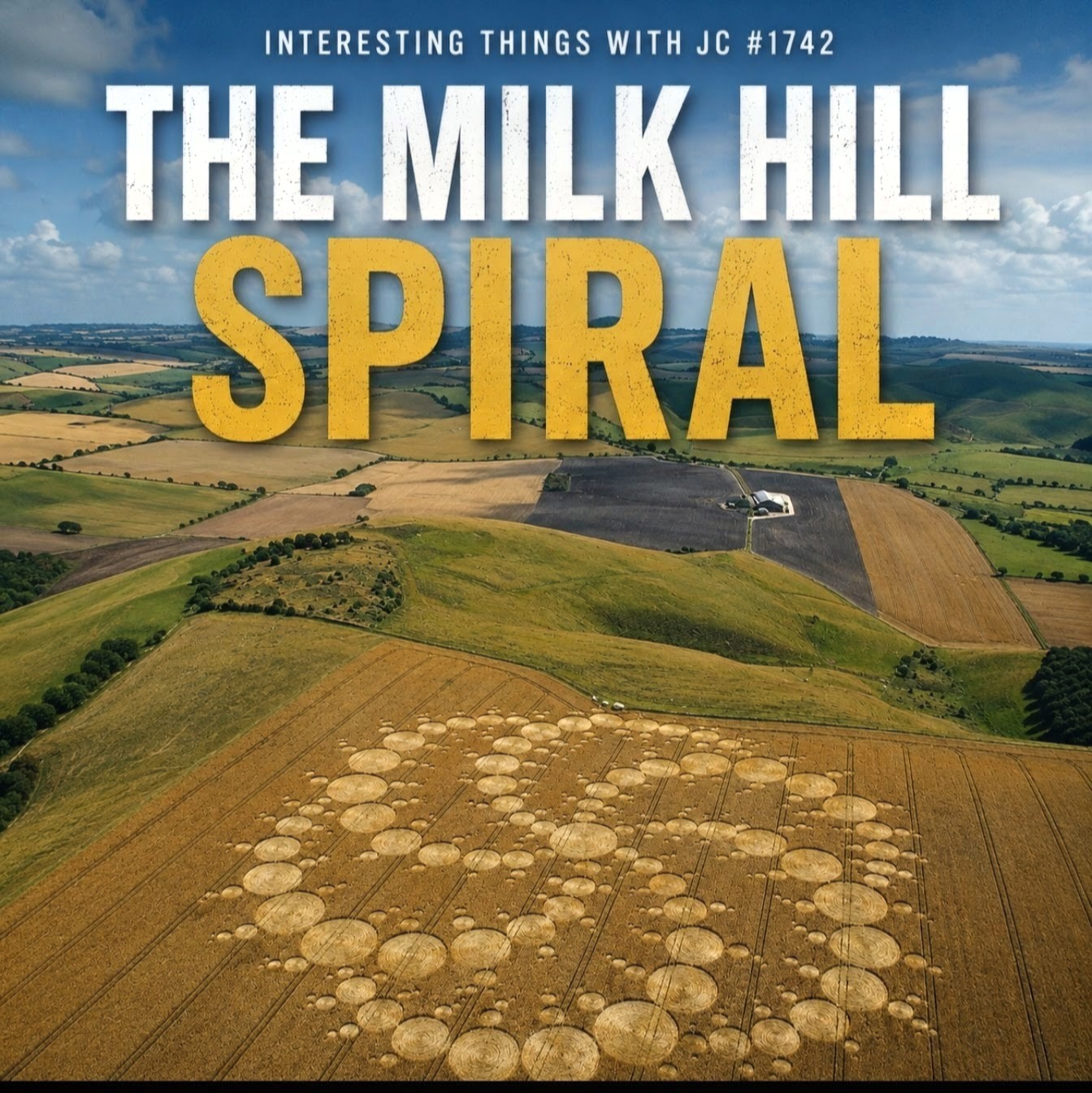
Aerial view of rolling farmland beneath a blue, partly cloudy sky. A large crop formation made of hundreds of circular shapes fills a wheat field in the foreground. Overlaid text reads “INTERESTING THINGS WITH JC #1742” and “THE MILK HILL SPIRAL,” with the title in large white and gold letters.
Transcript
Interesting Things with JC #1742:
"The Milk Hill Spiral"
On August 12, 2001, something enormous was lying in a wheat field on Milk Hill in Wiltshire, England. From the ground, it was difficult to take in. From the air, 409 individual circles resolved into a vast spiral arrangement across the hillside. Contemporary references disagree on its exact width, with published figures ranging from about 780 to 900 feet, or roughly 238 to 275 meters, but they agree on the feature that made the formation extraordinary: 409 separate circles working as one design.
Milk Hill rises above the Vale of Pewsey near Alton Barnes, in a part of southern England already well known for crop formations. This one stood apart because of its scale and complexity. The 409 circles formed a six-sided spiral pattern, with their sizes changing as the design swept outward from its center. The field itself was rolling rather than perfectly flat, which meant the geometry had to work across the contours of the hillside.
That changes the problem of making this thing. You see, whoever laid out the formation had to translate a large geometric plan onto a working wheat field while preserving the spacing, changing circle sizes and overall shape across hundreds of feet of ground. The people doing that work wouldn't have had the aerial perspective that makes the finished pattern immediately understandable in pictures...
Crop circles themselves don't require an extraordinary explanation. Human teams have demonstrated that elaborate formations can be planned and made with ordinary equipment, and Wiltshire became closely associated with that activity. But demonstrating that people can make crop circles isn't the same as establishing who made this particular one. No account I've been able to verify conclusively identifies the people responsible for the Milk Hill formation or documents exactly how they constructed it.
That distinction is very important because some of the most dramatic details attached to Milk Hill don't survive the same standard of evidence. The formation is often said to have been completed in four hours, in driving rain, at a pace approaching one circle every thirty seconds. Those claims appear in crop-circle archives and enthusiast accounts, but the available record does not establish the construction window or conditions firmly enough to present them as settled facts.
What remains doesn't need them. There were 409 circles arranged across a rolling wheat field, with individual elements changing in size while preserving the larger pattern. Someone had to conceive it, transfer that design onto the ground and execute it well enough that the geometry only became fully apparent when viewed from above.
And that's where Milk Hill becomes more interesting than the mythology surrounding it. Once the claims we can't establish are removed, the physical accomplishment doesn't disappear. It becomes easier to see.
Whatever method was used, real people encountered this formation in a real field in August 2001, photographed it from the air, measured it, argued over it, and left us with an object whose existence is documented even though its authorship is not.
Could, it have been something we’re not familiar with? Could it be something we’re just learning about in 2026, through the age of disclosure, and things like the buga sphere?
…maybe…
Twenty-five years later, there's no need to fill that empty space with an answer the evidence can't support. The formation was real. The 409 circles were real. The scale and geometry were real. Whoever put them there left behind the work, but not a confirmed name.
Sometimes the mystery isn't what came down from the sky. It's what was left on the ground.
These are interesting things, with JC.
Student Worksheet
Directions: Listen to the episode first. Then use the transcript and your listening notes to answer the questions. When a question asks you to explain or evaluate, support your response with specific evidence from the episode.
Comprehension Questions:
Where is Milk Hill located, and when was the formation reported?
How many individual circles made up the formation?
What range of measurements does the episode give for the formation's overall width?
How were the circles organized within the larger design?
Why did the rolling terrain make the formation a more complicated geometric problem?
What important information about the formation's construction remains unconfirmed?
Analysis Questions:
7. The episode states that humans have demonstrated the ability to make elaborate crop formations. Why does this fact not establish who made the Milk Hill formation?
8. The formation's 409 circles are treated differently from the claim that it was completed in four hours during driving rain. Explain why these claims should not be given the same level of certainty.
9. Classify each statement as Documented, Disputed, Inference, or Unsupported Conclusion. Give one sentence explaining each choice.
A. The Milk Hill formation contained 409 circles.
B. The formation was definitely constructed in four hours.
C. Whoever created the formation needed some method for transferring a large geometric design onto the field.
D. Because the creators have not been conclusively identified, the formation must have had a nonhuman origin.
Published descriptions give different measurements for the formation's width. Why is reporting the range more responsible than selecting one measurement and presenting it as certain?
Imagine you are investigating who created the formation. Identify two additional pieces of evidence that could strengthen an attribution. Explain why each would be useful.
Explain the difference between “We do not know who made it” and “Humans did not make it.” Why does that distinction matter when evaluating evidence?
Reflection: In 150–200 words, respond to the statement: An unanswered question is not automatically evidence for a particular answer. Use at least two specific details from the Milk Hill episode to support your response.
Evidence Check: Before submitting your work, review your answers and ask:
Did I distinguish facts from inferences?
Did I identify disputed information as disputed?
Did I provide evidence for my analytical answers?
Did I avoid treating missing information as proof of another explanation?
Did I acknowledge uncertainty when the evidence does not support a definite conclusion?
Difficulty Scaling:
Foundation: Complete Questions 1–9. For Question 9, identify the category and provide a brief explanation.
Standard: Complete Questions 1–12 and the 150–200-word reflection using specific episode evidence.
Advanced / Introductory College: Complete all Standard requirements, then locate two independent accounts discussing one disputed Milk Hill claim. Compare what each source actually establishes and determine whether the sources provide independent corroboration or repeat information originating elsewhere.
Student Output Expectations: Submit complete responses for the assigned difficulty level. Comprehension answers may be brief, but analysis questions should use complete sentences and specific episode evidence. Standard and advanced reflections should be 150–200 words and clearly distinguish documented information, inference, and uncertainty.
Academic Integrity Guidance: Use your own reasoning and clearly identify information taken from outside sources. Do not change uncertain information into fact simply because it appears repeatedly online. When using multiple sources, consider whether they are genuinely independent or whether one may be repeating another. When evidence is insufficient, state that limitation directly.
Teacher Guide
Quick Start: Begin with the podcast before providing background information. Tell students to listen for three categories: what is documented, what is disputed, and what remains unresolved. This establishes the lesson's evidence-evaluation focus before discussion begins.
Pacing Guide:
0–3 minutes: Bell ringer
3–10 minutes: Podcast listening
10–18 minutes: Vocabulary and comprehension check
18–32 minutes: Student Worksheet
32–43 minutes: Evidence discussion
43–52 minutes: Reflection or open-ended assessment
52–55 minutes: Exit Ticket
Bell Ringer: Ask students to describe something they know happened even though they do not know its cause. Then ask what additional evidence would be necessary before assigning a cause.
Audio Guidance: During the first listen, students should focus on the overall story rather than detailed transcription. Have them mark or record F for documented fact, D for disputed claim, and U for unresolved question.
Audio Fallback: If podcast audio is unavailable, read the supplied transcript aloud or have students alternate paragraphs. Keep the transcript as the opening narrative experience so the lesson remains audio-first in structure even when the recording cannot be played.
Time on Task: Standard lesson length is approximately 55 minutes. Extend to 75–90 minutes for source comparison, geometric modeling, or deeper discussion.
Materials:
Podcast audio or supplied transcript
Student Worksheet
Writing materials
Optional aerial image or geometric representation
Optional graph paper and calculator
Internet access for advanced source evaluation
Vocabulary Preparation: Preteach corroboration, attribution, and inference. Ask students to compare the statements “I observed it,” “a source reports it,” and “I conclude it.” Emphasize that these represent different levels of evidence.
Common Misconceptions:
Unknown authorship does not establish nonhuman authorship.
Evidence that humans can create complex crop formations does not identify the makers of this specific formation.
Repetition of a claim across multiple websites does not automatically count as independent corroboration.
Conflicting measurements do not mean the formation itself was undocumented.
Complexity alone cannot identify a creator or construction method.
Discussion Prompts:
Which Milk Hill claim has the strongest evidentiary support?
Which claim most needs additional corroboration?
Where is the boundary between reasonable inference and speculation?
What can an aerial photograph establish, and what can it not establish?
Why can acknowledging uncertainty strengthen an investigation?
Formative Checkpoints:
After listening, require one example each of a documented fact, disputed claim, and unresolved question.
During discussion, ask students to identify the evidence behind each conclusion.
Before assessment, have students exchange one inference with a partner and challenge whether the evidence fully supports it.
Use Worksheet Question 8 as a mid-lesson check for evidence classification.
Differentiation: Provide sentence frames such as “The evidence establishes ___ because ___” and “The available evidence does not establish ___ because ___.” Allow students who need additional support to classify claims before explaining them in full sentences. Advanced learners may trace apparently independent online claims to determine whether they originate from the same source.
Assessment Differentiation: Emerging writers may complete a structured evidence organizer before answering the open-ended assessment. Standard learners should provide complete written responses using episode evidence. Advanced and introductory-college learners should address a counterargument and explain limitations in the available evidence.
Time Flexibility: For a 30-minute version, use the podcast, Worksheet Questions 2, 6, and 7, followed by the Exit Ticket. For a block period, add source verification, geometric modeling, or an extended discussion of attribution and corroboration.
Substitute Readiness: Play or read the episode, assign Worksheet Questions 1–10, review the categories Documented, Disputed, and Unknown, then collect the reflection and Exit Ticket. The lesson can be taught without specialized background knowledge.
Engagement Strategy: Create three visible categories: Established, Disputed, and Unknown. Students place episode claims into one category and must defend each placement with evidence from the transcript.
Extensions:
Create a radial geometric design on graph paper using changing circle sizes.
Investigate how surveying methods can transfer a large design onto uneven terrain.
Trace one Milk Hill claim backward to its earliest identifiable source.
Compare two accounts of the formation and identify where they agree, differ, or repeat one another.
Cross-Curricular Connections: Geometry connects through circles, scale, symmetry, and spatial planning. English language arts connects through argument, evidence, and source evaluation. History and social studies connect through corroboration and attribution. Media literacy connects through source dependence and repeated claims. Engineering connects through translating a design into physical space.
SEL Connection: Emphasize intellectual humility, respectful disagreement, patience with uncertainty, and willingness to revise a conclusion when stronger evidence appears.
Skill Value Emphasis: The lesson develops critical thinking, evidence evaluation, communication, inquiry, problem solving, reasoning, decision-making, collaboration, adaptability, and professional judgment.
Answer Key:
Milk Hill, Wiltshire, England; August 12, 2001.
409 circles.
Approximately 780–900 feet, or 238–275 meters.
The field was rolling rather than perfectly flat, so the larger design had to work across changing terrain.
The creators and exact construction method remain unconfirmed in the episode's verified record.
General human capability establishes that such formations can be made; attribution requires evidence connecting specific people to the Milk Hill formation.
The 409-circle count is treated as documented, while the four-hour construction window and weather conditions are presented as insufficiently verified.
a. Documented. b. Disputed. c. Inference. d. Unsupported conclusion.
Reporting disagreement preserves the actual state of the evidence instead of manufacturing false precision.
Strong answers may include authenticated construction records, contemporaneous eyewitness evidence, verifiable documentation from creators, time-sequenced imagery, or independent evidence connecting particular people and methods to the formation.
Reflection Guidance: Strong responses should explain that absence of an established answer does not itself prove an alternative explanation. Students should use at least two details from the episode and clearly separate evidence from inference.
Quiz
Which characteristic is central to descriptions of the Milk Hill formation?
A. 409 individual circles
B. 409 stone markers
C. 900 identical triangles
D. Six rectangular fieldsWhy does the episode provide a range for the formation's width?
A. The field changed size after harvest
B. Published accounts report different measurements
C. No aerial photographs existed
D. The number of circles changed over timeWhich statement best represents the episode's treatment of authorship?
A. A named team has conclusively documented making it
B. Its nonhuman origin has been established
C. Available evidence does not conclusively identify its creators
D. Weather records identify its creatorsWhy is the four-hour construction claim treated cautiously?
A. Rain cannot occur in Wiltshire
B. Wheat cannot be flattened when wet
C. Available evidence does not firmly establish the claimed conditions and construction window
D. The formation appeared during winterWhich principle best represents the episode's approach?
A. The most extraordinary explanation should receive priority
B. Repetition establishes factual accuracy
C. Missing evidence should be replaced by the simplest guess
D. Conclusions should remain within the limits of available evidence
Assessment
Open-Ended Questions:
Explain how Milk Hill illustrates the difference between documented evidence, reasonable inference, and unsupported conclusion. Use at least three specific examples.
Evaluate this statement: “Nobody knows who made Milk Hill, therefore humans could not have made it.” Identify the reasoning problem and construct a more defensible conclusion.
3–2–1 Rubric:
3 — Proficient: Accurately distinguishes evidence from inference, uses specific episode evidence, acknowledges uncertainty, and clearly explains the reasoning.
2 — Developing: Demonstrates generally correct understanding but provides limited evidence, misses an important uncertainty, or gives incomplete reasoning.
1 — Beginning: Confuses claims with evidence, relies on unsupported conclusions, or provides little relevant evidence.
Exit Ticket: Complete three sentences: We know… / We can reasonably infer… / We cannot establish…
Standards Alignment
NGSS — Science & Engineering Practices
Analyzing and Interpreting Data
Connection: Students compare reported measurements, physical characteristics, and levels of certainty surrounding the Milk Hill formation.
Measurable Skill: Students distinguish consistent observations from disputed measurements and unsupported claims.
Justification: Worksheet Questions 3, 7, 8, and 9 require students to interpret evidence without overstating what the available information establishes.Engaging in Argument from Evidence
Connection: Students evaluate competing claims and defend conclusions using evidence from the episode.
Measurable Skill: Students construct and critique evidence-based explanations.
Justification: Assessment Question 2 requires students to identify faulty reasoning and replace it with a conclusion supported by available evidence.
CCSS Reading
CCSS.ELA-LITERACY.RI.11-12.1 — Cite strong and thorough textual evidence
Connection: Students use the transcript to distinguish explicit facts, reasonable inferences, disputed claims, and unresolved questions.
Measurable Skill: Students support written and oral conclusions with specific evidence from the episode.
Justification: Worksheet Questions 6–10 and Assessment Question 1 require direct evidence-based interpretation.CCSS.ELA-LITERACY.RI.11-12.7 — Integrate and evaluate multiple sources and formats
Connection: Students compare the podcast, transcript, optional aerial imagery, and outside source material.
Measurable Skill: Students identify agreements, discrepancies, and limitations across multiple forms of evidence.
Justification: The advanced worksheet task requires source comparison rather than simple information retrieval.
CCSS Writing
CCSS.ELA-LITERACY.W.11-12.1 — Write arguments supported by valid reasoning and relevant evidence
Connection: Students construct a defensible explanation about what can and cannot be concluded from the Milk Hill evidence.
Measurable Skill: Students develop a claim, support it with evidence, and acknowledge limitations.
Justification: Both open-ended assessment questions require claim-evidence-reasoning.CCSS.ELA-LITERACY.W.11-12.8 — Gather relevant information and assess source strengths and limitations
Connection: Students investigate disputed claims and evaluate whether sources are independent and credible.
Measurable Skill: Students assess relevance, authority, corroboration, and source limitations.
Justification: The advanced source-comparison task directly measures information-literacy and research skills.
CCSS Speaking & Listening
CCSS.ELA-LITERACY.SL.11-12.1 — Participate effectively in collaborative discussions
Connection: Students defend whether claims belong in the categories Established, Disputed, or Unknown.
Measurable Skill: Students explain reasoning, cite evidence orally, and respond to competing interpretations.
Justification: The discussion prompts and engagement activity require collaborative evidence evaluation.CCSS.ELA-LITERACY.SL.11-12.2 — Integrate information presented in diverse media and evaluate credibility and accuracy
Connection: Students begin with podcast audio and then work with the transcript and optional visual evidence.
Measurable Skill: Students compare information across audio, text, and visual sources.
Justification: The audio-first lesson structure requires students to process and evaluate information presented in multiple formats.
C3 Framework
D3.1.9-12 — Gather and evaluate sources
Connection: Students investigate the origin and evidentiary value of claims about Milk Hill.
Measurable Skill: Students distinguish independent corroboration from repeated or derivative claims.
Justification: The advanced worksheet task asks students to compare sources and determine how strongly each supports a claim.D3.2.9-12 — Evaluate source credibility
Connection: Students assess whether available sources adequately support claims about measurement, timing, weather, construction, and authorship.
Measurable Skill: Students justify why one source or claim deserves greater evidentiary weight than another.
Justification: Worksheet Questions 7, 9, and 10 require explicit judgments about evidence quality and uncertainty.
ISTE Standards
ISTE 1.3 — Knowledge Constructor
Connection: Students evaluate digital information while investigating disputed claims.
Measurable Skill: Students assess source accuracy, relevance, origin, and independence.
Justification: The advanced source-comparison activity requires critical digital research rather than passive acceptance of online information.ISTE 1.6 — Creative Communicator
Connection: Students communicate evidence-based conclusions through discussion and written analysis.
Measurable Skill: Students clearly explain the difference between fact, inference, dispute, and uncertainty.
Justification: The reflection, discussion, and assessment require precise communication of a nuanced conclusion.
Career Readiness Competencies
Analytical Thinking
Connection: Students separate the episode into documented, disputed, inferred, and unresolved elements.
Measurable Skill: Students correctly categorize claims and defend their classifications.
Justification: Worksheet Question 8 directly measures analytical reasoning.Communication
Connection: Students explain conclusions orally and in writing using relevant evidence.
Measurable Skill: Students present a clear, evidence-based explanation.
Justification: Discussion, reflection, and assessment tasks all require precise communication.Problem Solving
Connection: Students determine what additional evidence would be needed to resolve unanswered questions.
Measurable Skill: Students propose appropriate evidence for testing a claim.
Justification: Worksheet Question 10 requires students to turn uncertainty into a research problem.Adaptability
Connection: Students consider how conclusions should change when stronger or conflicting evidence appears.
Measurable Skill: Students revise a judgment when its evidentiary basis changes.
Justification: Formative discussion requires students to reconsider claims after peer review and additional evidence.Professional Judgment
Connection: Students practice withholding conclusions that go beyond available evidence.
Measurable Skill: Students distinguish what is established from what remains uncertain.
Justification: Assessment Question 2 and the Exit Ticket directly measure responsible decision-making under uncertainty.
Homeschool / Lifelong Learning Alignment
Independent Learning
Connection: Learners can complete the transcript analysis and evidence-classification tasks independently.
Measurable Skill: Conduct a basic evidence audit without specialized classroom support.
Justification: The worksheet provides a self-contained inquiry process suitable for individual learning.Information Literacy
Connection: Learners distinguish repeated claims from independently corroborated evidence.
Measurable Skill: Compare at least two sources for credibility and independence.
Justification: The advanced source-comparison task directly develops information-literacy skills.Real-World Application
Connection: Learners apply evidence standards to claims encountered in media, work, and everyday decision-making.
Measurable Skill: Identify when a conclusion exceeds the evidence supporting it.
Justification: The reflection transfers the lesson's reasoning process beyond the Milk Hill case.Self-Directed Inquiry
Connection: Learners identify unresolved questions and determine what evidence could help answer them.
Measurable Skill: Formulate an investigable question and identify useful evidence.
Justification: Worksheet Question 10 explicitly develops inquiry skills.Transferable Life Skills
Connection: Learners practice critical thinking, communication, reasoning, intellectual discipline, and decision-making.
Measurable Skill: Produce a conclusion that communicates both evidence and level of confidence.
Justification: The assessment and Exit Ticket require learners to distinguish certainty, inference, and unresolved information.
Show Notes
The Milk Hill Spiral gives students a compelling case study in evidence evaluation, geometry, media literacy, and intellectual discipline. Using the documented 2001 formation as the starting point, learners separate physical observations from disputed construction stories, investigate the difference between capability and attribution, and examine why an unanswered question cannot automatically support a preferred explanation. The lesson matters beyond crop formations because the same reasoning skills apply to research, journalism, science, workplace investigations, online information, and responsible everyday decision-making.
References
Bridgeman Images. (2001). Crop circle in wheat field, Milk Hill, Alton Priors, Vale of Pewsey, Wiltshire, 14th August 2001 (aerial photograph). https://www.bridgemanimages.com/en-US/blake-francine/crop-circle-in-wheat-field-milk-hill-alton-priors-vale-of-pewsey-wiltshire-14th-august-2001-aerial/photograph/asset/5914667
Crop Circle Archives. (n.d.). Crop circle at Milk Hill (2), Nr Alton Barnes, Wiltshire. Reported 12th August. https://www.cropcirclearchives.co.uk/archives/2001/MilkHill2/milkhill2001a.html
Irving, R., & Brookesmith, P. (2009, December 15). Crop circles: The art of the hoax. Smithsonian Magazine. https://www.smithsonianmag.com/arts-culture/crop-circles-the-art-of-the-hoax-2524283/
Live Science. (2022). In photos: Mysterious crop circles. https://www.livescience.com/15344-creepy-crop-circles-gallery.html