1783: "Humanity is Unprepared for AI"
Interesting Things with JC #1783: "Humanity is Unprepared for AI"
A student spends years preparing for a career while AI changes the work before graduation. Machines can already help people research, solve problems, and produce results, but employers may need fewer workers as those capabilities expand. Students must choose careers and decide when to trust AI systems that can still invent evidence.
Curriculum - Episode Anchor
Episode Title: Humanity is Unprepared for AI
Episode Number: 1783
Host: JC
Audience: Grades 9–12, introductory college, homeschool, lifelong learners
Subject Area: English Language Arts, social studies, economics, technology, information literacy, career readiness
Lesson Overview
Learning Objectives
Explain the difference between AI exposure, job transformation, and job replacement.
Analyze potential benefits and risks of human–AI collaboration in education and the workplace.
Evaluate AI-generated information using evidence, source verification, and uncertainty.
Develop an evidence-based position on which human skills may remain important as AI capabilities change.
Essential Question: How should people prepare for careers and responsibilities in a world where artificial intelligence can perform an increasing number of complex tasks?
Success Criteria
Students accurately explain why exposure to generative AI does not automatically mean a job will disappear.
Students identify at least two opportunities and two challenges associated with human–AI collaboration.
Students distinguish a convincing AI response from a verified, reliable response.
Students support conclusions with evidence from the episode and clearly identify areas of uncertainty.
Student Relevance Statement: Students making choices about education, training, and careers are entering a labor market in which AI may alter job tasks, required skills, productivity, and expectations. Understanding how to evaluate AI and adapt to technological change can help students make more informed decisions.
Real-World Connection: AI systems are already being used for research, writing, coding, analysis, design, customer service, and other professional tasks. Students may encounter similar systems in school, college, training programs, and employment.
Workforce Reality: In 2025, the International Labour Organization estimated that about one in four workers worldwide were in occupations with some exposure to generative AI. Its analysis emphasized that exposure measures task-level technological potential and should not be treated as a direct prediction of unemployment. Transformation of work was considered more likely than wholesale replacement across most exposed occupations.
Key Vocabulary
Terms
Artificial intelligence (AI) (ar-tuh-FISH-ul in-TEL-uh-jens) — Computer systems designed to perform tasks associated with abilities such as prediction, language processing, pattern recognition, reasoning, or content generation.
Generative AI (JEN-er-uh-tiv AYE-EYE) — AI designed to generate new content such as text, images, audio, video, or computer code in response to input.
Occupational exposure (ok-yuh-PAY-shuh-nuhl ik-SPOH-zher) — The degree to which tasks within an occupation could potentially be affected by a technology.
Automation (aw-tuh-MAY-shuhn) — The use of technology to perform tasks with reduced direct human effort.
Augmentation (awg-men-TAY-shuhn) — Using technology to assist or extend human capabilities rather than fully replacing the person performing the work.
Transformation (trans-fer-MAY-shuhn) — A substantial change in how a job is performed, including changes to tasks, tools, or required skills.
Reliability (ri-lahy-uh-BIL-uh-tee) — The degree to which a system performs consistently and produces dependable results under specified conditions.
Verification (vair-uh-fuh-KAY-shuhn) — The process of checking a claim or result against independent evidence.
Uncertainty (un-SUR-tuhn-tee) — The condition of not having complete confidence or knowledge about a result, prediction, or conclusion.
Narrative Core
Open: A student choosing a career today faces an unusual problem: the work they prepare for may change substantially before their education or training is complete.
Info: Artificial intelligence can increasingly assist with research, analysis, writing, design, coding, and other cognitive tasks. This creates opportunities for people to accomplish more while raising questions about employment, wages, skill requirements, and the distribution of productivity gains.
Details: The episode distinguishes technological exposure from automatic job elimination. It presents human–AI collaboration as a possible partnership in which machines contribute speed and computational capability while people contribute judgment, curiosity, responsibility, and purpose. It also raises a practical trust problem: an AI system can produce a confident answer while including inaccurate or fabricated information.
Reflection: Students are asked to consider what makes human contribution valuable when machines can produce similar outputs, how technological benefits might be distributed, and what evidence should be required before people trust an AI system.
Closing: These are interesting things, with JC.
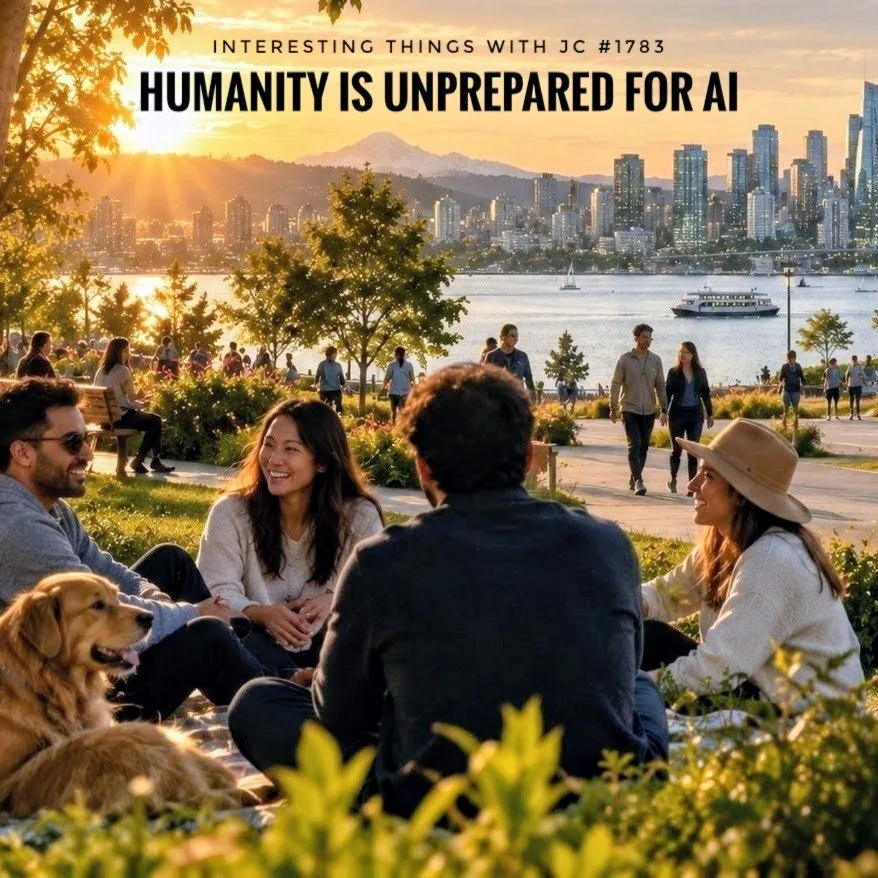
Podcast cover art for Interesting Things with JC episode #1783, “Humanity Is Unprepared for AI.” A group of friends gathers with a golden retriever in a sunny waterfront park overlooking a modern city skyline. The peaceful scene contrasts with the episode’s examination of artificial intelligence, changing careers, human–machine collaboration, job security, and the challenges of trusting AI systems.
Transcript
Interesting Things with JC #1783:
"Humanity is Unprepared for AI"
A student choosing a career today may spend years preparing for work that changes before they graduate. The uncertainty isn't simply whether artificial intelligence will take jobs. It's what happens when people begin working alongside machines that can perform increasingly complex tasks.
AI can help that student research a problem, test ideas, and build something they couldn't create alone. The machine supplies speed and computational power. The student brings curiosity, judgment, and a reason for doing the work.
That partnership could expand what people accomplish. It could also change how many workers employers need and what they're willing to pay them.
In 2025, the International Labour Organization estimated that one in four jobs worldwide had some exposure to generative AI. It found that transformation was generally more likely than outright replacement. Exposure doesn't mean unemployment, but it does mean familiar career paths may change.
And a job is more than a collection of tasks. It provides income, independence, community, and often a sense of purpose. If human–machine partnerships produce more with fewer workers, who receives the benefits? What happens to people whose skills no longer command the same wages?
Philosophy and religious traditions approach human purpose and dignity in different ways. But the student faces a practical version of the question: if a machine can produce the same result, what makes my contribution valuable?
Working together introduces another problem. Suppose AI helps the student complete a project and says it verified every source. If one reference is invented, can the student discover that? Will the system acknowledge the error?
Trust cannot depend on a convincing answer. It requires evidence of reliability, honest reporting of uncertainty, and ways to challenge and correct mistakes. The person using the system must still understand what they're responsible for.
AI is advancing while those arrangements remain unsettled. Nobody can reliably describe all its capabilities five or ten years from now.
The student cannot wait for certainty. They must choose what to learn, what work to pursue, and when a machine has earned enough trust to become a partner.
These are interesting things, with JC.
Student Worksheet
Comprehension
What uncertainty does the opening paragraph identify for a student choosing a career?
According to the episode, what capabilities might an AI system contribute to a human–machine partnership?
What qualities does the episode identify as contributions from the student?
What did the 2025 International Labour Organization estimate about global occupational exposure to generative AI?
Why does the episode state that exposure to AI should not automatically be interpreted as unemployment?
Analysis
Explain the difference between replacing a worker and transforming a worker's job. Give one hypothetical example of each.
The episode states that a job can provide income, independence, community, and purpose. How could technological change affect each of these dimensions differently?
Why is a confident or convincing AI answer insufficient evidence that the answer is reliable?
Suppose an AI system gives you five sources for a research paper. Describe a verification process you could use before relying on them.
Identify one possible benefit and one possible cost if AI allows a business to produce the same amount of work with fewer employees.
Reflection
What knowledge or skill would you prioritize developing if you knew AI capabilities would continue changing? Explain your reasoning using evidence or ideas from the episode.
What conditions would an AI system need to meet before you would trust it with an important academic or professional task?
Respond to the episode's question: If a machine can produce the same result, what might make a human contribution valuable? Distinguish your personal conclusion from claims directly made in the episode.
Difficulty Scaling
Level 1 — Identify: Answer Questions 1–5 using explicit information from the transcript.
Level 2 — Analyze: Complete Questions 6–10 and explain relationships between technology, work, trust, and responsibility.
Level 3 — Evaluate: Complete Questions 11–13 using evidence, counterarguments, and clearly stated reasoning.
Student Output: Produce complete responses to Questions 1–10 plus one reflection response from Questions 11–13. Advanced students should answer all questions and include at least one counterargument in a reflection response.
Academic Integrity Guidance: AI may be used only according to the teacher's instructions. If permitted, students remain responsible for checking factual claims, locating original sources, identifying unsupported statements, and submitting reasoning they understand. An AI-generated citation should not be treated as verified until the student confirms that the source exists and supports the claim attributed to it.
Teacher Guide
Quick Start: Provide the worksheet, introduce the essential question, play or read the episode, and have students distinguish claims made by the episode from questions the episode intentionally leaves unresolved.
Pacing Guide — Audio First
0–5 minutes: Bell Ringer and career-change prediction.
5–10 minutes: Preview vocabulary and essential question.
10–15 minutes: Listen to the episode without interruption.
15–20 minutes: Students identify the episode's central claim and unresolved questions.
20–32 minutes: Complete comprehension and analysis questions.
32–42 minutes: Conduct evidence-based discussion.
42–50 minutes: Complete reflection or Exit Ticket.
Bell Ringer: Ask students to name one occupation they believe could change substantially because of AI. They should identify a specific task that might change rather than simply predicting whether the occupation will disappear.
Audio Guidance: Play the episode once without interruption. Ask students to listen for three categories: what AI can do, what humans remain responsible for, and what the episode says remains uncertain.
Audio Fallback: If audio is unavailable, read the supplied transcript aloud or use paired reading. Preserve the original sequence and wording.
Time on Task: Approximately 45–50 minutes for a standard lesson; 75–90 minutes if the assessment and source-verification exercise are completed in class.
Materials
Episode audio or transcript
Student Worksheet
Internet-enabled device for optional verification activity
Notebook or digital response document
Teacher-selected AI system, if AI demonstration is permitted
Vocabulary Prep
Contrast automation with augmentation.
Explain that occupational exposure concerns the potential effect of technology on job tasks and does not itself establish that a worker will lose employment.
Connect verification, reliability, and uncertainty to familiar research practices.
Misconceptions
“AI exposure means the job will disappear.” Exposure identifies technological potential affecting tasks; employment outcomes depend on additional economic, organizational, social, and technical factors.
“If AI makes an error, all AI output is useless.” Reliability varies by system, task, context, and method of use; the instructional focus is appropriate verification.
“A fluent answer is probably accurate.” Fluent presentation and factual accuracy are separate characteristics.
“Only technical careers will be affected.” Generative AI can affect cognitive, administrative, creative, professional, and technical tasks as well as technology occupations.
“The future of AI employment effects is already known.” Current exposure research describes present technological potential, not a certain long-term employment outcome.
Discussion Prompts
Which parts of a job are easiest to describe as individual tasks, and which parts are harder to separate from human relationships or responsibility?
Does increasing productivity necessarily reduce employment? What additional information would be needed to answer that question?
Who should be responsible when a person relies on inaccurate AI-generated information?
What evidence should an AI system provide when it is uncertain?
Which is more important for future work: knowing how to use AI or knowing enough to evaluate what AI produces? Can the two be separated?
Formative Checkpoints
Students correctly distinguish job exposure from job loss.
Students identify evidence versus speculation in the transcript.
Students explain why source verification remains the user's responsibility.
Students acknowledge uncertainty when discussing future AI capabilities rather than presenting predictions as facts.
Differentiation
Additional Support: Provide a two-column organizer labeled “Human Contribution” and “Machine Contribution.” Allow students to cite paragraph numbers rather than composing extended explanations initially.
Advanced Learners: Require students to distinguish task-level automation from occupation-level replacement and evaluate a competing interpretation of AI's workforce effects.
English Learners: Preteach vocabulary, permit bilingual vocabulary notes, and provide sentence frames such as “Exposure differs from replacement because…”
Auditory Learners: Replay selected passages and have students summarize them orally.
Visual Learners: Map the chain from AI capability → task exposure → possible job transformation → possible economic or social outcome.
Assessment Differentiation: Students requiring support may answer the assessment through a structured paragraph, oral response, or graphic organizer. Advanced students should address competing explanations and the limits of available evidence.
Time Flexibility: For a 30-minute lesson, use the Bell Ringer, audio, Questions 1–5 and 8, and Exit Ticket. For a block period, add a live source-verification exercise and the full assessment.
Substitute Readiness: The lesson can be completed from the transcript and worksheet without prior subject expertise. Instruct students not to debate whether AI is inherently “good” or “bad”; instead, require them to identify specific claims, evidence, risks, benefits, and uncertainties.
Engagement Strategy: Present students with a hypothetical AI-generated citation and ask what steps would be necessary to determine whether it is real and whether it actually supports the associated claim. Do not treat apparent authenticity as proof.
Extensions
Compare two occupations by identifying which tasks appear more or less susceptible to AI assistance.
Ask students to design a five-step verification protocol for AI-assisted research.
Have students interview an adult about how technology changed the tasks required in that person's occupation.
Research a current occupational-exposure study and distinguish its measurements from predictions about employment.
Cross-Curricular Connections
Economics: Productivity, wages, labor demand, human capital, and distribution of economic gains.
English Language Arts: Evidence evaluation, argument construction, source credibility, and uncertainty.
Computer Science: Automation, generative models, system limitations, and human oversight.
Philosophy: Purpose, human value, responsibility, and the relationship between an outcome and the agent producing it.
Career Education: Adaptability, transferable skills, technological literacy, and career planning.
SEL: Use the episode's uncertainty as an opportunity to practice decision-making without requiring certainty. Students can separate factors they can influence—learning, verification, adaptability, judgment—from future technological developments they cannot confidently predict.
Skill Emphasis: Critical thinking, information literacy, technological literacy, adaptability, evidence evaluation, decision-making, communication, and career readiness.
Answer Key
Students may prepare for work that changes significantly before they complete their education or training.
Speed and computational power, including assistance with research, testing ideas, and building or creating.
Curiosity, judgment, and a reason or purpose for doing the work.
About one in four jobs worldwide had some exposure to generative AI.
Exposure concerns the possibility that tasks can be affected; the episode states that transformation is generally more likely than outright replacement.
Acceptable response: Replacement removes the need for a worker in a role or task; transformation changes what the worker does or how the work is performed. Examples should clearly demonstrate the distinction.
Responses should address multiple dimensions independently and recognize that effects need not move in the same direction.
Confidence or fluency does not independently verify factual accuracy; evidence and external checking are required.
Strong responses should include locating each source independently, confirming authorship/publication, checking that the source exists, reading the relevant material, and determining whether it supports the stated claim.
Benefits may include greater productivity, lower costs, increased output, or new capabilities. Costs may include reduced labor demand, displaced workers, wage pressure, retraining needs, or unequal distribution of gains. Students should avoid presenting any one outcome as inevitable.
11–13. Answers vary. Require a defensible claim, reasoning, appropriate episode evidence, and clear distinction between evidence and personal judgment.
Quiz Key: 1-B, 2-C, 3-B, 4-D, 5-C.
Quiz
In the episode, what is the main career uncertainty facing the student?
A. Whether every occupation will become fully automated
B. Whether the work they prepare for may change before they graduate
C. Whether college degrees will disappear
D. Whether computers will stop improving
What does occupational exposure to generative AI indicate most directly?
A. The percentage of workers who have already lost their jobs
B. The number of workers who personally use an AI chatbot
C. The potential for tasks within occupations to be affected by AI
D. The exact number of jobs that will disappear
Which human contribution does the episode specifically emphasize?
A. Faster computation
B. Judgment
C. Automated data processing
D. Unlimited memory
Why does the episode question whether an AI system should be trusted simply because it says that it verified its sources?
A. AI systems cannot produce citations
B. Students are prohibited from using computers
C. Every online source is unreliable
D. A system can provide convincing information that still contains an invented or inaccurate reference
Which statement best represents the episode's approach to the future of AI?
A. AI capabilities five or ten years from now are already predictable.
B. Students should delay career decisions until AI development stops.
C. People must make decisions despite substantial uncertainty about future capabilities.
D. Current occupations will remain essentially unchanged.
Assessment
Open-Ended Questions
Explain how human–AI collaboration could simultaneously increase what people can accomplish and create new workforce challenges. Use at least three specific ideas from the episode and distinguish established evidence from possible future outcomes.
Develop a trust protocol for using generative AI on an important school or workplace project. Explain how your protocol would detect inaccurate information, invented sources, or unjustified confidence.
3–2–1 Rubric
3 — Proficient: Makes a clear claim; accurately uses episode evidence; distinguishes evidence from prediction; explains reasoning; recognizes uncertainty or counterarguments; and addresses human responsibility.
2 — Developing: Provides a generally accurate response with relevant evidence but offers limited explanation, verification strategy, or treatment of uncertainty.
1 — Beginning: Gives a conclusion with little supporting evidence, confuses exposure with guaranteed job loss, or relies on unsupported assertions.
Exit Ticket
Write one statement about AI and work that the episode supports with evidence.
Write one important question about AI and work that remains unresolved.
Name one action a student can take today that does not depend on accurately predicting AI five or ten years from now.
Standards Alignment
NGSS — Science & Engineering Practices / Engineering Design
HS-ETS1-1 — Engineering Design: Students analyze the real-world challenge of adapting education and work to AI by identifying criteria and constraints for responsible human–AI collaboration, including reliability, workforce effects, and societal needs. The performance expectation asks students to analyze a major global challenge while considering societal needs and constraints.
Asking Questions and Defining Problems: Students distinguish measurable present-day questions about AI exposure from long-range predictions that cannot presently be resolved with confidence.
CCSS Reading
CCSS.ELA-LITERACY.RI.11-12.1 — Textual Evidence: Students use strong textual evidence to analyze explicit claims, inferences, and places where the episode leaves matters uncertain.
CCSS.ELA-LITERACY.RI.11-12.2 — Central Ideas: Students determine the episode's central ideas concerning work, trust, responsibility, and uncertainty and trace their development through the narrative.
CCSS Writing
CCSS.ELA-LITERACY.W.11-12.1 — Argument Writing: Students construct evidence-based arguments about human–AI collaboration and address competing claims.
CCSS.ELA-LITERACY.W.11-12.9 — Evidence from Informational Texts: Students incorporate relevant evidence from the episode when responding to analytical questions.
ISTE — Student Standards
1.3.b — Knowledge Constructor / Evaluate Information: Students evaluate the accuracy, validity, bias, origin, and relevance of digital content when checking AI-generated claims and citations.
1.3.a — Effective Research Strategies: Students develop research procedures for independently verifying AI-provided information.
1.3.d — Explore Real-World Issues: Students investigate the authentic problem of how AI may alter education, employment, and individual responsibility.
1.1.d — Technology Fundamentals: Students examine an emerging technology and consider appropriate, informed use rather than assuming technological output is inherently trustworthy.
C3 Framework
D3.2.9-12 — Gathering and Evaluating Sources: Students evaluate source credibility when determining whether AI-generated evidence can be trusted.
D3.3.9-12 — Evidence from Multiple Sources: Students compare evidence across sources and identify inconsistencies before accepting a claim.
D4.1.9-12 — Communicating Conclusions: Students construct arguments using evidence while acknowledging counterclaims and weaknesses in available evidence.
D2.Eco.3.9-12 — Economic Decision-Making: Students connect technological change to incentives affecting what businesses produce and how resources, including labor, may be used.
Career Readiness Competencies
Critical Thinking: Evaluate technological claims rather than treating fluency or confidence as proof.
Technology: Use AI tools while understanding the need for verification and human accountability.
Career Management: Identify adaptable skills and evaluate changing occupational tasks rather than relying on static career assumptions.
Communication: Explain evidence, uncertainty, and limitations clearly to others.
Professionalism: Accept responsibility for work completed with technological assistance.
Homeschool / Lifelong Learning
Learners connect AI developments to personal education and career decisions.
Learners practice independent verification of digital information.
Learners analyze technological change without requiring a predetermined position about whether AI's overall effects will be beneficial or harmful.
Learners develop adaptable research, reasoning, and decision-making habits applicable beyond formal schooling.
Show Notes
Episode 1783 examines what happens when artificial intelligence becomes a working partner rather than simply a tool. Beginning with a student choosing a career, the episode explores AI's potential to increase human capability while changing job tasks, workforce demand, wages, and expectations. It distinguishes occupational exposure from inevitable unemployment and raises a second challenge: determining when an AI system has earned trust. For the classroom, the episode connects career readiness with economics, information literacy, technological literacy, and questions about human judgment and responsibility. It matters because students must make decisions about learning and work before anyone can know exactly how capable future AI systems will become.
References
Gmyrek, P., Berg, J., Kamiński, K., Konopczyński, F., Ładna, A., Nafradi, B., Rosłaniec, K., & Troszyński, M. (2025). Generative AI and jobs: A refined global index of occupational exposure. International Labour Organization. https://www.ilo.org/publications/generative-ai-and-jobs-refined-global-index-occupational-exposure
International Labour Organization. (2025). Generative AI and jobs: A 2025 update. https://www.ilo.org/publications/generative-ai-and-jobs-2025-update
International Labour Organization. (2025, May 20). One in four jobs at risk of being transformed by GenAI, new ILO–NASK Global Index shows. https://www.ilo.org/resource/news/one-four-jobs-risk-being-transformed-genai-new-ilo%E2%80%93nask-global-index-shows
International Labour Organization. (2026). Workers’ exposure to AI: What indicators tell us – and what they don’t. https://www.ilo.org/publications/workers%E2%80%99-exposure-ai-what-indicators-tell-us-%E2%80%93-and-what-they-don%E2%80%99t
National Institute of Standards and Technology. (2025). Hallucination detection in large language models using diversion decoding. https://www.nist.gov/publications/hallucination-detection-large-language-models-using-diversion-decoding
Organisation for Economic Co-operation and Development. (2024). Using AI in the workplace: Opportunities, risks and policy responses. https://www.oecd.org/en/publications/using-ai-in-the-workplace_73d417f9-en.html