1784: "The Hydrogen Peroxide Mistake"
Interesting Things with JC #1784: "The Hydrogen Peroxide Mistake"
Hydrogen peroxide foams on a scraped knee, but the bubbles don't prove germs are dying. The same chemical reaction that attacks bacteria can also damage healthy skin cells, even as people keep pouring it onto wounds to help them heal.
Curriculum - Episode Anchor
Episode Title: The Hydrogen Peroxide Mistake
Episode Number: 1784
Host: JC
Audience: Grades 9–12, introductory college, homeschool, lifelong learners
Subject Area: Biology, chemistry, health science, scientific literacy
Lesson Duration: 45 minutes
Central Concept: A visible chemical reaction does not necessarily demonstrate an effective medical treatment.
Lesson Overview
Learning Objectives
Students will be able to:
Explain why hydrogen peroxide produces bubbles when it contacts damaged tissue.
Identify the roles of catalase, oxygen, and oxidation in the reaction.
Distinguish antimicrobial activity from evidence of improved wound healing.
Evaluate a familiar first-aid practice using scientific evidence.
Essential Question: Why can a substance that kills bacteria also interfere with the body's ability to heal?
Success Criteria
Students can:
Correctly interpret the chemical equation for hydrogen peroxide decomposition.
Explain why bubbling is not proof that bacteria have been killed.
Identify two reasons healthy tissue must be protected during wound care.
Support a conclusion with evidence from the lesson.
Student Relevance Statement: Many students have seen hydrogen peroxide applied to a scraped knee or encountered it in a household first-aid kit. This lesson explains why a familiar practice may not be supported by current medical guidance.
Real-World Connection: Dermatologists recommend gently cleaning ordinary minor wounds, maintaining a moist healing environment, and protecting the wound with a dressing.
Workforce Reality: Nurses, emergency medical technicians, athletic trainers, and other healthcare professionals must distinguish between a treatment's visible effects and its demonstrated benefits.
Key Vocabulary
Hydrogen peroxide (HY-druh-jən puh-ROK-side): H₂O₂, a reactive chemical compound with antimicrobial properties that can also damage living tissue.
Catalase (KAT-uh-lays): An enzyme found in many living cells that accelerates the decomposition of hydrogen peroxide.
Enzyme (EN-zime): A biological catalyst that increases the rate of a chemical reaction.
Oxidation (ok-sih-DAY-shun): A chemical process involving electron loss; oxidative reactions can damage cellular components.
Antimicrobial (an-tee-my-KROH-bee-ul): Capable of killing microorganisms or inhibiting their growth.
Cytotoxicity (SY-toh-tok-SIS-ih-tee): The ability of a substance to damage or kill cells.
Tissue (TISH-oo): A group of cells working together to perform a biological function.
Wound healing (WOOND HEE-ling): The biological process through which damaged tissue is repaired.
Evidence (EV-ih-dens): Observations, measurements, or research findings used to support or challenge a claim.
Narrative Core
Open
A child falls off a bicycle and scrapes a knee.
Someone reaches into the medicine cabinet, retrieves a brown bottle, and pours hydrogen peroxide over the injury.
Almost immediately, white bubbles appear.
For generations, that foaming reaction has looked like evidence that the medicine is working.
But what are those bubbles actually telling us?
Info
Hydrogen peroxide has the chemical formula H₂O₂.
It can damage microorganisms through oxidative reactions. However, its effects are not limited to harmful bacteria.
Human cells can also be injured by exposure to hydrogen peroxide, which is why healthcare guidance generally discourages its routine use on open wounds.
Details
The bubbles are largely oxygen gas released as hydrogen peroxide decomposes.
Catalase, an enzyme present in blood and many living tissues, accelerates this reaction.
Two molecules of hydrogen peroxide break down into two molecules of water and one molecule of oxygen gas.
The oxygen escapes as bubbles.
This reaction can occur in the presence of living cells, whether or not harmful bacteria are present. The bubbles therefore do not establish how many germs have been killed.
The distinction matters because wound healing requires surviving cells to migrate, multiply, and rebuild damaged tissue.
A chemical that injures those cells can interfere with repair, even if it also has antimicrobial properties. Medical guidance warns that peroxide can damage wound tissue and slow healing.
For ordinary minor cuts and scrapes, recommended care generally involves gently cleaning the wound with water, using petroleum jelly to maintain moisture, and applying a clean protective dressing.
Reflection
The hydrogen peroxide mistake is not simply a misunderstanding of chemistry.
It is a misunderstanding of evidence.
People see a dramatic physical reaction and interpret it as proof of a beneficial outcome.
Yet the observable reaction and the desired medical result are different things.
The important question is not whether the liquid bubbles.
It is whether the treatment helps the wound heal safely.
Closing
These are interesting things, with JC.
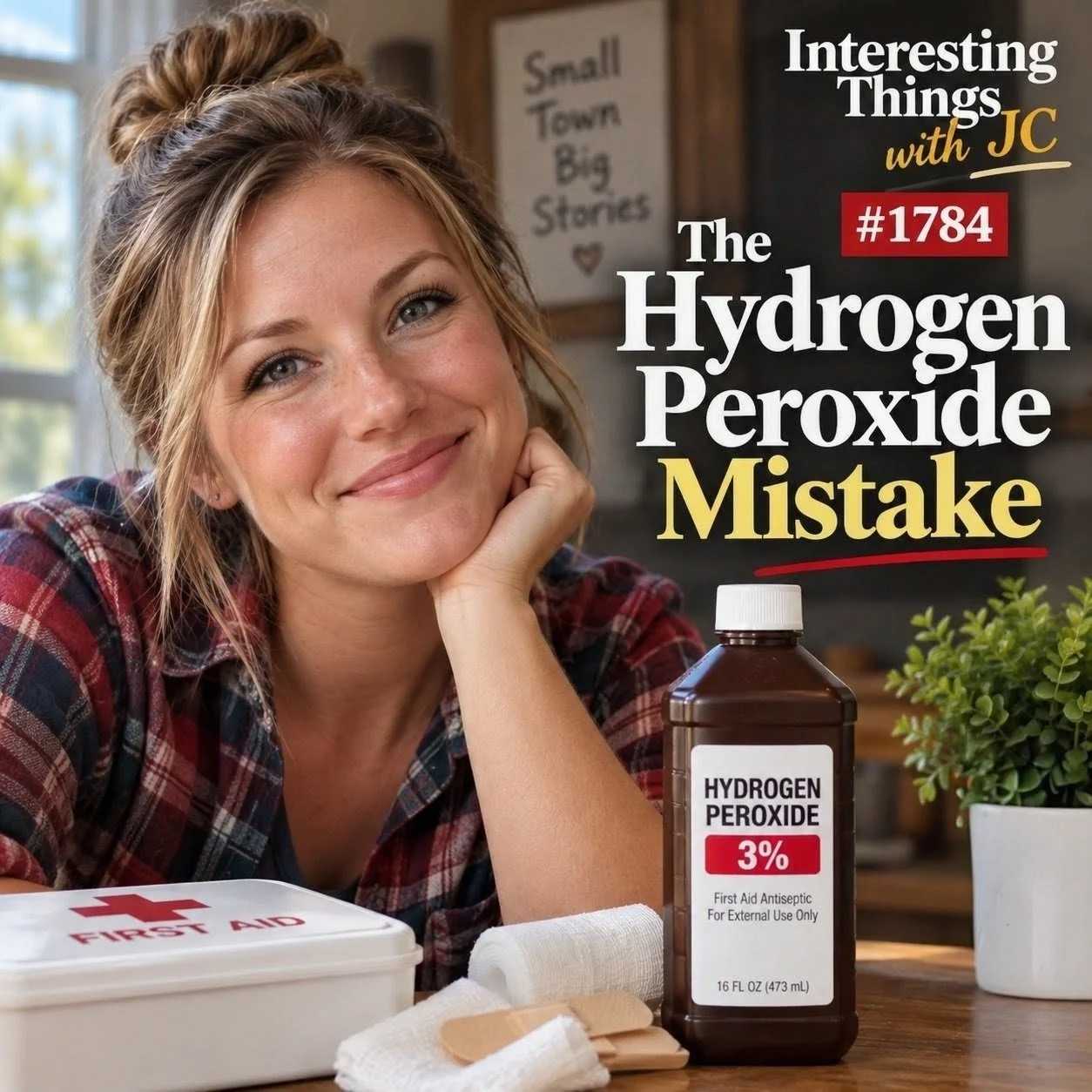
Podcast cover for Interesting Things with JC, episode 1784, “The Hydrogen Peroxide Mistake.” A smiling blonde woman in a red plaid shirt rests her chin on her hand beside a brown bottle of 3% hydrogen peroxide, a first-aid kit, gauze, and bandages. Large white and yellow lettering displays the episode title against a dark background.
Transcript
Interesting Things with JC #1784:
"The Hydrogen Peroxide Mistake"
For generations, treating a scraped knee often meant reaching for a brown bottle of hydrogen peroxide. Pour it on, watch the white foam rise, and it seemed obvious that something useful was happening.
Hydrogen peroxide was discovered in 1818 by French chemist Louis Jacques Thénard (tay-NAR), who called it oxygenated water. By the late nineteenth century, physicians were using it as an antiseptic, and eventually a diluted three-percent solution became common in household first-aid kits.
Its formula is H₂O₂, and that familiar bubbling begins when it meets catalase, an enzyme found in blood and living tissue. Catalase rapidly breaks hydrogen peroxide into water and oxygen gas, producing the foam.
Those bubbles aren't a measure of how many germs are dying. They mainly show that the peroxide is breaking down.
Hydrogen peroxide can kill microorganisms through oxidation, but the same chemistry can damage healthy human cells. Laboratory studies have shown that fibroblasts and keratinocytes, cells responsible for rebuilding connective tissue and skin, are vulnerable to peroxide exposure.
The body also produces hydrogen peroxide in tiny, controlled amounts during wound healing. It acts as a signaling molecule, helping coordinate immune responses and tissue repair. But the three-percent solution in a household bottle is far more concentrated, and repeated exposure can interfere with healing.
For years, people saw those bubbles and assumed the peroxide was cleaning the wound. We now understand that the reaction can also damage the healthy tissue needed for recovery.
For most minor cuts and scrapes, medical guidance favors rinsing with clean running water, gently cleaning the surrounding skin, and protecting the wound with an appropriate dressing.
The next time you reach for that familiar brown bottle, remember that the wound doesn't need to foam to get clean. A little water and a bandage will usually do the job, while your body takes care of the healing.
These are interesting things, with JC.
Student Worksheet
Name: ____________________
Date: ____________________
Episode: 1784 — The Hydrogen Peroxide Mistake
Instructions: Listen to the episode if available, or read the Narrative Core. Answer all questions using complete sentences where appropriate. Support analytical responses with scientific evidence.
Comprehension
What is the chemical formula for hydrogen peroxide?
What enzyme accelerates the breakdown of hydrogen peroxide?
Which gas produces the bubbles seen when hydrogen peroxide contacts damaged tissue?
Why does bubbling fail to prove that bacteria are being killed?
Analysis
5. Interpret the following equation. Identify the reactants, products, and role of catalase.
2H2O2→2H2O+O22H_2O_2 \rightarrow 2H_2O+O_22H2O2→2H2O+O2
Explain how hydrogen peroxide can damage both bacteria and healthy human cells.
A first-aid advertisement claims, "More bubbles mean better cleaning." Evaluate this claim using evidence from the lesson.
Compare the purpose of killing microorganisms with the broader goal of supporting wound healing.
Reflection
Why might people continue using a familiar treatment even when medical recommendations change?
Identify another situation in which a dramatic visible effect could be mistaken for evidence of effectiveness.
Difficulty Scaling
Level 1 — Foundational: Complete questions 1–5 using vocabulary definitions and the chemical equation.
Level 2 — Proficient: Complete all ten questions and support analytical responses with at least one specific scientific explanation.
Level 3 — Advanced: Complete all questions and design a hypothetical controlled study comparing two wound-care approaches. Identify the independent variable, dependent variables, and ethical limitations. Do not experiment on actual wounds.
Student Output: Submit ten numbered responses. Questions 5–10 should include two to four sentences each, except where a longer explanation is necessary. Advanced students should also submit a 150–200-word study proposal.
Academic Integrity Guidance: Use your own words. Distinguish information from the episode description, the instructional narrative, and outside sources. Do not invent research findings or claim that an experiment was performed when it was only proposed.
Teacher Guide
Quick Start: Display the essential question. Ask students to explain what bubbling might indicate before revealing the chemical reaction. Use the episode audio if available; otherwise, read the Narrative Core aloud.
Pacing Guide — Audio First
0–5 minutes: Bell ringer and initial predictions.
5–10 minutes: Episode listening or Narrative Core read-aloud.
10–17 minutes: Explain the chemical equation and catalase.
17–27 minutes: Complete worksheet comprehension and analysis questions.
27–35 minutes: Small-group evidence discussion.
35–42 minutes: Independent assessment.
42–45 minutes: Exit ticket and closing review.
Bell Ringer
Display this statement:
"The bubbles prove the wound is getting cleaner."
Ask students to classify the statement as a fact, inference, or unsupported conclusion. Have them explain their reasoning.
Audio Guidance
Play the complete episode once without interruption when the recording is available.
Ask students to listen for the distinction between visible reactions and medical outcomes.
Replay the relevant explanation if time permits.
Audio Fallback: Read the Narrative Core aloud. Clearly identify it as an instructional adaptation rather than JC's original recording.
Time on Task: 45 minutes, including approximately 10 minutes of listening or reading, 17 minutes of direct instruction and discussion, 10 minutes of written work, and 8 minutes of assessment and review.
Materials
Episode recording, if available
Narrative Core and student worksheet
Writing materials
Whiteboard or projector
Periodic table, optional
Reference materials listed in the References section
Safety Note: Do not apply hydrogen peroxide to students, volunteers, or actual wounds. No chemical demonstration is required.
Vocabulary Prep
Introduce hydrogen peroxide, catalase, and cytotoxicity before the main lesson.
Ask students to distinguish a chemical substance from an enzyme.
Use the reaction equation to connect the vocabulary to observable phenomena.
Misconceptions
Misconception: Bubbles represent dying bacteria. Correction: The bubbles are oxygen gas released during hydrogen peroxide decomposition.
Misconception: Killing microorganisms automatically improves healing. Correction: A treatment's overall effects on healthy tissue also matter.
Misconception: A substance is either completely safe or completely harmful. Correction: Safety depends on concentration, exposure, application, and context.
Misconception: Every wound can be treated at home. Correction: Serious, deep, contaminated, infected, or persistently bleeding wounds may require professional medical care.
Discussion Prompts
What can scientists legitimately conclude from observing bubbles?
What additional evidence would demonstrate that a wound treatment improves healing?
Why might a treatment appropriate for disinfecting an object be inappropriate for living tissue?
How can healthcare professionals communicate changes in recommendations without dismissing patients' experiences?
Formative Checkpoints
Students identify oxygen as the gas produced.
Students distinguish catalase from hydrogen peroxide.
Students explain the difference between antimicrobial activity and improved healing.
Students identify an unsupported conclusion in the advertisement scenario.
Differentiation
Additional Support: Provide a labeled chemical equation and a vocabulary word bank.
Advanced Learners: Require students to distinguish reaction rate from treatment effectiveness and propose measurable healing outcomes.
English Learners: Provide sentence frames such as "The bubbles indicate ___, but they do not establish ___."
Visual Learners: Diagram the conversion of hydrogen peroxide into water and oxygen.
Assessment Differentiation
Foundational: Permit a labeled reaction diagram and three-sentence explanation.
Proficient: Require complete written responses with scientific vocabulary.
Advanced: Require evaluation of experimental controls and potential sources of bias.
Time Flexibility
30-Minute Version: Use the read-aloud, questions 1–8, and exit ticket.
60-Minute Version: Add the advanced experimental-design activity and peer review.
Substitute Readiness: All required instructional content is included in the Narrative Core, worksheet, assessment, and answer key. No laboratory materials or specialized medical knowledge are required.
Engagement Strategy: Conduct an evidence-ranking activity. Present three statements: "It bubbles," "It kills some microorganisms," and "It improves wound healing." Students identify which claims require additional evidence and explain why.
Extensions
Research the biological role of catalase in protecting cells from oxidative damage.
Compare the purpose of disinfecting an inanimate surface with cleaning a minor skin injury.
Design a public-health infographic explaining the difference between visible chemical reactions and clinical effectiveness.
Cross-Curricular Connections
Chemistry: Chemical decomposition, catalysts, and reaction products.
Biology: Cellular injury and tissue repair.
Mathematics: Variables and measurable outcomes in controlled experiments.
English Language Arts: Evaluating claims and supporting conclusions with evidence.
SEL Connection: Practice respectful communication when discussing familiar family first-aid traditions. Emphasize that scientific recommendations can change as evidence develops.
Skill Value Emphasis: Scientific reasoning, evidence evaluation, health literacy, and communication.
Answer Key — Student Worksheet
H₂O₂.
Catalase.
Oxygen gas.
The reaction demonstrates peroxide decomposition, not a measured reduction in bacterial populations.
Hydrogen peroxide is the reactant; water and oxygen are the products. Catalase accelerates the reaction without being consumed.
Hydrogen peroxide participates in oxidative reactions that can damage cellular components in both microorganisms and human cells.
The claim is unsupported. Bubble production indicates oxygen release but does not measure cleaning effectiveness or healing outcomes.
Antimicrobial activity concerns microorganisms. Successful wound healing also requires preservation and repair of living tissue.
Accept responses discussing habit, personal experience, tradition, availability, or misunderstanding of visible effects.
Accept scientifically plausible examples that distinguish an observable effect from a demonstrated outcome.
Quiz Answer Key — Teacher Use Only
B
C
A
D
B
Assessment Guidance: Evaluate the accuracy of the chemistry, recognition of tissue damage, and use of evidence. Accept different conclusions about hypothetical experiments when supported by appropriate scientific reasoning.
Quiz
Instructions: Select the single best answer for each question.
1. What causes hydrogen peroxide to produce bubbles when it contacts damaged tissue?
A. Bacteria release carbon dioxide as they die.
B. Hydrogen peroxide decomposes and releases oxygen gas.
C. Water evaporates from the wound.
D. Skin cells release nitrogen gas.
2. What is the primary role of catalase in this reaction?
A. It creates hydrogen peroxide.
B. It converts oxygen into bacteria.
C. It accelerates hydrogen peroxide decomposition.
D. It prevents all cellular damage.
3. Why is hydrogen peroxide generally discouraged for routine cleaning of minor wounds?
A. It can damage healthy tissue and interfere with healing.
B. It contains no oxygen.
C. It prevents water from contacting the skin.
D. It permanently stops the immune system.
4. Which observation would provide the most direct evidence that a wound treatment improves healing?
A. The treatment produces more bubbles.
B. The treatment changes color.
C. The treatment has a strong odor.
D. Controlled research demonstrates improved healing outcomes.
5. Which statement best summarizes the lesson's central scientific principle?
A. Every antimicrobial substance is appropriate for every wound.
B. A visible chemical reaction does not automatically establish a beneficial medical outcome.
C. All chemical reactions are harmful to human cells.
D. Bacteria are necessary for every wound to heal.
Assessment
Open-Ended Questions
1. Explain the chemical process responsible for hydrogen peroxide bubbling on a scraped knee. Identify the role of catalase, describe the reaction products, and explain why the bubbles do not establish that bacteria have been killed.
2. A student argues that hydrogen peroxide must be an effective wound treatment because it has antimicrobial properties. Evaluate this reasoning using the concepts of cytotoxicity, tissue repair, and evidence-based wound care.
Scoring Rubric — 3–2–1
3 points - Proficient
Accurate scientific explanation, appropriate vocabulary, and clear evidence connecting chemical activity to healing outcomes.
2 points - Developing
Mostly accurate explanation with incomplete evidence, limited vocabulary, or minor conceptual errors.
1 point - Beginning
Limited explanation, major conceptual errors, or insufficient supporting evidence.
Scoring: Award 1–3 points per question, for a maximum of 6 points. A score of 5–6 demonstrates proficiency; 3–4 indicates developing understanding; 2 indicates the need for additional instruction.
Exit Ticket
Complete the sentence: "The bubbles produced by hydrogen peroxide are primarily ______."
Explain in one sentence why antimicrobial activity does not guarantee improved wound healing.
Identify one evidence-supported practice for caring for an ordinary minor scrape.
Expected Responses
Oxygen gas.
Antimicrobial chemicals may also damage healthy cells needed for tissue repair.
Gently clean with water, maintain moisture with petroleum jelly, or protect the wound with a clean dressing.
Assessment Integrity: Students should explain their reasoning independently. Award credit for scientifically equivalent language, not memorized wording alone.
Standards Alignment
NGSS — Science & Engineering Practices
Constructing Explanations and Designing Solutions: Students construct a scientifically supported explanation of peroxide decomposition and its relationship to wound care.
Engaging in Argument from Evidence: Students evaluate the claim that visible bubbling demonstrates treatment effectiveness.
Planning and Carrying Out Investigations: Advanced students design a hypothetical controlled investigation, identifying variables, measurements, and ethical constraints.
NGSS — Disciplinary Core Ideas
HS-PS1-2 — Chemical Reactions: Students use the chemical equation to explain how hydrogen peroxide decomposes into water and oxygen. This supports the standard's emphasis on explaining reaction outcomes, although the lesson does not fully assess its molecular-structure requirements.
HS-LS1-2 — Structure and Function: Students connect the roles of cells and tissues to the broader biological process of wound repair. The lesson provides a supporting application rather than a complete assessment of the performance expectation.
CCSS Reading
CCSS.ELA-LITERACY.RST.9-10.1 — Cite Specific Textual Evidence: Students support explanations of hydrogen peroxide and wound healing using evidence from the instructional text.
CCSS.ELA-LITERACY.RST.11-12.8 — Evaluate Scientific Reasoning: Students evaluate claims about treatment effectiveness by identifying unsupported conclusions and examining scientific evidence.
CCSS Writing
CCSS.ELA-LITERACY.WHST.9-10.1 — Write Arguments: Students develop evidence-based arguments evaluating the effectiveness of hydrogen peroxide for routine wound care.
CCSS.ELA-LITERACY.WHST.11-12.2 — Write Informative/Explanatory Texts: Students explain the chemical reaction and biological implications using accurate terminology.
C3 Framework — Inquiry
D2.Sci.1.9-12 — Science, Technology, and Society: Students investigate how scientific knowledge informs healthcare practices and evaluate the relationship between evidence and decision-making.
D4.1.9-12 — Construct Arguments: Students formulate an argument using evidence and acknowledge the limitations of observations.
ISTE — Knowledge Constructor
- 1.3.b — Evaluate Information: Students assess the credibility, accuracy, and relevance of information used to support health-related claims.
CTE — Health Science
Scientific and Technical Knowledge: Students apply introductory chemistry and biology to a practical healthcare scenario.
Safety Practices: Students distinguish ordinary minor-wound care from injuries requiring professional attention.
Career Readiness Competencies
Critical Thinking: Distinguish observations from conclusions.
Evidence Evaluation: Identify the evidence needed to establish treatment effectiveness.
Communication: Explain scientific findings in accessible language.
Professional Judgment: Recognize when established practices should be reconsidered in light of evidence.
UK National Curriculum — Key Stage 4
Chemistry — Chemical Changes: Interpret the decomposition reaction and identify the products.
Biology — Health and Disease: Explain the importance of protecting living tissue and preventing infection.
IB — Middle Years Programme
Sciences — Criterion A, Knowing and Understanding: Apply scientific knowledge to explain a familiar chemical reaction.
Sciences — Criterion D, Reflecting on the Impacts of Science: Evaluate the implications of scientific understanding for everyday healthcare decisions.
Homeschool and Lifelong Learning
Scientific Literacy: Explain why an observable effect is not sufficient proof of effectiveness.
Practical Health Literacy: Identify evidence-supported approaches to ordinary minor-wound care.
Independent Inquiry: Compare a familiar practice with contemporary medical guidance.
Show Notes
Hydrogen peroxide has long been associated with cleaning cuts and scrapes, but the familiar bubbling reaction is often misunderstood. In episode 1784, "The Hydrogen Peroxide Mistake," Interesting Things with JC explores the chemistry behind the foam and the important distinction between killing microorganisms and supporting wound healing. Students investigate how catalase breaks down hydrogen peroxide, why oxygen bubbles do not prove that bacteria are dying, and how a substance with antimicrobial properties can also damage healthy tissue. The episode connects chemistry, biology, and health literacy while challenging learners to distinguish dramatic observations from meaningful scientific evidence. The lesson encourages students to examine familiar practices critically and understand why healthcare recommendations must consider both effectiveness and potential harm.
References
American Academy of Dermatology Association. (2022). How to treat minor cuts. https://www.aad.org/public/everyday-care/injured-skin/burns/treat-minor-cuts
American Academy of Dermatology Association. (2025). Minimize a scar: Proper wound care tips from dermatologists. https://www.aad.org/public/everyday-care/injured-skin/burns/wound-care-minimize-scars
Cleveland Clinic. (2025). Antiseptic: What is it, types & how it's used. https://my.clevelandclinic.org/health/articles/antiseptics
Cleveland Clinic. (2026). Hydrogen peroxide: When to use it and when to skip it. https://health.clevelandclinic.org/what-is-hydrogen-peroxide-good-for
MedlinePlus. (2025). Cuts and puncture wounds. U.S. National Library of Medicine. https://medlineplus.gov/ency/article/000043.htm
MedlinePlus. (n.d.). Surgical wound care — open. U.S. National Library of Medicine. https://medlineplus.gov/ency/patientinstructions/000040.htm
MedlinePlus. (2026). How wounds heal. U.S. National Library of Medicine. https://medlineplus.gov/ency/patientinstructions/000741.htm