1786: "9 to 5 - The Movie"
Interesting Things with JC #1786: "9 to 5 - The Movie"
Jane Fonda, Lily Tomlin and Dolly Parton worked inside a fake office built around problems real working women were reporting: low wages, blocked promotions and sexual harassment. The comedy exaggerated the revenge, but the workplace problems came directly from women who had been organizing for change since the 1970s.
Curriculum - Episode Anchor
Episode Title: 9 to 5
Episode Number: 1786
Host: JC
Audience: Grades 9–12, introductory college, homeschool, lifelong learners
Subject Area: U.S. history, film studies, English Language Arts, workplace history, media literacy
Curriculum Basis: Interesting Things with JC Curriculum Framework System, Version 5.0.
Lesson Overview
Learning Objectives
Explain how the experiences of women office workers influenced the development of 9 to 5.
Distinguish between the film's exaggerated comedy and the documented workplace concerns that inspired it.
Analyze how filmmakers can transform research and firsthand experiences into fictional characters and situations.
Evaluate how the film's theme song, characters, and later adaptations extended the story's cultural reach.
Essential Question: How can entertainment use comedy and fictional exaggeration to communicate real experiences from the workplace?
Success Criteria: Students can identify at least three connections between historical workplace concerns and the film, support an interpretation with evidence from the episode, and explain why comedy became important to the filmmakers' approach.
Student Relevance Statement: Questions about workplace expectations, advancement, compensation, treatment by supervisors, and balancing work with personal responsibilities remain relevant to students preparing for employment.
Real-World Connection: The episode demonstrates how interviews, observation, and research can become source material for movies, music, television, and theater.
Workforce Reality: Workplace cultures and employment protections change over time. Understanding job responsibilities, compensation, advancement procedures, professional boundaries, and organizational policies can help workers evaluate their own workplaces.
Key Vocabulary
Terms
Clerical (KLAIR-ih-kul) — Relating to office work such as typing, filing, correspondence, recordkeeping, and administrative support.
Sexual harassment (SEK-shoo-ul huh-RASS-ment) — Unwelcome sexual conduct or other sex-based conduct that can affect a person's employment or working environment.
Pay equity (pay EK-wih-tee) — The principle of fair compensation without unjustified disparities.
Promotion (pruh-MOH-shun) — Advancement to a position carrying greater responsibility, status, or compensation.
Undercover research (UN-der-kuv-er REE-surch) — Gathering information while concealing or limiting disclosure of the researcher's purpose or identity.
Workplace culture (WORK-plays KUL-chur) — Shared practices, expectations, behaviors, and norms within an organization.
Satire (SAT-eye-er) — The use of humor, exaggeration, or ridicule to expose problems or criticize behavior.
Adaptation (ad-ap-TAY-shun) — A work transformed from one medium or format into another.
Narrative Core
Open: The office of Consolidated Companies looked like a functioning corporate workplace, but much of it was constructed for the film. Behind the fictional setting, however, were workplace experiences drawn from real women.
Info: Jane Fonda's idea was influenced by the organization 9to5, founded by clerical workers in 1973. The organization emerged from concerns that included workplace inequities, harassment, discrimination, compensation, and advancement. Screenwriter Patricia Resnick also conducted firsthand research by posing as a secretary.
Details: An early dramatic approach was transformed into comedy. The fictional Franklin Hart Jr. became the target of increasingly absurd revenge scenarios, while Violet, Doralee, and Judy represented recognizable workplace problems. Dolly Parton, making her theatrical film debut, memorized the screenplay and wrote the title song during production, using the sound of her acrylic fingernails as rhythmic inspiration.
Reflection: The film illustrates a storytelling technique in which exaggeration can coexist with recognizable social experience. Kidnapping a boss and suspending him from a ceiling are comic inventions; concerns about promotion, harassment, compensation, and working conditions came from experiences women workers were already discussing and organizing around.
Closing: These are interesting things, with JC.
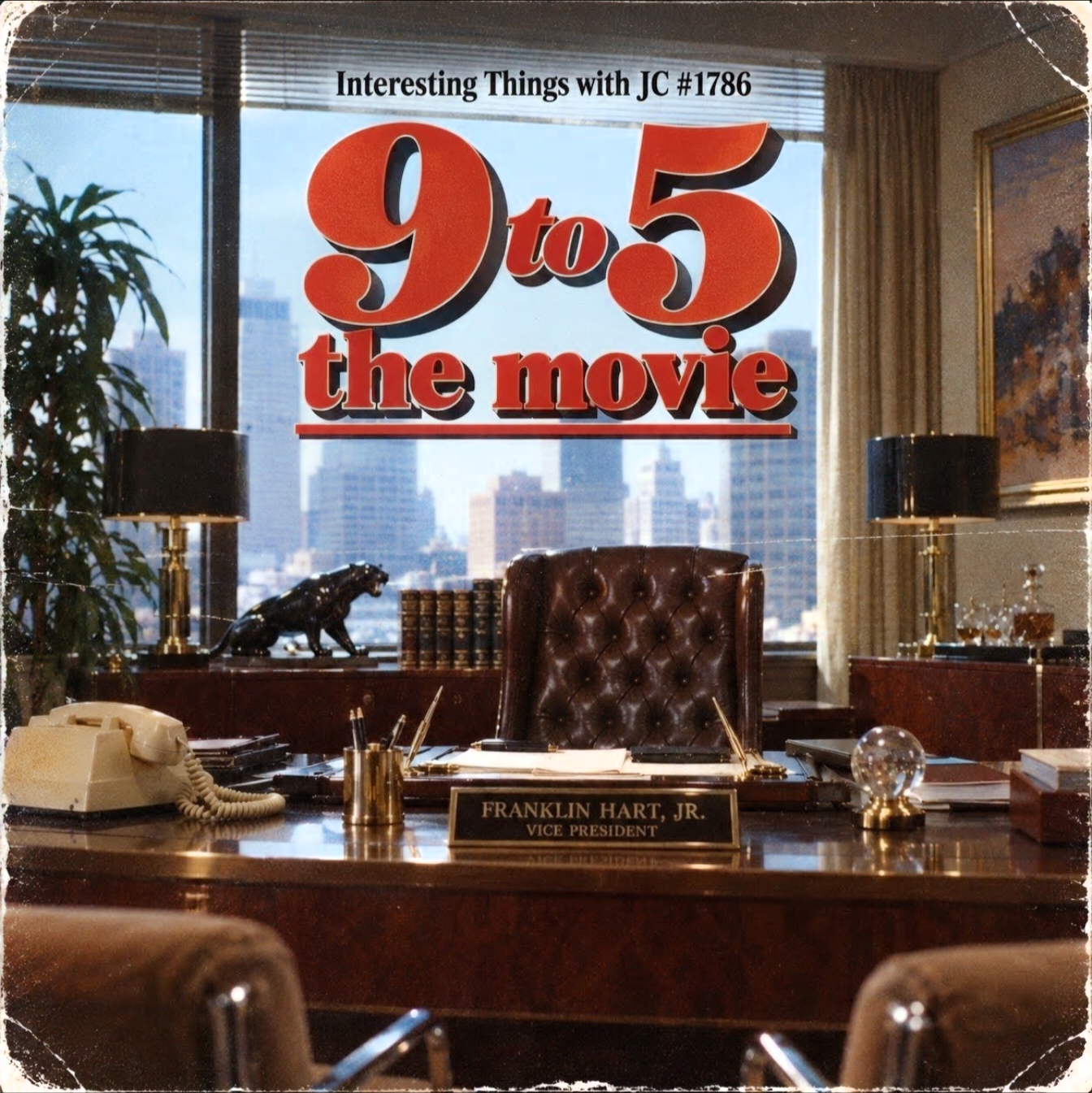
Podcast cover art for Interesting Things with JC #1786: 9 to 5 the Movie. A richly furnished 1980s executive office features a large wooden desk, brown tufted leather chair, cream rotary telephone, brass lamps, black panther sculpture, books, and a city skyline through tall windows. A desk nameplate reads “Franklin Hart, Jr., Vice President.” Small text at the top reads “Interesting Things with JC #1786,” with the large cream-and-red title “9 to 5 the movie” centered prominently above the desk.
Transcript
Interesting Things with JC #1786:
"9 to 5 - the Movie"
The office in 9 to 5 was called Consolidated Companies, and almost everything about it was fake. The elevators didn't work. The bathrooms were sets. The conference rooms, executive offices, bulletin boards and company signs were built at Twentieth Century-Fox. But the problems inside that office came from real working women.
Jane Fonda got the idea from 9to5, the organization Boston office workers had started in 1973. Women were organizing around low wages, limited opportunities for promotion, sexual harassment and the expectations placed on secretaries whose responsibilities often went well beyond their job descriptions. Fonda met with working women and listened to their experiences, while writer Patricia Resnick went undercover as a secretary at a large insurance brokerage company to see that world for herself.
The first version wasn't a comedy. It was a drama, and Fonda thought it had become too dreary and preachy. The direction changed when the filmmakers heard something else from the women they were interviewing: some had elaborate fantasies about what they'd like to do to their bosses.
That gave them their way into the story. The workplace could stay recognizable while the revenge became ridiculous.
So Franklin Hart Jr., played by Dabney Coleman, gets poisoned, shot at, kidnapped and eventually suspended from his bedroom ceiling in a bondage harness. Hart may have been exaggerated, but the problems weren't. Violet is passed over for a promotion. Doralee deals with sexual rumors Hart spreads about her. Judy is trying to enter the workforce after her marriage ends.
Lily Tomlin initially turned down the role of Violet. She had just finished another long film shoot and wasn't eager to start again, but her partner, Jane Wagner, convinced her to reconsider. If Tomlin required persuasion, Dolly Parton was an even bigger gamble.
Parton was already a country music star, but she'd never made a movie. She prepared by memorizing the entire screenplay, including everybody else's lines, apparently not realizing that movies aren't normally filmed from page one straight through to the end. She arrived for her first film knowing considerably more of the script than she needed.
Then she wrote the theme song.
Parton discovered that clicking her acrylic fingernails together sounded like typing. She used them to establish the rhythm of "9 to 5," a song that went to number one, earned an Academy Award nomination and won two Grammys.
Once Violet, Judy and Doralee take control of Consolidated, they introduce flexible hours, job sharing, equal-pay measures and an on-site daycare center. Productivity improves so much that company chairman Russell Tinsworthy arrives, assumes Hart deserves the credit and wants the changes expanded throughout the company.
Hart's greatest professional achievement happens while three women are secretly doing his job.
The closing titles have a little more fun with everybody. Violet becomes a vice president. Judy marries the Xerox representative. Doralee leaves Consolidated and becomes a country-and-western singer.
Hart gets sent to Brazil, where he's eventually abducted by a tribe of Amazons and never heard from again.
The movie opened in December 1980 and became one of the year's biggest hits. Its success led to a television series in 1982, but Dolly didn't return as Doralee. The role went to her younger sister, Rachel Dennison. Years later, 9 to 5 became a Broadway musical, with Dolly writing the music and lyrics.
There's also a small credit near the end of the original movie that's easy to overlook. The filmmakers thanked Working Women, the National Association of Office Workers, for its help and encouragement.
That credit brings the movie back to where it started.
Before there was a movie called 9 to 5, women were already organizing under that name. Before Dolly sang about barely getting by, they were talking about wages. Before Violet was passed over, they were talking about promotions. Before Doralee confronted Hart, they were talking about harassment.
Hollywood supplied the poisoned coffee, the kidnapping, the bondage harness, and the fake office.
The women supplied the stories.
These are interesting things, with JC.
Student Worksheet
Comprehension
What organization helped inspire Jane Fonda's idea for 9 to 5?
What research did Patricia Resnick conduct while developing the screenplay?
Why did the filmmakers move away from the original dramatic approach?
Identify one workplace problem associated with each of Violet, Doralee, and Judy.
How did Dolly Parton's fingernails contribute to the title song?
Analysis
Explain the episode's distinction between a "fake" office and "real" workplace problems. Why is this contrast important?
How does Franklin Hart function as an exaggerated character while still allowing the film to address recognizable workplace issues?
What is ironic about Tinsworthy crediting Hart for the improvements at Consolidated?
Why might comedy have allowed the filmmakers to address workplace problems differently from a serious drama?
Compare the real 9to5 organization's concerns with two problems depicted in the fictional Consolidated Companies.
Reflection
Can exaggerated comedy help an audience understand a serious problem? Use 9 to 5 as evidence for your answer.
What can creators gain by listening directly to people who have experienced the subject they are depicting?
Difficulty Scaling
Level 1 — Recall: Answer Questions 1–5 using specific details from the episode.
Level 2 — Interpretation: Answer Questions 6–10 using complete sentences and supporting evidence.
Level 3 — Synthesis: Answer Questions 11–12 and connect the episode to a different film, book, workplace, historical example, or contemporary situation.
Student Output: Complete Questions 1–10 plus one reflection question. Analysis responses should contain 3–5 sentences and cite specific episode details.
Academic Integrity Guidance: Base responses on your own interpretation of the episode. When using outside research, identify the source and distinguish its information from your own analysis.
Teacher Guide
Quick Start: Play or read the episode first without interruption. Students then identify which details describe filmmaking and which describe workplace history before completing the worksheet.
Pacing Guide — Audio First
0–5 minutes: Bell ringer and introduce the essential question.
5–12 minutes: Play the complete episode without interruption.
12–20 minutes: Review vocabulary and distinguish historical evidence from fictional plot elements.
20–35 minutes: Students complete comprehension and analysis questions.
35–45 minutes: Conduct discussion using Questions 6, 8, and 9.
45–52 minutes: Complete reflection or assessment.
52–55 minutes: Exit ticket.
Bell Ringer: Think of a comedy that deals with a serious subject. In 2–3 sentences, explain whether humor made the subject easier or harder to understand.
Audio Guidance: Play the complete episode once before providing detailed explanations so students encounter the narrative in its intended sequence.
Audio Fallback: If audio is unavailable, have students silently read the transcript, then assign alternating paragraphs for a second read aloud.
Time on Task: Approximately 45–55 minutes for one class period; 75–90 minutes when completing the extended assessment.
Materials
Episode audio or transcript
Student worksheet
Writing materials or digital response platform
Optional access to reference sources for extension research
Vocabulary Prep
Preteach clerical, satire, pay equity, and adaptation.
Ask students to identify vocabulary terms when they appear conceptually in the transcript.
Misconceptions
The film did not create the organization 9to5; the organization predates the movie.
Consolidated Companies was fictional, even though the film drew upon real workplace experiences.
Dolly Parton was an established recording artist but 9 to 5 was her theatrical film debut.
The movie's absurd revenge plot should not be confused with the real organizing activities described in the episode.
Discussion Prompts
What changes when a real workplace concern is represented through comedy?
Why does firsthand research matter when creating fictional characters?
What does Tinsworthy's reaction reveal about recognition and credit within the story?
Why is the acknowledgment of Working Women in the film credits significant?
Formative Checkpoints
Students correctly distinguish the organization 9to5 from the movie.
Students identify at least three real workplace concerns represented in the story.
Students explain the dramatic-to-comedic shift in their own words.
Students support one analytical claim with transcript evidence.
Differentiation
Additional Support: Provide a two-column organizer labeled "Film Fiction" and "Historical/Workplace Basis."
Advanced Learners: Analyze satire as a storytelling strategy and evaluate what may be gained or lost through exaggeration.
English Learners: Preview vocabulary and allow students to locate transcript evidence before answering orally or in writing.
Assessment Differentiation: Students may demonstrate understanding through a written response, structured oral explanation, or evidence-based concept map while maintaining the same content expectations.
Time Flexibility: For a 30-minute lesson, use Questions 1–5 and 8–9. For a block period, add outside research comparing the episode with documented history.
Substitute Readiness: Provide the transcript, worksheet, and answer key. No prior knowledge of the film is required.
Engagement Strategy: Have students mark every episode detail as "production," "fictional story," or "historical/workplace context," then discuss details that connect multiple categories.
Extensions
Research the history of 9to5 and compare its documented concerns with those depicted in the film.
Investigate the 1982 television adaptation.
Compare the movie with the Broadway musical and identify what changes when a story moves from film to stage.
Analyze how a theme song can reinforce a film's central ideas without quoting its lyrics.
Cross-Curricular Connections
History: Women's employment and office culture during the 1970s and 1980s.
ELA: Satire, characterization, irony, and adaptation.
Media Studies: Research, screenwriting, production design, and fictionalization.
Career Readiness: Workplace expectations, advancement, professional conduct, and organizational culture.
SEL Connection: Students can examine perspective-taking by considering how listening to workers' experiences affected the development of fictional characters.
Skill Value Emphasis: Source evaluation, evidence-based reasoning, media literacy, historical contextualization, and communication.
Answer Key
9to5, an organization founded by office workers in 1973.
Resnick posed as a secretary at a large insurance brokerage company.
The original drama was considered too dreary and preachy; stories about workers' revenge fantasies helped suggest a comedic approach.
Violet: denied advancement; Doralee: sexual rumors/harassment; Judy: entering the workforce following the end of her marriage.
Parton clicked her acrylic fingernails together, creating a typewriter-like rhythm that helped shape the song.
The physical workplace was manufactured for a movie, while the workplace concerns drew upon experiences reported by actual workers.
Hart's behavior and punishment are exaggerated for comedy, while his conduct provides a vehicle for depicting concerns involving harassment, recognition, and advancement.
Hart receives recognition for changes implemented while Violet, Judy, and Doralee are actually running the office.
Strong answers should explain how exaggeration and absurdity can make difficult subjects approachable while preserving recognizable conflicts.
Accept supported comparisons involving compensation, advancement, harassment, workplace expectations, or related concerns.
11–12. Answers will vary; require clear reasoning and specific evidence.
Quiz
Multiple Choice
What existed before the film 9 to 5?
A. The Broadway musical
B. The organization 9to5
C. Consolidated Companies
D. The television adaptationWhat did Patricia Resnick do as part of her research?
A. Worked undercover as a secretary
B. Directed workplace documentaries
C. Managed a film studio office
D. Interviewed only corporate executivesWhat helped shift the project from drama toward comedy?
A. A request from the television network
B. Dolly Parton's theme song
C. Stories about workers' fantasies involving their bosses
D. A decision to eliminate workplace issuesWhat was unusual about Dolly Parton's preparation for her first film?
A. She designed the office sets.
B. She memorized the entire screenplay.
C. She wrote Violet's dialogue.
D. She had previously played Doralee on television.What happens when Tinsworthy sees the improved company performance?
A. He immediately promotes all three women.
B. He closes Consolidated Companies.
C. He assumes Hart deserves the credit.
D. He discovers the kidnapping immediately.
Assessment
Open-Ended Questions
Explain how 9 to 5 combined fictional exaggeration with workplace experiences drawn from real women. Use at least three specific details from the episode.
Analyze the statement, "Hollywood supplied the poisoned coffee, the kidnapping, the bondage harness, and the fake office. The women supplied the stories." What distinction does this ending ask the listener to understand?
3–2–1 Rubric
3 — Proficient: Presents a clear claim, uses three or more accurate details, distinguishes fiction from historical context, and explains the significance of the evidence.
2 — Developing: Presents a reasonable claim and some accurate evidence but provides limited explanation or an incomplete distinction between fiction and historical context.
1 — Beginning: Provides minimal evidence, contains significant misunderstandings, or summarizes without analyzing the question.
Exit Ticket: In two sentences, identify one element of 9 to 5 that was deliberately exaggerated and one workplace concern rooted in the experiences discussed by real workers.
Standards Alignment
NGSS — Science & Engineering Practices
SEP 8 — Obtaining, Evaluating, and Communicating Information — Students distinguish narrative claims, historical context, and supporting sources, then communicate an evidence-based interpretation.
CCSS Reading
CCSS.ELA-LITERACY.RI.9-10.1 — Cite strong and thorough textual evidence — Students support worksheet and assessment responses with specific transcript evidence.
CCSS.ELA-LITERACY.RI.11-12.3 — Analyze a complex set of ideas or sequence of events — Students trace the progression from workplace experiences and research to screenplay, comedy, song, and adaptations.
CCSS Writing
CCSS.ELA-LITERACY.W.9-10.9 — Draw evidence from informational texts — Students integrate episode evidence into analytical responses.
C3 Framework
D2.His.14.9-12 — Analyze multiple and complex causes and effects of events in the past — Students examine relationships among changing workplace experiences, worker organization, filmmaking, and cultural representation.
ISTE / CTE
Knowledge Constructor — 1.3 — Students evaluate information from the episode and optional external sources to construct an evidence-based understanding of media and workplace history.
Career Readiness Competencies
Critical Thinking: Distinguish entertainment conventions from historically grounded concerns.
Communication: Present claims supported by relevant evidence.
Professional Awareness: Recognize how compensation, advancement, responsibilities, organizational culture, and professional boundaries affect workplace experience.
Homeschool/Lifelong Learning: Learners can independently use the transcript, worksheet, and reference material to practice historical inquiry, media literacy, source evaluation, and analytical writing.
Show Notes
9 to 5 turned a fictional corporate office into a comedy built partly from workplace experiences women were already discussing and organizing around. This episode traces the connection between the 1973 organization 9to5, Jane Fonda's development of the film, Patricia Resnick's research, Lily Tomlin and Dolly Parton's casting, Parton's famous title song, and the movie's later television and Broadway adaptations. For classrooms, the story offers a useful case study in satire, historical context, adaptation, workplace culture, and the ways firsthand experiences can become source material for popular entertainment.
References
American Film Institute. (n.d.). Nine to Five (1980). AFI Catalog. https://catalog.afi.com/Catalog/MovieDetails/56473
American Film Institute. (2020, April 15). AFI Movie Club: Nine to Five. https://www.afi.com/news/afi-movie-club-nine-to-five/
Academy of Motion Picture Arts and Sciences. (1981). The 53rd Academy Awards: 1981. https://www.oscars.org/oscars/ceremonies/1981
The Recording Academy. (n.d.). Dolly Parton: Artist. https://www.grammy.com/artists/dolly-parton/17205
The Numbers. (n.d.). 9 to 5 (1980): Box office and financial information. https://www.the-numbers.com/movie/9-to-5-%281980%29
9to5. (n.d.). History. https://9to5.org/about-us/history/
9to5. (2021, January 28). 9to5: Then & Now. https://9to5.org/9to5-then-now/
Playbill. (2009). 9 to 5. https://playbill.com/production/9-to-5-marquis-theatre-vault-0000008177
Playbill. (2009, April 7). What a way to make a livin': 9 to 5: The Musical begins Broadway run April 7. https://playbill.com/article/what-a-way-to-make-a-livin-9-to-5-the-musical-begins-broadway-run-april-7-com-159703