1787: "Does Apple Cider Turn Into Alcohol?!
Interesting Things with JC #1787: "Does Apple Cider Turn Into Alcohol?!"
Fresh apple cider starts bubbling. The sweetness drops. Alcohol is forming, and the process may not stop there.
Curriculum - Episode Anchor
Episode Title: Does Apple Cider Turn Into Alcohol?!
Episode Number: 1787
Host: JC
Audience: Grades 9–12, introductory college, homeschool, lifelong learners
Subject Area: Biology, chemistry, food science, microbiology, scientific literacy
Lesson Overview
Learning Objectives
Explain how yeast converts sugars in apple cider into ethanol and carbon dioxide through alcoholic fermentation.
Distinguish alcoholic fermentation from the oxidation of ethanol to acetic acid by acetic acid bacteria.
Analyze how microorganisms, oxygen, processing, and environmental conditions influence whether apple juice remains sweet cider, becomes hard cider, or progresses toward vinegar.
Use evidence from the episode and scientific sources to construct an accurate cause-and-effect explanation of cider transformation.
Essential Question: How can microorganisms and environmental conditions transform the same apple sugars into products with very different chemical properties?
Success Criteria: Students can accurately sequence sugar → ethanol + carbon dioxide → acetic acid; identify the microorganisms involved; explain the role of oxygen in vinegar production; and distinguish treated commercial cider from untreated cider.
Student Relevance Statement: Fermentation appears in foods and beverages students encounter regularly, including bread, yogurt, cider, vinegar, and other fermented products. Understanding the process connects everyday observations such as bubbling, changing sweetness, and pressure with microbiology and chemistry.
Real-World Connection: Fermentation is intentionally controlled in food production, biotechnology, agriculture, and beverage manufacturing. Temperature, microorganisms, sugar concentration, oxygen exposure, sanitation, and processing conditions can change the final product.
Workforce Reality: Food scientists, microbiologists, fermentation specialists, quality-control technicians, agricultural scientists, brewers, cider makers, and food-safety professionals monitor microorganisms and chemical changes to produce consistent and safe products.
Key Vocabulary
Terms
Fermentation (fur-men-TAY-shun) — A metabolic process in which microorganisms such as yeast convert organic compounds; in alcoholic fermentation, sugars ultimately yield ethanol and carbon dioxide.
Yeast (yeest) — Single-celled fungi; certain yeasts carry out alcoholic fermentation.
Ethanol (ETH-uh-nawl) — The alcohol produced during alcoholic fermentation.
Carbon dioxide (KAR-bun dye-OK-side) — CO₂, a gas produced during alcoholic fermentation that can create bubbles and increase pressure in a closed container.
Fructose (FRUK-tohs) — A simple sugar naturally present in fruit, including apples.
Glucose (GLOO-kohs) — A simple sugar that microorganisms can metabolize as an energy source.
Sucrose (SOO-krohs) — A sugar composed of glucose and fructose units and present in varying amounts in fruits and other plants.
Acetic acid (uh-SEE-tik ASS-id) — The organic acid largely responsible for vinegar's characteristic acidity and sharp flavor.
Acetic acid bacteria (uh-SEE-tik ASS-id bak-TEER-ee-uh) — Aerobic bacteria capable of oxidizing ethanol to acetic acid; relevant genera include Acetobacter and Komagataeibacter.
Pasteurization (pas-chur-ih-ZAY-shun) — Heat treatment used to destroy pathogens and reduce microbial hazards in foods and beverages.
Narrative Core
Open: A jug of fresh apple cider can appear unchanged while microscopic organisms begin altering its chemistry. Bubbling, fading sweetness, and pressure are observable clues that a biological and chemical transformation may be occurring.
Info: Apples provide fermentable sugars. When suitable yeast is present, alcoholic fermentation converts products of sugar metabolism into ethanol and carbon dioxide. The carbon dioxide accounts for bubbling and can contribute to pressure in a closed container.
Details: Hard cider is produced by fermenting apple juice with yeast and commonly contains approximately 5–10% alcohol by volume. The transformation does not necessarily end with ethanol. In the presence of oxygen, acetic acid bacteria can oxidize ethanol into acetic acid, moving an alcoholic liquid toward vinegar. Commercial processing changes the microbial starting conditions: pasteurization and other treatments are used to reduce microbial hazards, while untreated cider can contain microorganisms and requires appropriate food-safety handling.
Reflection: The starting material can remain essentially the same while biological agents and environmental conditions redirect its chemistry. The sequence illustrates how microorganisms participate in chemical transformations and why controlling a biological process matters in food production.
Closing: These are interesting things, with JC.
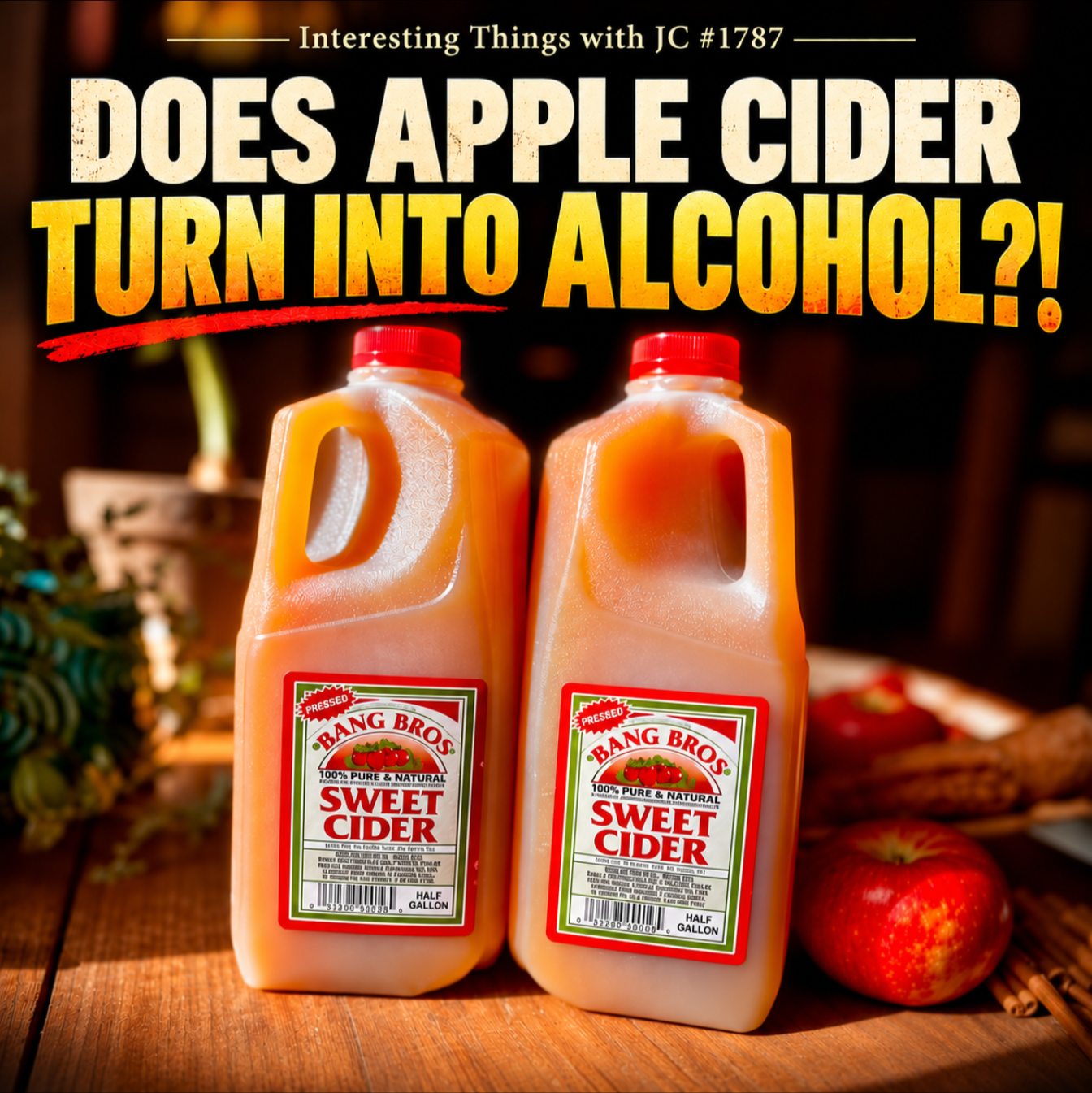
Cover art for Interesting Things with JC #1787. Two plastic jugs of amber apple cider with red caps sit on a wooden table beside red apples and cinnamon sticks. The cider labels read “Bang Bros Sweet Cider.” Large cream and yellow text above the jugs asks, “Does Apple Cider Turn Into Alcohol?!” A smaller line across the top reads, “Interesting Things with JC #1787.”
Transcript
Interesting Things with JC #1787:
"Does Apple Cider Turn Into Alcohol?!"
Leave the right jug of fresh apple cider sitting around long enough, and it may begin doing something you never asked it to do. The cider can start bubbling, pressure can build inside a closed container, the sweetness can fade, and eventually that innocent jug of cider may contain alcohol.
Fresh cider already has what the process needs because apples contain natural sugars, including fructose, glucose, and sucrose. Introduce yeast, whether it arrives naturally or is deliberately added by a cider maker, and those sugars become a food source.
The process is alcoholic fermentation. Yeast consumes sugar and produces ethanol and carbon dioxide, which explains the bubbles and why pressure can build in a sealed container. As fermentation continues, the cider becomes less sweet while its alcohol content rises. Hard cider commonly ends up around 5 to 10 percent alcohol by volume, depending on the apples, yeast, and fermentation conditions.
But the chemistry can keep going. If that ethanol is exposed to oxygen and certain acetic acid bacteria, including Acetobacter, the alcohol can be oxidized into acetic acid, the compound responsible for vinegar's characteristic sharpness.
So the same apple can pass through a remarkable sequence. Its sugars begin in fresh cider. Yeast can turn those sugars into alcohol, and under different conditions, bacteria can take that alcohol and move the cider toward vinegar.
That doesn't mean every jug from the grocery store is waiting to become alcoholic. Commercial cider is commonly pasteurized or otherwise treated to reduce microorganisms, while fresh untreated cider is more susceptible to natural fermentation.
And that's what makes a bubbling jug of fresh cider more than fruit juice getting old. The apple supplied the sugar from the beginning; microorganisms simply changed what happened to it. Sweet cider, hard cider, and apple cider vinegar can all begin with the same fruit, separated by which microorganisms arrive, the conditions around them, and where the process is stopped.
Sometimes the difference between apple cider, alcohol, and vinegar isn't the apple at all. It's what gets the chance to live in it.
These are interesting things, with JC.
Student Worksheet
Comprehension
What three sugars does the episode identify as naturally present in apples?
What microorganism is primarily responsible for alcoholic fermentation in cider?
What two major products result from alcoholic fermentation as described in the episode?
Why can pressure increase when cider ferments inside a closed container?
What substance must be present before acetic acid bacteria can move cider toward vinegar?
Analysis
Construct a three-stage sequence beginning with fresh cider and ending with vinegar. For each stage, identify the important chemical substance and microorganism.
A jug becomes less sweet while producing bubbles. What process most plausibly explains both observations? Support your answer with two pieces of evidence from the episode.
Explain why oxygen exposure has different significance during the transition from alcoholic cider toward vinegar.
Compare pasteurized or otherwise treated commercial cider with untreated fresh cider. How does microbial control change what is likely to happen?
Explain why the statement “old apple juice automatically becomes vinegar” is scientifically incomplete.
Reflection
What does the cider example demonstrate about the ability of microorganisms to change the chemical properties of food?
Identify another food-production process involving microorganisms. What similarities or differences would you investigate?
Difficulty Scaling
Level 1 — Identify: Name the organisms, starting materials, and products involved.
Level 2 — Explain: Describe cause-and-effect relationships among sugar consumption, bubbling, alcohol formation, and vinegar production.
Level 3 — Analyze: Predict how changing oxygen exposure, microbial populations, processing, or fermentation conditions could alter the pathway.
Student Output: Complete Questions 1–10 using complete sentences where explanation is required. Questions 11–12 may be completed as a 150–250-word written reflection or a teacher-approved equivalent.
Academic Integrity Guidance: Use the episode and assigned scientific sources as evidence. Distinguish information taken from sources from your own reasoning. Do not present copied or AI-generated explanations as original work; verify scientific claims and cite sources when required by your instructor.
Teacher Guide
Quick Start: Play or read the episode once without interruption. On the second pass, ask students to track four elements: starting material, microorganism, product, and environmental condition.
Pacing Guide — Audio First
0–5 minutes: Bell ringer and prediction.
5–10 minutes: First uninterrupted episode listen.
10–15 minutes: Vocabulary check and student reconstruction of the process.
15–25 minutes: Second listen/read with evidence annotation.
25–38 minutes: Student Worksheet Questions 1–10.
38–47 minutes: Discussion and misconception correction.
47–52 minutes: Assessment or extension.
52–55 minutes: Exit Ticket.
Bell Ringer: “A sealed jug of fresh cider begins bubbling and becomes less sweet. List two possible explanations for what is happening. What evidence would help you decide?”
Audio Guidance: During the first listen, students should focus on the story rather than take extensive notes. During the second listen, students record the sequence of transformations and the organisms responsible.
Audio Fallback: If audio is unavailable, use the verbatim transcript. Assign alternating paragraphs to readers or provide silent reading time before discussion.
Time on Task: Approximately 45–55 minutes for one class period; 70–90 minutes with the extension activity.
Materials
Episode audio or transcript
Student Worksheet
Paper or digital notebook
Board or display
Optional molecular models or fermentation-process diagram
Teacher-selected reference materials
Vocabulary Prep
Introduce fermentation, ethanol, carbon dioxide, acetic acid, and pasteurization before the second listen.
Have students classify vocabulary as organism, substance, process, or treatment.
Reinforce the distinction between yeast and bacteria.
Misconceptions
“Fermentation just means food has spoiled.” Fermentation is a specific biological process and can be intentionally controlled in food production.
“Yeast makes vinegar directly from apple sugar.” Yeast produces ethanol during alcoholic fermentation; acetic acid bacteria can subsequently oxidize ethanol toward acetic acid.
“Bubbles mean the cider is boiling.” During fermentation, carbon dioxide can create visible bubbling without boiling.
“Any cider left out will predictably become hard cider or vinegar.” Microbial populations and environmental conditions vary, and uncontrolled food should not be treated as a predictable fermentation experiment.
“Acidic juice cannot contain harmful microorganisms.” Acidity alone does not guarantee that untreated cider is free of foodborne hazards.
Discussion Prompts
Why does declining sweetness provide evidence about what microorganisms are doing?
How does carbon dioxide provide observable evidence of a process occurring at the cellular level?
Why is oxygen an important variable in the progression toward vinegar?
What variables would a commercial cider maker need to control for consistency?
How does pasteurization change the biological conditions without changing the fact that the juice originally came from apples?
Formative Checkpoints
Students correctly identify yeast rather than bacteria as the organism responsible for alcoholic fermentation.
Students identify ethanol and carbon dioxide as products associated with alcoholic fermentation.
Students distinguish alcoholic fermentation from acetic acid production.
Students include oxygen when explaining the activity of acetic acid bacteria.
Students explain why food processing affects microbial activity.
Differentiation
Additional Support: Provide a partially completed flowchart: apple sugars → ______ → ethanol + CO₂ → ______ → acetic acid.
Advanced Learners: Have students investigate the biochemical steps between glucose and ethanol or compare alcoholic fermentation with cellular respiration.
English Learners: Pair vocabulary with symbols: sugar → yeast → bubbles/alcohol → bacteria + oxygen → acid. Allow oral rehearsal before written responses.
Lifelong Learners: Focus discussion on interpreting everyday observations through scientific cause-and-effect reasoning.
Assessment Differentiation: Permit a labeled process model, oral explanation, or written response while holding the scientific-content criteria constant.
Time Flexibility: For a 30-minute lesson, use Questions 1–8 and the Exit Ticket. For a block period, add source evaluation and a molecular-level model.
Substitute Readiness: Provide the transcript, vocabulary list, worksheet, and answer key. No laboratory activity is required.
Engagement Strategy: Begin with the observable mystery—bubbles appearing in cider—and reveal the biological explanation only after students generate hypotheses.
Extensions
Balance a simplified alcoholic-fermentation equation and discuss conservation of atoms.
Research how temperature influences yeast fermentation.
Compare alcoholic fermentation with lactic acid fermentation.
Investigate how food producers measure sugar concentration and alcohol by volume.
Evaluate two online explanations of cider fermentation for accuracy and source credibility.
Cross-Curricular Connections
Chemistry: Chemical transformations, molecular products, oxidation, conservation of matter.
Biology: Microbial metabolism and fermentation.
Agriculture: Apple varieties, sugar content, processing, and crop use.
Food Science: Pasteurization, quality control, fermentation management, and food safety.
Mathematics: Percent alcohol by volume and quantitative fermentation measurements.
SEL Connection: Encourage intellectual flexibility by having students revise an initial explanation after encountering new evidence.
Skill Value Emphasis: Students practice causal reasoning, process modeling, evidence use, scientific vocabulary, source evaluation, and clear technical communication.
Answer Key
Fructose, glucose, and sucrose.
Yeast.
Ethanol and carbon dioxide.
Fermentation produces carbon dioxide gas; in a closed container, gas accumulation can increase pressure.
Ethanol.
Fresh cider contains sugars → yeast carries out alcoholic fermentation, producing ethanol and carbon dioxide → with oxygen, acetic acid bacteria oxidize ethanol toward acetic acid/vinegar.
Alcoholic fermentation. Evidence includes decreasing sweetness as sugar is consumed and bubbling caused by carbon dioxide production.
Acetic acid bacteria involved in vinegar production are aerobic and use oxygen while oxidizing ethanol to acetic acid.
Pasteurization or other validated treatments reduce microbial hazards/activity; untreated cider can contain microorganisms and is more susceptible to uncontrolled microbial change.
Vinegar formation requires appropriate microorganisms and conditions, including an alcoholic substrate and oxygen-dependent acetic acid bacterial activity; age alone does not define the process.
Accept responses explaining that microorganisms can metabolically transform compounds in food, changing chemical composition and observable properties.
Answers vary. Examples may include bread, yogurt, cheese, sauerkraut, or other fermented foods; students should identify a scientifically relevant comparison.
Quiz
Multiple Choice
Which organism is primarily responsible for alcoholic fermentation in cider?
A. Yeast
B. Acetic acid bacteria
C. Apple cells
D. VirusesWhich pair is produced during alcoholic fermentation as described in the episode?
A. Oxygen and glucose
B. Ethanol and carbon dioxide
C. Acetic acid and sucrose
D. Fructose and oxygenWhy may a fermenting container develop pressure?
A. Sucrose expands as it dissolves.
B. Apples release additional water.
C. Carbon dioxide gas is produced.
D. Acetic acid freezes inside the container.Which condition is particularly important when acetic acid bacteria convert ethanol toward acetic acid?
A. Exposure to oxygen
B. Complete removal of microorganisms
C. Freezing temperatures
D. Removal of all ethanolWhich statement best represents the sequence discussed in the episode?
A. Acetic acid → sugar → ethanol
B. Carbon dioxide → sugar → vinegar
C. Apple sugars → ethanol → acetic acid
D. Ethanol → apple sugars → oxygen
Assessment
Open-Ended Questions
Explain how one starting material—apple cider—can develop into products with substantially different chemical properties. Your answer must identify the relevant microorganisms, substrates, products, and environmental conditions.
A student claims, “If I leave any grocery-store cider on the counter, it will eventually become safe homemade vinegar.” Evaluate the scientific weaknesses in this claim using evidence from the lesson. Include both fermentation conditions and food-safety considerations.
3–2–1 Rubric
3 — Proficient: Accurately explains the complete sequence from apple sugars through alcoholic fermentation to acetic acid formation; distinguishes yeast from acetic acid bacteria; identifies carbon dioxide, ethanol, and oxygen appropriately; supports reasoning with relevant evidence.
2 — Developing: Describes the main sequence but omits or confuses one important organism, product, condition, or causal relationship.
1 — Beginning: Provides a partial description with major scientific inaccuracies or insufficient evidence.
Exit Ticket
Complete the sequence: apple sugars → ______ + ______ → acetic acid.
Name the organism responsible for the first transformation and the type of microorganism responsible for the second.
In one sentence, explain why a sealed container of actively fermenting cider can develop pressure.
Standards Alignment
NGSS — Science & Engineering Practices / Physical Science
HS-PS1-7 — Matter and Its Interactions: Students can use the simplified alcoholic-fermentation reaction to examine how atoms are rearranged while matter is conserved during chemical reactions. The performance expectation emphasizes mathematical representations supporting conservation of atoms and mass. NSTA
Developing and Using Models: Students create a process model connecting sugar, microbial activity, ethanol, carbon dioxide, oxygen, and acetic acid and use it to explain observable changes in cider.
CCSS Reading
CCSS.ELA-LITERACY.RST.9-10.1 — Cite Specific Textual Evidence: Students cite precise details from a science/technical text or transcript when explaining fermentation. Common Core Standards
CCSS.ELA-LITERACY.RST.9-10.2 — Determine Central Ideas or Conclusions: Students trace the episode's explanation of a multistage biological and chemical process and summarize it accurately. Common Core Standards
CCSS Writing
Evidence-Based Explanatory Writing: Students construct a concise scientific explanation using accurate terminology, causal sequencing, and evidence from supplied sources.
ISTE — Knowledge Constructor
ISTE 1.3.b — Evaluate Information: Students can extend the lesson by evaluating the accuracy, validity, bias, origin, and relevance of digital explanations about fermentation and food safety. ISTE
C3 Framework — Communicating Conclusions
D4.1.9-12 — Construct Arguments: Students construct precise claims using evidence from multiple sources while recognizing evidentiary limitations. Applied here, students can evaluate claims about whether cider will necessarily ferment or become vinegar. Smithsonian Learning Lab
D4.2.9-12 — Construct Explanations: Students communicate a correctly sequenced cause-and-effect explanation supported by relevant scientific information and data. POV | American Documentary Inc.
Career Readiness Competencies
Scientific Communication: Explain a technical biological process accurately to a non-specialist audience.
Process Analysis: Identify inputs, transformations, outputs, and environmental variables.
Quality Control: Recognize that microorganisms, sanitation, temperature, oxygen, processing, and other conditions affect food-production outcomes.
Information Literacy: Distinguish an evidence-supported scientific explanation from an unsupported claim.
Homeschool/Lifelong Learning
Learners connect microbiology and chemistry to an observable household product while practicing evidence-based reasoning.
The lesson can be completed independently through the transcript, worksheet, source review, and written assessment without laboratory equipment.
Show Notes
Does apple cider really turn into alcohol if it sits long enough? Episode #1787 follows the chemistry and microbiology from the natural sugars in apples to yeast-driven alcoholic fermentation and then, under different conditions, toward vinegar through the activity of acetic acid bacteria. For classrooms, the episode provides a compact example of microbial metabolism, chemical transformation, food science, evidence-based reasoning, and the importance of controlling conditions in real-world biological processes. The topic matters because familiar changes—bubbles, reduced sweetness, acidity, and pressure—can be explained through processes operating at the microscopic and molecular levels.
References
OpenStax. (n.d.). 4.4 Fermentation—Concepts of Biology. https://openstax.org/books/concepts-biology/pages/4-4-fermentation
Penn State Extension. (2025). Assessing the feasibility of growing apple cultivars for hard cider producers. https://extension.psu.edu/assessing-the-feasibility-of-growing-apple-cultivars-for-hard-cider-producers
Penn State Extension. (2025). Making cider vinegar at home. https://extension.psu.edu/making-cider-vinegar-at-home
Penn State Extension. (n.d.). Beer, hard cider, and distilled spirits production. https://extension.psu.edu/food-safety-and-quality/beer-hard-cider-and-distilled-spirits/production
U.S. Food and Drug Administration. (2025). What you need to know about juice safety. https://www.fda.gov/food/buy-store-serve-safe-food/what-you-need-know-about-juice-safety
Gomes, R. J., Borges, M. F., Rosa, M. F., Castro-Gómez, R. J. H., & Spinosa, W. A. (2018). Acetic acid bacteria in the food industry: Systematics, characteristics and applications. Food Technology and Biotechnology, 56(2), 139–151. https://pmc.ncbi.nlm.nih.gov/articles/PMC6117990/