1495: “The Grand Island Bridges - 90 Years of Steel and the People Who Took Care of It”
Interesting Things with JC #1495: "The Grand Island Bridges - 90 Years of Steel and the People Who Took Care of It” – They did not replace them. They repaired them. For 90 years, these steel spans stood because people took them personally. Because someone climbed them in the heat and the cold, checked every beam, every bolt, and fixed what time and weather tried to take away. People like Karen Fischer, and the men and women of the New York State Thruway Authority, who carried the responsibility of keeping others safe, often without recognition. This episode is dedicated to them, and to the idea that care, done well and done consistently, is what keeps a society moving.
Curriculum - Episode Anchor
Episode Title: The Grand Island Bridges - 90 Years of Steel and the People Who Took Care of It
Episode Number: 1495
Host: JC
Audience: Grades 9–12, college intro, homeschool, lifelong learners
Subject Area: U.S. History, Engineering, Infrastructure Studies, Civics
Lesson Overview
Students will:
Define the role of steel through-arch truss bridges in U.S. infrastructure development.
Compare the Grand Island Bridges to other U.S. steel bridges built during the Great Depression.
Analyze the significance of maintenance and labor in the longevity of public infrastructure.
Explain how individual contributions and local decision-making shaped the continued existence of the Grand Island Bridges.
Key Vocabulary
Through-arch truss (throo-ahrch truhs) — A type of bridge where the deck is located below a curved arch structure; allows both vertical clearance for boats and load-bearing strength.
Infrastructure (in-fruh-struhk-cher) — The physical and organizational structures, like roads and bridges, needed for a society to operate.
Galvanized (gal-vuh-nized) — A process where steel is coated with zinc to prevent rusting; used to protect structural components.
Latex overlay (lay-teks oh-ver-lay) — A protective layer added to concrete bridge decks to reduce water intrusion and extend durability.
Ironworker (eye-urn-wur-ker) — A skilled tradesperson who constructs and maintains metal structures, such as bridges and skyscrapers.
Narrative Core
Open: Life on Grand Island once depended entirely on the unpredictable Niagara River for transport and access.
Info: The construction of two steel through-arch truss bridges in 1935 connected Grand Island to the mainland, ending its isolation.
Details: The bridges have lasted nearly a century thanks to deliberate choices to maintain rather than demolish them, with contributions from workers like Karen Fischer and Cecil Smith.
Reflection: The episode honors unseen labor—workers who maintain essential structures without fame or recognition, ensuring society functions seamlessly.
Closing: These are interesting things, with JC.
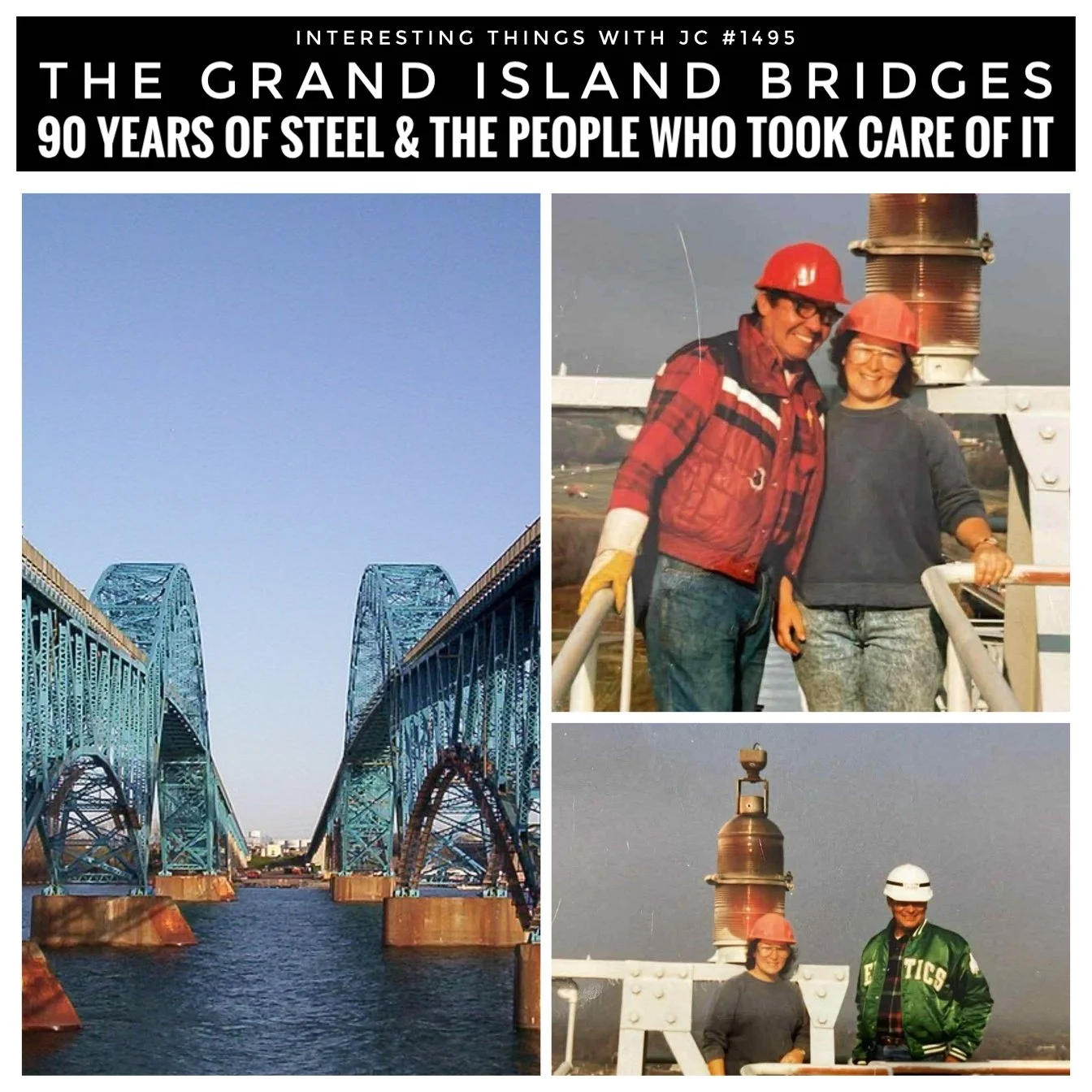
Composite image titled “The Grand Island Bridges – 90 Years of Steel & the People Who Took Care of It.” Left panel shows the twin steel arch truss spans of the Grand Island Bridges over the Niagara River, painted blue, with concrete piers rising from the water. Right panels show historic maintenance photos from 1989 taken on the bridge structure: one image shows Karen Fischer, a bridge inspector, standing on the bridge with Raymond “Lummy” Martin and Bill Martin, all wearing hard hats and work clothing; another image shows Karen Fischer standing with Cecil Smith, also wearing safety gear, on the bridge superstructure. The photos document inspection and maintenance work performed on the Grand Island Bridges by engineers and inspectors.
Transcript
For a long time, Grand Island depended on the river.
If the weather turned bad, ferries stopped. If the ice got thick, travel slowed to a crawl. Doctors, deliveries, workers, everyone waited on the Niagara River to cooperate. Life moved when the river allowed it.
That changed in 1935.
That year, two steel bridges opened at the same time. One reached south to Tonawanda. The other reached north to Niagara Falls. Together, the North and South Grand Island Bridges connected the island to both shores by road for the first time. From that point on, Grand Island was no longer cut off by water.
Each original bridge measures about 3,400 feet, a little over half a mile, or 1,036 meters. They were built as steel through-arch truss bridges, with the roadway set 93 feet, about 28 meters, above the Niagara River. That height was practical. It allowed ship traffic to pass underneath and gave the structure enough strength to handle ice, current, and heavy vehicle loads.
The bridges were built by the American Bridge Company during the Great Depression. These were not temporary crossings. They were built heavy, tall, and strong on purpose. Engineers expected them to take punishment, and they were right.
Across the country, many steel arch bridges from this era are gone. They were taken down and replaced when traffic grew or maintenance became inconvenient. The Grand Island Bridges survived because the decision was made to maintain them instead of abandoning them.
As traffic increased, the solution wasn’t removal. It was expansion.
The southbound twin span opened in 1963. The northbound twin followed in 1965. That created the four-bridge system that still carries Interstate 190 today. The original 1935 bridges remained in service, repaired and strengthened rather than scrapped.
That kind of longevity does not happen without people on the steel.
One of those people is Karen Fischer.
Karen spent more than fifteen years working maintenance and reconstruction across all four Grand Island bridges. She worked on deck replacements, structural steel repairs, sidewalk reconstruction, bridge painting projects, and rail systems. She saw the bridges up close, during the years when traffic sometimes had to run two-way on a single span just to keep everything moving.
In 1989, the southbound South Grand Island Bridge went through a major rebuild. Crews removed the entire deck and replaced it with lightweight concrete. A latex overlay was added to protect the surface from water intrusion. Structural steel exposed during demolition was repaired. The sidewalk on the west side of the bridge was completely rebuilt. The original bridge rail was removed, sent off site, repaired, galvanized, and reinstalled.
That rail is no longer there today. It was replaced in a later project. That is how infrastructure survives. Nothing is permanent. Everything is maintained, replaced, and improved over time.
On October 27, 1989, Karen climbed onto the arch of the bridge to photograph the view. She was accompanied by inspectors Raymond “Lummy” Martin and Bill Martin, both former ironworkers who knew what it meant to trust steel. From that height, Grand Island stretched out below, and the skyline of Niagara Falls was visible in the distance.
Another inspector who worked on the bridges was Cecil Smith.
Cecil came from an ironworker background. He inspected steel by climbing it, touching it, and checking it piece by piece. His brother was Jay Silverheels, the actor known for playing Tonto on The Lone Ranger. Jay worked in Hollywood. Cecil worked on bridges. Different paths. Same work ethic.
Cecil did not get famous for his job. Most people who cross these bridges will never know his name. That is true for most people who maintain infrastructure. They work out of sight, making sure things hold together.
That is why the Grand Island Bridges are still here.
They were not saved by speeches or plaques. They were kept alive by inspectors, ironworkers, engineers, and maintenance crews who showed up, followed procedures, fixed what was worn out, and went home knowing the structure was safer than when they found it.
Most drivers cross the bridges without thinking about any of this. They notice the traffic. They notice the weather. They keep going.
That is fine.
It means the bridges are doing exactly what they were built to do.
These are interesting things, with JC.
Student Worksheet
Why were the Grand Island Bridges originally constructed in 1935?
What engineering features allowed the bridges to support heavy traffic and river conditions?
Describe Karen Fischer’s role in the history of the Grand Island Bridges.
How did the maintenance strategy differ from what happened to other bridges built in the same era?
Reflect on the importance of workers like Cecil Smith in maintaining infrastructure.
Teacher Guide
Estimated Time: 2 class periods (45–60 minutes each)
Pre-Teaching Vocabulary Strategy:
Use word walls with visuals and real-world examples (e.g., photos of truss bridges, steelwork).
Conduct a “concept match” activity using definitions and images.
Anticipated Misconceptions:
Students may assume all large bridges are replaced rather than maintained.
Students may overlook the role of individual laborers in infrastructure longevity.
Discussion Prompts:
What are the consequences of failing to maintain infrastructure?
Should more infrastructure be preserved rather than replaced? Why or why not?
How does geography influence infrastructure development?
Differentiation Strategies:
ESL: Provide visuals and bilingual glossary. Use sentence frames for writing prompts.
IEP: Break down reading into small chunks with guided questions. Offer audio version of episode.
Gifted: Assign research projects comparing international bridge maintenance strategies or iconic bridges.
Extension Activities:
Research the American Bridge Company and its contributions during the Great Depression.
Interview a local civil engineer or visit a construction site.
Create a poster project showing bridge evolution over time.
Cross-Curricular Connections:
Physics — Load distribution in truss structures.
Civics — Public investment and maintenance decisions.
History — The New Deal era and infrastructure projects.
Engineering — Bridge design principles and structural materials.
Quiz
Q1. What type of bridge are the original Grand Island Bridges?
A. Suspension bridge
B. Through-arch truss bridge
C. Cable-stayed bridge
D. Beam bridge
Answer: B
Q2. Why was the bridge deck replaced in 1989?
A. To widen the bridge
B. To switch from asphalt to steel
C. To strengthen the structure and add a latex overlay
D. To make the bridge taller
Answer: C
Q3. Who was one of the key inspectors featured in the episode?
A. Jay Silverheels
B. Bill Martin
C. Karen Fischer
D. Thomas Edison
Answer: C
Q4. What does the presence of a sidewalk reconstruction project indicate?
A. That only vehicles use the bridge
B. That pedestrian access and safety were considered
C. That the bridge was too small
D. That sidewalks are irrelevant on bridges
Answer: B
Q5. What is significant about the fact that the bridges are still in use?
A. They are the oldest bridges in the world
B. They were the first bridges made of wood
C. They were abandoned and turned into parks
D. They were preserved through careful maintenance
Answer: D
Assessment
Explain how the maintenance philosophy applied to the Grand Island Bridges reflects broader ideas about public infrastructure.
Compare the careers of Karen Fischer and Cecil Smith. How did each contribute to the safety and longevity of the Grand Island Bridges?
3–2–1 Rubric
3 = Accurate, complete, thoughtful
2 = Partial or missing detail
1 = Inaccurate or vague
Standards Alignment
Common Core ELA (CCSS):
CCSS.ELA-LITERACY.RI.9-10.3 — Analyze how the author unfolds a series of ideas or events.
CCSS.ELA-LITERACY.RI.11-12.2 — Determine central ideas and summarize complex information.
CCSS.ELA-LITERACY.W.9-10.2 — Write informative texts to examine a topic thoroughly.
C3 Framework (Social Studies):
D2.His.1.9-12 — Evaluate how historical events and people shape modern decisions and policies.
D2.Civ.12.9-12 — Evaluate how infrastructure is maintained to support civil society.
NGSS (Science/Engineering):
HS-ETS1-3 — Evaluate a solution to a complex real-world problem.
HS-ETS2-1 — Analyze a major global challenge and how engineering has addressed it.
ISTE Standards:
1.3a — Students plan and employ effective research strategies to locate information for problems.
1.6d — Students publish or present content that customizes the message for their intended audience.
International (UK & IB):
IB MYP Individuals & Societies: Criterion B (Investigation) — Use historical inquiry to analyze events and people in context.
Cambridge IGCSE History (0470):
AO2: Demonstrate an understanding of the past through explanation and analysis.
Show Notes
This episode of Interesting Things with JC tells the story of the Grand Island Bridges, steel through arch truss bridges built during the Great Depression that connected Grand Island to mainland New York. More than a story of engineering, the episode honors the people who kept the bridges standing: ironworkers and inspectors, including Karen Fischer, who worked as a bridge inspector and Assistant Resident Engineer on the Grand Island Bridges, and Cecil Smith, a bridge inspector with an ironworker background, all carrying the responsibility of keeping those spans safe over decades. Their work underscores the value of maintenance over replacement and highlights the human hands behind the structures that move societies forward. In classrooms, this episode offers a strong entry point into U.S. infrastructure, the Great Depression, public works, and engineering ethics, encouraging students to recognize both technological achievement and the labor required to sustain it.
References
Historic Bridges. (n.d.). South Grand Island Bridge. https://historicbridges.org/bridges/browser/?bridgebrowser=newyork/grandislandsouth/
American Bridge Company. (n.d.). History & projects. https://www.americanbridge.net/
New York State Thruway Authority. (n.d.). Grand Island Bridges. https://www.thruway.ny.gov/travelers/map/grand-island-bridges.html
Federal Highway Administration. (n.d.). Historic bridge preservation. https://www.fhwa.dot.gov/bridge/preservation/
National Steel Bridge Alliance. (n.d.). Types of steel bridges. https://www.aisc.org/nsba/