
1496: "The Mysterious Death of Sam Cooke"
Interesting Things with JC #1496: "The Mysterious Death of Sam Cooke" – A man who mastered control of his music lost it in a single night. Conflicting accounts, missing evidence, and a silence in the timeline keep the questions alive.
Curriculum - Episode Anchor
Episode Title: Interesting Things with JC #1496: “The Mysterious Death of Sam Cooke”
Episode Number: 1496
Host: JC
Audience: Grades 9–12, college intro, homeschool, lifelong learners
Subject Area: U.S. History, Music History, Forensics, Media Literacy, Critical Inquiry
Lesson Overview
Learners will:
• Define key biographical and historical facts related to Sam Cooke’s life and death.
• Compare conflicting accounts and evidence surrounding the events of December 11, 1964.
• Analyze how missing documentation, witness inconsistencies, and contextual details influence historical interpretation.
• Explain why unresolved historical cases raise questions about fairness, evidence, and accountability.
Key Vocabulary
• Autopsy (AW-top-see) — A medical examination of a body after death to determine the cause; the autopsy revealed injuries that did not fully match reported events.
• Coroner’s Inquest (KOR-uh-nerz IN-kwest) — A legal inquiry into a suspicious death; Cooke’s inquest lasted fifteen minutes.
• Catalogue Rights (KAT-uh-log RITES) — Legal ownership of master recordings; Cooke controlled his own, making them extremely valuable.
• Testimony (TES-tuh-moh-nee) — A formal statement given by a witness; differing testimonies complicated the case.
• Bruising Pattern (BROO-zing PAT-ern) — Physical markings that can indicate the nature of a struggle; Cooke’s bruising raised questions about the official account.
Narrative Core
Open: Sam Cooke, a groundbreaking American soul singer and entrepreneur, is introduced at the height of his influence—an artist with control over his music, business, and future.
Info: Listeners learn about Cooke’s final night, the unexplained 90-minute timeline gap, and the arrival at the Hacienda Motel with Elisa Boyer. His financial habits, business affairs, and civil rights involvement frame the circumstances.
Details: The episode details the violent confrontation inside the motel office, the inconsistencies in witness statements, missing records, unexplained injuries, Franklin’s past, and the disappearance of Cooke’s cash.
Reflection: The story explores why unanswered questions persist, emphasizing fairness, evidence, and Cooke’s legacy as a pioneering artist whose unresolved death contrasts sharply with the clarity that defined his life.
Closing: “These are interesting things, with JC.”
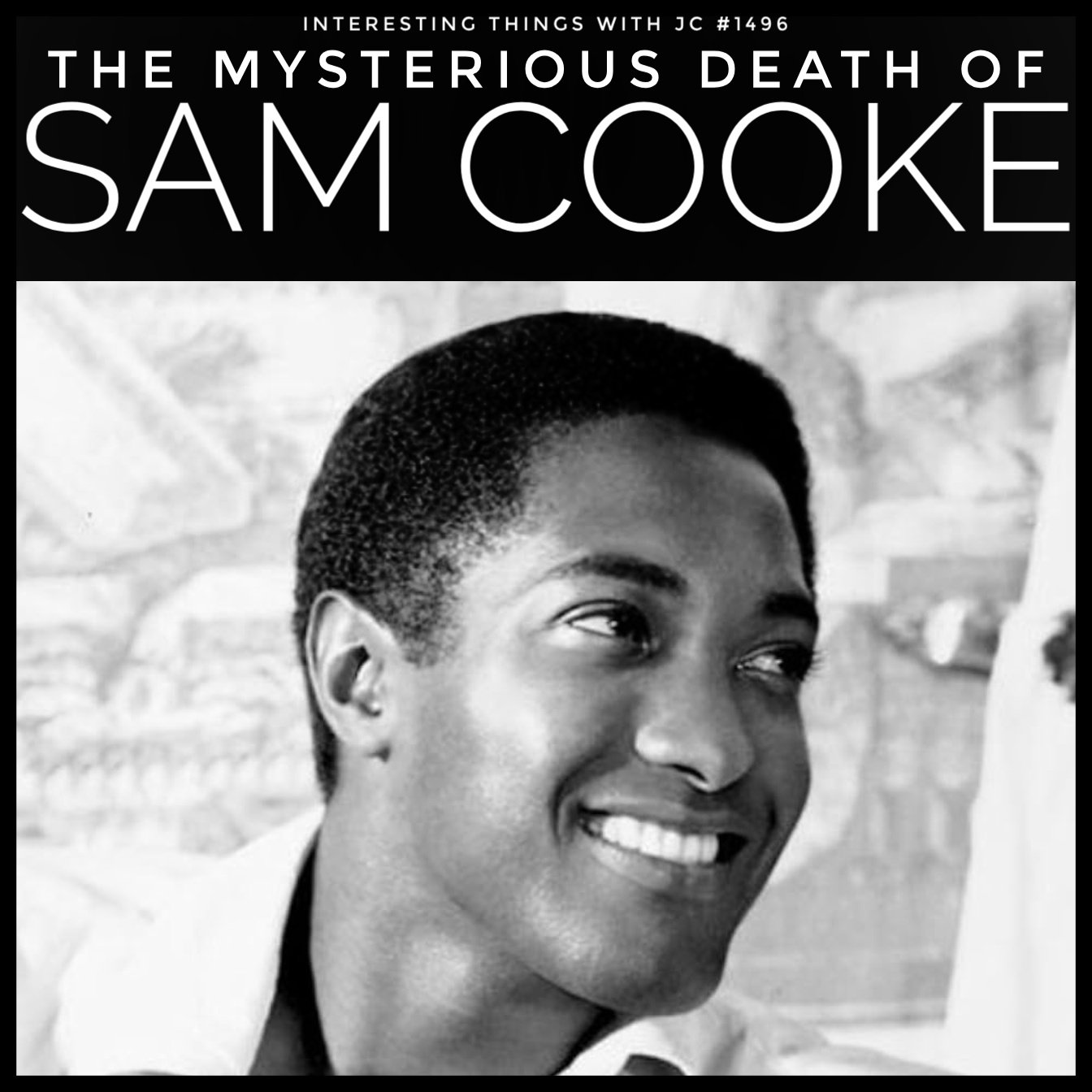
Black-and-white portrait of Sam Cooke, an American soul singer, shown from the shoulders up. He is facing slightly to the right and smiling softly. The image is used as the cover art for Interesting Things with JC episode #1496, titled “The Mysterious Death of Sam Cooke,” with the title displayed prominently above his photograph.
Transcript
Sam Cooke was one of the most influential American singers of his generation. Born in Clarksdale, Mississippi, and raised on the South Side of Chicago, he shaped modern soul music with a voice that carried smooth confidence and clear purpose. Songs like “You Send Me,” “Chain Gang,” and “Bring It On Home to Me” made him a national star. By 1964, he owned his own label and publishing company, holding rights worth millions. That level of control was rare, and it later became a blueprint for artists who wanted ownership of their work.
That makes the events of December 11, 1964 even harder to understand.
Cooke was last seen alive around 1 a.m. at Martoni’s restaurant on Sunset Boulevard. He was in good spirits, according to the staff and the musicians he spoke with. From that moment until about 2:35 a.m., when he reached the Hacienda Motel in South Los Angeles, the timeline goes silent. It is roughly a 90 minute gap with no confirmed stops, no verified witnesses, and no clear record of how he traveled from one place to the other.
When he arrived, he was with a young woman named Elisa Boyer (Ee-LEE-suh BOY-er). She later told police that he brought her there against her will. They checked into Room 15. Minutes later she ran from the room, taking her clothing and his. Cooke often carried between one and five thousand dollars in cash, worth about nine to forty five thousand dollars in today’s value. None of that money was ever found.
Room 15 was 34 feet, or 10.4 meters, from the motel office. Cooke crossed that distance wearing only his sport coat and shoes. Inside the office, the night manager, Bertha Franklin (BUR-thuh FRANK-lin), said Cooke grabbed her by the wrists and demanded to know where Boyer had gone. Franklin fired a .22 caliber pistol. The bullet entered Cooke’s chest, passed through his heart, and exited his back. She said she struck him afterward with a wooden broom handle about three feet long, or 0.9 meters. The coroner’s inquest took fifteen minutes and ruled the death justifiable homicide.
What followed raised doubts that never settled. Cooke’s autopsy showed a broken nose, two missing teeth, and heavy bruising across his ribs. His face and torso showed abrasions that did not align with a brief struggle inside a small office. The broom handle collected as evidence had no cracks, dents, or splintering. No fingerprints were taken from it, from the counter, or from the small amount of clothing Cooke still had. The autopsy confirmed he had been drinking, but not at a level that explained the severity of the injuries.
Franklin had a history that added more questions. In 1945 she was convicted of manslaughter after a violent altercation. She also had experience as a wrestler, which suggested physical strength and past involvement in confrontations. Her account of the fight did not fully match the pattern of Cooke’s injuries.
Boyer’s statements brought more uncertainty. Her first statement to police outlined the events in one order. Her later interview with the press shifted important details, including when she fled, what she carried, and how long Cooke tried to follow her. In most homicide investigations, these contradictions lead to deeper questioning. In this case, no additional steps were taken.
The setting added its own concerns. The Hacienda Motel operated at three dollars an hour and was known along that stretch of Figueroa for vice activity. Robberies and assaults were common in the area. The owner, Evelyn Cardena (EV-uh-lin car-DAY-nuh), left for Sausalito the next morning and was never interviewed. The motel’s sign in register for that night disappeared entirely. In most cases, that register would help confirm who was on the property.
Cooke’s Ferrari sat untouched in the parking lot. Inside its trunk was a locked suitcase containing contracts, clean clothing, and work materials. None of it had been moved.
His business affairs added more depth to the questions. Cooke had been working on national distribution for SAR Records, which would have expanded the reach of his label. He owned his master recordings, which were extremely valuable. Three months after his death, his manager, Allen Klein (AL-un KLINE), gained control of Cooke’s entire catalog. In the years that followed, those rights produced significant income.
Cooke had also begun raising money for civil rights efforts. His song “A Change Is Gonna Come” had not yet been released as a single, but it was already known among musicians as an important piece of work. The FBI kept a small file on Cooke that mentioned his public associations with Malcolm X (MAL-kum EX) and Muhammad Ali (Moo-HAH-med AH-lee). The file held no evidence of wrongdoing, but it did show that federal agencies were paying attention to his influence.
Taken one at a time, none of these facts overturn the official ruling. Taken together, they explain why the case has remained unsettled for sixty years. Sam Cooke spent his life building his own path, guiding his music, his business, and his future with a steady hand. The unanswered details around his final hours stand in contrast to the clarity he carried through the rest of his life.
For many who have studied this case, the remaining questions are not about drama. They are about fairness. A man who gave so much to American music deserves a full accounting of what happened in that small office in 1964. And if the full truth has not surfaced yet, the hope is that someday it will. Not for headlines, but for simple respect.
These are interesting things, with JC.
Student Worksheet
List two pieces of physical evidence mentioned in the episode that raised questions about the official account.
Explain why the missing sign-in register from the Hacienda Motel is historically significant.
Compare the different statements given by Elisa Boyer and describe how inconsistencies can influence an investigation.
Analyze how Sam Cooke’s business independence might have increased public curiosity about the circumstances of his death.
Creative prompt: Write a 150-word reflection on why unresolved historical cases continue to fascinate researchers and students.
Teacher Guide
Estimated Time: 60–90 minutes
Pre-Teaching Vocabulary Strategy:
Use a Frayer Model or semantic mapping to preview terms such as autopsy, inquest, testimony, and catalogue rights.
Anticipated Misconceptions:
• Students may assume that short inquests indicate clear evidence; discuss historical limitations and procedural issues.
• Some may conflate speculation with evidence; emphasize primary vs. secondary sources.
Discussion Prompts:
• What responsibilities do investigators have when witness accounts conflict?
• How does missing evidence shape historical interpretation?
• Why might Cooke’s influence in music and civil rights create broader public interest?
Differentiation Strategies:
• ESL: Provide vocabulary cards with visuals and simplified definitions.
• IEP: Offer guided notes with key facts pre-filled.
• Gifted: Assign document-based inquiry comparing Cooke’s case to another unresolved historical investigation.
Extension Activities:
• Research artist rights and ownership in the 1960s vs. today.
• Examine another notable inquest and compare procedural similarities and differences.
• Create a forensic reconstruction diagram based solely on episode details.
Cross-Curricular Connections:
• History: Civil rights era context.
• Music: Evolution of soul and artist ownership.
• Forensics: Injury pattern analysis and evidentiary procedures.
• Media Literacy: Reliability of conflicting testimony.
Quiz
Q1. What major piece of documentation from the motel went missing?
A. Guest receipts
B. Sign-in register
C. Telephone log
D. Security tapes
Answer: B
Q2. How long did the coroner’s inquest last?
A. 3 hours
B. 45 minutes
C. 15 minutes
D. 90 minutes
Answer: C
Q3. What injury did Cooke sustain that did not match a brief struggle?
A. Broken leg
B. Broken nose and missing teeth
C. Severe burn
D. Wrist fracture
Answer: B
Q4. How far was Room 15 from the motel office?
A. 10 feet
B. 34 feet
C. 60 feet
D. 100 feet
Answer: B
Q5. What key business asset did Cooke retain during his life?
A. Touring rights
B. Master recordings
C. Publishing of other artists
D. Television contracts
Answer: B
Assessment
Explain how inconsistent witness statements can affect the interpretation of a historical event.
Analyze why Sam Cooke’s death remains a subject of inquiry sixty years later.
3–2–1 Rubric
• 3: Accurate, complete, thoughtful, cites specific episode details
• 2: Partially accurate, missing detail, somewhat general
• 1: Vague, inaccurate, or not supported by evidence
Standards Alignment
Common Core (CCSS ELA)
• CCSS.ELA-LITERACY.RH.9-10.1: Students cite evidence from the transcript when evaluating inconsistencies.
• CCSS.ELA-LITERACY.RI.11-12.3: Analyzing complex interactions among events (timeline gaps, witness accounts).
• CCSS.ELA-LITERACY.WHST.9-12.2: Writing explanatory texts about forensic and historical processes.
C3 Framework (Social Studies)
• D2.His.12.9-12: Assess how historical problems create enduring questions (Cooke’s unresolved death).
• D3.2.9-12: Evaluate source credibility when evidence is incomplete or contradictory.
ISTE (Digital Literacy)
• ISTE 3a: Evaluate accuracy and credibility of sources when researching historical mysteries.
CTE Arts, Media & Entertainment
• AME.A1.3: Understand intellectual property in the arts (Cooke’s ownership of masters).
International Equivalents
• UK A-Level History (AQA 7042): Critical evaluation of sources and interpretations.
• IB DP History (Analysis & Evaluation Criteria): Assessing reliability, origin, and purpose of historical evidence.
• Cambridge IGCSE History (0470): Understanding cause, consequence, and interpretation in contested events.
Show Notes
This episode explores the life, legacy, and mysterious death of Sam Cooke, one of America’s most influential soul artists and most forward-thinking business owners of his era. By walking through the timeline of December 11, 1964, JC highlights inconsistencies in witness accounts, missing evidence, and unanswered investigative steps that have fueled public curiosity for decades. For classrooms, this episode provides a powerful case study in evidence evaluation, forensic reasoning, civil rights history, and the importance of fair and thorough investigative practices. It encourages learners to consider how gaps in documentation shape historical narratives and why unresolved cases continue to matter in conversations about justice and cultural legacy.
References
Encyclopaedia Britannica. (2024). Sam Cooke. https://www.britannica.com/biography/Sam-Cooke
Eder, B. (n.d.). Sam Cooke biography. AllMusic. https://www.allmusic.com/artist/sam-cooke-mn0000238115
Darling, C. (2019, February 6). Netflix Sam Cooke documentary looks at a controversial life and death. San Francisco Chronicle. https://www.sfchronicle.com/entertainment/article/Netflix-Sam-Cooke-documentary-looks-at-a-13588268.php
Guralnick, P. (2005). Dream boogie: The triumph of Sam Cooke. Little, Brown and Company. https://archive.org/details/dreamboogietrium00gura
