1497: "French Fries"
Interesting Things with JC #1497: "French Fries" – What we call fries began as a way for families to get through the bitter cold when the river froze. A simple food with a tougher story behind it.
Curriculum - Episode Anchor
Episode Title: French Fries
Episode Number: #1497
Host: JC
Audience: Grades 9–12, college intro, homeschool, lifelong learners
Subject Area: History, Culinary Arts, Sociology, Agricultural Science
Lesson Overview
By the end of this lesson, students will be able to:
Define how environmental conditions influenced the invention of fried potatoes in 17th-century Belgium.
Compare the evolution of fried potatoes from survival food to commercial product across cultures and time periods.
Analyze how naming conventions and cultural assumptions affected the global perception of “French fries.”
Explain the significance of food technology (e.g., temperature, fat, starch content) in shaping food texture and taste.
Key Vocabulary
Tallow (/ˈta-lō/) — A rendered form of beef or mutton fat used in cooking. In the episode, tallow was used to fry potatoes for a rich, crispy texture.
Russet Potato (/ˈrʌs.ɪt pəˈteɪ.toʊ/) — A starchy potato variety favored for frying due to its high starch content and moisture balance.
Smoke Point (/smoʊk pɔɪnt/) — The temperature at which an oil or fat begins to burn and smoke. Beef tallow has a high smoke point, making it suitable for frying.
Calorie Density (/ˈkæ-lə-ri ˈden-sə-ti/) — The number of calories in a given weight or volume of food. Potatoes provided essential calorie density for survival in winter.
Cultural Assumption (/ˈkʌl.tʃɚ.əl əˈsʌmp.ʃən/) — A belief or inference made based on one’s own cultural lens. U.S. soldiers assumed the fries were French due to the French language spoken in Belgian towns.
Narrative Core
Open: JC introduces the image of sitting at a Midwestern diner enjoying fries, contrasting it with the food’s humble, survivalist origins in frozen 17th-century Belgium.
Info: Historical context is provided about how Belgian villagers substituted fish with fried potatoes during harsh winters when rivers froze.
Details: The story tracks how potatoes spread through Europe, became popular street food in France, and later picked up the name “French fries” from American soldiers in WWI.
Reflection: The episode invites listeners to reflect on how everyday foods like fries began as solutions to environmental and social challenges.
Closing: These are interesting things, with JC.
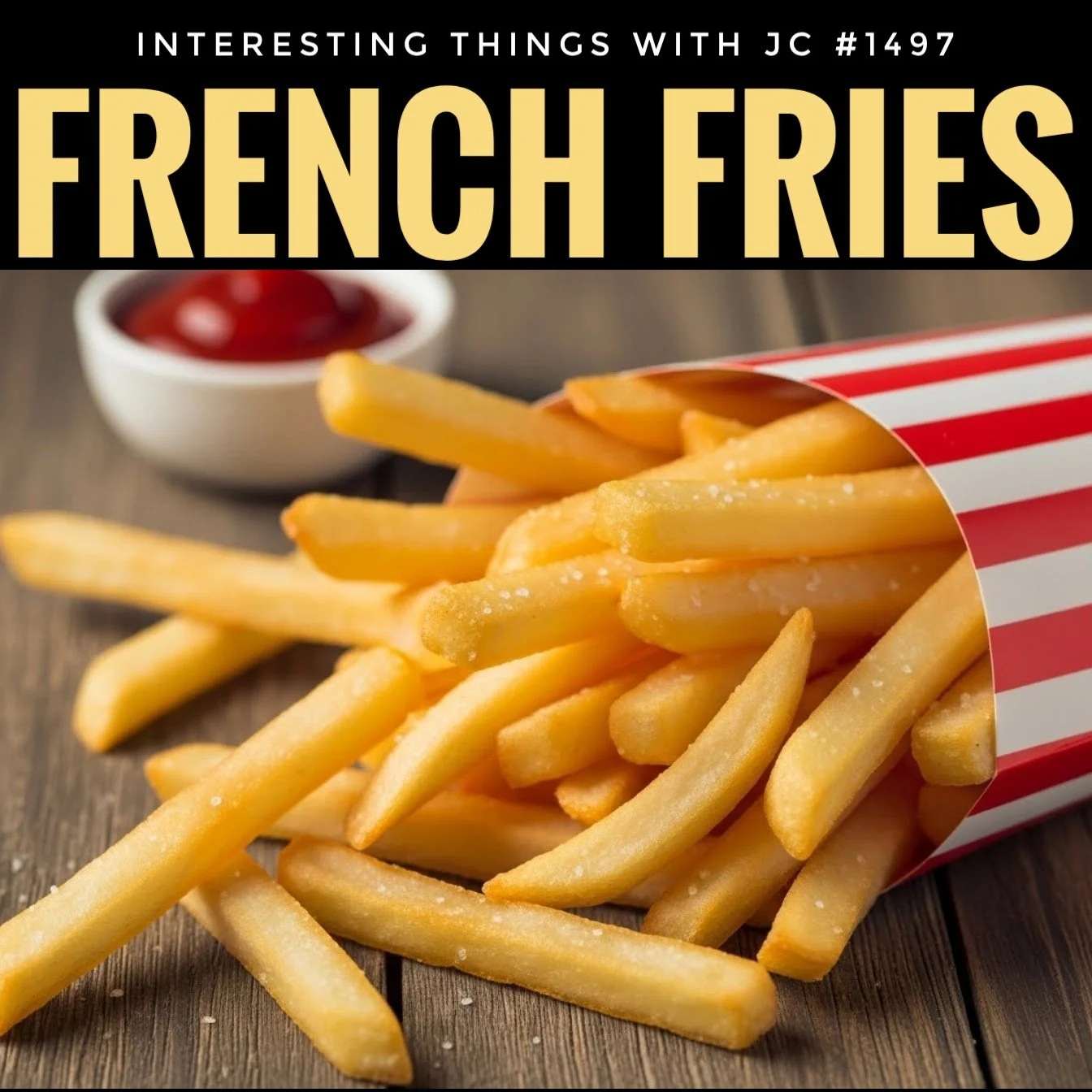
A close-up image of golden French fries spilling out of a red-and-white striped container onto a wooden surface. The fries are lightly salted and appear crispy. In the background, there is a small white dish filled with red ketchup. Text at the top reads “Interesting Things with JC #1497” and in large bold letters, “French Fries.”
Transcript
If you’ve ever sat at a diner with a plate of hot fries, it’s easy to forget this food started as a winter survival tactic. Along the Meuse River in Belgium (BEL-jum) in the late 1600s, families depended on small river fish for their daily meals. When the river froze and the fish disappeared, they turned to potatoes. They sliced them into strips about the same size as the fish they were used to frying, roughly 3 to 4 inches long (7.6 to 10.1 centimeters) and about a half-inch thick (1 centimeter), then cooked them in animal fat to get something warm and filling on the table.
By the 1700s, potatoes had spread across Europe because they grew well in rough soil and delivered dependable calories, around 1,300 per pound (2,860 per kilogram). Street vendors in Paris (PAH-ree) were already selling fried potatoes before the French Revolution of 1789. Travelers wrote about vendors setting up along bridges and crowded squares with baskets of hot fried potatoes ready for anyone passing by.
The name “French fries” traces back to 1917. American soldiers stationed in French-speaking Belgian towns tasted these fried potatoes. Assuming they were French food, they carried the name home. Restaurants in the United States later standardized frying temperatures between 350 and 375 degrees Fahrenheit (176 to 190 degrees Celsius), often using beef tallow with a smoke point around 400 degrees Fahrenheit (204 degrees Celsius), which helped create a steady crust and distinct flavor.
Even the shape matters. A thin fry crisps quickly because of the greater surface area. A thicker fry keeps more moisture inside. Many processors rely on russet potatoes due to their starch content, usually 18 to 22 percent, which produces the familiar contrast between a crisp exterior and soft interior.
A food born out of a frozen river and a need to get through winter eventually found its way to drive-ins, diners, fairs, and weeknight tables across the country. It’s a reminder that some of our everyday staples began as simple, practical solutions.
These are interesting things, with JC.
Student Worksheet
What environmental conditions led Belgian families to invent fried potatoes?
Why did American soldiers in WWI call fried potatoes “French fries”?
How did frying temperature and fat type influence the quality of early fries?
Explain the difference in texture between thin and thick fries.
Research and list one other modern food that began as a survival food.
Teacher Guide
Estimated Time:
45–60 minutesPre-Teaching Vocabulary Strategy:
Use a Frayer Model for “tallow” and “cultural assumption” to pre-load meaning.Anticipated Misconceptions:
Students may assume French fries are originally from France.
Confusion about Belgium’s French-speaking regions.
Misunderstanding of how calorie density influences food choices in history.
Discussion Prompts:
How do food innovations reflect survival needs?
What does the story of fries tell us about the globalization of culture?
How does science influence the taste and texture of our food?
Differentiation Strategies:
ESL: Pair visuals of potato slicing, map of Belgium, and temperature graphs.
IEP: Provide sentence starters for each worksheet question.
Gifted: Challenge students to research the history of another common food.
Extension Activities:
Cook thin vs. thick fries and conduct a texture/taste analysis.
Create an infographic timeline of the potato's history from Peru to the U.S.
Cross-Curricular Connections:
History: Agricultural shifts in Europe and the role of tubers in preventing famine.
Culinary Arts: Frying techniques and food chemistry.
Geography: Map skills tracing the spread of the potato from the Andes to Europe.
Quiz
What country is most associated with the origin of French fries?
A. France
B. Belgium
C. Germany
D. United States
Answer: B
What caused Belgians to start frying potatoes in the late 1600s?
A. War
B. Potato blight
C. Frozen rivers
D. Government policy
Answer: C
Why did American soldiers call them “French fries”?
A. The dish was served in France
B. French chefs invented them
C. French was spoken in the area
D. It was a French military recipe
Answer: C
What is one advantage of using beef tallow to fry potatoes?
A. It has no flavor
B. It has a low smoke point
C. It produces a soggy texture
D. It resists burning at high heat
Answer: D
Why are russet potatoes often used for fries?
A. They grow in warm climates
B. They have high starch content
C. They are sweet-tasting
D. They cook faster than others
Answer: B
Assessment
Analyze how cultural misunderstanding shaped the global identity of French fries.
Explain how the physical structure and chemistry of the potato influence its behavior during frying.
3–2–1 Rubric
3: Accurate, complete, thoughtful
2: Partial or missing detail
1: Inaccurate or vague
Standards Alignment
Common Core State Standards (CCSS)
CCSS.ELA-LITERACY.RI.9-10.3 – Analyze how the author unfolds an analysis or series of ideas.
Students trace the historical development of French fries through the text structure.CCSS.ELA-LITERACY.W.9-10.2 – Write informative texts to examine and convey complex ideas.
Students respond to assessments and worksheets with clarity and structure.
C3 Framework for Social Studies
D2.His.1.9-12 – Evaluate how historical events shaped culture and everyday life.
Focus on how food culture evolves from historical necessity.D2.Geo.2.9-12 – Use maps and geographic representations to explain human migration and settlement patterns.
Mapping the potato’s journey from the Andes to Europe and the U.S.
CTE – Agriculture, Food & Natural Resources
AGRI.04.02.02.a – Identify factors that influence global food systems.
Explores how weather, crops, and culture influence food development.
International Equivalents
UK AQA History 8145/1B – Understanding the development of society and key historical events.
Students trace the historical trajectory of food in European society.Cambridge IGCSE Geography (0460) – Food production and influences.
Explores environmental and social drivers in food cultivation and processing.IB MYP Individuals and Societies Criterion B – Investigating patterns and developments.
Aligns with the investigation of how cultural and environmental needs shape everyday practices.
Show Notes
In this episode, JC uncovers the humble and practical origins of one of the world’s most beloved foods: the French fry. What began as a clever winter substitute for river fish in 17th-century Belgium became a global fast-food staple shaped by survival, culture, chemistry, and a few misattributions. The story offers rich opportunities to explore how food, geography, language, and innovation intersect in our daily lives. For educators, this episode ties into critical thinking about food systems, historical causality, and cultural transmission. It also offers practical culinary insights into why fries taste the way they do. Thank you to Dr. Igo for suggesting this topic!
References
McGee, H. (2004). On Food and Cooking: The Science and Lore of the Kitchen. Scribner. https://www.simonandschuster.com/books/On-Food-and-Cooking/Harold-McGee/9780684800011
United States Department of Agriculture. (n.d.). Potato Facts. https://www.nass.usda.gov/Statistics_by_State/Washington/Publications/Potatoes/index.php
BBC, (2018) Can Belgium claim ownership of the French fry?. https://www.bbc.com/travel/article/20180730-can-belgium-claim-ownership-of-the-french-fry