Interesting Things with JC #1498: "The History of Hot Tubs" – From ancient stone pools to backyard bubbles, people have been sinking into hot water for the same reason: relief. Greeks soaked, Romans socialized, presidents healed, and engineers added jets!
Curriculum - Episode Anchor
Episode Title: The History of Hot Tubs
Episode Number: #1498
Host: JC
Audience: Grades 9–12, college intro, homeschool, lifelong learners
Subject Area: History, Sociology, Technology, Health and Wellness
Lesson Overview
Students will:
Define key historical innovations in bathing and hydrotherapy across cultures.
Compare ancient and modern uses of heated water for wellness and social interaction.
Analyze how technological advances (e.g., hypocausts, jets) shaped the evolution of bathing.
Explain cultural significance of hot springs and public baths in different societies.
Key Vocabulary
Thermae (THER-may) — Roman public bathhouses; some could host thousands and acted as centers for hygiene, relaxation, and socialization.
Hypocaust (HI-po-kawst) — A Roman heating system that pushed hot air under floors and walls to warm baths and rooms.
Onsen (OWN-sen) — Traditional Japanese hot springs, often rich in minerals, used for centuries as therapeutic soaking spots.
Hydrotherapy (HI-dro-THAIR-uh-pee) — The use of water, especially warm water, in the treatment of physical ailments or pain.
Jacuzzi (juh-KOO-zee) — A brand name that became synonymous with jetted hot tubs, originating from a family who designed pumps for medical use.
Narrative Core (Based on the PSF – Re-Labeled)
Open — The episode begins with a calming image: warm water slowing everything down, hinting at something ancient in our need to soak and rest.
Info — Historical grounding: Ancient Greeks and Romans built bathing cultures around natural springs and engineered systems.
Details — Cultural extensions in Japan’s onsen traditions, FDR's use of Warm Springs for therapy, and the invention of Jacuzzi-style tubs.
Reflection — The common thread across time: warm water for relief, connection, and healing—a timeless human need.
Closing — “These are interesting things, with JC.”
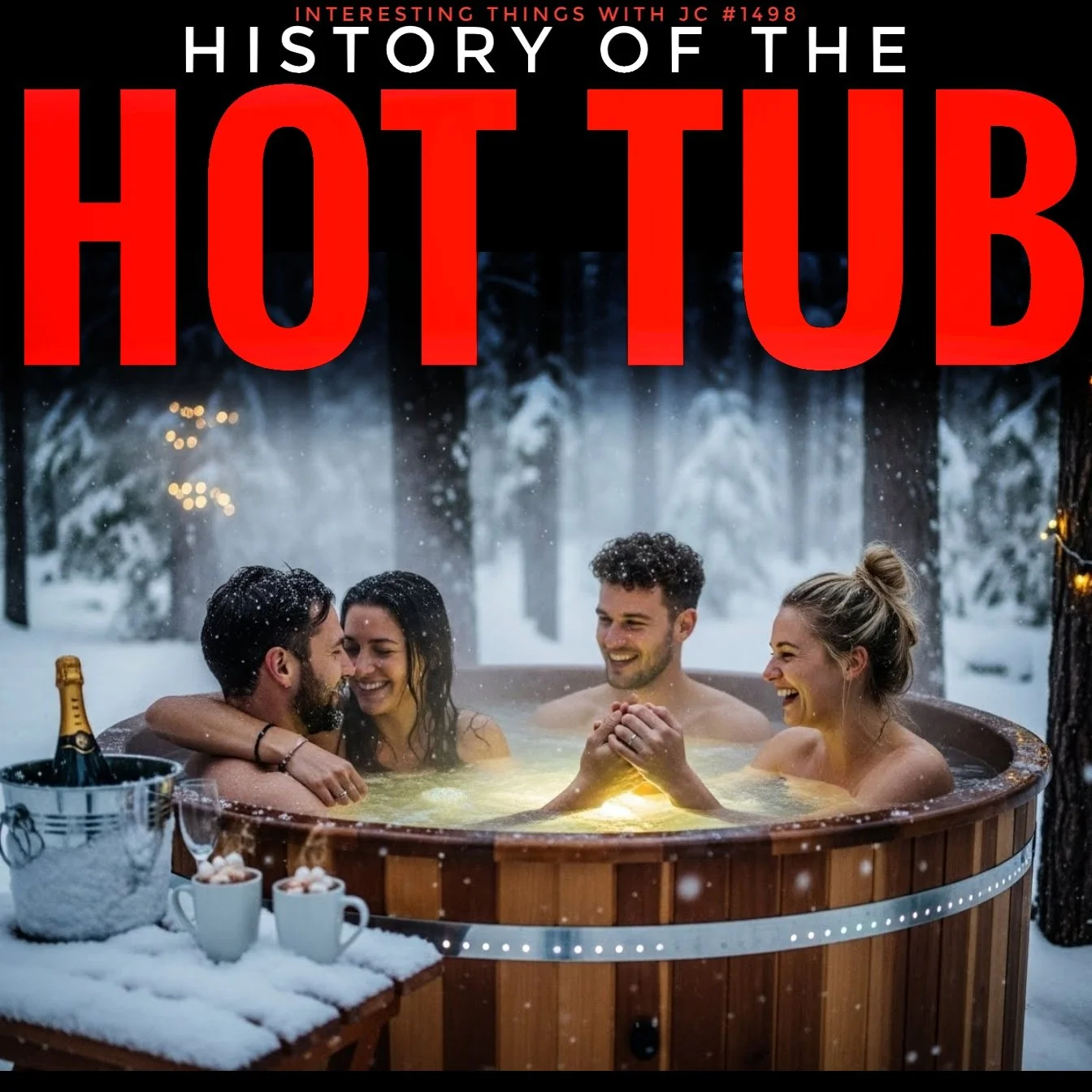
Four people relax in a steaming wooden hot tub in a snowy forest with cocoa, champagne, and lights nearby. Text reads History of the Hot Tub Interesting Things with JC 1498.
Transcript
There’s something about warm water that makes people just…slow down and relax. Always has. You sit still, the steam comes up, and for a few minutes the world quits hollering at you. That feeling goes back a lot farther than backyard decks and plastic covers.
Long before electricity or plumbing, people figured out that hot water helped sore muscles and tired bones. Around 800 BCE, the Greeks built stone soaking pools near natural hot springs. They didn’t rush it. Water warmed by the earth itself, usually around 100 to 104 degrees Fahrenheit (38 to 40 degrees Celsius), was thought to steady the body and clear the head.
The Romans took that idea and built it big. Public bathhouses, called thermae (THER-may), were everywhere by the first century CE. Some could hold thousands of people at once. Water was heated through hypocaust systems, furnaces pushing hot air under stone floors and through walls. A large Roman bath complex could cover over 20 acres (about 8 hectares). These weren’t just baths. They were places to talk business, hear news, and let your joints loosen up after a long day.
The idea never really went away. In Japan, natural hot springs known as onsen (OWN-sen) have been used for centuries, with water often rich in minerals like sulfur and iron. Folks believed the minerals mattered, but the steady heat did most of the work. Same principle. Sit. Soak. Heal.
In the United States, warm-water soaking got a presidential stamp of approval. Franklin Delano Roosevelt, the 32nd president, struggled with polio after 1921. He found relief at Warm Springs, Georgia, where the water stayed around 88 degrees Fahrenheit (31 degrees Celsius). He went so often that he built a treatment center there in 1927. That wasn’t luxury. That was therapy.
The modern hot tub showed up in 1956, thanks to the Jacuzzi brothers. They were Italian immigrants who built a portable hydrotherapy pump for a family member with arthritis. Jets changed everything. Water wasn’t just warm anymore…it moved. The first integrated Jacuzzi whirlpool bath hit the market in 1968, pushing heated water through multiple jets, usually holding 300 to 500 gallons (1,100 to 1,900 liters).
What started as medicine turned into routine. From Roman stone to fiberglass shells, the goal stayed the same. Warm water. Quiet moment. Body gets a break.
Turns out, people have always needed that. Still do.
These are interesting things, with JC.
Student Worksheet
What ancient civilization built hypocaust systems, and how did they work?
How did Japanese onsen differ from Roman thermae in purpose and design?
Why did Franklin D. Roosevelt regularly visit Warm Springs, Georgia?
What innovation did the Jacuzzi brothers bring to modern hydrotherapy?
In your own words, why has warm water remained a consistent part of human relaxation and therapy?
Teacher Guide
Estimated Time:
45–60 minutes
Pre-Teaching Vocabulary Strategy:
Use image prompts and maps to introduce key locations (Rome, Japan, Georgia) and visuals of thermae, onsen, and modern hot tubs. Vocabulary word walls.
Anticipated Misconceptions:
Students may assume hot tubs are purely modern luxuries.
Confusion between public baths (thermae) and natural springs (onsen, Warm Springs).
Discussion Prompts:
Why do you think cultures across time have returned to the concept of communal or therapeutic soaking?
How does public bathing reflect values of health, community, and design?
Could a modern equivalent to the Roman bathhouse exist today? Why or why not?
Differentiation Strategies:
ESL: Visual vocabulary cards; pair vocabulary with L1 translations.
IEP: Sentence starters for reflection responses; allow oral responses.
Gifted: Research assignment comparing another culture’s water rituals (e.g., Turkish hammam, Finnish sauna).
Extension Activities:
Build a timeline tracing the evolution of therapeutic bathing.
Design a “future hot tub” prototype using sustainable technology.
Research other therapeutic uses of natural elements (mud baths, salt caves, etc.).
Cross-Curricular Connections:
Physics: Heat transfer in hypocaust systems and jet propulsion.
Health Science: Therapeutic use of heat for muscular recovery.
World History: Cultural comparisons of Roman, Greek, and Japanese societies.
Quiz
Q1. What is a hypocaust system?
A. A system for collecting rainwater
B. A furnace that heats water directly
C. A system that pushes hot air under floors to heat spaces
D. A Roman plumbing method
Answer: C
Q2. When did the Greeks begin using natural hot springs for soaking?
A. Around 100 CE
B. Around 800 BCE
C. Around 1968
D. Around 1500 CE
Answer: B
Q3. What made the Jacuzzi brothers’ invention unique?
A. It used volcanic stones for heat
B. It filtered mineral water
C. It was a portable hydrotherapy pump with jets
D. It was solar-powered
Answer: C
Q4. Which president used hot springs as a form of therapy?
A. Abraham Lincoln
B. Franklin D. Roosevelt
C. Theodore Roosevelt
D. John F. Kennedy
Answer: B
Q5. Which country has a long tradition of bathing in mineral-rich onsen?
A. Italy
B. France
C. Japan
D. India
Answer: C
Assessment
Explain how the purposes of Roman thermae and Japanese onsen were both similar and different.
Analyze the connection between health needs and innovation in the invention of the Jacuzzi hot tub.
3–2–1 Rubric:
3 = Accurate, complete, thoughtful
2 = Partial or missing detail
1 = Inaccurate or vague
Standards Alignment
Common Core – History/Social Studies:
CCSS.ELA-LITERACY.RH.9-10.2 — Determine the central ideas of a historical text and provide an accurate summary.
CCSS.ELA-LITERACY.RH.11-12.4 — Determine the meaning of words and phrases as they are used in a historical context.
C3 Framework (Social Studies):
D2.His.1.9-12 — Evaluate how historical events and developments were shaped by unique circumstances.
D2.Geo.4.9-12 — Analyze relationships between physical environments and human activities.
Next Generation Science Standards (NGSS):
HS-PS3-4 — Use mathematical representations to support the claim that energy is conserved as it is transferred and transformed.
ISTE Standards for Students:
1.1 Empowered Learner — Students articulate and set personal learning goals based on historical understanding.
International Equivalents
UK National Curriculum – History KS4: Develop understanding of world history through cultural traditions and societal practices.
Cambridge IGCSE History: Understand historical sources and evaluate their relevance to cultural development.
IB MYP Individuals and Societies: Investigate the impact of science and technology on societies over time.
Show Notes
In this episode of Interesting Things with JC, listeners take a warm and winding journey through the history of hot tubs, from ancient Greek and Roman soaking rituals to Japanese onsen, and onward to American hydrotherapy and the Jacuzzi revolution. The episode shows how different civilizations have used warm water for therapy, social connection, and reflection across millennia. This topic opens doors to understanding how health practices, technology, and culture interlace across time. For students, it offers a chance to explore innovation and tradition through the simple but powerful act of soaking. Thank you Dr. Igo for suggesting this topic!
References
Aqua Living Stores. (n.d.). The long and fascinating history of hot tubs. Retrieved from https://aqualivingstores.com/the-long-and-fascinating-history-of-hot-tubs/
Lifestyle Outdoor. (n.d.). History of the hot tub. Retrieved from https://www.lifestyleoutdoor.com/history-of-the-hot-tub/
Rec Unlimited. (n.d.). The history of the hot tub. Retrieved from https://www.recunlimited.com/blog/history-hot-tub/
Rocky Mountain Hot Tub Co. (n.d.). The history of the hot tub. Retrieved from https://www.rockymountainhottubco.com/the-history-of-the-hot-tub/