Interesting Things with JC #1499: "Dance Hall Days" – Before the neon, before the synths, there were floors that creaked and shoes that scuffed. This one hit track holds more ghosts than glitter.
Curriculum – Episode Anchor
Episode Title: Dance Hall Days
Episode Number: #1499
Host: JC
Audience: Grades 9–12, college intro, homeschool, lifelong learners
Subject Area: Music History, Cultural History, Media Studies, Sociology
Lesson Overview
Students will:
• Identify how post–World War II dance halls functioned as social spaces
• Analyze lyrical tone shifts from innocence to control
• Examine how musical arrangement affects emotional meaning
• Evaluate historical music claims using charts and interviews
• Explain how orchestral reinterpretation extends cultural relevance
Key Vocabulary
Dance hall — Mid-20th-century community ballrooms used for social dancing and live music
Synth-pop — A genre emphasizing synthesizers and electronic production, prominent in the early 1980s
Arrangement — The organization of musical elements such as instrumentation, rhythm, and harmony
Orchestration — Assigning musical lines to instruments in an orchestra
Metaphor — Figurative language suggesting meaning beyond the literal
Yellow bell (Huang Zhong) — An ancient Chinese musical pitch representing the foundational tone of a scale
Narrative Core
Open: The episode begins in postwar dance halls filled with music, memory, and community
Info: Background on British dance halls and the rise of 1980s synth-driven pop
Details: The evolution of “Dance Hall Days,” chart success, lyrical meaning, MTV visuals, and orchestral revival in Prague
Reflection: How innocent attraction can shift toward control, mirrored through music and memory
Closing: “These are interesting things, with JC.”
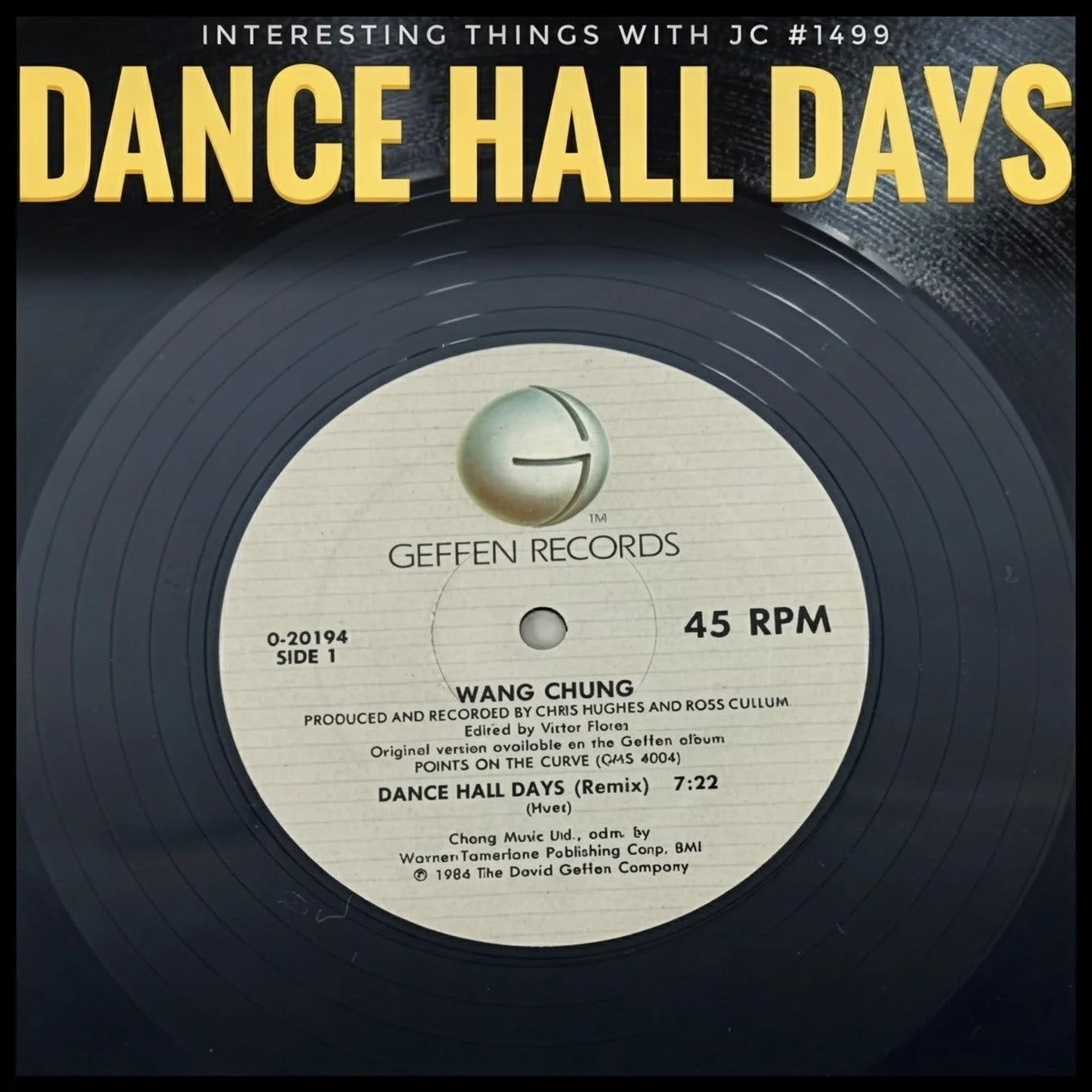
Square promotional image for Interesting Things with JC episode #1499 titled “Dance Hall Days.” The image features a close-up of a black vinyl record with visible grooves. At the center is a cream-colored Geffen Records label reading “Wang Chung,” “Dance Hall Days (Remix),” “45 RPM,” and production credits. Large yellow text across the top reads “DANCE HALL DAYS,” with smaller text above stating “Interesting Things with JC #1499.” The overall design evokes an 1980s vinyl single record aesthetic.
Transcript
If you grew up anywhere near a VFW hall, a Knights of Columbus basement, or a town ballroom with a sprung wood floor, you already know the smell. Old varnish. Cold air sneaking under the doors. Coffee in a dented metal urn. That’s where this story starts. Not in neon. Not in synths. But in dance halls where shoes scuffed instead of glowing.
“Dance Hall Days” came out in 1984, right when MTV was humming and synthesizers were elbowing guitars out of the spotlight. The band was Wang Chung (wong chung), two British musicians who looked every bit like the decade they landed in. The song showed up on their album Points on the Curve, released that same year, and it sounded like pure ’80s atmosphere. But it wasn’t born that way.
A couple years earlier, in 1982, the song existed under a different band name. Huang Chung (hwang chung). Same bones, same melody, but it went nowhere. The name confused people, radio didn’t bite, and the record sank fast. The band regrouped, shortened the name to Wang Chung (wong chung), which comes from the Chinese term meaning “yellow bell,” the first tone in an ancient musical scale. Simple. Striking. Easier to say. That change alone didn’t make the hit, but it cleared the road.
The song itself is built on memory. Jack Hues (hyooz), whose real name is Jeremy Ryder, grew up watching his father play saxophone in British dance halls after World War II. These were big rooms meant for community. Ballrooms that could hold a few hundred people, often around 100 feet long by 50 feet wide (30 by 15 meters). Couples met there. Teenagers learned how close was too close. Parents pretended not to notice.
That memory shaped the opening lines. “Take your baby by the hand.” Innocent. Courteous. Almost formal. But by the time the song reaches “take your baby by the wrist,” the mood shifts. The lyrics get tighter, stranger, even uncomfortable. There’s a line about an amethyst in her mouth. Not romantic. Not literal. Something symbolic and unsettling. Hues later said the song is about how innocent attraction can slide into obsession, control, or manipulation without anyone noticing right away.
Here’s the part almost nobody knows. An early demo of “Dance Hall Days” nearly ended up on Michael Jackson’s album Thriller in 1982. Quincy Jones and Jackson both liked it. They even suggested lyric changes. But Wang Chung (wong chung) held onto the song. They wanted it for themselves. Thriller went on to sell about 70 million copies worldwide. Wang Chung walked away from that moment. Instead, they got their own breakout.
When the reworked version hit, it climbed to number 16 on the Billboard Hot 100 in the United States. On the Billboard Dance Club Songs chart, it went all the way to number one. In the UK, it reached number 21, their only Top 40 hit there, and stayed on the charts for 14 weeks. Points on the Curve peaked at number 30 on the U.S. Billboard 200 and number 34 in the UK. No platinum plaques. No gold singles in the major markets. But enough sales to put them on big American tours. In Canada alone, the album sold at least 50,000 copies.
The music video sealed the deal. The most famous version opens in black and white, set outside a shuttered dance hall in the 1940s. Inside, it bursts into color. Swing dancers. A glittering disco ball. A woman frozen inside it, released when it shatters. Then it turns surreal. A suitcase grows legs and chases Jack Hues (hyooz) down the street. The video earned a nomination at the very first MTV Video Music Awards in 1984 for Best New Artist Video. It lost to Eurythmics, but that’s a tough room.
This iconic song of the era didn’t stay parked in the past. Decades later, it found a second life playing for a new generation on Flash FM in Grand Theft Auto: Vice City, a game set in a stylized 1986 Miami where excess, memory, and neon blur together. It also turned up in films like The Fighter and Bumblebee, and slipped into shows like Breaking Bad, Mr. Robot, and Glee. Each time, it arrived without explanation, carrying its mood intact.
Decades later, in 2019, Wang Chung (wong chung) revisited the song with the City of Prague Philharmonic Orchestra, recorded in Prague (prahg), on an album called Orchesography (or-KEST-ruh-GRAH-fee). Synth lines became string sections. Drum machines turned into full percussion. The melody held up.
Because “Dance Hall Days” isn’t really about the ’80s. It’s about learning early that good things change when you hold them too tight. Those rooms taught people how to enjoy a moment without trying to control it, how to notice when fun starts turning complicated, and when to step back before it does.
These are interesting things, with JC.
Student Worksheet
• What role did dance halls play in postwar community life?
• How do the lyrics of “Dance Hall Days” change in tone over time?
• Why does orchestral instrumentation alter emotional impact?
• What evidence supports the song’s chart performance?
• Why do some songs remain culturally relevant decades later?
Teacher Guide
Estimated Time: 45–60 minutes
Pre-Teaching Vocabulary Strategy:
• Introduce dance halls, synthesizers, and orchestras using images and short audio clips
• Create a visible vocabulary word wall
Anticipated Misconceptions:
• Students may assume 1980s music lacks historical roots
• Confusion between electronic production and live orchestration
Discussion Prompts:
• Why does music tied to memory often return decades later?
• How can sound change meaning without changing lyrics?
• Can one song belong to multiple eras?
Differentiation Strategies:
• ESL: Pronunciation guides and lyric excerpts
• IEP: Sentence starters and guided responses
• Gifted: Compare another pop song later re-recorded with orchestra
Extension Activities
• Create a timeline from postwar dance halls to orchestral reinterpretation
• Design a modern music video emphasizing memory and symbolism
• Compare synth-pop and orchestral instrumentation using a Venn diagram
Cross-Curricular Connections
• Music: Arrangement, orchestration, timbre
• ELA: Tone, metaphor, narrative progression
• History: Postwar social spaces and cultural memory
• Media Studies: MTV-era visual storytelling
Quiz
Q1. What inspired the atmosphere of “Dance Hall Days”?
A. 1990s nightclubs
B. British postwar dance halls
C. Jazz clubs
D. Stadium concerts
Answer: B
Q2. What defines the 2019 version of the song?
A. New lyrics
B. Faster tempo
C. Orchestral instrumentation
D. Acoustic guitar focus
Answer: C
Q3. What does “yellow bell” refer to?
A. A percussion instrument
B. A radio signal
C. A Chinese musical pitch concept
D. A type of dance hall
Answer: C
Q4. Which chart did the song reach number one on?
A. Billboard Hot 100
B. UK Singles Chart
C. Billboard Dance Club Songs
D. Rolling Stone Top 40
Answer: C
Q5. Why does the song remain relevant?
A. Advertising use
B. Timeless emotional themes
C. Constant lyric changes
D. Initial lack of popularity
Answer: B
Assessment
Explain how “Dance Hall Days” communicates meaning through lyrics, memory, and musical arrangement.
3–2–1 Rubric:
3 = Accurate, complete, thoughtful
2 = Partial understanding
1 = Inaccurate or vague
Standards Alignment
Common Core – History/Social Studies:
• CCSS.ELA-LITERACY.RH.9-10.2
• CCSS.ELA-LITERACY.RH.11-12.4
C3 Framework:
• D2.His.1.9-12
• D3.2.9-12
National Core Arts Standards:
• MU:Re7.2
• MU:Cn10.0
ISTE Standards:
• Knowledge Constructor
• Creative Communicator
International Equivalents
• UK National Curriculum – Music KS4
• Cambridge IGCSE Music
• IB MYP / DP Music
Show Notes
In this episode of Interesting Things with JC, “Dance Hall Days” connects postwar dance halls, 1980s synth-pop, and a modern orchestral recording in Prague. The episode shows how music preserves memory, how arrangement reshapes meaning, and why some songs continue to resonate long after their release.
References
Billboard. (1984, July 14). Billboard magazine (Hot 100 and Billboard 200 pages). World Radio History. https://www.worldradiohistory.com/Archive-All-Music/Billboard/80s/1984/BB-1984-07-14.pdf
Billboard. (1984, June 2). Billboard magazine (Dance/Disco chart reporting). World Radio History. https://www.worldradiohistory.com/Archive-All-Music/Billboard/80s/1984/BB-1984-06-02.pdf
MTV. (2018 archive capture). VMA 1984 (official archived page; winner context).
https://web.archive.org/web/20181211045510/http://www.mtv.com/vma/1984
Wang Chung. (2019). Orchesography (album page; City of Prague Philharmonic Orchestra collaboration). https://wangchung.bandcamp.com/album/orchesography
IMDb. (n.d.). Wang Chung: “Dance Hall Days (Version 2)” awards listing (nomination entry). https://m.imdb.com/title/tt6270542/awards/
Wang Chung. (1984) Dance Hall Days [Video]. YouTube. https://www.youtube.com/watch?v=V-xpJRwIA-Q