1500: "James Brown - Inmate 155413"
Interesting Things with JC #1500: "James Brown - Inmate 155413" – On December 15, 1988, the Godfather of Soul woke up as a prisoner, not a performer. This is the moment when unmatched influence collided with consequence, and fame offered no shield.
Curriculum - Episode Anchor
Episode Title: “James Brown - Inmate 155413”
Episode Number: 1500
Host: JC
Audience: Grades 9–12, college intro, homeschool, lifelong learners
Subject Area: U.S. History, Music History, Cultural Studies, Media Literacy, Criminal Justice
Lesson Overview
This episode examines the life of James Brown through a pivotal and often overlooked moment: his incarceration in 1988. Students explore how cultural influence, personal accountability, and the justice system intersect, while analyzing how legacy can contain contradictory truths. The lesson emphasizes factual historical analysis, media literacy, and critical reflection on fame, consequence, and redemption.
Measurable Learning Objectives
Students will be able to:
Define how James Brown contributed to the development of funk and modern popular music.
Compare James Brown’s cultural influence with the legal consequences he faced in 1988.
Analyze how narrative storytelling presents complex historical figures with dual legacies.
Explain why fame and artistic achievement do not exempt individuals from legal accountability.
Key Vocabulary
Funk (fuhngk) — A music genre emphasizing rhythm and groove; James Brown helped define its structure and performance style.
Inmate (in-mayt) — A person confined to an institution such as a prison; Brown became inmate number 155413.
Aggravated Assault (ag-ruh-vay-tid uh-sawlt) — A serious criminal charge involving an attack or threat with a weapon.
Probation (proh-bay-shun) — A court-ordered period of supervision instead of or following imprisonment.
Legacy (leh-guh-see) — The lasting impact of a person’s actions and achievements after their life or career.
Narrative Core
Open: The episode opens with the striking contrast of one of America’s most powerful performers waking up as a prison inmate.
Info: Listeners are given historical context about James Brown’s birth, rise to fame, musical achievements, and influence on American culture.
Details: The 1988 police chase, weapons charges, trial, conviction, and prison sentence reveal the consequences of Brown’s actions.
Reflection: The story reflects on the coexistence of artistic greatness and personal failure, challenging listeners to hold both truths at once.
Closing: These are interesting things, with JC.
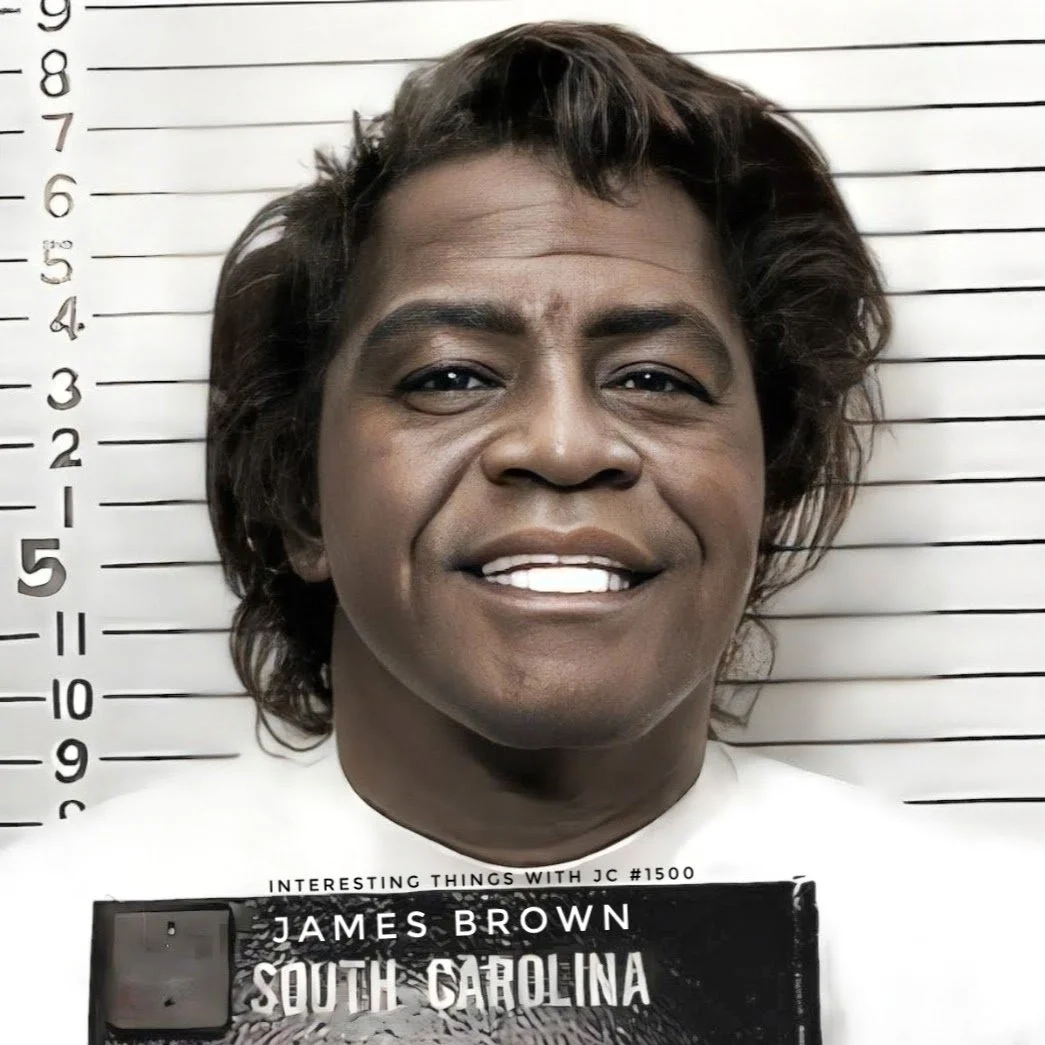
Mugshot-style image of a man identified on the page as musician James Brown, wearing a prison uniform and standing in front of a height chart while holding a South Carolina booking placard.
Transcript
On December 15th, one of the most powerful performers in American music history woke up as an inmate.
James Brown, born May 3, 1933, in Barnwell, South Carolina, the man known worldwide as the Godfather of Soul, officially became inmate number 155413 at the State Park Correctional Institute in South Carolina.
By 1988, Brown was 55 years old and had already reshaped American music. He had put 99 singles on the Billboard charts, more than Elvis Presley at the time. He helped invent funk, influenced hip-hop sampling culture, and built a touring machine that could perform over 300 shows a year, sometimes playing two cities in one night, separated by hundreds of miles.
But that same year, his personal life was unraveling. Earlier in 1988, Brown had been charged with carrying a pistol without a permit and with PCP possession. He was on probation when events took a darker turn.
On September 24, 1988, Brown entered an insurance seminar in Augusta, Georgia, carrying a shotgun and a pistol. No shots were fired, but he ordered everyone to leave the building. He then drove off in his pickup truck.
Police gave chase across state lines into South Carolina and back into Georgia. Officers eventually shot out three of his tires. Even then, Brown kept driving, sparks flying from the wheel rims, until the truck crashed into a ditch about six miles, roughly 9.7 kilometers, down the road.
Brown later claimed he feared for his life during the arrest. His wife, Adrienne, said he was heavily medicated following jaw surgery. Police testified that he tried to run them down.
The court focused on actions, not explanations. Brown was convicted of aggravated assault and failing to stop for a police officer. He was sentenced to six years and six months in prison.
He served about three years before his release in 1991. Against expectations, he returned to touring, performing demanding shows well into his 60s. In 1998, another drug charge sent him into a 90-day treatment program.
James Brown died on December 25, 2006, at age 73.
His legacy holds two truths at once. A man who built rhythms that still drive modern music, and a man who learned, late and painfully, that fame does not outrun consequence.
These are interesting things, with JC.
Student Worksheet
Explain how James Brown changed American music before 1988.
Describe the events that led to James Brown’s arrest and imprisonment.
Why does the episode emphasize “actions, not explanations”?
In your own words, explain what it means for a legacy to hold two truths at once.
Creative prompt: Write a short reflection on another historical figure with a complicated legacy.
Teacher Guide
Estimated Time
One 45–60 minute class period
Pre-Teaching Vocabulary Strategy
Introduce vocabulary using short historical examples and audio clips of funk music to build context.
Anticipated Misconceptions
Students may believe fame protects individuals from legal consequences.
Students may confuse artistic influence with moral character.
Discussion Prompts
Can someone be culturally important and personally flawed at the same time?
Why do societies struggle with separating art from the artist?
Should legacy focus more on achievement or accountability?
Differentiation Strategies
ESL: Provide vocabulary sentence frames and visual timelines.
IEP: Offer guided notes and reduced written output options.
Gifted: Assign comparative research on another influential musician and their legacy.
Extension Activities
Analyze James Brown samples used in hip-hop songs.
Research changes in criminal justice outcomes for celebrities versus non-celebrities.
Cross-Curricular Connections
Music: Rhythm, performance, and genre development
Civics: Legal accountability and due process
Media Literacy: Narrative framing of public figures
Quiz
Q1. What musical genre is James Brown most associated with?
A. Jazz
B. Funk
C. Blues
D. Rock
Answer: B
Q2. What year was James Brown incarcerated?
A. 1975
B. 1982
C. 1988
D. 1995
Answer: C
Q3. What charge resulted from the police chase?
A. Tax evasion
B. Aggravated assault
C. Fraud
D. Trespassing
Answer: B
Q4. How long was James Brown sentenced to prison?
A. Two years
B. Four years
C. Six years and six months
D. Ten years
Answer: C
Q5. What is the central theme of the episode?
A. Music industry profits
B. Celebrity immunity
C. Fame versus consequence
D. Touring logistics
Answer: C
Assessment
Open-Ended Question 1
Explain how the episode uses James Brown’s life to explore accountability.
Open-Ended Question 2
Analyze why the episode argues that legacy can contain contradictory truths.
3–2–1 Rubric
3 = Accurate, complete, thoughtful response with clear examples
2 = Partial understanding with missing or unclear details
1 = Inaccurate or vague response
Standards Alignment
CCSS.ELA-LITERACY.RH.9-10.2
Analyze central ideas of a historical text and summarize key events.
CCSS.ELA-LITERACY.RH.11-12.6
Evaluate authors’ perspectives and narrative choices in historical storytelling.
C3.D2.His.4.9-12
Analyze complex historical causes and effects.
NAfME Music Standard MU:Re7.1.HS
Perceive and analyze musical works in historical and cultural context.
UK National Curriculum – History KS4
Understanding significance and interpretation of historical figures.
IB DP Individuals and Societies
Evaluating cultural impact and ethical dimensions of historical case studies.
Show Notes
This episode explores a lesser-known chapter in the life of James Brown, examining how one of the most influential musicians in American history became a prison inmate in 1988. By grounding the narrative in verified events, the episode challenges listeners to grapple with fame, accountability, and the complexity of legacy. In the classroom, this story supports discussions in history, music, civics, and media literacy by demonstrating how cultural achievement and personal consequence can coexist. The episode remains relevant today as society continues to debate how public figures should be remembered.
References
• Biography.com. James Brown Biography https://www.biography.com/musicians/james-brown
• Rock & Roll Hall of Fame. James Brown https://www.rockhall.com/inductees/james-brown
• The New York Times. Pareles, J. (2006). James Brown, ‘Godfather of Soul,’ Dies at 73
https://www.nytimes.com/2006/12/26/arts/music/26brown.html
• History.com. James Brown Begins His Prison Sentence (December 15, 1988)
https://www.history.com/this-day-in-history/december-15/james-brown-begins-his-prison-sentence
• Wayne Robins Substack. Talking to James Brown in Jail, 1989 https://waynerobins.substack.com/p/talking-to-james-brown-in-jail-1989
• National Museum of Crime & Punishment. James Brown – Celebrity Mugshots
https://www.crimemuseum.org/crime-library/celebrity-mugshots/james-brown