Interesting Things with JC #1501: "When Metal Touches Metal in Space" – In orbit, metal doesn’t behave. When clean surfaces meet in a vacuum, they can fuse into a single piece, locking parts forever. It’s a physics trap that nearly ended missions, and still shapes every move made in space.
Curriculum - Episode Anchor
Metal behaves differently in the vacuum of space, revealing how environmental conditions fundamentally change physical laws we take for granted on Earth.
Episode Title: When Metal Touches Metal in Space
Episode Number: 1501
Host: JC
Audience: Grades 9–12, college intro, homeschool, lifelong learners
Subject Area
Physical Science, Physics, Engineering, Materials Science
Lesson Overview
This episode explores the phenomenon of cold welding, explaining why metals that separate easily on Earth can permanently bond in the vacuum of space. Through real historical examples from early satellites and modern spacecraft design, learners examine how atomic-level interactions challenge engineering assumptions and require innovative solutions.
Learning Objectives
Define cold welding and explain why it occurs in a vacuum environment.
Compare the behavior of metal surfaces on Earth versus in space.
Analyze real-world engineering problems caused by cold welding in spacecraft.
Explain how engineers prevent cold welding in modern space systems.
Key Vocabulary
Cold Welding (kohld WEHL-ding) — The bonding of clean metal surfaces in a vacuum due to shared electrons at the atomic level.
Vacuum (VAK-yoom) — An environment with little to no air or atmospheric pressure.
Oxidation (ok-sih-DAY-shun) — A chemical reaction where metal combines with oxygen, forming a thin surface layer.
Lubricant (LOO-brih-kunt) — A substance used to reduce friction between moving parts.
Vacuum Chamber (VAK-yoom CHAYM-ber) — A sealed enclosure used to simulate space-like conditions on Earth.
Narrative Core
Open – The listener is drawn in with a familiar action: tightening a bolt and expecting it to come apart later.
Info – The episode explains how Earth’s atmosphere normally prevents metals from directly bonding.
Details – In space, clean metals share electrons, leading to cold welding that once crippled early satellites and threatened missions.
Reflection – The story highlights how space removes everyday protections we never notice.
Closing – These are interesting things, with JC.
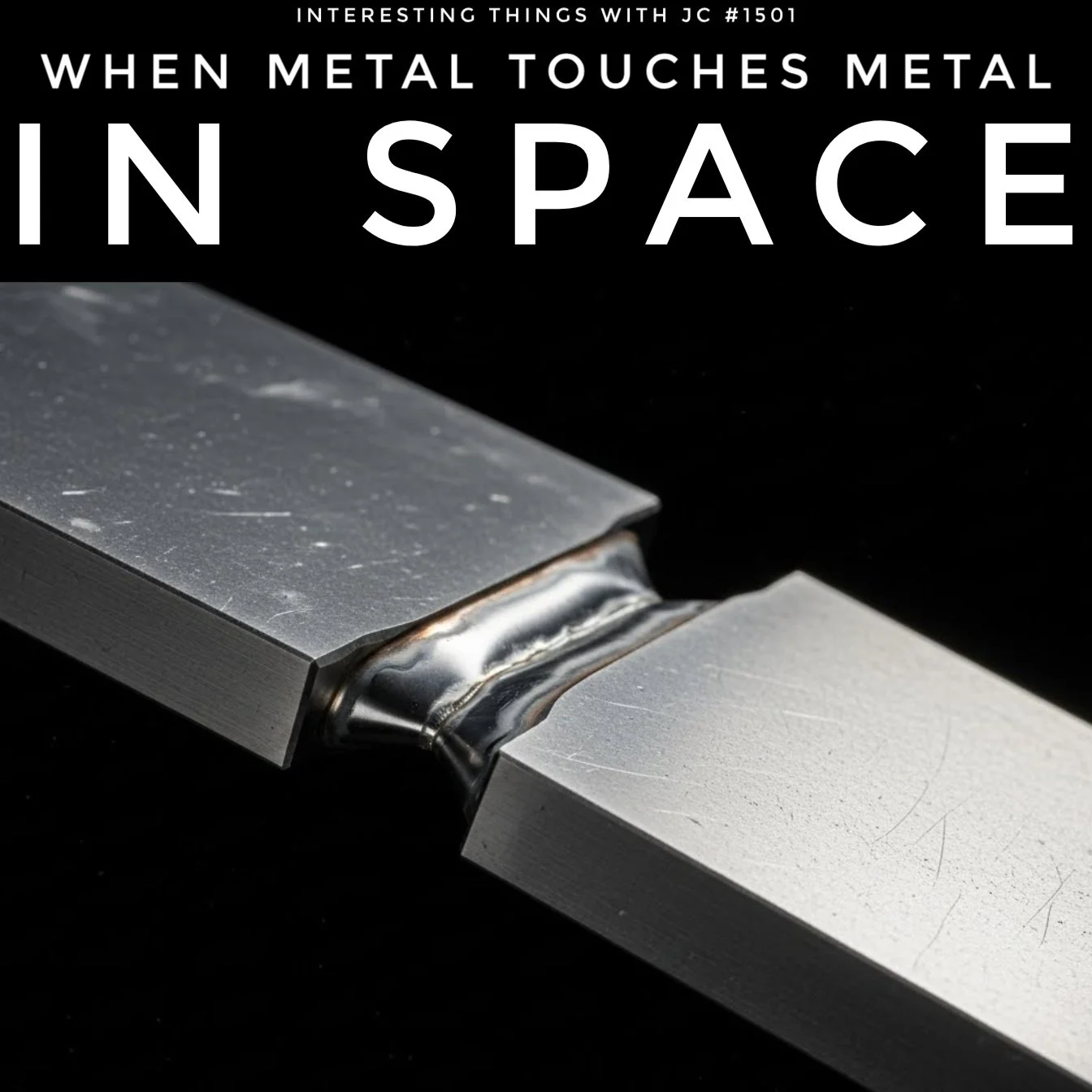
Promotional image for Interesting Things with JC episode #1501 titled “When Metal Touches Metal in Space.” The image shows two rectangular metal bars aligned horizontally against a black background, permanently fused at their ends by a smooth, silvery weld seam. Large white text across the top reads “WHEN METAL TOUCHES METAL IN SPACE,” with smaller text above identifying the podcast and episode number.
Transcript
Interesting Things with JC #1501: “When Metal Touches Metal in Space”
If you’ve ever tightened a bolt or closed a door, you expect one thing. You expect it to come back apart when you need it to. On Earth, that’s a safe assumption.
In space, it isn’t.
Up there, where there’s no air at all, metal can do something strange. When two clean pieces of metal touch, they can stick together permanently. Not glued. Not frozen. Welded.
It’s called cold welding. And despite the name, it has nothing to do with cold.
Here’s what’s really happening. On Earth, air and moisture sit between metal surfaces. Even polished metal has tiny layers of oxidation you can’t see. Those layers keep atoms from getting too close.
Space removes all of that.
In a vacuum, when bare metal meets bare metal, the atoms don’t see a line between “yours” and “mine.” They share electrons. The boundary disappears. The metals become one piece.
Engineers first noticed this problem in the early days of satellites, in the 1950s and 1960s. Parts that moved perfectly on the ground would lock up in orbit. Hinges stopped moving. Bolts froze in place. Bearings seized without warning.
By the time NASA was sending astronauts into space, this was a serious concern. Spacecraft are full of metal parts that must move. Docking systems. Hatches. Solar panels. If any of those cold welded at the wrong moment, the mission could be over.
Testing on Earth confirmed the danger. In vacuum chambers, engineers pressed clean metal samples together. When they tried to pull them apart, the metal ripped before the bond broke. The weld was stronger than the metal itself.
So engineers adapted.
They coated parts with gold or silver. They used special lubricants that wouldn’t evaporate in a vacuum. They avoided using the same metals together. Sometimes they even roughened surfaces on purpose, just to keep atoms from lining up.
On the International Space Station, about 250 miles, or 400 kilometers, above Earth, cold welding is still something crews plan around every day. Every moving part is designed to avoid it.
What makes this unsettling is how quiet it is. No sparks. No warning. Just two pieces touching, and never letting go.
Space doesn’t just challenge us with distance. It challenges the rules we take for granted.
Even metal isn’t the same up there.
These are interesting things, with JC.
Student Worksheet
Explain why oxidation prevents cold welding on Earth.
Describe one real spacecraft component that could fail due to cold welding.
Why is the term “cold welding” misleading?
Create a diagram or written explanation showing how atoms behave differently in air versus a vacuum.
Teacher Guide
Estimated Time
30–45 minutes
Pre-Teaching Vocabulary Strategy
Use side-by-side images or models of oxidized versus polished metal surfaces.
Anticipated Misconceptions
Cold welding is caused by low temperature rather than lack of atmosphere.
Welding always requires heat or sparks.
Discussion Prompts
Why do you think early engineers did not predict cold welding?
How does this example show the importance of testing in extreme environments?
Differentiation Strategies
ESL: Provide vocabulary cards with visuals.
IEP: Allow oral responses or diagrams instead of written explanations.
Gifted: Research another space-specific materials challenge and present findings.
Extension Activities
Design a spacecraft hinge that prevents cold welding.
Analyze how cold welding could affect future lunar or Mars missions.
Cross-Curricular Connections
Physics: Atomic forces and electron sharing
Engineering: Materials selection and design constraints
Chemistry: Surface reactions and oxidation
Quiz
Q1. What causes cold welding in space?
A. Low temperatures
B. Magnetic attraction
C. Shared electrons between clean metals
D. Ice formation
Answer: C
Q2. Why doesn’t cold welding usually happen on Earth?
A. Gravity prevents it
B. Air and oxidation separate metal surfaces
C. Metals are weaker
D. Earth is warmer
Answer: B
Q3. When was cold welding first noticed as a problem?
A. During Apollo missions
B. In ancient metalwork
C. Early satellite missions in the 1950s–60s
D. On the ISS
Answer: C
Q4. Which method helps prevent cold welding?
A. Using identical metals
B. Polishing surfaces perfectly
C. Applying special coatings
D. Lowering pressure further
Answer: C
Q5. Why is cold welding dangerous for spacecraft?
A. It causes explosions
B. It increases weight
C. It can permanently seize moving parts
D. It blocks radio signals
Answer: C
Assessment
Open-Ended Questions
Explain how cold welding changes engineers’ assumptions about materials.
Describe two strategies engineers use to prevent cold welding and why they work.
3–2–1 Rubric
3 = Accurate, complete, thoughtful
2 = Partial or missing detail
1 = Inaccurate or vague
Standards Alignment
NGSS HS-PS2-6
Understand atomic-level forces that influence material interactions.
NGSS HS-ETS1-2
Design solutions to complex engineering problems under constraints.
Common Core RST.9-10.3
Follow and analyze scientific explanations and processes.
Common Core WHST.9-10.2
Write explanatory texts based on technical concepts.
Cambridge IGCSE Physics 4.1
Understand particle behavior and forces under different conditions.
IB DP Physics Topic 3
Explore thermal and atomic interactions in real-world systems.
Show Notes
This episode examines cold welding, a counterintuitive phenomenon where metal surfaces permanently bond in the vacuum of space. Through historical examples and modern engineering solutions, the story illustrates how space removes everyday environmental barriers like air and oxidation. In classrooms, this episode supports lessons on atomic forces, engineering design, and the importance of testing assumptions. Cold welding remains relevant today as humanity plans longer missions and builds more complex structures beyond Earth.
References
Monroe, R. E. (1966). Adhesion in the space environment (NASA Technical Note D-3759). National Aeronautics and Space Administration. https://ntrs.nasa.gov/citations/19670009180
Shapiro, W. (1995). Space mechanisms lessons learned study (NASA Reference Publication 1359). National Aeronautics and Space Administration. https://ntrs.nasa.gov/citations/19960000954
Merstallinger, A., Holzbauer, R., & Bamsey, N. (2021). Cold welding in hold-down points of space mechanisms due to fretting when omitting grease. Lubricants, 9(8), Article 72. https://www.mdpi.com/2075-4442/9/8/72
Holzbauer, R. (2024). Cold welding under space and launch conditions. European Space Mechanisms and Tribology Symposium (ESMATS). https://www.esmats.eu/amspapers/pastpapers/pdfs/2024/holzbauer.pdf