1502: “The World’s Largest Pinecone Isn’t What You Think”
Interesting Things with JC #1502: “The World’s Largest Pinecone Isn’t What You Think” – Hidden inside Vatican City stands a bronze pinecone taller than a house, cast nearly two thousand years ago and quietly endured ever since. It’s not novelty or record chasing...it’s scale, symbolism, and survival that outlived an empire.
Episode Anchor
An exploration of how an everyday natural object became one of the largest surviving bronze sculptures of the ancient world, revealing Roman engineering skill, symbolism, and endurance across civilizations.
Episode Title (verbatim)
The World’s Largest Pinecone Isn’t What You Think
Episode Number
1502
Host: JC
Audience: Grades 9–12, college intro, homeschool, lifelong learners
Subject Area
History, Art History, Engineering, Classical Studies
Lesson Overview
Students investigate the Fontana della Pigna, a monumental bronze sculpture in Vatican City, to understand ancient Roman engineering, symbolism, and cultural continuity. Through this episode, learners analyze how material science, art, and meaning intersect in historical artifacts that outlast the societies that created them.
3–4 Measurable Learning Objectives
Define the historical and physical characteristics of the Fontana della Pigna.
Explain how ancient Roman bronze casting demonstrates advanced engineering and resource organization.
Analyze the symbolic meaning of pinecones in Roman art and architecture.
Compare modern interpretations of “world’s largest” records with historically grounded definitions.
Key Vocabulary
Pigna (PEEN-yah) — Italian for “pinecone,” referring directly to the sculpture’s form and name.
Bronze casting (BRAHNZ KAS-ting) — The process of creating objects by pouring molten bronze into molds, used at large scale in ancient Rome.
Pantheon (PAN-thee-on) — A major Roman temple near where the pinecone fountain may have originally stood.
Cortile (kor-TEE-lay) — An Italian word meaning courtyard, as in the Cortile della Pigna.
Symbolism (SIM-buh-liz-um) — The use of objects or images to represent broader ideas, such as renewal and continuity.
Narrative Core (Based on the PSF – use renamed labels)
Open – A surprising claim that the world’s largest pinecone is hidden in plain sight, not in nature or modern art.
Info – Background on the Vatican sculpture, its size, age, and original function as a Roman fountain.
Details – Technical facts about bronze casting, relocation across centuries, and comparisons with modern records.
Reflection – Consideration of how ordinary objects, when enlarged and preserved, can outlast entire civilizations.
Closing – These are interesting things, with JC.
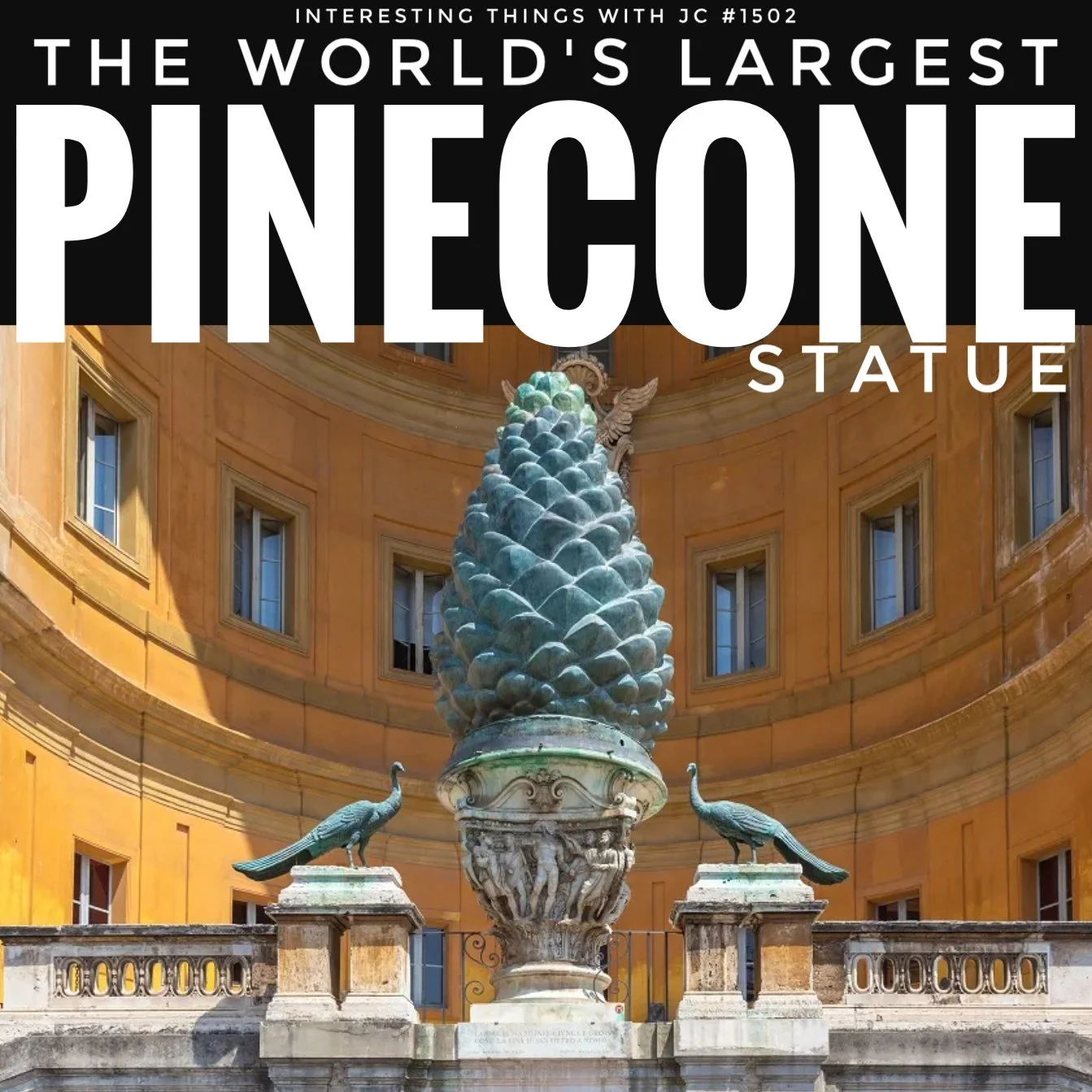
Large bronze pinecone sculpture known as the Fontana della Pigna stands in a Vatican courtyard, mounted on an ornate stone base and flanked by two bronze peacocks, with a curved ochre building and windows behind it.
Transcript
The largest pinecone-shaped statue in the world is not a roadside attraction or a modern art project. It stands inside Vatican City, in a courtyard most visitors cross without stopping.
The sculpture is called the Fontana della Pigna (fon-TAH-nah DEL-lah PEEN-yah). “Pigna” is simply the Italian word for pinecone. The name is literal. What matters is the size, the age, and the fact that it has remained intact for nearly two thousand years.
The bronze pinecone measures about 13 feet tall (4 meters) from base to tip. It was cast during the first or second century A.D., when the Roman Empire was at its height. This was not created as decoration alone. It functioned as part of a fountain in ancient Rome, likely installed near the Pantheon (PAN-thee-on) or the Temple of Isis (EYE-sis). Water once flowed from the top and ran over the overlapping bronze scales before collecting below.
Casting an object of this scale required advanced metalworking. Bronze is dense and heavy. At more than four meters tall, the sculpture weighs several tons, or several thousand kilograms. Producing something like this in the ancient world required organized labor, skilled artisans, and access to significant resources.
As Rome changed, the pinecone stayed. Buildings were dismantled. Materials were reused. Governments fell. The sculpture was eventually moved during the Middle Ages to Old St. Peter’s Basilica. In 1608, it was relocated again to its current location in the Vatican Museums.
The courtyard where it stands is now called the Cortile della Pigna (kor-TEE-lay DEL-lah PEEN-yah), the Courtyard of the Pinecone. The sculpture sits centered in a large niche, elevated and framed, treated as an object meant to remain.
There is no official Guinness World Record for the largest pinecone statue. Records exist for pinecone mosaics made from thousands of individual cones, covering areas near 970 square feet (90 square meters). There are also modern installations shaped like pinecones, and records for the largest natural pinecones produced by trees such as the Coulter pine.
But when the definition is a single sculptural object shaped like a pinecone, cast as one form, art historians and reference sources consistently identify the Vatican’s bronze Pigna as the largest known example.
In the ancient world, pinecones carried meaning. They symbolized growth, renewal, and continuity. They appear repeatedly in Roman architecture and sculpture. The symbol was direct. Life renews itself. What falls returns again.
These are interesting things, with JC.
Student Worksheet
Why was the Fontana della Pigna originally created, and how was it used?
What challenges would Roman engineers have faced in casting such a large bronze object?
Explain why the sculpture does not hold an official world record but is still considered the largest of its kind.
How does the symbolism of the pinecone connect to Roman beliefs about life and continuity?
Teacher Guide
Estimated Time
One 45–60 minute class period.
Pre-Teaching Vocabulary Strategy
Introduce Italian terms and Roman architectural references using images or maps for context.
Anticipated Misconceptions
Students may assume large ancient sculptures were decorative only, not functional.
Students may confuse modern “records” with historically contextual definitions.
Discussion Prompts
Why do some objects survive while others from the same era disappear?
How does scale change the meaning of an ordinary object?
Differentiation Strategies
ESL: Provide vocabulary sentence frames and pronunciation guides.
IEP: Allow oral responses or visual mapping instead of written answers.
Gifted: Research another Roman engineering artifact and compare techniques.
Extension Activities
Design a modern monument inspired by an everyday object and explain its symbolism.
Investigate ancient Roman water systems and fountains.
Cross-Curricular Connections
Physics: Weight, materials, and structural stability.
Art: Symbolism and form.
Engineering: Large-scale manufacturing in pre-industrial societies.
Quiz
Q1. Where is the Fontana della Pigna located today?
A. Near the Pantheon
B. In Old St. Peter’s Basilica
C. In the Vatican Museums courtyard
D. In central Rome
Answer: C
Q2. What material is the pinecone made from?
A. Marble
B. Stone
C. Iron
D. Bronze
Answer: D
Q3. What was the sculpture’s original function?
A. A tomb marker
B. A fountain feature
C. A religious altar
D. A city gate ornament
Answer: B
Q4. Approximately how tall is the sculpture?
A. 6 feet
B. 9 feet
C. 13 feet
D. 20 feet
Answer: C
Q5. What did pinecones symbolize in ancient Rome?
A. Power and conquest
B. Wealth
C. Growth and renewal
D. Navigation
Answer: C
Assessment
Open-Ended Questions
Explain how the Fontana della Pigna demonstrates Roman engineering skill.
Discuss why symbolism was important in Roman public art.
3–2–1 Rubric
3 = Accurate, complete, thoughtful
2 = Partial or missing detail
1 = Inaccurate or vague
Standards Alignment
CCSS.ELA-LITERACY.RH.9-10.2
Determine central ideas of a historical text and summarize key details.
CCSS.ELA-LITERACY.RH.9-10.4
Determine the meaning of domain-specific words and phrases.
C3.D2.His.2.9-12
Analyze change and continuity in historical contexts.
NGSS HS-ETS1-2
Design and evaluate solutions considering materials and constraints, applied here to ancient engineering.
UK National Curriculum History KS4
Understanding the significance of historical sources and interpretations.
IB MYP Individuals and Societies
Analyzing how material culture reflects societal values.
Show Notes
This episode explores the Fontana della Pigna, a massive bronze pinecone sculpture that has survived nearly two thousand years from ancient Rome to modern Vatican City. By examining its engineering, movement across history, and symbolic meaning, the episode demonstrates how ordinary natural forms can become enduring cultural artifacts. In the classroom, this topic encourages students to connect history, engineering, and symbolism, showing why ancient technologies and ideas still matter today.
References
Vatican Museums. (2020, September 30). The Pinecone returns to the Niche of the Belvedere. Vatican Museums Official Site.
https://www.museivaticani.va/content/museivaticani/en/eventi-e-novita/iniziative/Eventi/2020/restauro-pigna.htmlAleteia. (2024, September 2). The story behind the Vatican’s 13-foot pinecone sculpture. https://aleteia.org/2024/09/02/the-story-behind-the-vaticans-13-foot-pine-cone-sculpture/
J. Paul Getty Museum. (n.d.). Cortile della Pigna (Pinecone Courtyard). Getty Research Institute. https://www.getty.edu/art/collection/object/1048ND
University of Florida IFAS Extension. (2024, December 4). Weekly “What Is It?”: Roman pines and the Vatican pinecone. https://blogs.ifas.ufl.edu/escambiaco/2024/12/04/weekly-what-is-it-roman-pines/
Claridge, A. (2010). Rome: An Oxford archaeological guide (2nd ed.). Oxford University Press. https://global.oup.com/academic/product/rome-9780199546831